Strength Training and Injury Prevention: Eccentric, Balance, and the "Muscle Armor" That Protects You
A Midnight Message That Made Me Write This
Around 11 PM that night, I received a message from a long-time student, A-Kai: “Coach, I pulled something again. Back of my left leg. Third time in six months.” A-Kai is a dedicated cyclist and runner—he rides the Yangjin P-word mountain road every weekend and logs riverside runs on weekdays. He’s fit, and his willpower is even stronger. But he has one common problem—he never does strength training. To him, training means “cardio”; lifting weights is something bodybuilders do, unrelated to endurance sports.
I’ve coached athletes and general fitness populations for fifteen years, and this conversation repeats itself almost every month. People are willing to spend hours cycling, running, and swimming, yet refuse to invest thirty minutes twice a week in strength training. The result: muscles, tendons, and ligaments are chronically overloaded beyond their capacity, and injuries keep coming back, time after time.
In this article, I want to organize the concepts and methods I’ve accumulated over the years—on the sidelines, in the training room, and through rehab processes—and lay them out for you. We’ll cover why strength is your body’s “armor,” why eccentric training is the most critical piece for protecting muscle, how balance and proprioception complete the final piece of the puzzle, and give you a program you can follow directly. This isn’t meant to scare you—it’s meant to help you do the right things before you get injured.
Bottom line first: Strength training is one of the strongest-evidenced, highest-value injury prevention tools in sports science today. It doesn’t care about your age, your sport, or whether you want to become a bodybuilder.
Foundational Concepts: Why Strength Protects You from Injury
Muscles Are Your Body’s “Active Shock Absorbers”
Many people assume joint stability comes from bones and ligaments. Bones and ligaments do provide structure, but they are “passive”—the moment you step into a pothole, brake hard on a descent, or land off-balance, what can actively contract, absorb impact, and pull the joint back into a safe position is muscle.
Imagine your muscles are a shock absorber system. If the shocks are soft and weak, a pothole in the road transmits all the impact straight to the frame—your joints and tendons. If the shocks are strong and elastic, they absorb most of the impact. Strength training is how you upgrade that shock absorber system.
What the Evidence Says
This isn’t just my personal opinion; it’s backed by solid research. A widely cited systematic review and meta-analysis (Lauersen et al., 2018) pooled multiple randomized controlled trials and concluded: adding strength training to a training program can reduce the risk of sports injuries by roughly two-thirds, and it works for both acute injuries (like strains and sprains) and overuse injuries (like anterior knee pain), across different sports and age groups. More importantly, the research observed a clear dose-response relationship—the more adequate the strength training volume, the better the protective effect.
This finding is especially important for endurance athletes, because our common mistake is “train only the sport, skip strength.” You might think an extra 100 km of riding is best for your body, but one solid strength session may contribute more to keeping you injury-free in the long run.
Four Mechanisms by Which Strength Protects Against Injury
Why does getting stronger mean fewer injuries? I usually explain it to students from four angles:
| Mechanism | Plain-Language Explanation | Corresponding Injury Scenario |
|---|---|---|
| Increased tissue tolerance | Muscles and tendons can handle greater loads before breaking down | Shin pain or Achilles discomfort when mileage suddenly increases |
| Improved movement control | Form doesn’t break down under fatigue; joints don’t wobble | Knee pain from deteriorating landing form late in long distances |
| Enhanced eccentric braking capacity | Muscles can firmly “hold” during deceleration and landing | Hamstring strains during downhill running, sudden stops, or changes of direction |
| Balanced left/right and front/back muscle groups | Corrects strength asymmetries and compensation patterns | Injuries from overuse on the dominant side or overly weak antagonists |
Of these four, the third—“eccentric braking capacity”—is the most overlooked, yet it offers the strongest protective effect. Let’s focus on it next.
Eccentric Training: The Most Critical Piece for Protecting Muscle
What Is an Eccentric Contraction
Muscle contractions come in three types: concentric (muscle shortens while producing force, e.g., lifting a dumbbell up), isometric (force production with no change in length, e.g., holding a plank), and eccentric (muscle produces force while being lengthened, e.g., slowly lowering a dumbbell).
Eccentric contractions are the “brakes” in our daily movement. Walking downstairs, downhill running, landing with absorption, sudden stops—these are all eccentric. And in sports injuries, a large proportion of muscle strains occur precisely during the eccentric phase, because the muscle is being forcefully lengthened while resisting with high tension—the highest tension point, where tearing is most likely.
Why Eccentric Training Is Especially Effective for Injury Prevention
The key is this: eccentric training simultaneously increases muscle strength and length tolerance. Research shows that targeted eccentric training allows muscle fibers to produce force steadily even in a lengthened state—essentially adding a layer of protection at your muscle’s most dangerous angle.
Take the hamstrings (back of the thigh—exactly where A-Kai keeps pulling up) as an example. The classic eccentric exercise is the Nordic Hamstring Exercise (NHE). How strong is the evidence for this movement? Multiple meta-analyses indicate that when the Nordic hamstring exercise is incorporated into a training program and actually performed consistently (with high adherence), the incidence of hamstring strains can be reduced by roughly half (about 50%). It’s one of the few preventive exercises in sports medicine with such a clear effect.
I’ll be honest and add: some researchers have raised methodological questions about certain analyses, suggesting the effect may not be entirely consistent. But even accounting for those critiques, the broad direction—“strengthening hamstring eccentric strength helps reduce strain risk”—holds up in both clinical and training settings. That’s why every endurance athlete I coach has eccentric elements in their program.
How to Do the Nordic Hamstring Exercise
This movement looks simple, but it’s brutally honest—it will immediately tell you how weak your hamstrings are.
- Kneel on a yoga mat, knees on the ground, torso upright, core braced, body in a straight line from knees to head.
- Have someone hold your ankles down, or anchor them under a barbell or fixed object.
- Lean forward very slowly like a rigid board, using your hamstrings to “hold” the entire way, trying to last until the very last moment.
- When you can’t hold anymore, catch yourself with your hands, then push back to the starting position.
The first time a beginner tries this, they usually drop with a “thud” halfway down—that’s completely normal. The key is extending that controlled eccentric range as much as possible; as you progress, the angle you can control will get larger and larger.
General Principles for Eccentric Training
Eccentric work isn’t just for the hamstrings. Here’s a comparison of eccentric exercises I commonly assign to different populations:
| Target Area | Eccentric Exercise | Suitable For | Common Beneficial Scenarios |
|---|---|---|---|
| Hamstrings (back of thigh) | Nordic hamstring exercise, single-leg Romanian deadlift with slow lowering | Runners, sprinters, change-of-direction sports | Reducing posterior chain strains |
| Calves and Achilles tendon | Slow-lowering calf raises (up on both feet, down on one) | Runners, hikers, jumping sports | Achilles tendinopathy rehab and prevention |
| Quadriceps (front of thigh) | Slow squats, controlled stair descent | Cyclists, downhill runners, knee pain populations | Patellar tendon discomfort, anterior knee pain |
| Rotator cuff | Slow lowering with external rotation using a resistance band | Swimmers, upper-body sports | Shoulder impingement, rotator cuff overuse |
Eccentric exercises have one characteristic: they tend to cause delayed onset muscle soreness (DOMS), especially in the first few weeks. So dosage should progress gradually—don’t train so hard on day one that you can’t walk down the stairs the next day. We’ll emphasize this again in the “Common Mistakes” section later.
Balance and Proprioception: The Final Piece of the Puzzle
Strength Alone Isn’t Enough
I often say: “Strength is the engine, balance is the steering wheel.” No matter how powerful the engine, if the steering wheel fails, you’ll still crash. Many sprains, falls, and loss of control upon landing aren’t because your muscles aren’t strong enough, but because your body doesn’t know where it is in space—this is a problem with proprioception.
Proprioception is your ability to know, even with your eyes closed, how much your knee is bent or where your foot is placed. It’s managed by sensory receptors in your muscles, tendons, and joints. Joints that have been injured (especially ankles that have been sprained) often have diminished proprioception, which is one reason why “once you sprain it, you’re more likely to sprain it again.”
What Balance Training Works On
The core of balance training is practicing joint stability in unstable or controlled-demand situations. It requires no equipment and can be done anytime:
- Single-leg stance: Progress from standing steady with eyes open to eyes closed, on a soft pad, and adding upper-body movements as interference.
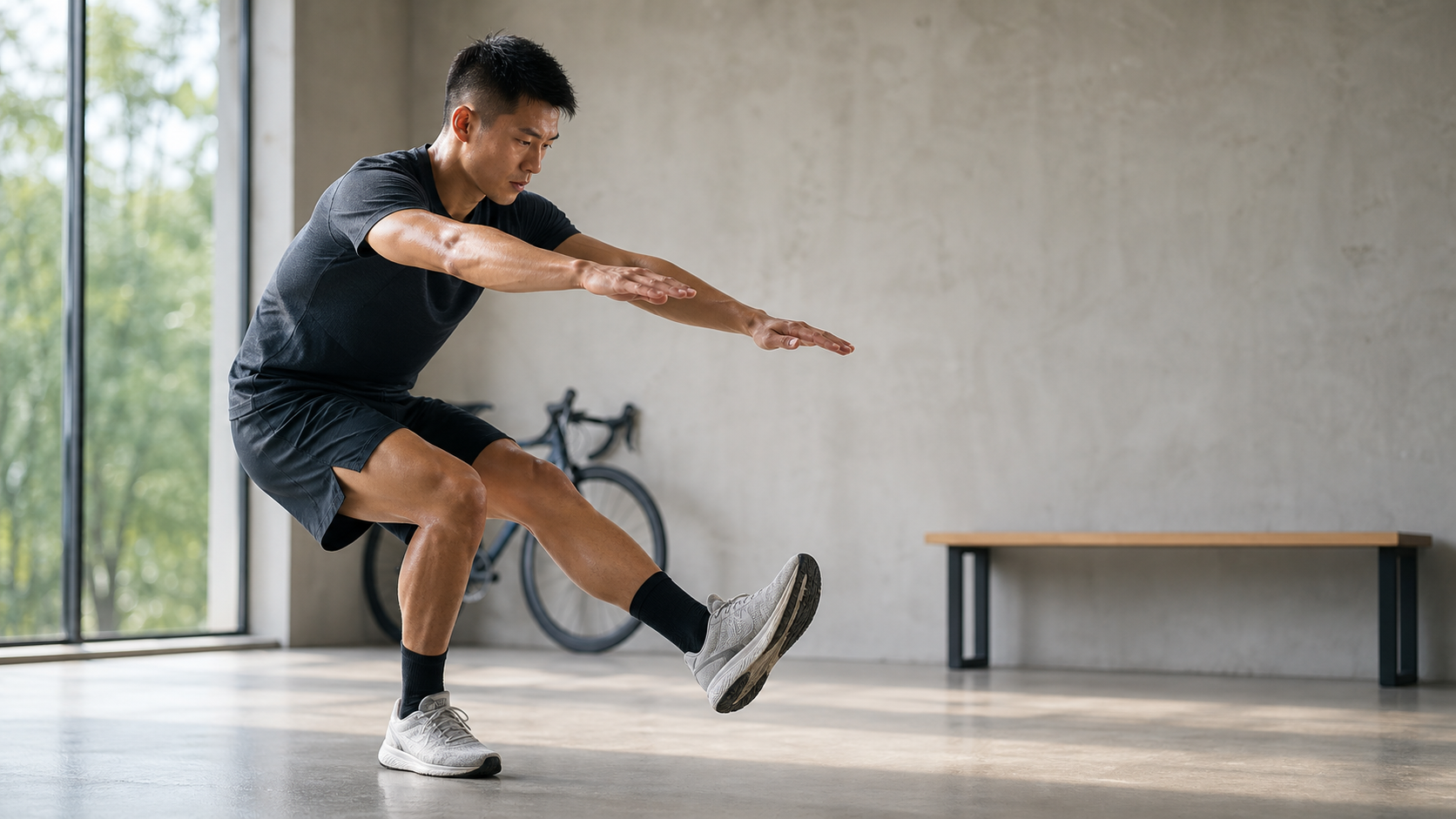
- Single-leg deadlift (bodyweight or loaded): Trains hip strength and balance simultaneously—one of my favorite movements.
- Lunges and lateral lunges: Train landing control and change-of-direction stability.
- Landing absorption drills: Jumping down from a low box and practicing a “light, stable, and silent” landing.
For Taiwan’s athletic population, I particularly recommend incorporating single-leg stances into daily life. You can do them while waiting for the bus, brushing your teeth, or standing in line. The accumulated volume over a day is substantial, and it’s completely free.
The Progression Ladder for Balance Training
| Stage | Example Movement | Hold/Reps Recommendation | Progression Criteria |
|---|---|---|---|
| Beginner | Single-leg stance, eyes open | 30 sec per leg × 2-3 sets | Can stand steady without swaying |
| Level 1 | Single-leg stance, eyes closed | 20-30 sec per leg × 2-3 sets | Can hold with eyes closed |
| Level 2 | Single-leg stance on soft pad/pillow | 20-30 sec per leg × 2-3 sets | Can control on unstable surface |
| Level 3 | Single-leg deadlift, single-leg squat | 6-10 reps per leg × 2-3 sets | Maintains stability throughout movement |
| Sport-specific | Landing absorption, change-of-direction control | Design based on the sport | Stable even at high speed |
The volume of balance training doesn’t need to be large, but it must be frequent and consistent. The nervous system requires repeated stimulation to adapt. Incorporating it three to four times a week, just a few minutes each session, yields excellent results.
Combining All Three: A Ready-to-Follow Weekly Schedule
Now that the concepts are covered, the key is making it practical. Below is a beginner weekly schedule I designed for “a typical adult who does regular endurance exercise but almost no strength training,” assuming you exercise four to five days a week. This schedule incorporates strength, eccentric, and balance work—each strength session only takes 30 to 40 minutes.
| Day | Main Content | Focus |
|---|---|---|
| Monday | Sport-specific cardio (cycling/running/swimming) | Easy to moderate intensity |
| Tuesday | Strength A (lower body focus) + Balance | Squats, deadlifts, Nordic hamstring curl intro |
| Wednesday | Sport-specific cardio | Intervals can be arranged |
| Thursday | Balance + Core (short, 20 minutes) | Advanced single-leg stance, plank, bird dog |
| Friday | Strength B (full body) + Eccentric calves | Lunges, upper-body push/pull, slow-lower calf raises |
| Saturday | Long-duration sport or rest | Depends on training cycle |
| Sunday | Complete rest or walking | Recovery |
Strength A Sample Workout (Lower Body Focus)
| Exercise | Sets × Reps | Tips for Beginners |
|---|---|---|
| Bodyweight or weighted squat | 3 × 10-12 | Knees track over toes; add weight only when you can sit down with control |
| Romanian deadlift | 3 × 8-10 | Keep back straight; feel the stretch in your hamstrings |
| Nordic hamstring curl (eccentric) | 2-3 × 3-6 | Only go through the range you can control; gradually extend it |
| Split squat/Lunge | 3 × 8-10 per leg | Front knee shouldn’t track too far past toes |
| Single-leg stance (balance) | 30 sec per leg × 2 | Close your eyes once steady |
Strength B Sample Workout (Full Body)
| Exercise | Sets × Reps | Tips for Beginners |
|---|---|---|
| Glute bridge or single-leg glute bridge | 3 × 12-15 | Squeeze glutes; don’t compensate with your lower back |
| Push-up (knees allowed) | 3 × 8-12 | Keep body in a straight line |
| Row (band or dumbbell) | 3 × 10-12 | Squeeze shoulder blades together |
| Slow-lower calf raise (eccentric) | 3 × 10-12 | Up with both feet, lower slowly with one |
| Side plank | 20-30 sec per side × 2 | Don’t let hips sag |
Weight Selection Principle: Beginners should prioritize movement quality first. Use light weights or bodyweight to groove the movement pattern, then gradually add load. A simple way to gauge if the weight is appropriate—if the last two reps feel challenging but you can still maintain form, you’re about right.
Common Mistakes and Fixes
After coaching students for years, I’ve found that people tend to fall into highly repetitive pitfalls. Here are the most common ones, along with fixes.
Mistake 1: Only Doing Cardio, Treating Strength as an “Extra”
This is the number one issue for endurance athletes, and A-Kai is a classic example. Fix: Schedule strength training into fixed time slots, treating it as non-negotiable as your cycling or running—at least twice a week. You won’t get slower from strength training; instead, you’ll be more durable and able to train more.
Mistake 2: Going Too Hard on Eccentrics, Too Sore to Move the Next Day
Delayed onset muscle soreness from eccentric training is particularly pronounced. Many people do twenty reps of Nordic hamstring curls on their first try, then can’t walk down stairs for three days and never dare to do them again. Fix: Start eccentric movements with low volume. For example, begin with just two to three reps of Nordic hamstring curls twice a week, letting your body adapt before gradually increasing. Better to do a little consistently than a lot and then quit.
Mistake 3: Ignoring Balance, Thinking It’s for Old People
Many young athletes think balance training is “too easy and pointless.” But loss of control on landing and ankle sprains from direction changes are all related to balance and proprioception. Fix: Treat balance exercises as warm-ups or “training snacks,” sprinkling in a few minutes daily. Especially if you’ve sprained your ankle before, you must add this.
Mistake 4: Ignoring Left-Right Asymmetry
Many injuries stem from unilateral overuse. Your dominant leg and arm chronically take on more load while the other side stays weak. Fix: Incorporate more unilateral movements (single-leg deadlifts, split squats, single-arm rows). You’ll honestly discover which side is weaker and then target it for reinforcement.
Mistake 5: Suddenly Spiking Training Volume
This isn’t really strength training’s fault, but it’s often the trigger for injury. Many people in Taiwan are sedentary, then sign up for a marathon or a Wuling Challenge and suddenly spike their weekly running or cycling volume. Tissues can’t adapt fast enough and break down. Fix: Follow the principle of “progressive overload.” Don’t increase weekly training volume too aggressively, and use strength training to build up your tissue tolerance as a safety net.
Mistake 6: Pushing Through Pain
“Coach, it hurts a bit but I can still run”—I frown when I hear this. Mild muscle soreness is fine, but if it’s sharp pain at a specific point, pain that worsens with movement, or pain that alters your movement pattern, that’s your body asking for help. Fix: Learn to distinguish between “soreness” and “pain.” Rest when you should rest, see a doctor when you should, and don’t let a minor injury become a major one.
Actionable Advice for Readers at Different Levels
Everyone starts from a different point, so I’ve divided my advice into three tiers. Just find where you fit.
Complete Beginner (Almost No Strength Training Experience)
- Start with bodyweight movements. Get squats, glute bridges, push-ups, and single-leg stances down first; don’t rush to add weight.
- Do strength training twice a week, 30 minutes per session, focusing on major muscle groups.
- Start eccentric movements at the lowest volume (e.g., three reps of Nordic hamstring curls per session) to let your body adapt gradually.
- The goal is to “build a habit,” not to “get strong immediately.” If you can stay consistent for the first six to eight weeks, you’re already ahead of most people.
Athletes with a training background but no systematic strength training (like A-Kai)
- Formally schedule strength training into your weekly plan, giving it the same importance as your sport-specific aerobic work, two to three times per week.
- Target your sport-specific weaknesses: runners and multidirectional-sport athletes should focus on eccentric hamstring and glute work; cyclists should do more eccentric quadriceps and core work; swimmers should take care of their rotator cuff muscles.
- Incorporate unilateral exercises to identify and correct left-right asymmetries.
- Review your plan every four to six weeks and progressively increase the load.
Advanced athletes or those with a history of repeated injuries
- Seek professional assessment. Sports medicine and sports physical therapy resources in Taiwan are more abundant than before. Many hospitals have sports medicine departments, and there are also qualified athletic trainers and physical therapists in the community who can perform movement assessments and strength symmetry testing to help you find the root cause of your recurring injuries.
- Make your eccentric training more systematic and align it with periodized programming.
- Returning after injury must be progressive—don’t jump straight back to your pre-injury training volume the moment the pain disappears.
A few practical reminders specific to Taiwan
Living in Taiwan, there are several environmental factors worth considering:
- Hot and humid climate: Training outdoors in summer can easily lead to dehydration and elevated body temperature. Muscles are more prone to injury when fatigued and dehydrated. Be sure to hydrate during training, avoid the midday heat, and adjust fluid intake individually—using minimal thirst and light-yellow urine as rough guidelines.
- Nutrition for those who eat out often: Muscle repair requires adequate protein. Eating out is convenient in Taiwan, but meals often contain too many carbohydrates and not enough protein. Try to include a clear protein source in every meal (chicken breast, soy products, eggs, fish), with total intake adjusted according to body weight and training volume.
- Healthcare access: With Taiwan’s National Health Insurance, seeing a doctor is easy. Don’t self-diagnose online when injured—go to orthopedics, rehabilitation, or sports medicine as appropriate. Early and correct diagnosis can save you a lot of unnecessary detours.
- Venue options: Riverside parks, public parks, and community gyms are all excellent venues for strength and balance training. Even at home, a set of resistance bands and a yoga mat can complete most beginner programs. The barrier to entry is truly low.
Warm-up, Eccentrics, and Cool-down: The Structure of a Complete Strength Session
Many people walk into the gym and immediately load up the barbell, which actually increases the risk of injury. A well-designed strength session should be like a journey with a clear beginning, middle, and end. Here is the standard structure I use with my athletes—you can follow it directly.
Dynamic Warm-up (8-10 minutes)
The purpose of the warm-up is not to stretch until it hurts, but to raise tissue temperature, awaken the neuromuscular connection, and open up the joints you’ll be using. In this phase, I rarely include static stretching (holding a position for a long time), because static stretching before training can actually have a slightly negative effect on subsequent force output. Instead, I use dynamic movements:
- High knees and butt kicks in place, 20 reps each
- Bodyweight squats and hip circles, 10-15 reps each
- Walking lunges with torso rotations, 2 trips back and forth
- A few “preparation sets” with light loads, using roughly 60-70% of your working weight to run through the main movements you’ll be doing
Taiwan’s summers are hot and humid, so training in an air-conditioned indoor space actually helps the warm-up; but on winter mornings training by the riverside or outdoors, your body is colder, so the warm-up needs to be longer. Better to spend an extra five minutes than to let cold muscles take on heavy loads directly.
Main Session (20-30 minutes)
This is the main arena for strength, eccentric work, and balance—the content of the “Strength A/B Plans” mentioned earlier. There is one principle for ordering: put the movements that require the most focus, the highest technical demand, or the most effort first. Usually, multi-joint compound movements (squats, deadlifts) come first, with single-joint or balance work later. Eccentric-focused movements (like the Nordic hamstring curl) are best done while you still have mental energy, because they demand a great deal of control.
Cool-down and Stretching (5-8 minutes)
After training is the ideal time for static stretching. Take the major muscle groups you just worked—front and back of the thighs, glutes, calves, chest and back—and hold each stretch for 20 to 30 seconds, paired with a few slow, deep breaths. The cool-down is not an optional ritual; it helps you transition gradually from a high-tension state back to calm, and over the long term it supports recovery and flexibility.
The Key to Progression: Periodization and Overload Principles
I often tell my athletes: “Injuries aren’t usually caused by one heavy lift—they’re mostly accumulated from ‘too fast, too much, too soon.’” For strength training to be both effective and safe, the key lies in knowing how to progressively increase the load.
The Four Levers of Progression
Progress isn’t only about “adding weight.” You actually have four levers you can turn, and you should only turn one at a time so your body can keep up:
| Lever | How to Adjust | When It’s Appropriate |
|---|---|---|
| Reps | Add one or two more reps per set | Early beginner phase, while building movement experience |
| Sets | Increase from 2 sets to 3 sets | When you want more total volume without adding weight |
| Weight | Add a small amount of weight once movement is stable | When your form is already solid |
| Difficulty/Angle | Switch to a harder variation (e.g., from double-leg squat to single-leg squat) | When bodyweight work is no longer challenging |
Only turning one lever at a time is the most important advice I give beginners. If you add weight, volume, and a harder movement all at once, your body can’t adapt fast enough, and soreness and injury will follow.
A 12-Week Progressive Example
Using the Nordic hamstring curl, an eccentric movement, as an example, here’s how to “increase slowly” without blowing up. The numbers below are conservative reference ranges; actual adjustments should depend on individual adaptation:
| Week | Frequency | Sets × Reps per Session | Focus |
|---|---|---|---|
| Weeks 1-2 | 1x per week | 2 × 3 | Establish the movement pattern; expect to be very sore |
| Weeks 3-4 | 2x per week | 2 × 4 | Add frequency after soreness subsides |
| Weeks 5-8 | 2x per week | 3 × 5 | Gradually extend the controlled eccentric range of motion |
| Weeks 9-12 | 2x per week | 3 × 6-8 | Enter the maintenance and refinement phase |
Notice something? Over the full 12 weeks, the increase in volume is actually very gradual. This is exactly the spirit of eccentric training—better slow than stopped. Too many people try to hit the final goal in the first week, end up too sore to continue, and waste all their effort.
When to Back Off
Beyond adding load, you also need to know when to “step back.” When the following signs appear, proactively reduce your load or take an extra rest day:
- Poorer sleep quality, or a noticeably elevated resting heart rate (roughly 5 to 10 bpm or more above your normal)
- A clear drop in strength during training, or deteriorating form
- Persistent soreness in a specific area that hasn’t resolved after three or four days
- Low mood or a lack of motivation to train
These are all signs your body is telling you “recovery isn’t keeping up.” Reducing load isn’t laziness—it’s part of smart training.
Key Differences by Sport
The general principles of strength and eccentric training are universal, but different sports require different emphases. I’ve compiled a comparison table for several endurance sports common in Taiwan so you can quickly find your focus.
| Sport | High-Risk Areas | Priority Strengthening | Special Notes |
|---|---|---|---|
| Road Cycling | Front of knee, lower back, neck and shoulders | Eccentric quads, glutes, core | With prolonged fixed posture, lower back and neck/shoulder fatigue are very common |
| Road Running/Marathon | Hamstrings, calves, IT band, plantar fascia | Eccentric hamstrings, eccentric calves, gluteus medius | Increase mileage gradually; landing control is key |
| Triathlon | All of the above plus shoulders | Full-body balance + rotator cuff | With three disciplines stacking up, recovery management is especially important |
| Swimming | Shoulder impingement, rotator cuff | Rotator cuff, upper back | Focus on scapular stability rather than overdeveloping the chest |
| Hiking/Trail Running | Knees (especially downhill), ankles | Eccentric quads, ankle balance | Downhill is the “eccentric boss”—make sure to cover balance work |
Take cyclists, for example: many people assume riding doesn’t cause injuries, but maintaining a fixed position for long hours makes lower back and neck/shoulder overuse very common. Downhill runners and hikers, on the other hand, face the “eccentric boss”—large amounts of downhill running mean long periods of eccentric braking with the quads. Without prior training, sore legs the next day are the least of your worries; long-term knee strain is the real problem.
FAQ
These are the questions my athletes ask me most often, answered all in one place.
Q: Will strength training make me heavier and hurt my cycling or running performance?
For the vast majority of endurance athletes, moderate strength training will not make you bulky and heavy. The bodybuilders you see are the result of extensive, hypertrophy-specific training and dieting. Strength training aimed at injury prevention and performance enhancement primarily improves neural recruitment efficiency and tissue tolerance, which often makes you ride more economically and run longer.
Q: I’m older now. Is strength training still suitable for me?
Absolutely, and it’s even more necessary. As we age, muscle mass naturally declines, and strength training is one of the most effective ways to counter this process, while also significantly reducing the risk of falls and fractures. The key is to start with light loads and slow tempos. If you have chronic conditions (such as hypertension, heart disease, or joint degeneration), be sure to consult your physician first for individualized adjustments.
Q: I’m very sore after eccentric training. Did I overdo it and get injured?
When you first start eccentric training, delayed onset muscle soreness (DOMS) is a normal response. It typically peaks a day or two after training and subsides within a few days. This feeling of “diffuse soreness that’s a bit tender to the touch” is nothing to worry about. However, if you experience sharp pain at a single point, joint swelling, or pain severe enough to prevent normal movement, that’s not just simple soreness—stop and reassess, or even seek medical attention.
Q: What if I don’t have time to go to the gym?
This is the most common excuse I hear, and it’s also the easiest to overcome. The beginner program in this article can be done almost entirely at home with just a yoga mat and a set of resistance bands. Single-leg stands, squats, glute bridges, push-ups, and Nordic hamstring curls all require no equipment. What you really need isn’t a facility—it’s the commitment to set aside two 30-minute sessions each week.
Q: How soon can I return to training after an injury?
There’s no standard answer; it depends on the severity of the injury and the type of tissue involved. The principle is to progress gradually within a pain-free range—don’t jump straight back to your pre-injury intensity the moment the pain disappears. Ideally, for more serious or recurring injuries, you should have a physical therapist or sports medicine professional assess you and design a phased return-to-sport plan. In Taiwan, rehabilitation and sports medicine resources are readily accessible, so make good use of them.
What Happened to A-Kai
Let’s return to A-Kai from the opening, who pulled a hamstring three times in six months. What we did was actually quite simple: we formally scheduled strength training into his week—twice per week—with a focus on building eccentric hamstring strength (progressing the Nordic hamstring curl from three reps per set, gradually adding more), adding single-leg Romanian deadlifts and balance training, and teaching him to distinguish between “soreness” and “pain,” as well as when to rest.
The process wasn’t dramatic—just steady, consistent weekly work. A few months later, his messages changed from “I pulled it again” to “Coach, I climbed Wuling Pass this time with zero issues, and my legs still felt strong on the final stretch.” He didn’t turn into a bodybuilder, and his cycling didn’t get slower. He just gained an invisible layer of armor.
This is the core message I want to convey through this article: Strength training isn’t about getting big to show off—it’s about enabling you to keep doing the sports you love, healthily, for the long haul. Eccentric work helps your muscles withstand force at their most vulnerable angles, balance helps your joints stay stable in chaotic situations, and consistent strength training binds it all together as the foundation for staying injury-free over the long term.
Don’t wait until you’re messaging your coach at midnight saying “I’m injured again” to start. Begin today with a set of squats, a few Nordic hamstring curls, and one single-leg stand. Your body will repay you with a very, very long stretch of staying injury-free.
Key Takeaways
- Strength training is one of the most evidence-backed injury prevention methods, significantly reducing the risk of acute and overuse injuries, with a clear dose-response relationship.
- Eccentric training (such as the Nordic hamstring curl) strengthens muscles under lengthened conditions and is key to protecting muscles and reducing strains.
- Balance and proprioceptive training completes the movement-control puzzle, and is especially important for those who have suffered sprains.
- Combining all three, progressing gradually, and staying consistent is more effective than any single secret.
- Distinguish between “soreness” and “pain,” and make good use of Taiwan’s accessible medical resources—don’t let a minor injury turn into a major one.
This article is for educational purposes and does not replace individual diagnosis or treatment advice from physicians, physical therapists, or dietitians. If you have recurring injuries, chronic pain, or cardiovascular or metabolic conditions, please consult a qualified medical professional for an individualized assessment before starting a new training program.
References
- Lauersen et al., systematic review and meta-analysis on strength training and sports injury prevention: https://www.researchgate.net/publication/327150440_Strength_training_as_superior_dose-dependent_and_safe_prevention_of_acute_and_overuse_sports_injuries_A_systematic_review_qualitative_analysis_and_meta-analysis
- Systematic review and meta-analysis on adherence to strength training and lower injury rates in contact sports (PMC): https://pmc.ncbi.nlm.nih.gov/articles/PMC12099121/
- Meta-analysis on Nordic hamstring curls and hamstring injury prevention (ResearchGate): https://www.researchgate.net/publication/309217733_Effect_of_Injury_Prevention_Programs_that_Include_the_Nordic_Hamstring_Exercise_on_Hamstring_Injury_Rates_in_Soccer_Players_A_Systematic_Review_and_Meta-Analysis
- Methodological re-evaluation study on the preventive effect of Nordic hamstring curls (PubMed): https://pubmed.ncbi.nlm.nih.gov/34520846/
Related Reading
- Why Endurance Athletes Need Strength Training: The Dual Key of Economy and Injury Prevention
- Flexibility and Injury: Does Stretching Really Prevent Injuries? A Coach’s 15 Years of Evidence and Practice with Athletes
- The Truth About Warm-ups and Injury Prevention: Debunking Myths and Protecting Your Body with the Right Methods
- The Unique Adaptations of Eccentric Training: From Mechanics and Tendons to DOMS Management—A Coach’s Field Notes
西進武嶺 免費訓練分析服務 Intervals | 練不夠還是練過頭?你哪一種類型選手?AI模型告訴你! | 備戰神器 | 公路車 訓練 | CT Yeh
4 年前
Never Stop 西進武嶺 前後雙機 完整全程錄影 訓練台 實境
8 年前
[教學] Premiere 影片 手震 修正 教學 防抖 單眼 影像 GoPro 穩定 Video Stabilization
8 年前
戰略) Zwift Race 如何咬在第一集團 如何評估自己要開多少推力 (請開1.5倍速看)
7 年前
一個測試有沒有認真練車的方法😂 #公路車
10 個月前
秘境雪場 日本 八甲田 冰樹探險與滑雪體驗 ft. Q老師 & 運動生活
7 年前
西進武嶺 自製新版AI配速表產生器 x 賽前攻略 抱佛腳! 沒有功率計也可以產生配速表嗎?有什麼其他眉角賽前要注意的呢? | 西進武嶺 / 東進武嶺 KOM 攻略 | 公路車 | CT Yeh
4 年前
把帶被我推爛,換新的防推爛款💪 #cycling #公路車 #曜越單車
2 年前