Complete Guide to Shoulder Pain: Swimmer's Shoulder and Rotator Cuff Impingement, a Coach's Manual from Strengthening to Preventing Aggravation
Starting with a Triathlete’s Shoulder
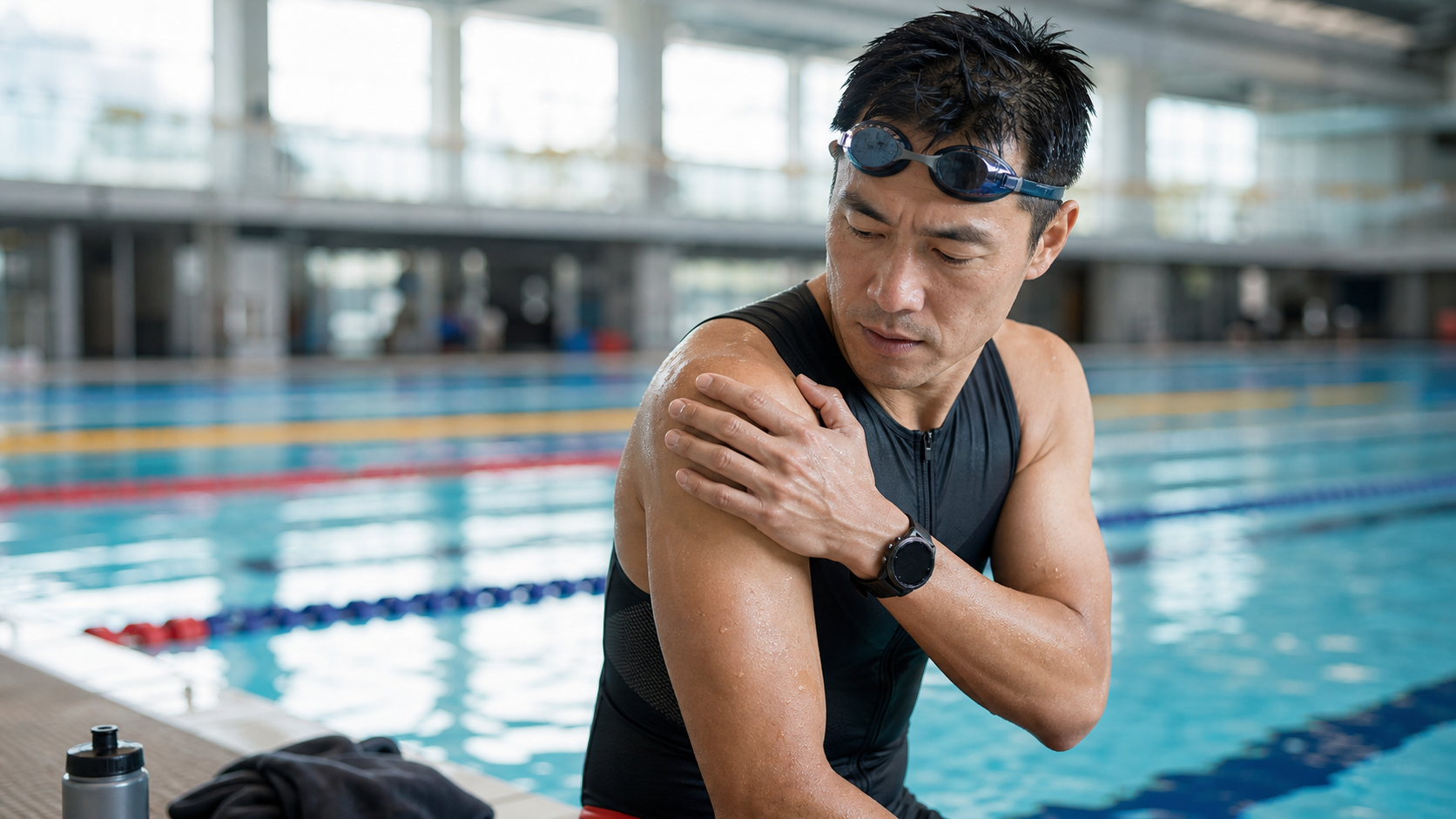
I still remember the first time A-Zhe walked in. He was a tech engineer in his early forties who had been doing triathlons on weekends for years, swimming freestyle smoothly and beautifully. That day, he sat down and immediately rubbed his right shoulder: “Coach, my shoulder has been getting sore at the end of each pull phase lately, and when I roll over in bed and put pressure on it, there’s a sharp twinge. Do I just need to rest for a few days?”
I asked him to raise his arm and trace a big circle. When his arm reached roughly shoulder height and went just a bit higher, he winced—that “painful arc” is almost the signature move of swimmer’s shoulder. I had a pretty good idea of what was going on. This wasn’t simply “overtraining”—it was classic shoulder impingement combined with rotator cuff overuse, something I’ve seen far too many times in swimmers, triathletes, and even gym-goers who do excessive overhead pressing.
In this article, I want to organize the concepts and practical methods I’ve used over the past decade-plus to help athletes deal with shoulder pain. Whether you’re a swimming enthusiast, a triathlete, or a cyclist who wants to add upper-body cross-training, if your shoulder bothers you during overhead movements, this article is worth reading to the end. I’ll go from the scientific foundation to specific training plans, and I’ll also honestly tell you which situations warrant seeing a doctor rather than toughing it out on your own.
One detail that stuck with me: what A-Zhe resisted most at first was me telling him to “cut back on volume.” He felt that swimming less meant regressing, meant “admitting defeat.” This is actually the mindset I encounter most often among athletes in Taiwan—we’re too used to “pushing through, enduring, and toughing it out,” treating pain as a test of willpower. But the shoulder doesn’t work that way. The more you pile on volume under a faulty movement pattern, the more you weld the problem in place. The truly smart approach is to take a step back temporarily, fix the root cause, and then steadily build the volume back up. Throughout this article, I’ll walk you through this “fix it first, then get stronger” logic.
Let me say the most important thing up front: shoulder pain is not something that will resolve on its own with rest. The core of most swimmer’s shoulder cases is muscle imbalance and faulty movement patterns. Rest only temporarily masks the pain—once you’re back in the water or under load, it comes right back. The real solution is “rebalancing,” not “pausing.”
Concepts and Scientific Foundation: How Swimmer’s Shoulder Develops
What Are Swimmer’s Shoulder and Shoulder Impingement
“Swimmer’s shoulder” is not a single diagnosis but a syndrome characterized primarily by anterior shoulder pain. Its core mechanism is that during repetitive overhead pulling motions, the rotator cuff tendons get repeatedly compressed in the subacromial space (beneath the coracoacromial arch), leading over time to tendon inflammation, degeneration, and even swelling of the surrounding bursa.
Let me clarify a few key structures first so you understand why we’ll train the way we do later:
- Rotator cuff: Composed of four muscles—supraspinatus, infraspinatus, teres minor, and subscapularis—they act like four slings that hold the humeral head securely “sucked” into the glenoid fossa. Their job isn’t to produce large forces but to stabilize the joint center as your arm moves.
- Subacromial space: The gap between the acromion (a bony projection of the scapula) and the humeral head. The rotator cuff tendons and bursa pass through here. The space isn’t large to begin with—once the humeral head migrates upward, or the scapula doesn’t move smoothly, this gap gets compressed and the tendons get pinched.
- Scapula: Many people overlook it, but it’s actually the “foundation” of all shoulder movement. Your arm can raise smoothly only because the scapula rotates, elevates, and posteriorly tilts correctly on the rib cage. If the foundation is unstable, no matter how much you train the house above it (the shoulder joint), it will be crooked.
Why Swimming Is Especially Prone to This
The numbers speak for themselves. According to sports medicine literature reviews, shoulder pain is the most common orthopedic injury among swimmers, with a prevalence rate ranging from approximately 40% to 91%—an astonishing figure. The reason lies in the nature of swimming: elite swimmers may swim about 14 kilometers per day, which translates to roughly 2,500 shoulder rotations per session, accumulating to about 16,000 shoulder rotations per week of training.
With such massive repetition, any minor flaw in technique or muscle imbalance gets amplified into injury. Research also indicates that over the course of a season, swimmers develop progressive muscle imbalances in the rotator cuff—typically, the muscles responsible for “internal rotation and pulling forward” (the main drivers of the pulling phase) get progressively stronger, while the muscles responsible for “external rotation and pulling the shoulder back into a stable position” become relatively weaker. This front-to-back imbalance is one of the key risk factors for swimmer’s shoulder.
(Source cited in the references at the end; values are ranges reported in the literature, and individual cases will vary.)
Scapular Dyskinesis: The Often-Overlooked Culprit
If you focus only on the rotator cuff, you’ll miss half the problem. Clinically, patients with shoulder impingement very commonly present with “scapular dyskinesis”—in plain terms, the scapula moves incorrectly, at the wrong timing, and at the wrong angle.
Multiple studies on subacromial impingement syndrome have shown that adding scapular stabilization training to a rehabilitation program (strengthening the lower trapezius, serratus anterior, etc.) provides meaningful benefits in improving scapular movement, reducing pain, and increasing strength and shoulder function. This is why, when I work with athletes, I never only train the “rotator cuff”—I always address scapular and thoracic spine mobility at the same time.
Scapulohumeral Rhythm: The Precise Coordination Behind Raising Your Arm
Let’s break it down one more level. For your arm to raise smoothly overhead, it’s not just the shoulder joint doing the work—it’s the coordinated division of labor between the shoulder joint and the scapula, which sports science calls “scapulohumeral rhythm.” Roughly speaking, for every 3 degrees your arm elevates, about 2 degrees come from the shoulder joint and about 1 degree from the scapula rotating on the rib cage. This ratio isn’t a rigid formula, but the concept matters: if the scapula doesn’t rotate when it should, or rotates too late, the shoulder joint has to bear a larger range of motion on its own, and the subacromial space is more likely to be compressed.
I often use an analogy with my athletes: the scapula is like a camera gimbal, and the humeral head is the lens. If the gimbal wobbles or sticks, no matter how good the lens is, you can’t get a stable image. Many people with shoulder pain train their rotator cuffs endlessly without improvement—the problem lies in the “gimbal”: the serratus anterior is weak, the lower trapezius doesn’t know how to engage, and the upper trapezius is overly tight and compensates. So every time they raise their arm, the scapula moves along a faulty path. This is also why simply taking anti-inflammatories or applying pain patches often only treats the symptoms.
“Intrinsic” vs. “Extrinsic” Impingement: Not All Impingement Is the Same
Sports medicine broadly categorizes impingement into two types, and it’s worth knowing the distinction. Extrinsic impingement refers to the tendon being physically compressed in the bony space beneath the acromion, and it’s more related to acromion shape, posture, and scapular control; intrinsic impingement occurs more in overhead athletes—at the extreme angle of arm elevation with external rotation, the deep rotator cuff makes contact with and wears against the posterosuperior glenoid labrum. In sports like swimming, triathlon, volleyball, badminton, and baseball, the two components often coexist. This reminds us: treating swimmer’s shoulder isn’t just about “opening up the space”—we also need to work on movement control and angle management, which is why technique correction is so crucial.
What Kind of Shoulder Pain Do You Have? Clarify Before You Act
Before giving you methods, I want to help you build a framework for assessment. Different types of pain require different priorities in how you handle them.
| Type | Typical Sensation | Common Scenario | First Step |
|---|---|---|---|
| Early overuse (trainable) | Soreness late in the session, resolves by next day, normal range of motion | Ramping up too fast, stroke collapsing in the late pull phase | Reduce volume but keep training, strengthen external rotation and scapular control |
| Impingement (needs adjustment) | “Painful arc” in mid-range elevation, pain at specific angles | Long-term imbalance, poor posture | Reduce aggravating movements, rebuild movement patterns |
| Acute inflammation (reduce load first) | Dull ache at rest, night pain, swelling sensation | Sudden spike in training, one overly intense session | Relative rest, seek medical evaluation, avoid pushing through |
| Suspected tear/structural issue (see a doctor) | Obvious weakness, inability to lift, severe pain after trauma, catching/locking | Falls, pulls, age-related degeneration | Seek medical imaging evaluation promptly |
The key takeaway from this table: The first two types can be managed with training and adjustments; for the latter two, reduce activity first and seek medical care when necessary. When in doubt, err on the side of caution. In Taiwan, seeing an orthopedist or a rehabilitation specialist is actually quite convenient—with National Health Insurance coverage, the barrier to booking an evaluation is low. Don’t keep putting it off because you’re “afraid of being told you’re overreacting.”
A practical self-check: slowly raise the affected arm straight forward and then out to the side. If you feel significant pain in the zone “just above shoulder height” and it eases once you pass the top, this “painful arc” strongly suggests impingement. But this is only a reference and cannot replace a professional examination.
Practical Approach: How to Train for Recovery, Not for Worsening
This is the main event. I break training down into four pillars, and the order matters—first loosen, then stabilize, then strengthen, and only finally return to your sport. Many people rush into aggressively training external rotation with a resistance band the moment they feel pain, but if the foundation (scapula, thoracic spine) hasn’t been addressed, they end up impinging even more.
Pillar One: Restore Range of Motion (Loosen What’s Stuck First)
People with impingement typically have two areas of tightness: the posterior shoulder capsule and insufficient thoracic spine mobility. If the posterior capsule is too tight, it pushes the humeral head forward and upward, actually reducing the subacromial space.
- Sleeper Stretch: Lie on your side with the affected shoulder down, elbow bent to 90 degrees. Use the other hand to gently press the forearm downward until you feel a stretch in the back of the shoulder. Hold for 30 seconds, 3 reps. Keep the pressure light—if it hurts, back off.
- Thoracic Rotation and Extension: Use a foam roller under your upper back and roll back and forth, or do the “open book” rotation from a four-point kneeling position, 8 to 10 reps per side. Many people in Taiwan sit hunched over a desk all day, and thoracic stiffness is a common issue—don’t skip this step.
Pillar Two: Rebuild Scapular Stability (Lay the Foundation)
This is the step I’m most reluctant to let athletes skip. The key muscles are the serratus anterior and lower trapezius.
- Wall Slides: Face the wall, forearms against it. Actively depress and retract the scapulae, then slide the arms up the wall. Throughout the movement, feel the scapulae “actively controlling” rather than shrugging.
- Prone Y, T, W Raises: Lie face down, position your arms in Y, T, and W angles, and lift them gently. The key is to squeeze the scapulae first, then raise the arms, 8 to 12 reps per letter.
- Serratus Punch: Lying on your back or standing, extend your arm forward and at the top, “punch” a little further to protract the scapula, feeling it glide along the ribcage.
Pillar Three: Strengthen the Rotator Cuff (Rebuild External Rotation Strength)
Research consistently shows that one of the key modifiable factors in swimmer’s shoulder is strength endurance of abduction and external rotation. So what we’re training isn’t power—it’s endurance and control.
In terms of training parameters, a common approach in the literature is: use a resistance band, set the intensity at a pain-free range (pain ≤ 3/10), perform 3 sets of 10 to 15 reps per exercise, with a slow tempo (about 2 seconds concentric, 2 seconds eccentric). This dosage is very practical for the general athletic population, and I use it almost exactly as written.
- Side-Lying External Rotation / Standing Band External Rotation: Keep your elbow tucked at your side, bent to 90 degrees, and rotate the forearm outward. Keep the elbow glued to your body throughout. This is the main dish for external rotators.
- Band Internal Rotation: The opposing exercise, to maintain front-back balance, but don’t train it more than external rotation (many people have it backwards).
- 90/90 External Rotation: An advanced exercise—arm abducted to 90 degrees, elbow bent to 90 degrees, performing external rotation. This mimics the angle of overhead sports. Add it once your foundation is solid.
Pillar Four: Return to Sport (Progressively Back to Water, Back to Load)
This is the step where people rush the most. My principle is: first be pain-free on land, then return to the water; in the water, reduce volume and intensity first, technique before distance. For swimming, start with a kickboard, single-arm strokes, and slow technique swimming—don’t jump straight back into a full-intensity workout.
A practical guideline for returning is “pain monitoring”: if pain during training doesn’t exceed 3/10, there’s no significant aggravation within 24 hours after training, and it’s no worse the next morning, you can maintain or make small progress. Conversely, if you experience more pain the day after training or night pain returns, you’ve progressed too fast—step back a level. I often ask athletes to keep a simple “shoulder diary” on their phone—rate your shoulder on a 0 to 10 scale every day, and look at the trend at the end of the week. It’s far more reliable than going by feel. This kind of objective self-monitoring is the key habit for breaking the “heal then re-injure” cycle.
Complete Progressive Program Example
The table below is the framework I often give to athletes with “early overuse to clear impingement, but no acute inflammation or structural issues.” Please perform everything in a pain-free manner—if any movement hurts more than 3/10, regress or stop.
| Week | Mobility | Scapular Stability | Rotator Cuff Strengthening | Sport Return |
|---|---|---|---|---|
| Weeks 1–2 | Sleeper stretch + thoracic daily | Wall slides, bodyweight YTW | Side-lying external rotation bodyweight/light band, 3×12 | Pause high-aggravation swimming, switch to land-based technique |
| Weeks 3–4 | Maintain, add open book | Add serratus punch | Band external rotation 3×15, add light internal rotation for balance | Kickboard + single-arm slow swimming, short distances |
| Weeks 5–6 | Maintain | YTW with light load | Introduce 90/90 external rotation, 3×12 | Gradually increase freestyle distance, keep intensity low |
| Weeks 7–8 | Maintain | Integrate into warm-up | Maintain and slightly increase resistance | Return close to original program, monitor pain |
Note: This is an educational example, not a one-size-fits-all prescription. Age, injury, goals, and available time all affect the plan. Having a physical therapist tailor it to your individual situation is ideal.
Warm-Up and Cool-Down: Don’t Underestimate Those 10 Minutes a Day
Many athletes ask me, “Is there a lazy version?” If I had to pick one thing to do every day, it would be the shoulder girdle warm-up before swimming or lifting: 10 wall slides, 15 band external rotations, and 8 reps each of YTW—the whole set takes under 10 minutes. The literature also supports that “on-land, open-chain, with a small number of exercises (around five or fewer)” is more effective for preventive strengthening than cramming in a bunch of fancy movements. Less is more.
Dosage and Progression Reference Table for Key Exercises
Many people get stuck on “how many reps, how much weight, how often to add more.” I’ve compiled the common dosages for several core exercises into the table below so you have a guideline. Remember, these numbers are a starting point, not gospel. The highest priority is pain-free movement and quality of execution. If you can’t perform it perfectly, regress. Better to do fewer reps with perfect form.
| Exercise | Purpose | Starting Dosage | Progression Direction | Common Mistakes |
|---|---|---|---|---|
| Band External Rotation | Strengthen external rotator endurance | 3 sets × 15 reps, light resistance | Gradually increase resistance, introduce 90/90 angle | Elbow away from body, shrugging compensation |
| Wall Slide | Serratus anterior and upward scapular rotation | 3 sets × 10 reps | Add band around forearms for resistance | Using shrugging to initiate, excessive lumbar arch |
| Prone YTW | Lower trapezius and posterior scapula | 2 sets × 10 reps per letter | Hold small water bottle (0.5–1 kg) | Lifting arms before squeezing scapula, neck tension |
| Sleeper Stretch | Loosen posterior joint capsule | Hold 30 sec × 3 reps | Just maintain, no need to increase intensity | Forcing into pain, holding breath |
| Serratus Push-up Plus | Scapular protraction control | 3 sets × 12 reps | Progress to push-up plus | Only pushing with hands, not engaging scapula |
Regarding “how often to add more”: My general rule is, when you can complete the upper end of the current dosage with standard form and no pain (e.g., external rotations done solidly for 3×15 without compensation), and you don’t have increased discomfort the next day, only then consider a small increase in resistance or angle difficulty. Change only one variable at a time. Don’t increase both weight and volume simultaneously, or you won’t be able to tell which one pushed you over the edge.
Technical Corrections in the Pool: Addressing the Root Cause
No matter how diligently you train on land, if your stroke mechanics remain the same in the water, the impingement will return. These freestyle technical points are the ones I see students struggle with most often and are the most worthwhile to fix first:
- Insufficient body roll: Many people swim freestyle like a “flat board floating on the water,” forcing the shoulder to rotate hard in a confined space. Adequate torso roll (both shoulders rotating side-to-side with the rhythm of breathing and arm strokes) allows the shoulder to generate force at a more comfortable angle, significantly reducing impingement.
- Excessive internal rotation on hand entry (thumb-first entry): Entering the water with the palm angled thumb-down brings the humerus into an internally rotated position, which is precisely the angle prone to impingement. Changing to a more neutral hand or palm entry is much friendlier to the shoulder.
- Dropped elbow in the later phase of the pull: If the elbow collapses during the catch phase, not only is propulsion efficiency poor, but the shoulder also endures more shear force. High-elbow catch is key for both efficiency and shoulder protection.
- Asymmetry from breathing to one side only: Long-term breathing exclusively to one side can lead to uneven loading on the shoulders. Practicing bilateral breathing is beneficial for long-term shoulder health.
These technical points are hard to convey adequately in text. I strongly recommend having a professional swim coach observe you in person, or having someone film you from an underwater angle. Many pools and triathlon teams in Taiwan offer technique assessments. Investing in this once is often more efficient than months of self-experimentation.
Common Mistakes and Corrections: Pitfalls I’ve Seen Students Fall Into Countless Times
Mistake 1: Complete rest when it hurts, then suddenly overdoing it when it feels better
This is the classic cycle. Complete rest does relieve acute pain, but the imbalance and movement patterns causing the impingement haven’t changed. Once you feel better and return to the water or under the barbell, the same problem reappears, sometimes worse. The correction is “relative rest”—reduce the aggravating activities, but maintain, or even increase, corrective training.
Mistake 2: Overdoing band internal rotation, neglecting external rotation
Movements like pulling, bench pressing, and overhead pressing heavily utilize the internal rotators. If you’re also hammering chest and internal rotation work in the gym while rarely training external rotation and the posterior scapular muscles, you’re tilting an already imbalanced scale further. Correction: Training volume for external rotation and the posterior scapula should at least match internal rotation, and early on, should even be greater.
Mistake 3: Only training muscles, not fixing technique
No matter how strong your rotator cuff, if you shrug your scapula during the pull and don’t rotate your hips, impingement will still occur. Technique and movement patterns are fundamental. Insufficient body roll in swimming, excessive internal rotation on hand entry (thumb-first), and dropped elbow in the later pull phase are all common technical sources of impingement. For this, I recommend having a swim coach analyze your stroke.
Mistake 4: Forcing stretches through pain, believing “pain means it’s working”
“No pain, no gain” is a dangerous myth in shoulder rehabilitation. When the rotator cuff and bursa are inflamed, forcing stretches only worsens the inflammation. Training should be conducted within a pain-free or mild pain (≤ 3/10) range. Pain is your body’s signal to back off, not a badge of honor.
Mistake 5: Ignoring sleeping posture and daily habits
Many people in Taiwan sit for long hours at work and look down at their phones, leading to rounded shoulders and a hunched back. This posture causes the scapula to tilt forward, reducing the subacromial space. Additionally, those who habitually sleep on their affected shoulder often experience more pronounced nighttime pain. Correcting daily posture and adjusting sleep position (affected shoulder up, supported by a pillow) can sometimes be more effective than doing extra sets.
Mistake and Correction Reference Table
| Common Mistake | Why It’s Harmful | My Correction Suggestion |
|---|---|---|
| Complete rest when it hurts | Imbalance and mechanics unchanged, high recurrence rate | Relative rest + uninterrupted corrective training |
| Too much internal rotation, too little external rotation | Worsens anterior-posterior muscle imbalance | External rotation/posterior scapula volume at least equal |
| Only training strength, not fixing technique | Movement pattern still causes impingement | Get a coach to fix pull and body roll |
| Forcing stretches through pain | Worsens tendon and bursa inflammation | Keep pain controlled at ≤ 3/10 throughout |
| Rounded shoulders, hunched back, sleeping on affected shoulder | Reduces subacromial space, causes night pain | Fix posture, adjust sleep position, add support |
Actionable Advice for Readers of Different Levels
Everyone starts from a different point. I’ve divided the advice into three levels; you can find where you fit.
Beginners / Office Workers Who Swim Occasionally
What you need most is prevention over treatment. Your shoulders are fine now, but if you plan to increase your swimming volume, or start triathlon or heavy overhead lifting, please build the “foundation” first:
- Before every swim or lifting session, spend 10 minutes on shoulder girdle warm-up (wall slides, band external rotations, YTW).
- Follow the “gradual progression” principle when increasing volume; don’t increase weekly distance or intensity by more than about 10%.
- Address minor soreness immediately; don’t wait until it becomes “pain when raising the arm” before getting concerned.
- Improve your sitting posture and reduce slouching in daily life; this is especially important for office workers in Taiwan who sit for long periods.
Intermediate / Triathletes and Swimmers with Consistent Training
You may have already experienced shoulder discomfort once or twice. The key is to make corrective training a regular habit, not just something you do when it hurts:
- Schedule 2 to 3 independent scapular and rotator cuff sessions per week (refer to the progressive program weeks 3–6 earlier).
- Regularly review your internal vs. external rotation training ratio; don’t let internal rotation dominate.
- Have a coach or training partner film your stroke technique, paying special attention to whether your elbow drops in the later pull phase.
- When it’s hot (Taiwan’s summer pool and outdoor water temperatures are high), fatigue sets in easily. Under fatigue, technique breaks down first, and the shoulder suffers first. Shorten your session when tired.
Those Currently in Pain / Advanced but Recurrently Injured
If you already have a noticeable painful arc, night pain, or recurrent injuries on the same side:
- Deload first. Remove high-stimulus pulling and overhead weights, and focus primarily on corrective training.
- Seriously evaluate whether you should see a doctor. If you experience pain at rest, night pain, significant weakness, severe pain after trauma, or a catching sensation in the joint, please seek evaluation from an orthopedic or rehabilitation specialist promptly. If necessary, get an ultrasound or imaging to rule out structural issues like tendon tears.
- Seeing a rehabilitation specialist is very convenient in Taiwan. Physical therapists can provide individualized manual therapy and exercise prescriptions, which is far more efficient than piecing together information online. With the National Health Insurance system, the barrier to seeing a doctor or getting an ultrasound is low. Clarifying structural issues early can actually save you a lot of wasted rehabilitation time.
- If the doctor recommends anti-inflammatory medication, injections, or further intervention after evaluation, discuss it thoroughly with them. Don’t self-medicate with long-term painkillers to push through training. Painkillers suppress the signal, not the problem itself. Using them to force through swimming or lifting often turns a minor injury into a major one.
- For those with recurrent injuries on the same side, especially review your habits outside of training time: desk height, phone posture, habitual one-shoulder backpack carrying, and sleeping on the affected shoulder. These small things that accumulate for over a dozen hours daily often have a bigger impact than the training plan itself.
Quick Reference by Severity Level
| Level | Core Goal | Weekly Commitment | Red Flags (Seek Medical Attention) |
|---|---|---|---|
| Beginner / Occasional Swimmer | Prevention, building a foundation | Daily warm-ups are sufficient | Persistent painful arc |
| Intermediate / Consistent Training | Regular correction, technique refinement | 2–3 dedicated sessions | Repeated same-side injuries |
| Already in Pain / Recurrent Injury | Reduce load, seek medical care, rebuild | Focus on correction | Night pain, weakness, trauma, locking |
FAQ
Q: Can I keep swimming while my shoulder hurts?
A: It depends on the severity. If it’s mild soreness late in the session that doesn’t affect your stroke, and you can finish pain-free after reducing volume, you can swim while making adjustments. But if it hurts as soon as you get in the water, pain exceeds 3/10, or it affects your pulling motion, reduce the load first—pushing through will only prolong recovery.
Q: Do taping, massage guns, and anti-inflammatory medication work?
A: These are “supports” that can temporarily relieve discomfort, but none of them will change the muscle imbalances and movement issues causing the impingement. They can help you feel more comfortable while doing corrective training, but don’t treat them as a fundamental solution. Use anti-inflammatory medication as directed by your physician or pharmacist.
Q: How long until I get better?
A: It varies from person to person. For mild overuse, consistent corrective work often brings noticeable improvement in two to four weeks; those with obvious impingement may need six to eight weeks or longer. The key is consistency—training sporadically rarely yields results.
Q: Why should cyclists read this too?
A: Long hours on the drops, supporting your upper body, plus many riders use swimming or strength training as cross-training—your shoulders endure overhead and supporting stress as well. Building a stable shoulder girdle benefits both your riding posture and cross-training.
Q: Do I need to buy a lot of equipment?
A: No. A resistance band, a wall, and a yoga mat can cover 90% of corrective training. Equipment was never the point—consistency and proper form are.
Q: Taiwan summers are so hot—what should I watch out for with outdoor training or open-water swimming?
A: Fatigue sets in quickly in high heat, and fatigue is the number one culprit behind technique breakdown—once you’re tired, your pull deforms, your body stops rotating, and your shoulders immediately take on more load. In summer, be stricter about session length and stay hydrated. Stop when you feel your technique starting to fall apart; don’t push through fatigue just to complete the distance—that’s exactly when injuries peak.
Q: Heat or ice?
A: General principle: in the acute phase right after onset, with obvious swelling and heat, short periods of ice can help relieve discomfort; in the chronic phase dominated by tightness and stiffness, warmth helps with relaxation and mobility. But this is only a general rule—if pain persists or worsens, have a professional assess it rather than just continuing to apply compresses on your own.
Q: I do strength training—which exercises should I be especially careful with?
A: Overhead presses, behind-the-neck pulldowns, incline bench presses, and dips—movements that bring the shoulder into overhead or extreme positions—require extra caution for those with impingement. If necessary, switch to a neutral grip, reduce range of motion, or pause them temporarily. Add them back gradually once your shoulder is stable and pain-free, and maintain scapular control throughout.
Q: Can supplements repair the rotator cuff?
A: Currently, no supplement can replace proper training and recovery. A balanced diet, adequate protein, and sleep are the foundation of tissue repair. Eating out is common in Taiwan, and protein intake often falls short—that’s actually a more worthwhile area to address first. For any supplement use, consult your physician or nutritionist first.
Conclusion: Treat Your Shoulders as a Lifetime Asset
Back to A-Zhe from the beginning. We spent about six weeks first releasing his tight thoracic spine and posterior shoulder, rebuilding scapular control, restoring the chronically weak external rotation strength, and having his swim coach correct the issue of his elbow dropping late in the pull. When he returned to near his original training volume in week seven, that nagging soreness had almost disappeared, and he was no longer being woken by pain from pressure at night. He later told me, “So it wasn’t that I wasn’t working hard enough—I was just training the wrong things all along.”
That sentiment is actually shared by many people with shoulder pain. Swimmer’s shoulder and rotator cuff impingement are rarely “just overtraining”—they’re usually the combined result of imbalance, mechanics, and recovery not being properly managed. The good news is that all three can be improved with the right approach.
Remember a few key points: pain is a signal, not an enemy—train within a pain-free range; build the foundation (scapula and mobility) before strengthening; balance external and internal rotation; technique and posture matter as much as strength; and when red flags like night pain, weakness, trauma, or joint locking appear, don’t push through—see a doctor. Take care of your shoulders, and you’ll be able to swim longer, ride farther, and train for years to come.
Finally, I want to emphasize “patience.” Shoulder rehab isn’t like cardio training—you won’t see obvious progress in a week. It’s more like saving money: accumulating a little each day, consistently, until one day you suddenly realize, “Hey, this movement doesn’t hurt anymore.” I’ve coached many students, and the ones who got stuck were never held back by a bad program—they quit after two weeks without seeing results. Give yourself at least six to eight weeks, treat corrective training like brushing your teeth, and you’ll look back and thank the version of yourself who was willing to slow down and build a solid foundation. The road of sport is long, and your shoulders are partners for life—they deserve to be taken seriously.
This article is educational content and cannot replace individual diagnosis and treatment advice from a physician, physical therapist, or nutritionist. If you have significant pain, weakness, a history of trauma, or chronic conditions, be sure to seek individualized assessment and management from a qualified medical professional.
References
- Epidemiology of Injuries and Prevention Strategies in Competitive Swimmers (PMC): https://pmc.ncbi.nlm.nih.gov/articles/PMC3435931/
- Effect of Preventive Exercise Programs for Swimmer’s Shoulder Injury on Rotator Cuff Torque and Balance: A Randomized Controlled Trial (PMC): https://pmc.ncbi.nlm.nih.gov/articles/PMC11899141/
- Effectiveness of Therapeutic Exercise in Musculoskeletal Risk Factors Related to Swimmer’s Shoulder (PMC): https://pmc.ncbi.nlm.nih.gov/articles/PMC9222170/
- Effect of scapular stabilization exercise program in patients with subacromial impingement syndrome: a systematic review (PMC): https://pmc.ncbi.nlm.nih.gov/articles/PMC7365732/
- Frontiers | Effect of scapular stabilization exercises on subacromial pain (impingement) syndrome: a systematic review and meta-analysis of RCTs: https://www.frontiersin.org/journals/neurology/articles/10.3389/fneur.2024.1357763/full
Related Reading
- The Complete Guide to Swimming Shoulder Pain: Causes and Prevention of Shoulder Impingement Syndrome
- The Complete Guide to Preventing Swimmer’s Shoulder: Causes, Diagnosis, and Strength Training for Rotator Cuff Injuries
- The Complete Diagnosis and Treatment Guide for Swimmer’s Shoulder
- Shoulder Strengthening for Swimming: Preventive Training for the Rotator Cuff
一日北高/長距離團騎 常見問題補充篇 / 組團或跟團的眉角 / 壯車友容易被瘦車友慢性拉爆 / 原來屁股痛可能是這個原因...? / 風場配速法 / 公路車 / CT Yeh
2 年前
一日北高常見問題大集合 | 攻略 | 路線 | 訓練 | 補給 | 自行車 單車 | 一日雙城 | 雙塔 | TWB北高360 | 屁股痛
6 年前
抖肩舞 台灣x日本交流版 (台灣 vs 前橋) 赤城山登山賽 coincidance
8 年前
再一組! 全碳幅條 碟煞/無內胎輪組 開箱! 到底好騎嗎? UNAAS X40 | 公路車 | CT Yeh
4 年前
一日北高前的西濱集訓 | 跟著11小時軍團 | 300W踩不動的大逆風 | 輪車破風差幾瓦?
6 年前
靠單車減肥35公斤 心得分享與整理
7 年前
鉅齒紋輪組!? ControlTech MEG-T50 EVO 碳纖維幅條輪組/ 功率對比實驗 / 公路車 / CT Yeh
2 年前
碟煞公路車 銑面器 !? 原來銑完差這麼多! 降低蹭碟機率! | TIME 公路車 保養小記錄 | CT Yeh
3 年前