Correct Use of Athletic Taping and Supports: A Coach's Practical Guide to Purposes, Evidence, and Dependency Risks
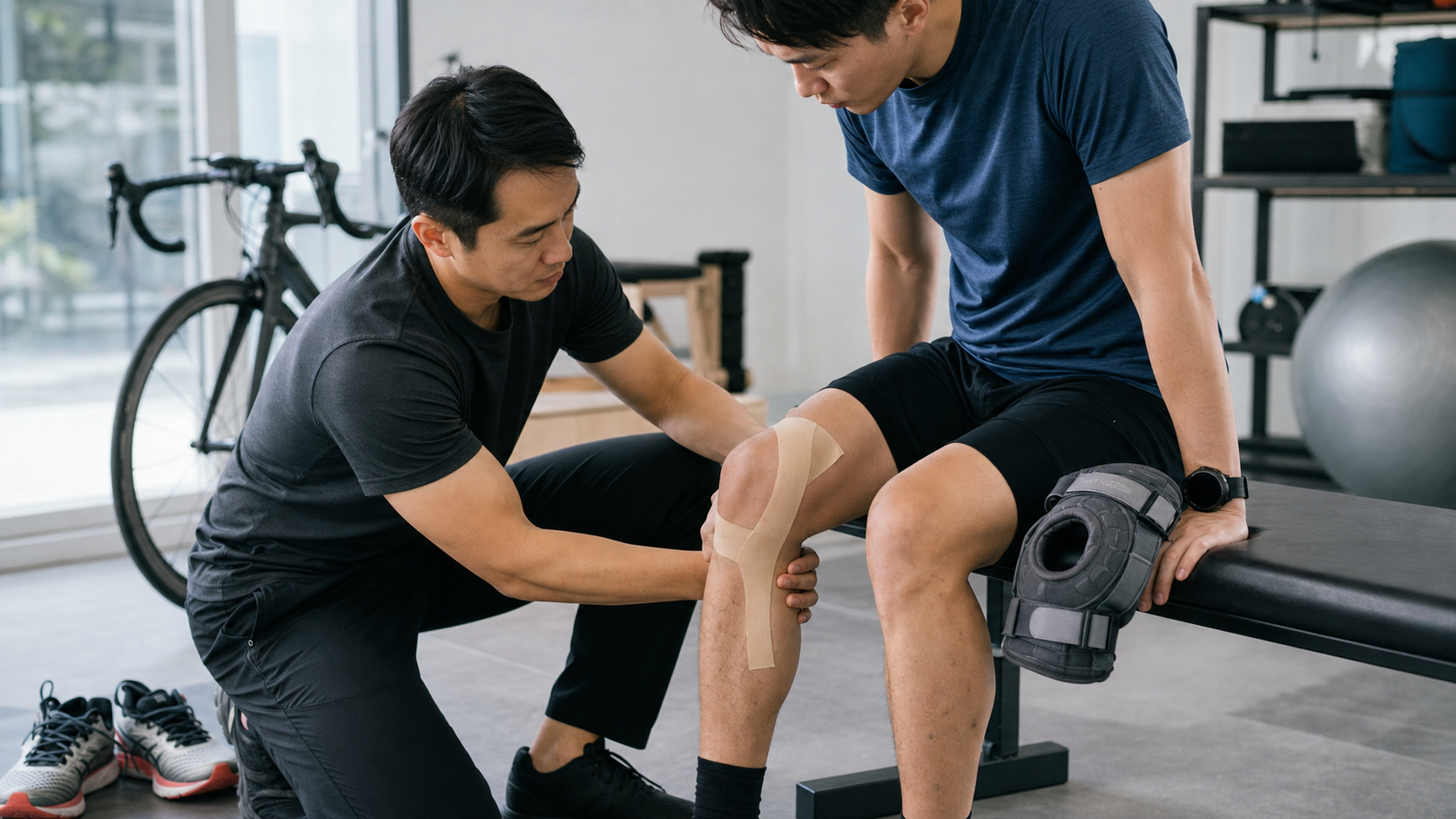
Opening: That Roll of Colored Tape Is Neither a Panacea nor a Placebo
In my fifteen years of coaching athletes, one of the questions I get handed most often is: “Coach, I’m sore here. Can you put some of that colored tape on me? If I tape it, won’t it stop hurting?”
Usually, I’ll ask a question back: “Why are you sore?”
Because for me, taping and bracing (brace/support) have never been a “stick it on and it’s solved” move. They are the conclusion of a whole set of judgments. Judgments about what? About whether this discomfort is acute or chronic, whether it’s structural injury or simple fatigue, whether today you should push through for a race or go home and rest, and whether your core and glutes are actually awake yet. Only after these preliminary judgments are made does taping or bracing have the role it’s supposed to play.
One case that left a deep impression on me was an amateur cyclist in his early forties who rode Yangmingshan’s Balaka and Fengguizui every weekend. After long descents, he’d get a stabbing pain on the outside of his left knee. He went to a sporting goods store and bought a so-called “all-purpose” patellar strap, which he wore for over half a year. For the first two months, he did feel some improvement, so he wore it more and more often, even while commuting. When he came back to me six months later, the pain hadn’t improved—instead, he’d developed tightness on the outside of his thigh and gluteal weakness.
The mistake he made is actually the most typical one among Taiwan’s athletic population: treating assistive devices as treatment, and treating the disappearance of symptoms as the resolution of the problem.
In this article, I want to address taping and bracing from “do they work” to “how to use them correctly,” and then to “when you should worry about over-reliance.” This is a long article because this topic has been oversimplified for too long, and I want to take the space to explain it clearly.
1. First, Understand: What Taping and Bracing Actually Do
Many people lump “taping” and “bracing” together, but their mechanisms of action are actually quite different. I usually start by laying out the positioning of these two categories for my athletes.
Taping Is Not Just One Thing
The most common type seen on the streets of Taiwan is that elastic kinesiology tape—colorful, stretchy, and when applied, it gently lifts the skin into wrinkles. But taping actually falls into at least two major categories with completely different mechanisms:
| Type | Material Properties | Primary Purpose | Typical Use Scenarios |
|---|---|---|---|
| Rigid / white tape | Almost no elasticity, stiff | Restrict joint range of motion, provide mechanical support | Protection after acute ankle sprain, fixation during competition |
| Elastic / kinesiology tape | Elastic, extensible | Sensory feedback, pain modulation, auxiliary for swelling and lymphatic drainage | Chronic soreness, fatigued muscles, post-surgical lymphatic drainage support |
These two are often mixed up, leading to mismatched expectations. Some people put soft kinesiology tape on a freshly sprained ankle expecting it to “stabilize,” but that type of tape was never meant to provide mechanical fixation. Conversely, some people use rigid tape long-term on chronically sore trapezius muscles, which restricts normal movement and makes things tighter instead.
Grading of Braces
Braces are the same—from soft to hard, it’s a spectrum:
- Compression sleeve: Like knee sleeves and calf sleeves, these mainly provide proprioceptive feedback and mild compression, with very limited mechanical support.
- Semi-rigid brace: Features lateral stays or plastic shells that can substantially restrict movement in a certain direction—for example, the ankle braces many basketball players use.
- Rigid / functional brace: Used post-surgery or for severely unstable joints, usually prescribed by medical professionals.
To sum it up in one sentence: taping and bracing do three main things—restrict harmful ranges of motion, enhance joint position sense (proprioception), and give you a bit of psychological security. They do not repair tissue, and they do not replace strength.
2. What the Evidence Says: Don’t Overestimate, but Don’t Dismiss It Either
This is the section I most want to explain clearly, because public attitudes toward these two things are extremely polarized—either they’re glorified as “tape it and it won’t hurt,” or dismissed as “pure placebo, useless.” The real evidence lies in the middle, and it varies a lot by topic.
Elastic Kinesiology Tape: Quite Limited Effects on Pain
Let’s start with the most popular and most over-marketed colorful kinesiology tape. Overall, the conclusions from systematic reviews and meta-analyses are conservative: in musculoskeletal injury populations, kinesiology tape does not provide additional significant pain reduction beyond other treatments. It’s considered to have “limited potential for pain reduction,” and on outcomes like range of motion, strength, and athletic performance, study results conflict with each other and there’s no clear consensus (see references 1 and 2 at the end).
In other words, that roll of colored tape probably isn’t making you feel better through a “physical therapeutic effect.” It’s more likely that it changes your sensation and attention toward that area, plus a bit of psychological reassurance. This doesn’t mean it has no value at all—for some people, “feeling supported and more willing to move” is meaningful in itself, especially during the fear-of-movement phase. But if you expect it to provide structural support like a painkiller or a brace, you have the wrong expectation.
I usually tell my athletes this: Kinesiology tape is more of a “reminder patch” than a “treatment patch.” It reminds you that this area needs care and reminds you to be careful with your movements, but what actually repairs tissue is rest, progressive loading, and strength training.
Ankle Braces / Ankle Taping: For Prevention, the Evidence Is Actually Stronger
Interestingly, when we switch to the topic of “preventing ankle sprains,” the evidence becomes much clearer.
According to systematic reviews and meta-analyses, for athletes with a history of sprains, taping or semi-rigid ankle braces can reduce the incidence of re-sprain by roughly half to 70% (compared to no external support at all). And between the two, braces perform slightly better on the efficiency metric of “number needed to treat to prevent one sprain,” and they’re also more durable—because tape loosens during activity and gradually loses its restrictive capacity (see references 3 and 4 at the end).
There are two key details I always emphasize:
- The most effective population is people who have already sprained. For those who have never sprained, the preventive benefit is less obvious. This actually makes intuitive sense—a sprained ankle often has some degree of ligament and proprioceptive damage, and external support is precisely what compensates for that.
- Tape loosens during activity. After a basketball game or a long ride, the tape’s restrictive power drops noticeably; braces are relatively more stable and durable.
So if you have a history of ankle sprains and you play ball or trail run, “wearing a well-reviewed ankle brace” is a defensible choice based on the evidence.
Condensing the Evidence into a Decision Table
| Purpose of Use | Strength of Evidence (Approximate) | My Practical Advice |
|---|---|---|
| Using kinesiology tape to “cure” chronic pain | Weak, limited effect | Don’t treat it as therapy; at most use it as an aid and reminder |
| Using ankle braces/taping to prevent re-sprain in those with a history | Relatively clear, supportive | Worth using; braces especially |
| Using braces to replace strength training | No support | Not acceptable; counterproductive long-term |
| Using taping to improve proprioception and psychological stability | Highly individual | Varies by person; can try |
| Using braces for short-term protection after acute injury | Reasonable | Fine short-term; must be combined with medical evaluation |
Please note: I’m giving ranges and directions for the numbers above, not false precision. Sports science literature naturally varies due to differences in study design. Any claim that guarantees “a XX% reduction” should be met with skepticism.
3. How to Do It in Practice: When to Tape, When to Brace, and When to Do Neither
Now that the concepts are covered, let’s talk about application. I’ll divide this section by “scenario,” because the same body part requires completely different handling in different states.
Scenario A: The First 48 to 72 Hours of an Acute Sprain / Strain
This is the phase that requires the most caution and the most medical judgment. Access to healthcare is very convenient in Taiwan—under the NHI, seeing an orthopedist or rehabilitation specialist, or getting evaluated by a qualified physical therapist, isn’t difficult. I strongly recommend: for moderate or worse acute injuries, let a professional determine whether there’s a fracture or ligament tear before discussing taping and bracing.
The principle for this phase now leans toward the newer concept of PEACE & LOVE (protection, avoiding excessive anti-inflammatories, progressive loading, etc.), replacing the older RICE that previous generations are familiar with. If support is needed at this stage, it leans toward rigid taping or semi-rigid braces for short-term protection, with the goal of restricting movement in harmful directions and letting the tissue settle down—not elastic tape.
Scenario B: Chronic Soreness / Overuse
The cyclist with knee pain mentioned earlier falls into this category. The core of a chronic problem is never the tape; it’s why overuse is happening. Is it insufficient strength? Poor bike fit with bad saddle settings? Training volume ramping up too fast (I often see people get injured after increasing weekly mileage by more than 10% at once)? Or an imbalance between flexibility and mobility?
In this situation, bracing/taping is at most “symptom-phase decompression,” letting you do the things that actually matter—adjusting training volume, strengthening glutes and core, correcting cycling or running form—without being in so much pain. It’s a supporting role, not the lead.
Scenario C: Strategic Use on Important Race Day
Race day is an exceptional situation. Sometimes an athlete has a “known, controllable” old injury—for example, a stable patellar tracking tendency—and using taping or a brace on race day for some support and psychological reassurance is reasonable. Here’s a pre-race gear checklist I give:
| Check Item | Why It Matters |
|---|---|
| Has this support been tested in training? | Race day is not experiment day; never use something untested on race day |
| Any skin damage, or allergies to tape? | Taiwan’s summers are hot and humid; tape easily causes rashes and blisters |
| Will it compress blood circulation over long periods? | Overly tight compression gear can cause numbness and swelling distally |
| Will it mask the warning signs that you should stop? | Support can help you push through, but it can also make you push too far |
The last item is the key point. The most dangerous thing about assistive devices is that they can make you push through the signals your body was sending to make you stop, turning a minor injury into a major one.
Two Practical Reminders for Taiwan’s Climate and Eating-Out Culture
First, Taiwan is hot and humid. In summer, tape adhesion drops quickly, and skin left covered for long periods is prone to rashes and blisters. Skin should be clean and dry before application; change the tape if it’s been on too long (more than a day or two) or after heavy sweating. If the skin becomes red, itchy, or painful, tear it off—don’t tough it out.
Second, many people think injuries are only related to training, but recovery quality is just as critical. In Taiwan, people who eat out a lot commonly don’t get enough protein. If you’re not getting at least 1.2 to 1.6 grams of protein per kilogram of body weight per day, you don’t have the raw materials for tissue repair, and no amount of taping will make up for it. Instead of obsessing over tape colors, first make sure you’re getting enough protein (beans, fish, eggs, meat) at every meal.
4. Common Mistakes and Corrections: I’ve Seen Too Many People Fall into These Traps
In this section, I’ll lay things out as “mistake → why it’s wrong → how to fix it,” all based on real situations I’ve seen repeatedly over the years.
Mistake 1: Using a Brace as a Long-Term Solution, Wearing It Every Day
Why it’s wrong: Long-term stability around a joint is maintained by muscles and proprioception. If you let an external brace do the work for an extended period, your own stabilizing system lacks stimulation and can become increasingly “lazy,” creating dependency. That’s one of the reasons the cyclist got weaker the more he wore it.
Fix: Set “use scenarios” and a “phase-out schedule” for the brace. For example: wear it only during high-risk activities (ball sports, trail running, races); simultaneously schedule 2 to 3 sessions per week of strength and balance training for that joint, letting your own stability gradually take over.
Mistake 2: Using Assistive Devices to Mask Pain While Continuing the Same Training Volume
Why it’s wrong: Pain is a signal, not an enemy. If you cover up the signal but don’t reduce the volume, it’s like disabling the alarm and continuing to speed.
Fix: Pain means you need to adjust your load. First reduce volume and find the cause, then talk about returning to original intensity. Assistive devices can accompany you through this reduction phase, but they can’t let you skip it.
Mistake 3: Learning Tape Application Randomly Online, with Wrong Direction and Tension
Why it’s wrong: Taping’s effects are limited to begin with. Applying it in the wrong direction and with the wrong tension means you won’t even get the “sensory feedback” benefit, and you might restrict the wrong movements.
Fix: If you really want to use taping for a specific issue, have a qualified physical therapist demonstrate the correct application once, understand the principles, and then do it yourself. Don’t just watch short videos and slap it on.
Mistake 4: Wrong Brace Size or Strapping Too Tight
Why it’s wrong: Overly tight compression gear compresses circulation. Over time, the distal areas become numb and swollen—more harm than good.
Fix: Choose the right size. After putting it on, the distal areas (fingers, toes) should not feel numb or noticeably cold; check after activity for overly deep indentations or skin color changes.
Mistake 5: Treating “Disappearance of Symptoms” as “Being Healed”
Why it’s wrong: This is the most expensive lesson. Suppressing symptoms doesn’t mean tissue repair is complete. Returning to full load too early leads to high recurrence rates.
Fix: Return should be “progressive.” Establish objective return-to-play criteria—for example, being able to complete a pain-free single-leg squat on the affected side, stable single-leg jump landings, and reduced bilateral strength asymmetry—rather than “I’m not in pain today, so let’s go all out.”
5. On Dependency: When You Should Worry That You “Can’t Let Go”
“Dependency” actually has both a physiological and a psychological layer.
Physiologically, the concern about long-term replacement of your own stability with external support is real, but this is a “usage pattern” issue, not a fault of the brace itself. The same ankle brace is a great helper when used for “short-term protection in high-risk activities + regular strength training”; it becomes a crutch when used as “I’ll just wear it and do nothing else.”
Psychologically, it’s more subtle. I’ve met many athletes whose injuries were long healed and whose strength had returned, but they just “couldn’t move without wearing it”—a security blanket concept. This psychological dependency can quietly limit your performance and reduce your trust in your own body.
I use a few self-check questions to help athletes determine whether they’re sliding into dependency:
- Am I using it “selectively” in high-risk situations, or “indiscriminately” every day?
- When I take it off, is my body genuinely unstable, or is it just “a bit of a mental unease”?
- While using the assistive device, am I simultaneously doing things to make myself stronger (strength, balance, mobility)?
- Have I set conditions and a timeline for phasing it out?
If your answers lean toward “indiscriminate use, psychologically can’t let go, no accompanying training, no phase-out plan,” then it’s time to confront the dependency. A healthy relationship is: the assistive device is a temporary scaffold on your path to getting stronger, not a permanent prosthetic.
6. Actionable Advice for Readers at Different Levels
After all these principles, let me condense them into concrete actions for three levels, so you can find where you fit.
For Beginners / General Exercisers
- Don’t rush to buy tape or braces. Most early-stage discomfort comes from insufficient warm-up, training volume ramping too fast, and poor posture. Handle these three things first.
- Keep weekly training volume increases to around 10% or less as a conservative direction—don’t suddenly surge on the weekend.
- If pain truly persists for more than a week or two, or there’s obvious swelling or weakness, see a doctor or physical therapist—don’t play doctor yourself. Taiwan’s NHI makes it easy to get care; don’t skip this step.
- If you do use assistive devices, prioritize short-term use in situations with clear risk or old injuries.
For Advanced Athletes / Regular Trainers
- Build your own injury log: which body part, at what intensity it becomes uncomfortable, what treatment you used, and how effective it was. This is worth more than any tape.
- If you have recurring old injuries (e.g., a sprained ankle), choose a well-reviewed brace you’ve tested for high-risk workouts or races, and keep training that joint’s strength and balance.
- Treat taping as a “sensory aid” and psychological tool—don’t give it therapeutic expectations.
- Set a phase-out plan for every assistive device: once certain objective conditions are met, start reducing use.
For Competitive Athletes
- Everything you plan to use on race day must be validated during training. Zero experiments on race day.
- Establish a division of labor with your medical team (team doctor, physical therapist); leave acute injury judgments to the professionals.
- Incorporate assistive devices into your overall risk management, but know their ceiling—they reduce risk, not eliminate it, and they can’t replace fundamentals.
- Be especially vigilant against the temptation to “push through warning signs.” Rankings matter, but a mishandled injury can sideline you for an entire season.
Appendix 1: Complete Treatment Processes for Three Real Cases
No matter how many principles I explain, nothing is clearer than real examples. The following three cases have been de-identified; the situations are real, and the numbers aren’t exaggerated.
Case 1: Trail Runner with Recurrent Lateral Ankle Sprains
A woman in her mid-thirties who loved technical trail routes like Yangmingshan and Yuanzui-Shaolai had sprained the same ankle four times in two years, with the most recent one costing her six weeks off. Her first words when she came in were: “I want to buy the stiffest ankle brace and lock it down.”
My approach wasn’t to buy a brace first, but to assess her single-leg balance and ankle strength. The results weren’t surprising: on the affected side, she couldn’t hold a single-leg stance with eyes closed for even ten seconds, and her peroneal muscles were clearly weak. That was the root cause of her recurrent sprains—not that her brace wasn’t stiff enough, but that her proprioception and strength were both compromised.
Our plan ran on two parallel tracks: one was bracing—given her clear history of sprains and high-risk terrain, we chose a well-reviewed semi-rigid ankle brace to be worn only during trail runs (this is exactly the use the evidence best supports); the other was rehab training, focusing on balance and peroneal strength. Three months later, her single-leg eyes-closed balance had improved to over thirty seconds, and the brace went from “worn every time” to “worn only on the most technical routes.”
This case perfectly demonstrates that saying: A brace compensates for what you’re temporarily missing, but you need to grow that missing piece back at the same time.
Case 2: Triathlete Who Wanted to Tape Up His Whole Body Before a Race
A serious amateur triathlete, nervous before a race, had watched online videos and covered his shoulders, thighs, and calves with colorful tape, saying it would keep his “muscles from blowing up.”
I didn’t outright dismiss him, because psychological reassurance has value in competition too. But I reminded him of two things: first, the evidence that these tapes prevent “muscle blowout” or delay fatigue is actually very weak—don’t skimp on your pacing strategy and fueling homework and expect tape to save you; second, many of the placements he’d applied that day had wrong directions, and two spots were actually slightly restricting the direction of his force production.
We reduced the tape to just one or two spots where he genuinely had old injuries and where taping gave him psychological comfort, removed the rest, and redirected his focus to pacing, hydration and electrolytes, and segment strategy. He ended up setting a personal best in that race. This shows tape can serve as a psychological aid, but it should never crowd out the fundamentals that actually determine performance.
Case 3: Elderly Walker with Knee Discomfort Who Wanted to Wear a Knee Brace Long-Term
A woman in her sixties had knee soreness when climbing stairs. Her daughter bought her a knee brace, and she wore it every day from then on—even wanting to sleep in it. Six months later, she told me her knee wasn’t any better, and her legs had become “weaker.”
This requires great caution, because knee pain in older adults has many causes (osteoarthritis, sarcopenia, etc.). A doctor’s evaluation is mandatory—you can’t self-diagnose. After the doctor ruled out serious issues, we found that her core and thigh strength had declined significantly with age. What she really needed was gentle progressive strength training (wall squats, seated leg raises, that kind of thing), with the knee brace reserved for “longer walks on uneven terrain.” A few months later, she was walking more steadily and with more strength, and her brace use had dropped dramatically.
I want to give a special reminder about older adults: for any chronic knee or hip pain, see a doctor first. Don’t use assistive devices as an excuse to delay medical care.
Appendix 2: Quick Reference for Assistive Device Use by Body Part
Different joints have different characteristics, so the logic of using assistive devices varies slightly. Here’s a quick-reference table for your convenience.
| Body Part | Common Issues | Reasonable Role of Assistive Devices | Training/Treatment That Must Accompany |
|---|---|---|---|
| Ankle | Recurrent lateral sprains | Brace for high-risk activities in those with a history; evidence-supported | Peroneal strength, single-leg balance |
| Knee | Patellar pain, iliotibial band syndrome | Short-term symptom relief during flare-ups, not treatment | Gluteus medius, quadriceps, running/cycling form correction |
| Wrist | Overuse, instability after falls | Short-term protection during acute phase | Forearm strength, grip strength, movement patterns |
| Lower back | Chronic low back pain | Lumbar support only for specific heavy-load situations, short-term | Core stability, hip mobility |
| Shoulder | Impingement, instability | Taping mostly as sensory aid | Scapular stabilizers, rotator cuff muscles |
Looking at this table, you’ll notice a common structure: the assistive device column is always “short-term, situation-specific, supportive,” while the “must accompany” column is the main body of problem-solving. This isn’t a coincidence—it’s the core of this entire article.
One more point many people overlook: assistive devices cannot replace a proper warm-up and cool-down. I’ve seen too many people skip five to ten minutes of dynamic warm-up yet spend ages applying tape. The order is completely reversed. A warm-up raises tissue temperature and wakes up the neuromuscular system—that’s the cheapest, most effective, and zero-dependency-risk form of “protection.”
Appendix 3: How to Decide “Should I Use It Today?”
One of the most practical questions athletes ask me is: “So today, when I head out, do I wear it or not?” I give them a simple three-question decision process.
- Is today’s activity high-risk? (Technical terrain, contact sports, races → lean toward using; flat commuting, easy aerobic → lean toward not using)
- Do I have a clear old injury or instability in this area? (Yes → more reason to use; no → usually not needed)
- Am I doing things to make myself stronger and eventually able to let go of it? (Yes → use with peace of mind; no → add this first, don’t let it become a crutch)
After answering these three questions, whether to use it or not is usually clear. The spirit of this process is: make every use a “conscious choice,” not an “unconscious habit.” Dependency forms precisely because something quietly shifts from a choice into a habit.
7. Quick Q&A (FAQ)
Q: Does colorful kinesiology tape actually work?
A: The overall evidence for “pain reduction” is limited and results are mixed. It’s more of a sensory feedback and psychological reassurance aid—don’t treat it as therapy. But if you feel more willing to move and more comfortable with it, and there are no side effects, there’s no harm in using it as a low-cost aid.
Q: Will an ankle brace make my ankle weaker over time?
A: The key is how you use it. If you use it only short-term in high-risk situations and keep training strength and balance regularly, it’s unlikely to. If you rely on it indiscriminately long-term and don’t train at all, that’s when it becomes a problem.
Q: Which is better, taping or bracing?
A: It depends on the purpose. For mechanical restriction and durability, semi-rigid braces are usually more stable and long-lasting; for lightweight and sensory feedback, taping is more flexible. For preventing re-sprain in those with a history, the evidence slightly favors braces.
Q: Can I learn taping methods online by myself?
A: You can understand the principles, but for your first time, I strongly recommend having a qualified physical therapist demonstrate it to confirm the direction and tension are correct. Otherwise, the effect is diminished or it can even backfire.
Q: What should I do if tape keeps falling off when I sweat in summer?
A: Thoroughly dry and clean the skin first, shave excess hair, and rub the tape a bit after application to activate the adhesive. But accept that it will naturally loosen under prolonged high heat and heavy sweating—change it when needed. Don’t strap it so tight to prevent falling off that it affects circulation.
Q: Can children and adolescents use tape or braces for sports?
A: Growing children’s joints and bones are still developing. Any recurrent pain should not be covered up with tape while continuing to push through—a pediatric orthopedic or sports medicine physician must evaluate first. For children, assistive devices should be even more “short-term and under professional guidance,” and the concern about long-term dependency is especially important during developmental years.
Q: Are more expensive braces better?
A: No. Whether it fits your purpose, whether the size is right, whether you’ll actually use it regularly, and whether it’s been validated in training matter far more than price. An expensive brace that’s uncomfortable and ends up thrown in a drawer has a value of zero.
Appendix 4: A Sample Four-Week Progressive “Reduce Dependency” Plan
If you find yourself already somewhat over-reliant on a certain brace, don’t rush to remove it completely tomorrow—both your body and mind will resist. I often use a four-week progressive phase-out framework to help athletes smoothly take back control from the device. This is just a sample framework; in practice, it must be adjusted based on your injury status and professional evaluation.
| Week | Brace Use | Training Focus | Observation Indicators |
|---|---|---|---|
| Week 1 | Maintain original frequency | Start 2 to 3 sessions per week of strength and balance for the target joint | Record discomfort level without the brace (0 to 10 scale) |
| Week 2 | Try not wearing it for low-risk activities | Increase balance difficulty (eyes closed, unstable surfaces) | Whether low-risk activities still feel okay without the brace |
| Week 3 | Wear only for moderate-to-high-risk activities | Add sport-specific movements (jump landings, cutting) | Whether bilateral strength/balance asymmetry is narrowing |
| Week 4 | Wear only for races/highest-risk situations | Maintain training, emphasize movement quality | Whether you psychologically trust your body again |
The soul of this table isn’t in the content of the cells, but in the direction: brace use decreases week by week, while your own capability increases week by week. The moment those two lines cross, you’re free.
If at any week, when you remove the brace, your body is genuinely unstable (not just mentally uneasy, but truly wobbly or genuinely painful), that means you’re tapering too fast. Go back to the previous week, build up the training, and then move forward. This process can’t be rushed, but the direction is right.
One final reminder: if your injury is post-surgical or involves moderate-to-severe instability, the phase-out plan must be led by your physical therapist or physician. The table above is a conceptual illustration for people with mild dependency, not a prescription for those with structural injuries.
Conclusion: Putting Assistive Devices Back in Their Proper Place
Let’s return to the cyclist with knee pain from the opening. What we did afterward wasn’t flashy at all: we reduced his weekend mileage that had been spiking, reset his saddle height and fore-aft position, had him train his gluteus medius and core twice a week, used the patellar strap only short-term during long-descending workouts, and set a phase-out condition of “stop using once you can complete a pain-free single-leg squat.” A little over three months later, not only was he pain-free, but he’d put that strap he’d worn for six months into a drawer—because he no longer needed it.
That, in my view, is the correct use of taping and bracing: they are temporary scaffolds on your road to recovery and strength, helping you through the most vulnerable stretch, and then they bow out gracefully. They don’t repair tissue, they don’t build strength, and they don’t replace judgment. What truly keeps you healthy on the bike, on the run, and in sport for the long haul is progressive training, adequate recovery, respect for your body’s signals, and the wisdom to seek professional help when needed.
Next time someone hands you a roll of tape and asks, “Will taping this make it better?” I hope you’ll also pause and ask: “Why does it hurt?”
Looking at the long arc of time, among all the athletes I’ve coached, the ones who ride longest, run farthest, and get injured least are never those with the most braces in their cabinets or the fullest rainbow of tape colors. They’re the ones who understand progression best, respect their body’s signals most, and are most willing to seek professional help when needed. For them, assistive devices are stage-specific tools that exit when their job is done; for the dependent, they become crutches that never come off. The difference between these two types of people isn’t in the equipment—it’s in the mindset. I hope this article helps you become the former, and I hope every time you head out, you carry a version of yourself that understands your body better and stands on firmer ground.
This article is educational content and cannot replace individual diagnosis and treatment advice from a physician, physical therapist, or nutritionist. If you have obvious swelling, inability to bear weight, joint instability, persistent or worsening pain, please seek medical evaluation promptly. If you have diabetes, peripheral circulatory or neurological disorders, coagulation-related conditions, or other chronic diseases, be sure to discuss with your medical team before using compression gear or tape, and undergo individualized evaluation—do not self-judge.
References
- Effect of Kinesiology Taping on Pain in Individuals With Musculoskeletal Injuries: Systematic Review and Meta-Analysis (PubMed) — https://pubmed.ncbi.nlm.nih.gov/24875972/
- Effect of kinesiology taping on pain in individuals with musculoskeletal injuries (DARE / NCBI Bookshelf) — https://www.ncbi.nlm.nih.gov/books/NBK291269/
- Taping and bracing in the prevention of ankle sprains: current concepts (Journal of ISAKOS) — https://www.jisakos.com/article/S2059-7754(21)00176-0/fulltext
- Prevention of Lateral Ankle Sprains (PMC / NIH) — https://pmc.ncbi.nlm.nih.gov/articles/PMC6602401/
Related Reading
- The Scientific Examination of Sports Taping: Does Kinesiology Tape Really Work? A Coach Helps You Distinguish Claims from Evidence
- Choosing a Running Knee Brace: When to Use IT Band Taping vs. Knee Support Sleeves
- Running Knee Braces and Kinesiology Tape: A Scientific Analysis of Assistive Gear for Preventing Knee Injuries
- The Science of Cool-Downs and Stretching: Does It Really Work? A Coach Sees Through the Mythologized Ritual
#公路車 #Fitting 靠人工智慧APP 幫你調整單車
6 年前
大家都在開箱的...單車用藍芽對講耳機真的有幫助嗎? SENA BiKom 20 長距離旅遊 & 海鷗繞圈賽 實際體驗心得 / 公路車 / CT Yeh
9 個月前
一日北高/長距離團騎 常見問題補充篇 / 組團或跟團的眉角 / 壯車友容易被瘦車友慢性拉爆 / 原來屁股痛可能是這個原因...? / 風場配速法 / 公路車 / CT Yeh
2 年前
摔車後補裝備: 好市多新款單車安全帽& Specialized Romin 北高整路屁股都不痛的坐墊 | 一千元居然有MIPS | CT Yeh | 公路車
4 年前
多到選擇障礙... 換個單車把帶想一個小時 / BTP / 編織&軟木特有材質超吸睛! / 公路車 / CT Yeh
1 年前
把帶被我推爛,換新的防推爛款💪 #cycling #公路車 #曜越單車
2 年前
一日北高常見問題大集合 | 攻略 | 路線 | 訓練 | 補給 | 自行車 單車 | 一日雙城 | 雙塔 | TWB北高360 | 屁股痛
6 年前
碟煞公路車 銑面器 !? 原來銑完差這麼多! 降低蹭碟機率! | TIME 公路車 保養小記錄 | CT Yeh
3 年前