When Passion Becomes a Prison: Recognizing Exercise Addiction and Compulsive Exercise, the Entanglement of Eating Disorders, and a Practical Guide to Finding Balance
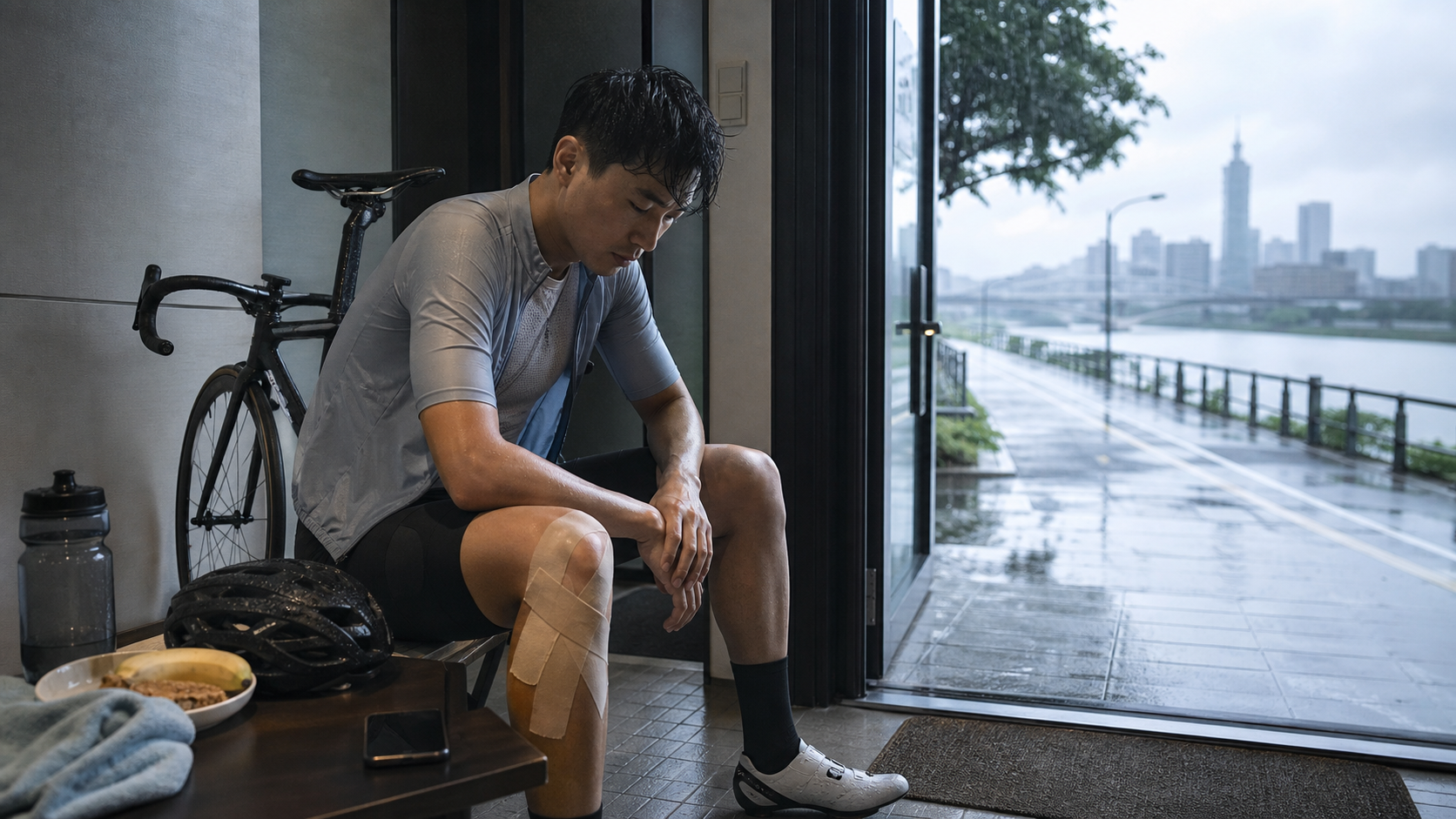
The Trainee Who Insisted on Riding in the Pouring Rain
I’ll never forget Ah-Xiang. It was a Saturday morning; Taipei’s plum rain front had turned the entire riverside bike path into a flood zone. The weather bureau had issued a heavy rain advisory. I posted in the group chat, “Today’s workout is moved indoors to the trainer,” and everyone replied “Got it”—except Ah-Xiang, who sent back: “Coach, I still want to ride outside. I’m afraid that taking one day off will make me lose progress.”
At that point, his right iliotibial (IT) band had been inflamed for nearly three weeks. I told him to cut back; he agreed verbally, but on the days I couldn’t see, he secretly made up the mileage. His Strava had not a single blank day in 365 days—even when he had a fever of 38.5°C from a cold, even on the night his mother was hospitalized for surgery, he did core exercises in the hospital hallway just so he “could fall asleep.” He told me: “If I don’t move, I get so anxious my chest feels tight.”
At that moment, I knew clearly: this was no longer discipline. It was a hostage situation.
I’ve coached athletes and general fitness populations for fifteen years and have seen too many people turn “passion” into “imprisonment.” Taiwan’s fitness culture has exploded in recent years—riverside bike paths, gyms, running routes, and triathlon events are all hard to book. That’s a good thing. But beneath this wave, a group of people are quietly turning exercise from “a tool that makes life better” into “a tyrant that dominates life.” This article is about exactly that: what exercise addiction and compulsive exercise are, why they so often intertwine with eating disorders, and how we can identify and correct them.
Let me make one thing clear first: this article is not meant to scare you into exercising less. The benefits of regular exercise for body and mind are irreplaceable. What I want to discuss is that thin line between “passion” and “addiction”—a line often masked by the halo of self-discipline.
Conceptual Foundation: What Exactly Is Exercise Addiction?
It’s Not “Training a Lot”—It’s “Losing the Freedom to Choose”
Many people think exercise addiction simply means “training too hard, too much.” That’s wrong. The volume itself isn’t the point; the point is your relationship with exercise—when you’re no longer the master who “decides whether to exercise,” but a slave who “can’t stand not exercising,” that’s the problem.
Exercise science generally uses the term “exercise dependence” to describe this phenomenon, borrowing the framework of addictive behaviors to understand it. A widely used assessment tool, the Exercise Dependence Scale (EDS), breaks exercise dependence down into seven dimensions. These seven dimensions are essentially my core checklist for judging whether a trainee has crossed the line:
| Dimension | Plain-Language Explanation | Ah-Xiang’s Example |
|---|---|---|
| Tolerance | Needs to train more and more to get the same satisfaction | Went from 100 km per week to 300 km and still felt it wasn’t enough |
| Withdrawal | Stopping training causes anxiety, irritability, insomnia, restlessness | Chest tightness and irritability on any day without riding |
| Intention effect | Often trains longer and harder than originally planned | Said he’d ride 2 hours, but it always turned into 4 |
| Lack of control | Wants to cut back but can’t | Agreed to reduce volume but secretly made up mileage |
| Time | Spends large amounts of time on exercise and related preparation | Daily routine completely revolves around training |
| Reduction of other activities | Sacrifices socializing, work, and family for exercise | Turns down gatherings and family events to train |
| Continuance despite injury/illness | Keeps training despite knowing he’s injured or sick | Rides anyway with fever and inflammation |
If you’re looking at this table and starting to feel a little uneasy, thinking, “I might hit a few of these too”—don’t panic. We’ll talk about what to do later. Identification is always the first step toward change.
Primary vs. Secondary: Two Different Kinds of Addiction
This is a key distinction I believe every coach and exercise enthusiast should understand, yet few talk about:
- Primary exercise dependence: Exercise itself is the goal. These people eat fairly normally; they’re simply addicted to the act of exercising—chasing that post-workout high, that thrill of performance improvement, that sense of relief from “having moved.” Research shows that this “pure exercise addiction without co-occurring eating issues” is actually relatively rare.
- Secondary exercise dependence: Exercise is a “means”; the real core is controlling weight and body shape, or using exercise to offset what was just eaten. This is often tied to eating disorders, where exercise becomes a tool for “compensation,” “atonement,” or “punishment.”
Why does this distinction matter? Because the treatment approaches are completely different. For primary dependence, we adjust the relationship between training and life; for secondary dependence, adjusting the workout plan alone won’t work—you have to address the distorted cognition about the body, food, and self-worth behind it, and that often requires professional medical team intervention.
A Necessary Bit of Data (Ranges, Not False Precision)
According to literature reviews on exercise addiction, the prevalence among “regularly exercising populations” falls roughly between 3% and 14%, with general exercisers around 8%; the figures vary noticeably by population, assessment tool, and definition. At first glance, these numbers don’t seem high—but consider this: Taiwan has millions of people who exercise. Even at the most conservative estimate, this represents a very large invisible population.
What’s even more alarming is its relationship with eating disorders, which we’ll discuss next.
Scientific Foundation: Why Do Exercise Addiction and Eating Disorders So Often Go Hand in Hand?
A “3.5 Times” Figure
One finding from the research stands out to me: a meta-analysis pooling multiple studies with over two thousand adult participants found that exercise addiction occurs more than three and a half times more often in people with eating disorders than in those without. This isn’t coincidence; it’s the deep interlocking of two behavioral patterns at the psychological level.
The literature also shows that compulsive exercise rates are strikingly high in eating disorder populations—studies mention that a substantial proportion of anorexia nervosa patients (up to 80% in some cited literature) exhibit compulsive exercise behavior, and a considerable proportion of bulimia nervosa patients do as well. Conversely, excessive exercisers themselves have a significantly elevated risk of developing eating disorders. This is a bidirectional, mutually reinforcing vicious cycle.
Why Do They Interlock? Three Psychological Mechanisms
Drawing on my experience with trainees, I’ll translate the mechanisms from the research into three plain-language points:
- The “offset” math game: Converting food into “how many kilometers I need to ride to burn it off.” After eating a bento box, the brain immediately calculates, “That requires 30 more kilometers of riding.” Exercise is no longer about becoming stronger; it’s about “paying off a debt.”
- The sense of security from “control”: When a person feels out of control in life, emotions, or self-worth, “controlling the body” becomes one of the few things they can still firmly grasp. Eating a little less, moving a little more, brings a false but real sense of mastery.
- The “emotional regulation” painkiller: Exercise does bring pleasure and relaxation in the brain. For some people, it becomes the only way to handle anxiety, depression, or emptiness—just as some use alcohol and others use shopping, they use exercise. When they stop, the suppressed emotions surge back, which is why “withdrawal” feels so unbearable.
An Often Overlooked Physiological Red Flag: Low Energy Availability
Here I want to specifically highlight a condition that is increasingly common in Taiwan’s sports community yet often mistaken for being “dedicated”—low energy availability (LEA). Simply put, it means that after subtracting the energy burned through exercise from the energy you take in, the remainder left to support your body’s basic functions is too little.
When compulsive exercise is combined with deliberate undereating, the body remains in a long-term energy deficit, and a cascade of warning signs emerges. In sports medicine, this is related to the concept of Relative Energy Deficiency in Sport (RED-S), and it affects the entire body’s systems—not just “losing weight”:
| System | Possible Warning Signs |
|---|---|
| Endocrine / Reproductive | Menstrual irregularities or amenorrhea in women; reduced libido and morning erections in men |
| Skeletal | Decreased bone density, recurrent stress fractures |
| Metabolic | Abnormally low resting heart rate (bpm), feeling cold easily, metabolic downregulation |
| Immune | Recurrent colds, slower wound healing |
| Performance | Training more but performance stagnates or even declines |
| Psychological | Low mood, anxiety, excessive preoccupation with food and body weight |
Remember this: “Training more but performing worse” is your body crying out for help, not a sign that you aren’t trying hard enough.
Why “Withdrawal” Feels So Real: A Plain-Language Look at Neurophysiology
Many trainees ask me: “Coach, I’m not a drug addict, how can I have withdrawal?” I usually explain it this way—exercise activates the brain’s reward circuitry, triggering the release of neurotransmitters like dopamine and endorphins, making you feel pleasure, relaxation, and even a bit “high.” For most people, this is a healthy positive feedback loop; but for those with addictive tendencies, the brain gradually equates “the good feeling from exercise” with “daily emotional stability.” So once training stops, that sense of calm and control is yanked away, and anxiety, irritability, and restlessness surge in—this is why withdrawal feels so real, and it’s not something you’re imagining.
Understanding this is crucial because it allows us to view those struggling with addiction through empathy rather than blame. They aren’t “too obsessed” or “thin-skinned”—their brains have genuinely turned exercise into an emotional painkiller. What needs to be addressed isn’t exercise itself, but helping the brain relearn: there are other ways to find stability besides working out.
A Quick Reference for “Danger Signal Tiers”
I’ve roughly categorized the warning signs I commonly see in clinical practice and with my trainees into three tiers by severity, so you can quickly gauge where you or someone around you might fall. This is not a diagnosis, but a reminder of when to heighten your awareness and when to seek help immediately:
| Tier | Typical Signs | Recommended Action |
|---|---|---|
| Yellow (Be Aware) | Occasional unease when skipping training, frequently exceeding planned workouts, starting to use exercise to “offset” food intake | Self-awareness, set training limits, talk to someone |
| Orange (Take Seriously) | Training through minor injuries, sacrificing social life for training, hiding training volume, intense anxiety on rest days | Proactively schedule rest and observe reactions, seriously consider seeking professional help |
| Red (Seek Help) | Pushing through obvious injuries, rapid weight loss, amenorrhea in women, obsessive thoughts about food and weight, using exercise to punish oneself | Seek medical attention promptly; multidisciplinary medical intervention is needed |
If you see yourself in the red tier, don’t hesitate, and don’t tell yourself “it’s not that bad yet”—the longer these conditions are left unaddressed, the harder they are to treat. Early intervention has a far better prognosis than toughing it out.
Practical Methods: How to Recognize It and Take Back Control
This section is what I actually use with my trainees. I’ve broken it down into “Self-Recognition” and “Adjustment Strategies.”
Step One: Three Honest Self-Questions
Before using any assessment scales, I ask trainees to honestly answer three questions. You don’t have to show anyone—just ask yourself:
- “If I didn’t exercise at all today, how would I feel?” —If the answer is “relaxed, nice to have a break,” that’s healthy; if it’s “anxious, guilty, restless, like I’m worthless,” that’s a red flag.
- “Am I exercising to make my life better, or is my life making way for exercise?” —Are work, family, friends, and sleep being gradually eaten away by training, one by one?
- “When I eat, am I constantly calculating ‘how much exercise will this take to burn off?’” —If so, you’ve already slid into the territory of secondary dependence.
Step Two: A Simple Self-Checklist
You can use this checklist weekly and tick off items. The more you tick, the closer you are to the zone that needs serious attention. This is not a diagnostic tool—it’s a mirror to help you see yourself clearly:
| Checklist Item | Applies in the Past Two Weeks? |
|---|---|
| Noticeable anxiety, irritability, or insomnia after one day off from training | ☐ |
| Completed training despite being injured or sick | ☐ |
| Turned down important social or family events to train | ☐ |
| Often trained longer or harder than planned | ☐ |
| Used exercise to “offset” food after eating | ☐ |
| Strong guilt when a training session is missed | ☐ |
| Want to cut back or rest but can never follow through | ☐ |
| Hidden your actual training volume from family and friends | ☐ |
Based on my experience, if you tick three or more items and this persists for several weeks, I strongly urge you to take this seriously and consider seeking professional help. Hiding your training volume (the last item) is especially important as an indicator—when a behavior requires secrecy, it usually already knows something isn’t right.
Step Three: Practical Strategies for Rebuilding a Healthy Relationship
This is the pacing I actually use with trainees going through “withdrawal.” Note that the goal here is never to stop you from exercising, but to put exercise back in its proper place.
Strategy One: Proactively Schedule “Complete Rest Days” and Treat Them as Part of Training
I put rest days into the training plan, written in red ink, and tell my trainees: “This slot is called ‘Progress Day.’” Because supercompensation, adaptation, and getting stronger all happen during rest, not during training. For someone with an addiction, being allowed to rest—even being required to rest—is part of the treatment.
Strategy Two: Set a “Ceiling” Instead of Just a “Floor”
Most people set training goals as a floor (at least ride this much). For those with dependent tendencies, I do the opposite and set a ceiling—this week, ride at most X kilometers, each session at most Y minutes; exceeding that is crossing the line. Learning to “stop when enough is enough” is harder than “just a little more,” and it’s also more important.
Strategy Three: Shift the Meaning of Exercise from “Numbers” Back to “Feelings”
For a period of time, turn off the data that fuels your addiction—don’t look at power, don’t look at distance, don’t compare Strava rankings. Instead, ride by feel: how the wind is blowing today, how your legs feel, whether the cotton trees by the roadside have bloomed. Turn exercise from “an exam you can never pass” back into “something that makes you feel good.”
Strategy Four: Address “the Time When You’re Not Exercising”
The core of addiction often lies in “not knowing what to do when not exercising” and “having nowhere for emotions to go when not exercising.” So I work with trainees to find alternative activities: getting a good night’s sleep, having a meal with family without rushing, doing some stretching and breathing, cultivating a hobby completely unrelated to exercise. Fill that void, and you’ll make it through the withdrawal.
Step 4: A Four-Stage Blueprint for “Gradual Reduction and Rebuilding”
Many people ask me: “Coach, I know I’m overtraining, but how exactly do I ease back?” I give them a phased blueprint. This isn’t a rigid rule, but a reference for pacing; actual adjustments should be made based on individual circumstances and (if any) the advice of a medical team:
| Stage | Approximate Timeline | Training Adjustments | Psychological & Lifestyle Focus |
|---|---|---|---|
| Stage 1: Hit the Brakes | Weeks 1–2 | Set a training cap first, insert 2 complete rest days per week, no new mileage | Acknowledge the problem, share your behavior with someone you trust, observe anxiety reactions on rest days |
| Stage 2: Loosen the Compulsion | Weeks 3–6 | Remove the power meter and rankings, exercise based on “feel”; allow “last-minute cancellations” without making up the session | Find 1–2 non-exercise alternative activities, practice coexisting with anxiety rather than eliminating it immediately |
| Stage 3: Rebuild the Relationship | Months 2–3 | Arrange training based on the body’s true feedback; quantity goals give way to “quality” and “enjoyment” | If eating issues are involved, a nutritionist/psychologist should be involved by now |
| Stage 4: Long-Term Balance | Ongoing | Exercise becomes part of life, not all of it; can flexibly adjust for weather, work, and family | Regularly self-check to detect early signs of relapse |
I want to emphasize: In this table, “not feeling anxious on rest days” is a hundred times more important than “mileage numbers.” If you find yourself falling apart on a day off during Stage 1, that is precisely the signal that you need professional help—not a sign to “just push through.”
Another Case: The Woman Who Converted Lunch Boxes into Kilometers
Let me tell you about another trainee who left a deep impression on me, Xiao-Jie. On the surface, she was the most “dedicated” person I’ve ever coached—never missed a workout plan, kept meticulous food logs, and had impressively low body fat. At first, I even held her up as a model for other trainees.
It wasn’t until a group ride when everyone went out to eat that I noticed she only ordered a plate of blanched greens. While others ate their pork chop lunch boxes, she was hunched over her phone calculating something. I later found out she was calculating, “If I eat this meal, how many more kilometers do I need to ride to burn it off?” She confessed to me that she hadn’t had her period for over six months, had lost nearly 8 kilograms, yet still felt she wasn’t “thin enough”; she would sneak out for another ride along the riverside late at night because she had “eaten too much during the day.”
This is a classic case of secondary exercise dependence combined with an eating disorder. The first thing I did wasn’t to change her training plan, but to be very honest with her: “Xiao-Jie, this has gone beyond what I can handle as a coach. I’ll be with you, but I need you to promise me you’ll see a doctor.” I helped her book an appointment at the relevant hospital clinic and, with her consent, spoke with her family. It wasn’t easy—there were setbacks and resistance—but over a year later, she told me her period had returned, and she could “finally enjoy a meal without doing the math first.”
I share these two cases to let you know: These people are not weak-willed or unreasonable; they are often the hardest working, most disciplined, and most demanding of themselves. This is precisely what makes exercise addiction so insidious—it hides under the cloak of virtue.
Common Mistakes and Corrections
Having coached for so many years, I’ve seen countless well-intentioned but counterproductive approaches. Here are the most common pitfalls and how to defuse them.
Mistake 1: “He’s so disciplined, that’s a strength!”
This is the most dangerous misconception. Taiwanese society deeply admires “self-discipline,” “perseverance,” and “never giving up,” which often causes compulsive exercise to be packaged as a virtue and even used as an inspirational model.
Correction: The difference between discipline and compulsion lies in flexibility. A disciplined person can adjust based on circumstances—move indoors when it rains, rest when tired, stop when injured. A compulsive person cannot; any deviation from the plan triggers intense anxiety. When you see someone who “must train no matter what,” that’s not strong willpower; that’s someone who is trapped.
Mistake 2: Trying to Quit Cold Turkey with “Willpower,” Leading to Rebound
Many people sense something is wrong and try to drastically cut their training volume through sheer willpower. The result is skyrocketing anxiety, they last two days, then compulsively make up for it, plunging into deeper self-loathing.
Correction: What needs to be broken is the “compulsiveness,” not the “exercise.” Reduce volume gradually and structurally while addressing the underlying emotions, rather than cutting out exercise entirely. Cut too fast, and the withdrawal backlash will be fierce.
Mistake 3: Only Adjusting the Training Plan, Ignoring Diet and Psychology
If it’s secondary dependence (exercise used to control weight), no matter how beautifully you redesign the training plan, it won’t work because the problem isn’t the plan.
Correction: This situation almost certainly requires a cross-disciplinary team—physicians, clinical psychologists, and nutritionists working together. What a fitness coach can do is “not become an accomplice” (not using weight as the sole goal, not rewarding overtraining) and making appropriate referrals.
Mistake 4: Friends and Family Using Shame or Provocation
“You’re so pathological” or “You’re completely obsessed”—comments like these only make the person feel more ashamed and drive the behavior further underground.
Correction: Use concern, not criticism. “I’ve noticed you seem really tired lately, and you keep training even with an injury. I’m a bit worried about you. Want to talk?” Expressing worry, offering companionship, and withholding judgment are far more effective than any form of provocation.
Actionable Advice for Readers at Different Levels
If You’re a “General Exerciser Still in the Healthy Zone, But Want to Ensure You Don’t Cross the Line”
- Schedule at least 1–2 complete rest days per week, and rest with a clear conscience.
- Regularly ask yourself those three honest questions, especially when you notice you’re “getting more anxious the more you train.”
- Beyond training, deliberately maintain life anchors unrelated to exercise—family, friends, hobbies.
- Taiwan’s summers are hot and humid, and winter air quality is often poor. Learning to adjust or even cancel training due to weather is a sign of maturity, not weakness. People who can flexibly adapt to external conditions are usually far from addiction.
If You “Checked a Few Boxes and Feel a Bit Uneasy”
- First, don’t blame yourself. The fact that you’re willing to face it is already a huge step.
- Try setting a “training cap” and proactively schedule rest days to observe your reaction—if rest days cause extreme anxiety, that’s a very clear signal.
- Tell someone you trust. Bringing the behavior into the light is key to breaking the cycle of secrecy.
- If you find that exercise is deeply intertwined with “controlling weight” and “offsetting food,” please read on.
If You’re Already Showing Signs of an Eating Disorder
I want to say this very seriously: Please seek professional help, and the sooner, the better.
- Recurrent stress fractures, prolonged amenorrhea in women, significant rapid weight loss, obsessive thoughts about food and weight, using exercise to punish yourself—these are not things you can resolve by simply “thinking more positively.”
- In Taiwan, you can start with a family medicine or psychiatric (mental health) clinic. Many hospitals have integrated eating disorder clinics or referral pathways; for sports injuries, you can see a rehabilitation or sports medicine clinic. Most of these are covered by National Health Insurance, and the barrier to seeking care is lower than you think.
- Eating disorders carry a relatively high mortality risk among all mental illnesses. They are a medical issue, not a willpower issue, and not your fault.
If You’re a Coach, Family Member, or Friend
- Stop praising “training through pain.” Redefine what “dedication” means—being dedicated also means resting seriously, fueling properly, and listening carefully to your body.
- Watch for the warning signs: training despite injury, refusing rest, hiding training volume, abnormal weight changes, social withdrawal.
- Start with concern, support with companionship, and when necessary, help the person find professional resources rather than trying to play therapist yourself.
A Self-Calibration Checklist for a “Healthy Exercise Relationship”
Finally, here’s a comparison table I really like to use, putting “healthy” and “already crossing the line” side by side, so you can see at a glance where you stand:
| Aspect | Healthy Relationship | Already Crossing the Line |
|---|---|---|
| Motivation | For health, enjoyment, connection | To offset food, control weight, atone |
| Flexibility | Can adjust or cancel as circumstances dictate | Any deviation triggers intense anxiety |
| Rest | Rest with a clear conscience | Rest brings guilt, anxiety, insomnia |
| When injured | Stops, seeks medical care | Pushes through pain and illness |
| Life | Exercise is part of life | Life is completely rearranged around exercise |
| Emotions | Relaxed and satisfied after exercise | Only exercise can suppress anxiety |
| Toward food | Eating is for nourishment and enjoyment | Eating is about “how much I’ll need to burn later” |
If you find yourself drifting further toward the right-hand column, this isn’t meant to make you feel guilty—it’s a gentle reminder: it’s time to put this good thing called exercise back where it belongs.
Frequently Asked Questions (FAQ)
These are the questions I get asked most often in lectures and when coaching clients, compiled here for you.
Q1: I exercise every day—does that mean I’m addicted?
Not necessarily. High frequency doesn’t equal addiction. The key lies in “flexibility” and “motivation”—can you rest with a clear conscience when needed? Are you exercising for enjoyment and health, or to offset guilt or suppress anxiety? Someone who exercises daily but can adjust flexibly and genuinely enjoys it is usually fine; someone who only trains three days a week but falls apart when they have to skip a session is actually more concerning.
Q2: What’s the real difference between exercise addiction and a “serious athlete in training”?
Elite athletes do have staggering training volumes, but healthy athletes share two traits: they strategically reduce volume and recover (periodized training inherently includes rest weeks), and their self-worth isn’t entirely tied to their training. Compulsive exercisers, on the other hand, experience intense guilt and anxiety with any rest, and often push through injuries, sacrificing health for the reassurance of “never stopping.” The difference is—athletes use rest to gain progress; addicts fear that rest will make them lose themselves.
Q3: If I stop, won’t I quickly lose fitness, gain weight, and undo all my progress?
This is exactly the fear that addictive thinking loves to feed you. In reality, a short period of complete rest (a few days to a week or two) will almost never “undo your progress”—in fact, it often leads to better performance once you resume, because your body finally has the chance to repair and supercompensate. What truly causes regression, injury, and even damages your health is prolonged overtraining without rest. Appropriate rest isn’t your enemy; it’s a necessary condition for getting stronger.
Q4: Who should I ask for help? Is seeking medical care in Taiwan a hassle?
It’s not as troublesome as you might think. If the issue is primarily about the relationship between training and your mind-body state, you can start with a psychiatrist or clinical psychological counseling; if there’s a clear co-occurring eating disorder, many medical centers have integrated clinics for eating disorders; for sports injuries, see a rehabilitation medicine or sports medicine clinic. Most of these are covered by National Health Insurance. Being willing to take that first step of booking an appointment is often the beginning of getting better.
Q5: I’m a family member and I’m really worried about them, but they get angry whenever I bring it up. What should I do?
Don’t rush to “correct” them. Start with observation and concern (“I’ve been a bit worried about you lately; you seem really exhausted”), and avoid judgment and labels (“You’re being pathological” will only push them away). You don’t need to convince them all at once—what you need to do is let them know “someone cares and is always available to talk,” and help them find professional resources when they’re willing. The power of companionship is often far greater than logic.
Conclusion: True Strength Is Knowing When to Stop
Back to A-Xiang. Over the following six months or so, what we did was actually simple yet incredibly hard—we taught him to rest. I put rest days into his training plan, set training caps for him, had him turn off his power meter for a while, accompanied him in rediscovering the original joy of riding, and when I judged that it was beyond my scope, I referred him to a psychiatrist and a nutritionist.
One day he texted me: “Coach, it’s raining today, so I stayed home to have dinner with my mom. Didn’t ride. And it actually felt pretty good.” Reading that message made me happier than seeing him break any KOM record.
I want to say this to everyone reading this article who feels a little hit by it: Loving exercise is a wonderful thing, but when that love starts to hijack your life, your emotions, and your relationship with food and your body, it’s no longer love.
True strength has never been about how many watts you can push or how far you can ride. True strength is being able to stop, with a clear conscience, when it’s time to stop—and then, tomorrow, set out again as a more complete, freer version of yourself.
Exercise should be the wings of your life, not the chains on your feet. May we all train long, train joyfully, and train—freely.
This article is educational content and does not replace individual diagnosis and treatment advice from physicians, physical therapists, or nutritionists. If you or someone around you is experiencing compulsive exercise, eating disorders, or related mental health concerns, please seek professional medical help as early as possible.
References
- Exercise addiction: A narrative overview of research issues (PMC): https://pmc.ncbi.nlm.nih.gov/articles/PMC9869993/
- Prevalence and Correlates of Exercise Addiction in the Presence vs. Absence of Indicated Eating Disorders (Frontiers): https://www.frontiersin.org/journals/sports-and-active-living/articles/10.3389/fspor.2020.00084/full
- A comparative meta-analysis of the prevalence of exercise addiction in adults with and without indicated eating disorders (PubMed): https://pubmed.ncbi.nlm.nih.gov/31894540/
- How Compulsive Exercise Causes Harm (ACUTE): https://www.acute.org/resources/medical-risks-compulsive-exercise-and-eating-disorders
- Examining the Relationship between Exercise Dependence, Disordered Eating, and Low Energy Availability (MDPI Nutrients): https://www.mdpi.com/2072-6643/13/8/2601
- Exercise Dependence — an overview (ScienceDirect Topics): https://www.sciencedirect.com/topics/social-sciences/exercise-dependence
Related Reading
- Exercise Addiction: The Dark Side of a Good Habit—How to Recognize and Break Free When Self-Discipline Becomes a Shackle
- 8 Warning Signs of Exercise Addiction: When Training Shifts from Healthy to Compulsive
- Running Addiction: When a Love for Running Becomes a Psychological Dependence
- When Exercise Becomes a Prison: On the Road to Recovery from Eating Disorders, Is Exercise a Cure or a Poison?
一個測試有沒有認真練車的方法😂 #公路車
10 個月前
靠單車減肥35公斤 心得分享與整理
7 年前
4K 東眼山 x 水蜜桃冰沙 百人單車約騎! 操完再吃冰 多爽快
7 年前
西進武嶺 免費訓練分析服務 Intervals | 練不夠還是練過頭?你哪一種類型選手?AI模型告訴你! | 備戰神器 | 公路車 訓練 | CT Yeh
4 年前
#公路車 #Fitting 靠人工智慧APP 幫你調整單車
6 年前
一日北高常見問題大集合 | 攻略 | 路線 | 訓練 | 補給 | 自行車 單車 | 一日雙城 | 雙塔 | TWB北高360 | 屁股痛
6 年前
一日北高/長距離團騎 常見問題補充篇 / 組團或跟團的眉角 / 壯車友容易被瘦車友慢性拉爆 / 原來屁股痛可能是這個原因...? / 風場配速法 / 公路車 / CT Yeh
2 年前
單車 一日北高 ( 雙城 ) 肥宅雙人瘋狂行 紀錄片 REACTO
10 年前