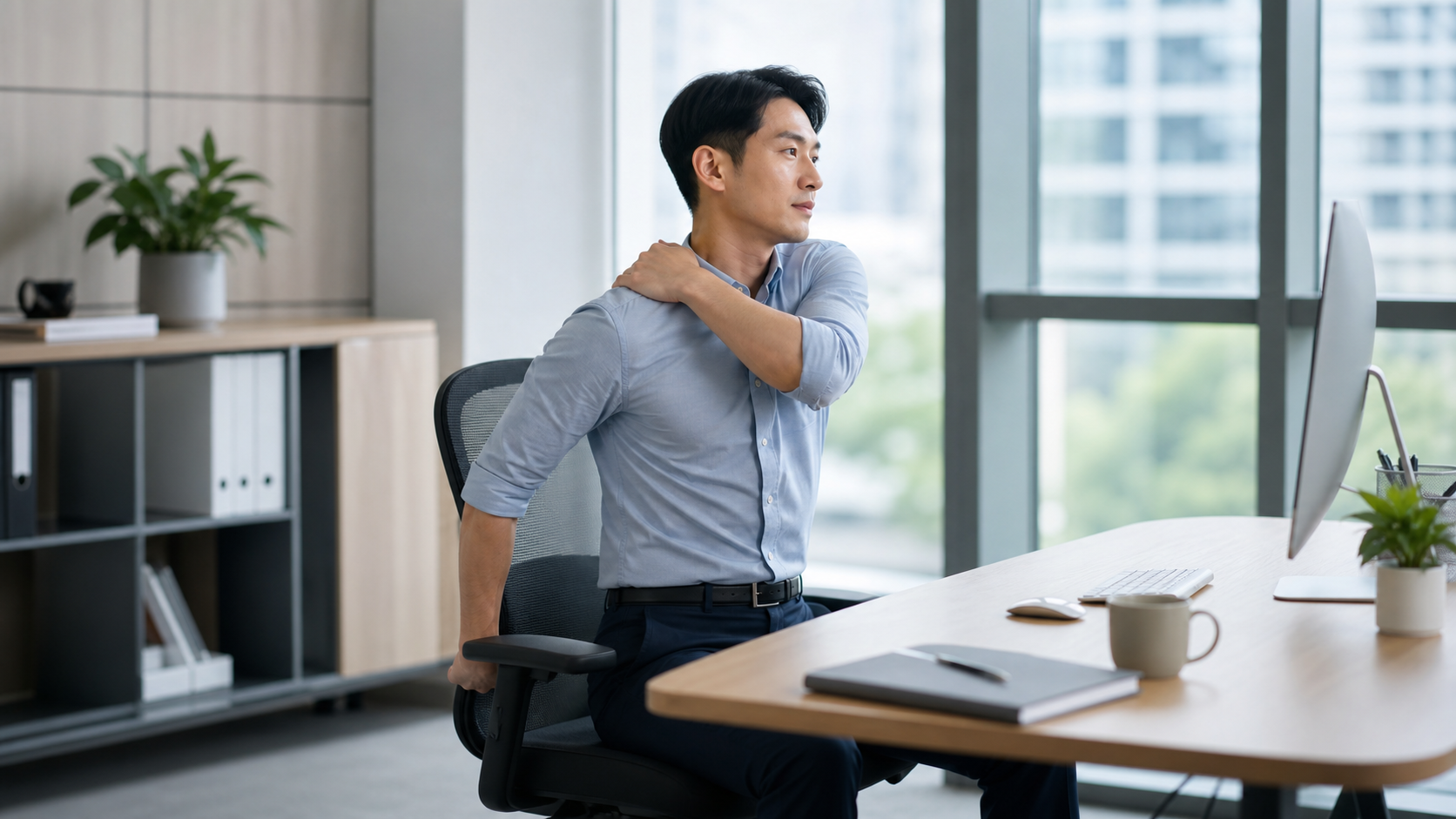
First, Let Me Tell You About a Case I’ll Never Forget
I first met A-Zhe after a corporate health seminar. He was a 34-year-old backend engineer working in the Neihu Science Park, spending what he estimated to be “about ten to twelve hours” a day in front of a screen. He came to see me not because he wanted to get into shape, but because his company health check report showed his fasting blood glucose hovering at the high end of normal, his waist circumference exceeding the standard, and his shoulders and neck so chronically tense that he could only sleep after a massage. His first question to me was: “Coach, I really don’t have time to exercise. Is there no hope for someone like me?”
I’ve trained athletes and regular office workers for nearly fifteen years, and I’ve heard that sentence far too many times. My answer usually makes people pause: “You don’t need to ‘find time to exercise.’ What you need to do is ‘stop staying still all the time.’ These two things look similar, but they’re actually very different.”
This article is a complete set of “you can move at your desk” practices I’ve developed over the years working with desk-bound workers like A-Zhe. It doesn’t require you to change into workout clothes, doesn’t require you to leave your seat for long, and doesn’t require any equipment. Its core message is just one sentence: Rather than chasing that perfect one-hour workout after work, first solve the problem of “not moving at all” during your eight-hour workday. For the vast majority of Taiwanese office workers, the health return on the latter is actually astonishingly high.
Why “Prolonged Sitting” Is Itself an Independent Health Problem
Many people have a misconception that as long as they hit the gym, cycle, or run along the riverside after work, sitting all day doesn’t matter. This idea has been largely revised in exercise science. The metabolic risks associated with prolonged sitting are partly independent and cannot be fully offset by “exercise after work.” This is why the term “active couch potato” has emerged in recent years—referring to people who exercise weekly but sit for extremely long hours during the day. Their health risks are still higher than most people imagine.
What Happens Inside Your Body When You Sit for Long Periods
When we maintain a seated position for a long time and the large muscle groups in our lower body barely contract, several changes occur in the body. Let me explain in the simplest terms:
- Glucose metabolism worsens: The thighs and buttocks are the largest muscle groups in the body. When muscles contract, they act like a sponge, actively absorbing blood sugar for use, and this process doesn’t require much insulin. Prolonged sitting “shuts down” these large muscles, making post-meal blood sugar more likely to stay elevated, forcing the pancreas to secrete more insulin to clean up. Over time, this is linked to insulin resistance and the risk of type 2 diabetes.
- Blood circulation slows down: When sitting for long periods, venous return from the lower limbs deteriorates, and blood tends to pool. This is why your feet feel swollen and calves feel heavy after sitting all afternoon. Vascular endothelial function also worsens with prolonged inactivity.
- Postural muscle imbalance: Long-term forward leaning and hunching cause the pectoralis minor and hip flexors to become tight, while the lower back, glutes, and deep neck flexors become weak, forming what we commonly call “upper crossed” and “lower crossed” postural syndromes. Most shoulder, neck, and lower back pain stems from this.
- Energy expenditure approaches zero: Sitting burns only slightly more energy than lying down, and the cumulative difference over a full day is considerable.
The World Health Organization lists “physical inactivity” as one of the leading risk factors for preventable death globally, recommending that adults accumulate 150 to 300 minutes of moderate-intensity physical activity per week. But there’s a key detail that’s often overlooked: The biggest risk isn’t “how many hours you sit,” but “how long you sit continuously without interruption.” Research literature generally indicates that eight hours of sitting, broken up by getting up and moving periodically, is significantly less harmful than eight hours of uninterrupted sitting.
Understanding the “Muscle Pump” with a Life Analogy
I often use this analogy with my trainees: your calf muscles are the body’s “second heart.” The heart pumps blood out, but pushing blood from the lower limbs back up to the heart, against gravity, relies heavily on the squeezing action of the leg muscles contracting and relaxing—this is the “muscle pump.” When you sit for long periods, this pump nearly shuts down, blood pools in the lower limbs, and return flow worsens. The moment you stand up, walk around, or rise onto your toes, the pump restarts and circulation immediately improves. This is also why your feet swell after sitting all afternoon but feel much better after walking a few steps. Once you understand this mechanism, you’ll realize: The movement doesn’t need to be big; the key is getting the large muscle groups to “contract.” Movements like calf raises and squats that actually engage the leg muscles work better than just standing around.
One Key Number: The Power of “Breaking Up” Prolonged Sitting
This is the scientific point I most want every reader to remember. Multiple randomized crossover trials have found that getting up every 30 minutes or so for a few minutes of light activity (such as standing and walking) can significantly reduce the rise in post-meal blood sugar and insulin. In studies of postmenopausal, overweight women, breaking up sitting with 5 minutes of standing every 30 minutes produced a considerable reduction in post-meal blood glucose response, and light walking breaks had similar effects. A network meta-analysis also indicated that “moving every 30 minutes” is one of the most effective strategies among various sitting-break approaches for improving blood sugar and insulin (see references at the end of the article).
Please note that these figures come from different studies and different populations. I treat them as “trends and directions” rather than guarantees of how much any individual’s numbers will drop. But the direction is highly consistent: Frequency matters more than intensity. You don’t need to break a sweat every time; you need to “move frequently.” For busy Taiwanese office workers, this is fantastic news—because it’s something you can do right next to your desk.
A Three-Tier Structure for Office Exercise
When working with trainees, I break office exercise into three tiers, from easy to hard, from frequent to occasional. You don’t need to do all three. Start with Tier 1—just doing Tier 1 well is enough to change your health check numbers.
| Tier | Name | Frequency | Duration per Session | Primary Purpose | Will You Sweat? |
|---|---|---|---|---|---|
| Tier 1 | Breaking Up Sitting (Micro-Movement) | Every 30–60 minutes | 1–3 minutes | Metabolism, circulation, blood sugar | No |
| Tier 2 | Desk-Side Mobility and Stretching | Every 1–2 hours | 3–5 minutes | Posture, pain, joint mobility | No |
| Tier 3 | Desk-Side Micro-Strength Training | 1–2 times daily | 5–10 minutes | Strength, muscular endurance, physique | Possibly light sweating |
The philosophy behind this structure is: Tier 1 is for “metabolism,” Tier 2 is for “posture and pain,” and Tier 3 is for “strength and physique.” Each addresses a different problem, and they cannot replace one another. Many people only do Tier 3 (going to the gym after work) while completely ignoring Tier 1, which is why their blood sugar and back pain issues never get resolved.
Tier 1: Micro-Movements to Break Up Sitting (Most Important—Do This First)
If you only do one thing, do this tier. The core principle is: Every 30 minutes, get your body out of the seated position for at least 1 to 2 minutes. The activity doesn’t matter—walking to refill your water, going to the restroom, standing while on the phone, or talking to a colleague face-to-face (instead of messaging) all count.
How to Remind Yourself? A Practical Guide for Taiwanese Office Workers
This is the hardest part—not that you can’t do it, but that you’ll forget. Here’s what I give my trainees:
- Anchor to existing habits: Link “getting up” to things you already do. For example, refill your water every time you finish a glass (which also forces you to drink more—Taiwan’s air-conditioned offices make it easy to become dehydrated without noticing), or stand up and stretch every time you finish a phone call.
- Use the Pomodoro Technique: Set a 30-minute timer on your phone or computer, and stand up when it goes off. Engineers can install a reminder tool; accounting and administrative staff can just use their phone alarm.
- A clever trick for meetings: If you’re on a video call and don’t need to show your face or take notes, stand during the meeting. Deliberately choose a water dispenser or printer that’s farther from your desk.
- Switch to a smaller cup: When you finish a small cup of water, you have to get up to refill it—a natural break mechanism. This trick is especially effective for people who are too lazy to get up.
Specific Options for Micro-Movement
| Action | How To | Suggested Duration | Additional Benefits |
|---|---|---|---|
| Get up to refill water / pour tea | Walk to the water dispenser and back | 60–120 seconds | Hydration, moves lower limbs |
| March in place / short walk | March beside your seat or walk down the aisle | 60–90 seconds | Promotes blood flow back from lower limbs |
| Wall-squats or supported squats | Hold onto desk or wall, squat down and stand up slowly | 30–60 seconds | Activates glutes and large leg muscles, helps blood sugar |
| Calf raises (heel lifts) | Stand and repeatedly rise onto toes then lower | 30–60 seconds | Calf pump, reduces lower limb swelling |
| Stand while on the phone | Stand for the entire call | Depends on call length | Zero additional time cost |
I especially want to highlight “wall/desk-supported squats” and “calf raises.” These two actually contract the large muscle groups in the thighs and calves, giving a slightly better effect on blood sugar than just walking. A-Zhe later developed this habit: every time the Pomodoro timer went off, he would stand up and do 10 slow squats plus 20 calf raises. The whole thing takes under 40 seconds, doesn’t look odd to colleagues, and doesn’t leave him out of breath.
Layer 2: Desk-Side Mobility and Stretching (Addressing Shoulder, Neck, and Back Aches)
This layer is for “aches and pains.” The most common complaints among desk-bound workers are stiff shoulders and neck, tight lower back, and wrist pain. Below is the desk-side stretching combo I most often prescribe to my clients—all of it can be done sitting or standing next to your seat, no lying down or mats required.
Upper Body: Targeting Shoulders, Neck, and Hunched Posture
- Thoracic extension with hands behind head: Sit in a chair, place both hands lightly behind your head, open your elbows, and as you inhale, lean your upper back backward and open your chest. Hold for 2–3 seconds, then return. Do 8–10 reps. This is the most effective move against hunched posture.
- Deep neck flexor activation (chin tucks): Sit up straight, imagine someone gently pushing your chin with a finger, and tuck your chin slightly inward (creating a double chin). Hold for 5 seconds, do 8–10 reps. This improves “tech neck / forward head posture.”
- Upper trapezius and levator scapulae stretch: Gently place one hand on your head and guide it diagonally forward until you feel a stretch between the back of your neck and shoulder. Hold each side for 20–30 seconds. People with chronically tight shoulders and neck will feel this immediately.
- Chest opener / shoulder stretch: Clasp your hands behind your back, slowly extend them backward and downward to open the chest. Hold for 15–20 seconds.
Lower Body and Torso: Targeting Lower Back and Hips
- Seated hip flexor / glute stretch: While seated, cross one ankle over the opposite knee (forming a figure-4), lean your torso slightly forward, and feel the stretch on the outer hip. Hold each side for 20–30 seconds. Desk-bound people often have “sleepy” glutes; this move wakes them up.
- Seated spinal rotation: Sit up straight, cross your arms over your chest or hold the chair back, and slowly rotate your torso left and right, holding each side for 10–15 seconds to mobilize the thoracic spine and lower back.
- Standing hip flexor stretch: Stand next to your seat, step one foot half a stride backward (heel doesn’t need to touch the floor), and gently push your pelvis forward until you feel a stretch in the front of the thigh and front of the hip. This is one of the most important stretches for desk workers, because prolonged sitting shortens the hip flexors.
Hands and Eyes: Don’t Forget Them
- Wrist stretch: Extend one arm straight with the palm facing outward, and use the other hand to gently pull the fingers back toward your body to relax the forearm. Anyone who types or uses a mouse for long hours must do this—it reduces wrist and forearm discomfort.
- 20-20-20 eye care rule: Every 20 minutes of screen time, look at something 6 meters (about 20 feet) away for 20 seconds. This isn’t “exercise” per se, but it’s very practical for relieving eye fatigue, and it’s a good reminder to get up.
Layer 3: Desk-Side Micro Strength Training (Advanced, for Posture and Strength)
Once you’ve turned the first two layers into habits, you can add a bit of strength work. No equipment needed—a chair, desk, wall, and your own body weight are enough. Here’s a weekly menu I give to advanced office clients. Pick one or two moves per day; the principle for every move is “doable, not forced.”
| Exercise | How To | Suggested Sets | Target Area |
|---|---|---|---|
| Wall Sit | Slide down a wall into a seated position, thighs as parallel to the floor as possible, hold | 20–40 sec × 2–3 sets | Thighs, glutes |
| Desk Push-Up | Place hands on a sturdy desk edge, keep body straight, do push-ups | 8–15 reps × 2–3 sets | Chest, shoulders, arms |
| Chair Sit-to-Stand | Without using hands, slowly stand up from a chair and sit back down | 10–15 reps × 2–3 sets | Glutes, legs, core |
| Calf Raise (Standing) | Rise onto toes, then lower slowly | 15–20 reps × 2–3 sets | Calves |
| Seated Leg Raise | Sit up straight, extend one leg straight and hold for 2 seconds | 10–12 reps per side | Front thighs, core |
| Chair Triceps Dip | Support yourself on a sturdy chair edge, lift hips off the chair, bend and extend elbows | 8–12 reps × 2 sets | Back of arms |
Safety note: For desk push-ups and triceps dips, make absolutely sure the desk and chair are stable and won’t slide or tip over. If you have a rolling chair, lock it against a wall or switch to a fixed chair. I’ve seen accidents from this—better safe than sorry.
Putting It All Together: A Workable Desk-Side Daily Schedule
Principles alone are too abstract, so here’s a full day laid out for you. This is the version I designed for A-Zhe that he could actually sustain (he works about 9 hours a day):
| Time Slot | Content | Time Spent |
|---|---|---|
| 09:00 Arrive at office | Stand while organizing the day’s to-dos, chest opener 3 times | 1 minute |
| Alarm every 30 minutes | Get up to refill water / walk around, or 10 squats + 20 calf raises | ~1 minute × multiple times |
| 10:30 | Thoracic extension + chin tucks, 8 reps each | 2 minutes |
| 12:00 Lunch | Walk to buy takeout (choose a slightly farther shop), stand or walk for 10 minutes after eating | Folded into lunch break |
| 14:00 Slump period | Wall sit 30 sec ×2 + chair sit-to-stand 12 reps | 3 minutes |
| 15:30 | Figure-4 glute stretch + standing hip flexor stretch | 3 minutes |
| 17:00 | Desk push-ups 12 reps ×2 | 3 minutes |
| Before leaving | Wrist and neck stretches to cool down | 2 minutes |
You’ll notice that the total “extra” time for all of this is under 20 minutes a day, and it’s spread across natural breaks, so it barely affects your work. The health return on those 20 minutes is far higher than you’d think. In particular, the “10-minute walk after lunch” has a very real effect on post-meal blood sugar. Since Taiwanese lunch takeout tends to be high in carbs (bento boxes, noodles, rice balls), moving after a meal matters even more.
Common Mistakes and Fixes
These are the recurring pitfalls I’ve encountered with my clients—check yourself against them.
Mistake 1: Only caring about “post-work exercise” while sitting all day
Fix: Let me say it again—post-work exercise is great, but it cannot fully offset the metabolic damage of uninterrupted sitting during the day. Please prioritize building the Layer 1 “break up sitting” habit first. That’s the single highest-return thing you can do.
Mistake 2: Chasing perfect form to the point of not doing anything
Many people watch a bunch of tutorial videos and think, “If my form isn’t perfect, I might as well not do it.” Fix: The purpose of desk-side exercise is “move often,” not “move perfectly.” Doing ten reps at 60% quality beats doing zero reps at 100% quality. Start moving first; refine the details later.
Mistake 3: Completely Ignoring Desk and Chair Setup
Half of posture problems come from your environment. Here’s the basic ergonomic checklist I give my clients:
| Item | Ideal Setup | Common Mistakes |
|---|---|---|
| Monitor height | Top of screen roughly at eye level | Monitor too low, looking down and hunching |
| Monitor distance | About an arm’s length away | Too close, causing eye strain |
| Chair height | Thighs roughly parallel to the floor, feet flat | Feet dangling or knees higher than hips |
| Elbow angle | Elbows at about 90 degrees when typing | Shrugging shoulders, wrists bent upward |
| Lower back support | Chair back following the curve of your lower back | Lower back unsupported, slouching in the seat |
If your company won’t provide a standing desk, a cheap fix is to stack a few books or a cardboard box to raise your laptop, then use an external keyboard and mouse. This alone can greatly improve the problem of the screen being too low.
Mistake 4: Forgetting to Hydrate and Ignoring Environmental Factors
Taiwan’s summers are long and air-conditioned offices are dry. Many people sit for three hours straight without drinking a drop. By the time you feel thirsty, you’re already mildly dehydrated, which makes you even more tired and less inclined to move. Fix: Treat hydration as a natural mechanism to break up prolonged sitting. Keep a water cup on your desk, and when it’s empty, get up to refill it. Two birds with one stone.
Mistake 5: Toughing Out Pain Until It Becomes a “Habit”
General tightness and mild soreness will improve with movement and stretching. But if you experience any of the following, don’t try to tough it out on your own—seek medical attention: numbness in your hands or feet, weakness in your legs, pain severe enough to disrupt sleep, or pain that persists for more than two to three weeks without improvement. Taiwan’s National Health Insurance makes it easy to see a doctor. Rehabilitation, orthopedics, and neurology departments can all help with assessment. Don’t treat warning signs as “just the fate of an office worker.”
Customized Advice for Different Occupational Groups
The sedentary workers I’ve coached are quite diverse, and different professions have different pain points. Here are specific recommendations for several common types in Taiwan.
Engineers / Designers (Heavy Screen Users)
This group’s problems are the most concentrated: long periods of intense focus, not getting up for hours once in a flow state, and chronic neck rotation from using dual or even triple monitors. For cases like A-Zhe’s, I usually ask them to use the downtime during “compiling / waiting for tests to run” to get up—since you’re waiting anyway, you might as well stand up and move. I also strongly recommend placing your most-used primary monitor directly in front of you at eye level to reduce prolonged neck twisting. The 20-20-20 rule for eye protection is especially important for this group, because they have the highest density of screen time.
Accountants / Administrative Staff / Customer Service (Those Tied to a Fixed Rhythm)
The challenge for this group is that they “can’t easily leave their seats,” especially customer service reps who may need to be on calls continuously. My approach is to make the first tier a “version you can do while seated”—seated leg raises, seated spinal twists, chin tucks, and calf raises (lifting your heels while seated). All of these can be done sitting down without affecting your calls. When you get a break (like lunch or a shift change), make up for it with standing and walking. The key is not to remain completely motionless all day just because you “can’t leave your seat.”
Sales / Field Workers (Alternating Between Prolonged Sitting and Rushing Around)
This group often overlooks the problem of “prolonged sitting while driving.” Long drives are also continuous sitting. Red lights and rest stops are natural break points: get out of the car and walk around, do a few calf raises and chest openers. When you’re back at the office doing paperwork, apply the same 30-minute rule.
A Note for Managers
If you lead a team, consider incorporating “standing meetings” or “walking meetings” into your culture. Short meetings held standing up are not only more efficient, but they also help the entire team break up prolonged sitting. A healthy office culture often starts with whether the manager is willing to lead by example.
A One-Week Progressive Plan: From Zero to Habit
Many people fail because they “try to change too much at once.” What I usually give new clients is this four-week progressive table, allowing the body and habits to adapt gradually.
| Week | This Week’s Only Goal | Specific Actions | Success Criteria |
|---|---|---|---|
| Week 1 | Build the “get up” reflex | Set an alarm every 60 minutes; when it rings, get up and walk for 1 minute | Achieve 5+ times per day |
| Week 2 | Shorten the interval + add movements | Change to every 30 minutes; add 10 squats or calf raises when you get up | Achieve 8+ times per day |
| Week 3 | Add stretching | Every 1–2 hours, do one set of desk-side stretches (neck/shoulders or hips) | Complete 3 sets of stretches per day |
| Week 4 | Add light strength training + post-meal walk | Pick 1–2 strength movements daily + walk for 10 minutes after lunch | Achieve this for 5 consecutive workdays |
The design philosophy behind this table is “add only one new habit at a time.” Focus on just one thing each week, and once it becomes automatic, stack the next one on top. I’ve seen too many people start with great ambition, try to do everything at once, and give up within three days. It’s the people who add gradually who actually stick with it and turn it into a lasting habit. Habit formation is never about explosive effort—it’s about keeping the barrier low enough that you won’t resist it.
Action Advice for Readers at Different Levels
Everyone starts from a different point. I divide readers into three categories and give different first steps for each.
If You’re a Heavy Sedentary Worker Who “Barely Moves at All”
Your first step is just one thing: Set an alarm for every 60 minutes, and when it rings, get up and walk for 1 minute. Don’t try to do everything at once. First, make “getting up” automatic. After two weeks, shorten the interval to 30 minutes and add squats and calf raises. Take it step by step—the key is consistency.
If You Already Move Somewhat and Want to Be More Systematic
You can go straight to the “daily desk-side schedule” mentioned earlier, doing both the first and second tiers together, and pick one or two strength movements from the third tier each day. The goal is to make “desk-side micro-exercises” as routine as brushing your teeth, not a task that requires willpower to force yourself through.
If You Have a Chronic Condition or Health Concerns
I need to say this conservatively and clearly. If you have diabetes, high blood pressure, heart disease, have had a past injury, or are experiencing any recent discomfort, please consult your physician or physical therapist for an individualized assessment before starting any new exercise program. Most of these micro-exercises are light activity with low risk, but individual situations vary greatly—for example, certain cardiovascular or bone/joint conditions require professional adjustment of movement selection and intensity. Exercise is great, but “exercise that’s right for you” is what truly helps. That requires a professional to judge based on your situation, not something a single article can determine.
Three Practical Additions for the Taiwan Context
Bringing exercise science into real Taiwanese offices involves several local details worth highlighting. These are the points I most often add during corporate lectures.
The Hidden Trap of Air Conditioning and Hydration
Taiwan’s summers are long and office air conditioning is strong. Many people don’t feel thirsty all morning, and only realize they’re mildly dehydrated when headaches or poor concentration set in. Mild dehydration alone can make you tired and less inclined to move, creating a vicious cycle. My advice is simple: keep a visible water cup on your desk, and design “finishing your water and refilling it” as your natural mechanism for breaking up prolonged sitting. This one trick solves both “forgetting to drink water” and “forgetting to get up” at the same time—it’s my favorite two-birds-one-stone recommendation. Seats directly under an air conditioning vent also tend to cause tighter neck and shoulders. If you can adjust your seat direction or add a light jacket, you’ll feel much more comfortable.
Post-Meal Strategies for Those Who Eat Out
Taiwanese lunch options are convenient but tend to be high in refined carbohydrates—bento box rice, braised pork rice, dry noodles, fried rice, rice balls. These all cause blood sugar to rise quickly after meals. As mentioned earlier, light activity after meals is particularly effective at lowering blood sugar, so those who eat out should especially seize the “post-meal walk” golden window. I usually recommend: Instead of immediately putting your head down to nap after lunch, walk for 10 minutes before returning to your seat. Even just walking a lap around the office building, or walking out to buy an unsweetened drink and walking back, is better than nothing. These 10 minutes matter more metabolically for those who eat out than most people realize. When ordering, asking the restaurant to “halve the rice and add an extra serving of blanched vegetables” is also a very practical small adjustment.
Easy Access to Healthcare Through NHI—Don’t Let Warning Signs Become Big Problems
Taiwan’s low barrier to medical care and convenient National Health Insurance is a huge advantage. But I’ve noticed many office workers instead get into the habit of “enduring the pain, and only getting a massage when they can’t take it anymore,” treating their body’s warning signs as the fate of an office worker. For the red-flag symptoms mentioned earlier—numbness in the hands or feet, leg weakness, pain that disrupts sleep, or symptoms that persist for two to three weeks without improvement—please don’t self-diagnose online or tough it out. Go see a rehabilitation, orthopedics, or neurology specialist. After a professional assessment, a physical therapist can also teach you movements better suited to your condition. Making good use of Taiwan’s convenient medical resources is an important part of taking care of yourself.
Quick FAQ
Q: Is standing while working (with a sit-stand desk) all I need?
A: Standing is better than sitting, but “standing still the whole time” isn’t optimal either—prolonged standing can strain your lower body and cause discomfort. The best approach is alternating between “sitting, standing, and walking” to keep your body changing positions frequently. A sit-stand desk is a great tool, but don’t use it as an excuse to stay still.
Q: I already walk 10,000 steps a day. Do I still need these?
A: Yes. 10,000 steps is great, but if those steps are concentrated in the morning and evening, you’re still sitting continuously for eight hours during the workday, and the metabolic problem of “continuous inactivity” remains. Spreading your steps out and moving more during the day is even better.
Q: Aren’t these movements too few to be effective?
A: For people who already exercise regularly, these indeed can’t replace formal training. But for those who are sedentary and barely move, simply breaking up prolonged sitting brings real improvements in metabolism and aches. Its role is to “fill in the biggest gap you’re missing,” not to replace all exercise.
Q: I feel even more tired after a nap and especially sleepy in the afternoon. Will moving around help?
A: Yes. When you feel groggy in the afternoon, wall squats plus a few steps of marching can boost circulation and alertness—usually more lasting than another cup of coffee, and it won’t affect your sleep at night.
Q: I’m worried about colleagues giving me odd looks if I do these exercises in the office. What should I do?
A: This holds many people back, but most micro-exercises are subtle enough to go unnoticed—getting up to refill your water, doing chin tucks while seated, seated leg raises, standing while on a call—these all look like natural everyday actions. If you’re really shy, start with completely inconspicuous moves like “getting up to walk around” and “seated stretches.” Often, once you start moving, you’ll actually inspire colleagues to join in, creating a positive office culture.
Q: How long until I see results?
A: It varies from person to person. I won’t guarantee “you’ll improve by X amount in X weeks” because everyone’s starting point, diet, and sleep are different. But based on my experience coaching clients, tightness in the neck, shoulders, and lower back usually improves fastest (from a few days to a week or two), and energy levels and afternoon fatigue often improve early on as well. Metabolic-related lab numbers take longer to accumulate and are tied to overall lifestyle. The key is making it a long-term habit, not expecting miracles after two weeks.
Conclusion: Win the Eight Hours of Your Day First
Back to A-Zhe. Six months later, I saw him again—he hadn’t become a fitness influencer, nor did he hit the gym every day. He had simply turned “move every 30 minutes” into a habit, taken a fixed 10-minute walk after lunch, and done some stretches and squats by his desk. At the next company health check, his fasting blood glucose was back in the normal range, his waist was a bit smaller, and what surprised him most was that the neck and shoulder pain that had plagued him for years had eased dramatically. He said: “Turns out the answer I’d been looking for wasn’t to push harder—it was to stop staying still.”
That’s exactly the message I want to give every sedentary office worker. You don’t need to become an athlete, and you don’t need to sacrifice your work or your life. You just need to, on every ordinary workday, let your body get out of the chair every now and then. Little by little, these tiny movements will slowly repay you with a better body—in your blood sugar, circulation, posture, and mood.
After reading this today, start with the simplest step: set an alarm, and the next time it goes off, stand up and take a walk. You really can move, right by your desk.
This article is for educational purposes and does not replace individual diagnosis or treatment advice from a physician, physical therapist, or nutritionist. If you have a chronic condition, previous injury, or any physical discomfort, please consult a professional before starting a new exercise program.
References
- WHO-related summary on physical activity and sedentary risks: The Hidden Health Risks of Too Much Sitting (Allianz Care)
- Breaking up sitting and metabolic health: Expert Reveals a Simple Way to Reduce The Health Risks of Sitting (ScienceAlert)
- Effects of interrupting prolonged sitting every 30 minutes on post-meal blood glucose and insulin (network meta-analysis): Impact of Prolonged Sitting Interruption on Blood Glucose, Insulin and Triacylglycerol (MDPI Applied Sciences)
- Breaking up prolonged sitting with standing or walking reduces post-meal metabolic responses in postmenopausal women: Breaking Up Prolonged Sitting With Standing or Walking (Diabetes Care)
- Randomized crossover trial on prolonged sitting, standing, and activity breaks and their effects on vascular function and post-meal blood glucose: Effects of prolonged sitting, standing, and activity breaks (PMC)
Related Reading
- The Health Crisis of Sedentary Workers and How to Fix It: A Practical Guide from “Activity Breaks” to Standing Work
- The Science of Sitting: Does Sitting Too Long Really Equal Chronic Self-Harm? A Coach Helps You Understand the Risks and Solutions
- A Must-Read for Sedentary Office Workers Who Ride: The Complete Mobility Restoration Training Manual
- Exercise and Stress Management: A Coach’s Guide to Using Physiological Mechanisms and Daily Exercise Prescriptions to Ride Stress Back Under Control
實景訓練台) 彰化經典百K 高強度喵團 90分鐘 跟著一起練功 2019 Indoor workout Changhua Classic 100 Taiwan
7 年前
白沙屯媽祖進香在家走!UREVO 坡度自調走步機 / 可連接訓練遊戲APP MyWhoosh / 邊看直播邊走起來 / CT Yeh
11 個月前
元宇宙運動 ! RouvyAR 虛擬實境約騎! 台灣路段開箱 帶你日月潭環潭一圈 | 團騎競賽參加教學 | 常見小問題整理 三人共享一年不用一千 | 公路車 | 訓練台 | CTYeh
5 年前
碟煞公路車 優缺點?換車一年半實際經驗分享 / 公路車 / CT Yeh
2 年前
摔車後補裝備: 好市多新款單車安全帽& Specialized Romin 北高整路屁股都不痛的坐墊 | 一千元居然有MIPS | CT Yeh | 公路車
4 年前
西進武嶺 免費訓練分析服務 Intervals | 練不夠還是練過頭?你哪一種類型選手?AI模型告訴你! | 備戰神器 | 公路車 訓練 | CT Yeh
4 年前
#公路車 #Fitting 靠人工智慧APP 幫你調整單車
6 年前
碟煞公路車 銑面器 !? 原來銑完差這麼多! 降低蹭碟機率! | TIME 公路車 保養小記錄 | CT Yeh
3 年前