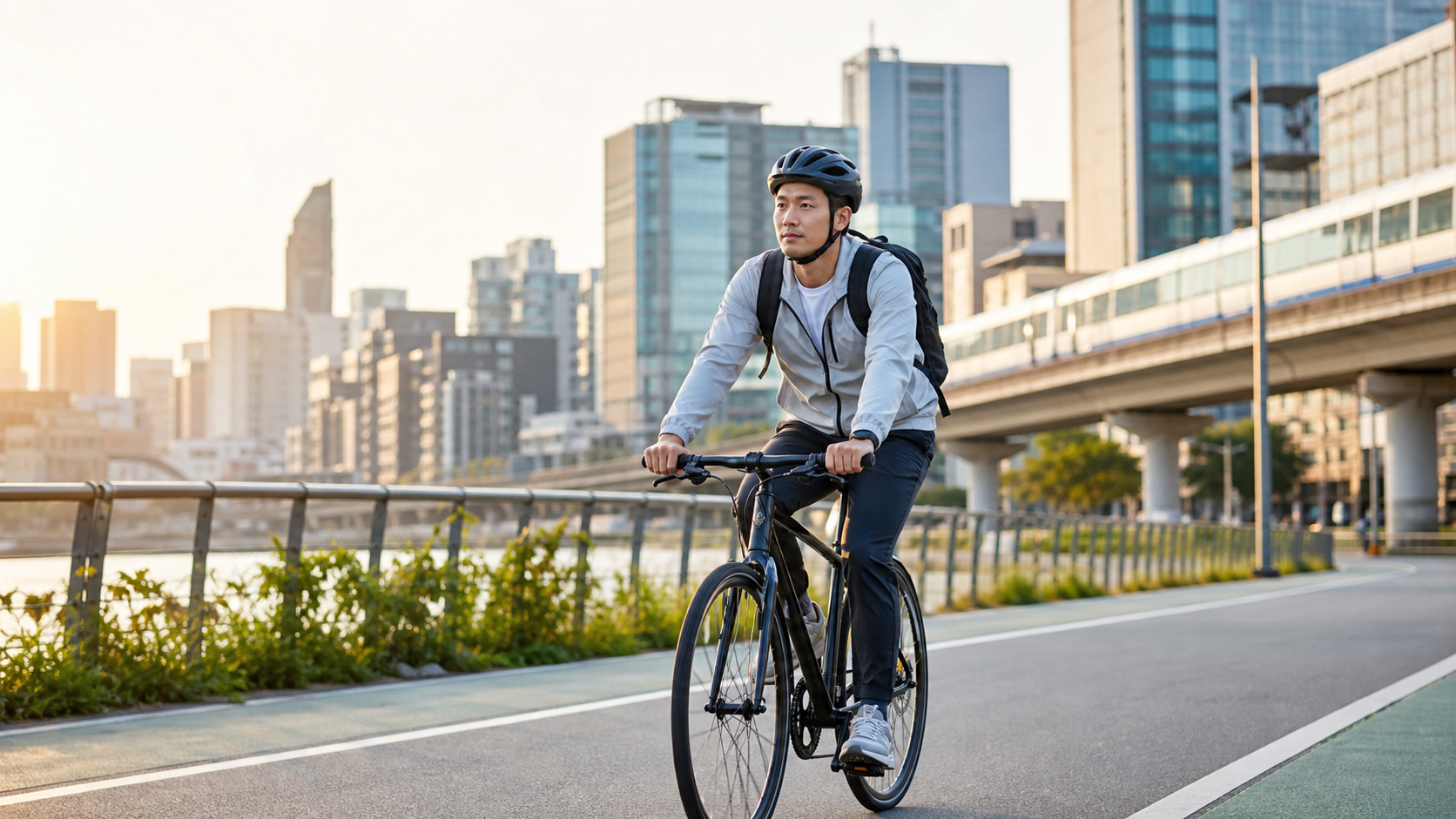
It Starts with a Client’s Complaint
Among the athletes I’ve coached, the most common phrase I hear is: “Coach, I really don’t have time to exercise.”
A few years ago, there was an engineer named A-Kai who worked in the Neihu Science Park. His health check report was a wall of red flags: elevated fasting blood sugar, triglycerides over the limit, and he weighed nearly 14 kg more than he did in college. His workdays were long, and when he got home, all he wanted to do was lie flat. On weekends, he had to spend time with family. Forcing him to carve out an hour for the gym lasted less than two weeks before he gave up.
I asked him: “How long is your daily commute?” He said about 40 minutes each way, by car or MRT. I did the math for him: 80 minutes round-trip a day, 400 minutes over a five-day workweek—that’s over 160 hours a year. That’s an entire block of time being thrown away. If he could turn even part of that “movement” into “training,” he wouldn’t need to squeeze in extra exercise time at all, and his health would quietly come back.
A-Kai later switched to a hybrid “MRT + bike” commute: he got off one stop early and rode a U-Bike or his own commuter bike for the final 3 to 4 kilometers. Six months later, at his follow-up appointment, his triglycerides had dropped significantly, his pants were one size looser, and most importantly—he never went through the pain of “starting to exercise.” He just changed how he moved.
That’s what I want to talk to you about: making your commute a workout. It’s not about turning you into a competitive athlete; it’s about redesigning the “movement” you have to do every day anyway into a block of time with training benefits. For busy Taiwanese office workers, this might be the highest-return exercise strategy there is.
Why Is Commuting Exercise Such a Good Deal? What Science Says
The WHO Exercise Prescription
Let’s start with the most basic threshold. The World Health Organization’s (WHO) 2020 physical activity guidelines recommend that adults accumulate at least 150 to 300 minutes of moderate-intensity aerobic activity per week, or 75 to 150 minutes of vigorous-intensity aerobic activity, plus muscle-strengthening activities involving all major muscle groups at least two days per week.
That number doesn’t look huge, but according to surveys by the Health Promotion Administration, a significant portion of Taiwanese adults don’t meet this standard. The reason often isn’t that they don’t want to move—it’s that they “can’t find the time.”
The key insight is that the WHO guidelines specifically emphasize—every bout of physical activity counts, and it adds up. You don’t need to do a full 30 minutes in one go; accumulating it in segments during your commute works just as well. A 20-minute moderate-intensity ride each way adds up to 40 minutes round-trip. Ride four days a week, and you’ve easily cleared the 150-minute weekly threshold without setting aside any extra time.
I often lay this equation out for my clients because it has a strange persuasive power: meeting the official recommended amount of exercise isn’t as out of reach as it seems. What really holds most people back is never “I can’t do 150 minutes”—it’s “I can’t find those 150 minutes.” The value of commuting exercise is that it hides those 150 minutes inside the travel time you’d spend anyway, effectively buying you guideline-compliant exercise at “zero additional time cost.”
Active Commuting and Health Outcomes
The benefit of turning movement into exercise isn’t just about “making up time.” A large prospective cohort study tracking over 260,000 British adults for several years found that, compared with commuters who used passive modes like driving or public transit, those who commuted by bicycle had significantly lower risks of cardiovascular disease and all-cause mortality. Walking to work also helped, but among commuter groups, those whose commutes “included cycling” showed the most pronounced reductions in disease and mortality risk.
I want to be clear: this is an observational study showing “association.” People who cycle to work might already be more health-conscious or have different socioeconomic profiles, so it can’t be taken as absolute proof that “cycling will definitely add years to your life.” But it at least points clearly in one direction: turning daily movement into active exercise and better cardiovascular health are on the same path. That matches exactly what I’ve seen on the sidelines over the years.
Active vs. Passive Commuting: What’s the Difference?
I often use a simple comparison table so clients can see at a glance what “changing how you move” actually changes:
| Aspect | Passive Commuting (Driving / Riding Only) | Active Commuting (Cycling / Walking) |
|---|---|---|
| Physical activity level | Nearly zero; sitting the whole time | Accumulates moderate-intensity aerobic time |
| Impact on sedentary time | Extends sitting time | Breaks up sitting; engages the legs |
| Daily calorie expenditure | Low | Noticeably higher |
| Mood and mental state | Traffic easily causes frustration | Outdoor activity aids relaxation |
| Additional time cost | Low (but need to find separate time to exercise) | Low (exercise and movement are combined) |
| Long-term health association | Little positive contribution | Associated with better cardiovascular health |
The main message of this table is that the real advantage of active commuting is that it merges “movement” and “exercise”—two things that would otherwise require separate time—into one single activity. For Taiwanese office workers who never have enough time, this “killing two birds with one stone” efficiency is what makes it truly irreplaceable.
Why “Making It Daily” Beats “Going All Out”
From a sports science perspective, commuting exercise has three structural advantages:
- High frequency, sustainable: Training effects come from long-term, consistent accumulation, not occasional bursts. Commuting happens every day, making it inherently the most stable “training schedule.”
- Naturally moderate intensity: Commuting rides mostly fall in the low-to-moderate intensity zone, which is exactly the sweet spot for building an aerobic base, burning fat, and driving cardiovascular adaptations—and it’s also the least likely to cause injury or excessive fatigue.
- No extra willpower required: You’re already moving anyway; making it exercise doesn’t require a separate “decision,” which dramatically lowers the dropout rate. In behavioral science, this is called “attaching a new habit to an existing one”—the easiest way to build a habit.
I often tell my clients: “Three years of moderate training beats three weeks of a perfect plan.” The greatest value of commuting exercise is that it’s extremely easy to sustain.
Sedentary Time: The Hidden Risk of Modern Life
There’s another angle that’s often overlooked: commuting exercise isn’t just about “adding exercise”—it’s also about “reducing sitting.” Modern office workers can sit continuously for eight to ten hours a day, and prolonged sitting is linked to poorer metabolism, postural issues, and tightness in the lower back, neck, and shoulders.
I’ve seen plenty of clients who clearly exercise on weekends, yet their health check numbers still aren’t ideal—the problem often lies in “sitting nearly all day for five weekdays.” This “weekend warrior” pattern struggles to offset the impact of extensive weekday sitting.
Commuting exercise cuts right into that gap: it forces you to get up and move at both ends of the day, swapping what would be purely seated travel time for time spent standing, pedaling, and sweating. This “breaking up sitting” effect is something a single weekend workout can’t provide. I often say: “Rather than cramming in one big session on the weekend, it’s better to never miss a day during the week.”
Practical Methods: How to Design Your Commute as a Training Session
Three Commuting Exercise Models
Not everyone can ride all the way to the office. Given Taiwan’s urban environment, I usually recommend choosing one of the following three models based on distance and practical conditions:
| Model | Suitable Distance (One Way) | Approach | Best For |
|---|---|---|---|
| Fully Active | 3–12 km | Cycle or walk the entire commute | Those with a moderate home-to-work distance and a relatively safe route |
| Hybrid Commute | 10–30 km | MRT / train + cycling or walking for the final segment | Urban office workers with longer distances who want to avoid dangerous road sections |
| Get Off Early | Any | Get off the bus / MRT 1–2 stops early, then brisk-walk or ride a shared bike | Complete beginners or those wanting a low-barrier start |
A-Kai used the second model, the “hybrid commute,” which is also the one I most recommend for general Taiwanese office workers as a starting point: it keeps the reliability and weather protection of public transit while turning that last mile into exercise.
Controlling Intensity with Heart Rate and Perceived Exertion
Commuting is not a race; the focus is on being “effective” rather than “going all out.” I use two simple indicators to help trainees gauge intensity:
The first is perceived exertion (RPE, Rating of Perceived Exertion), rated on a scale of 1 to 10:
| Intensity Zone | RPE | Breathing and Speaking State | Commuting Purpose |
|---|---|---|---|
| Easy | 3–4 | Can hold a full conversation easily | Warm-up, cool-down, recovery days |
| Moderate | 5–6 | Speech is broken into phrases, but not breathless | Main commuting pace, builds aerobic base |
| Somewhat Hard | 7–8 | Can only speak short sentences, noticeably breathless | Occasional uphill surges or when running late |
| High Intensity | 9–10 | Barely able to speak | Not recommended for regular commuting |
For most of your commute, maintaining a “moderate intensity” at RPE 5 to 6 is ideal—you’re breathing harder and working up a light sweat, but you won’t arrive at the office drenched and disheveled.
The second is heart rate. If you have a sports watch, you can use a rough reference range: estimate your maximum heart rate with “220 minus your age,” and keep your commuting pace between 60% and 75% of that maximum heart rate. For example, a 40-year-old would have an estimated maximum heart rate of about 180 bpm, putting moderate intensity roughly between 108 and 135 bpm.
Please note that “220 minus age” is only a rough estimation formula; individual variation can be significant, with some people running higher or lower. Heart rate numbers are for “reference,” not something to “stare at and force yourself to hit.” Perceived exertion should always come first. If you slept poorly or are under stress, and your heart rate is higher at the same intensity, slow down—don’t push through.
Sample One-Week Commuting Training Schedule
Many people assume commuting exercise means “riding the same route every day.” In reality, with a little variation, you can balance aerobic base, recovery, and a bit of stimulus. Here’s a one-week sample I design for more advanced commuters (assuming a one-way ride of about 25 to 35 minutes):
| Day | Outbound Ride | Return Ride | Training Focus |
|---|---|---|---|
| Monday | Moderate steady ride (RPE 5–6) | Easy recovery ride (RPE 3–4) | Ease into the week; don’t overdo it |
| Tuesday | Moderate steady ride | Include 2–3 uphill accelerations | Add a bit of intensity stimulus |
| Wednesday | Easy ride or walking | Easy ride or walking | Active recovery day |
| Thursday | Moderate steady ride | Moderate steady ride | Accumulate aerobic time |
| Friday | Moderate steady ride | Easy recovery ride | Preserve energy for the weekend |
Beginners should simply ignore the “uphill acceleration” slot and keep everything at moderate or easy intensity for the first four to six weeks. Getting your body used to “moving every day” matters far more than chasing intensity.
Estimating Calorie Burn and Fitness Benefits
Trainees often ask: “How many calories does this kind of riding burn?” Here’s a rough estimate for common Taiwanese scenarios to give you an idea (actual numbers vary greatly with body weight, wind resistance, gradient, and bike weight):
| Scenario | Duration | Approximate Calorie Burn |
|---|---|---|
| 70 kg person, moderate intensity flat commute | 30 minutes | About 200–300 kcal |
| Same as above, with climbs or headwind | 30 minutes | About 300–400 kcal |
| Brisk walking commute | 30 minutes | About 120–180 kcal |
These are range values, not precise guarantees. The point isn’t how many calories you burn in a single session, but the compound effect of “round trips, every day, accumulated over years.” Burning an extra 300 kcal a day means 1500 kcal over a five-day work week—that has far more significance for long-term weight and metabolic health than one weekend of intense sweating.
Progressive Overload: A One-Month Ramp-Up Rhythm
Many people fail because they try to do everything in the first week. I usually give beginners a “one-month progressive table” so both their body and daily habits have time to adapt:
| Week | Frequency | One-Way Intensity/Distance | This Week’s Goal |
|---|---|---|---|
| Week 1 | 2–3 days per week | Easy, last 1–2 km | First, make “moving differently” a habit |
| Week 2 | 3 days per week | Easy to slightly moderate, 2–3 km | Start noticing your breathing and a light sweat |
| Week 3 | 3–4 days per week | Moderate, 3–4 km | Find your comfortable cruising rhythm |
| Week 4 | 4 days per week | Mostly moderate, 4 km or more | Steady accumulation; start feeling fitness payback |
The spirit of this table comes down to one phrase: Better slow than stopped. The goal of the first month isn’t to get stronger; it’s to “not give up.” Once “commuting exercise” becomes as natural as brushing your teeth, all subsequent progress will follow naturally.
Gear and Logistics: The Essentials Without Breaking the Bank
The barrier to commuting exercise is low, but a few basic logistics can greatly boost your willingness to stick with it. Here’s a checklist I often recommend to trainees, along with the problems each item solves:
| Item | Necessity | Pain Point It Solves |
|---|---|---|
| A well-maintained city bike / shared bike | Essential | No need for an expensive bike; just needs to be safe to ride |
| Commuting backpack or pannier bags | Essential | Keeps your back less sweaty and lowers your center of gravity |
| Change of shirt + small towel | Highly recommended | Solves the embarrassment of “arriving at the office drenched in sweat” |
| Wet wipes / portable deodorant | Recommended | A lifesaver when there’s no shower available |
| Lightweight rain jacket + waterproof bag | Recommended | An essential flexible option for Taiwan’s rainy season |
| Sports watch or phone app | Optional | Tracks days and heart rate to maintain motivation |
Remember: These are tools to “help you keep going,” not “prerequisites to start.” Even if you buy nothing at all, getting off one stop early and walking tomorrow still counts.
Taiwan-Specific Scenarios: Practical Tips for Climate, Road Conditions, and Eating Out
For commuting exercise to last long-term, it must be tailored to Taiwan’s environment. This is the part I feel many overseas articles miss, yet it’s the most useful for you.
Dealing with Taiwan’s Humidity, Heat, and Afternoon Thunderstorms
Taiwan’s summers are humid and hot, and the most realistic enemies of commuting exercise are sweating and sudden downpours. My practical advice:
- Keep a change of clothes and a towel at the office: This is the key to sustaining commuting exercise. If you can dry off and change at work, you’ll feel presentable again and be willing to do it every day.
- Make use of early morning and evening: In summer, try to avoid the high-temperature hours around noon. Morning rides are cooler, and the air is relatively better.
- Hydrate in advance: In hot, humid conditions, drink 300 to 500 ml of water before your commute, and top up moderately if the ride exceeds 30 minutes. For moderate-intensity short commutes, plain water is usually enough; sports drinks aren’t necessary.
- Rainy season backup plan: During the plum rain and typhoon seasons, check the weather forecast the night before, prepare a rain jacket and waterproof bag, or simply switch back to public transport—allowing yourself flexibility means one rainstorm won’t make you give up entirely.
Air Pollution and Route Selection
In certain seasons and regions of Taiwan (especially central and southern Taiwan in winter), air quality can be poor. My advice:
- Check the day’s AQI (Air Quality Index). When it reaches an orange alert (unhealthy for sensitive groups) or above, those with respiratory conditions or asthma should switch to public transport.
- Choose routes that favor riverside bike paths, park greenways, and small back streets, avoiding major arterial roads with heavy traffic. Taipei’s riverside bike paths and the levee roads in various counties and cities are excellent choices for commuting exercise—safer and with better air.
- Generally healthy adults don’t need to stop entirely due to mild air pollution, but you can lower the intensity to reduce heavy breathing.
Nutrition Logic for Those Who Eat Out
Taiwan’s convenient food options are actually an advantage for commuters, but you need to choose wisely:
- If riding to work in the morning on an empty stomach causes discomfort, eat a little easily digestible carbohydrate first, such as a banana or a slice of toast, to avoid dizziness from low blood sugar.
- For short-to-medium commutes (under 30 minutes), no extra meals or supplements are needed; three regular meals are sufficient. Don’t use commuting exercise as an excuse to overeat.
- After riding and arriving at work, a balanced breakfast (such as a dan bing / onigiri with unsweetened soy milk) is plenty, covering both protein and carbohydrates.
Safety: The Prerequisite for Turning “Commuting” into “Training” Is Arriving Safely
I want to be serious in this section. All the benefits of commuter exercise are built on safety. Taiwan’s urban traffic environment is not particularly friendly to cyclists; road-rights awareness, motor vehicle traffic flow, and intersection conflicts are all real risks.
Gear and Visibility
| Item | Recommendation | Reason |
|---|---|---|
| Helmet | Always wear one, and it must fit properly | Head protection, most critical in a fall |
| Front and rear lights | Recommended even during the day | Increases your visibility, especially on cloudy or rainy days |
| Bright/reflective clothing | Wear while commuting | Helps motorists notice you earlier |
| Rearview mirror | Recommended to install | Check traffic behind before changing lanes |
| Brakes and tire pressure | Check weekly | The most neglected maintenance on commuter bikes |
Three Golden Rules of Riding Behavior
- Be predictable: Ride in a straight line, don’t weave, and signal clearly with hand gestures before changing direction. Making drivers “able to guess what you’ll do” is the most important safety strategy.
- Don’t trade your life for time: When rushing to avoid being late for work, people are most likely to run red lights or squeeze through traffic gaps. My requirement for trainees is—Better late than in the hospital. Time can be made up; your life cannot.
- Assume others don’t see you: At intersections, near car doors, and around turning vehicles, always keep a margin. This “defensive riding” mindset can avoid the vast majority of commuting accidents.
Take Physical Warning Signs Seriously
Although commuter exercise is moderate, if you have a history of chronic illness, be cautious before starting. If you have heart disease, high blood pressure, diabetes, or other chronic conditions, please consult your physician before beginning any regular exercise program, and have your doctor assess appropriate intensity and precautions. If you experience chest tightness, chest pain, unusual shortness of breath, dizziness, or cold sweats during exercise, stop immediately and seek medical attention as soon as possible. Taiwan’s National Health Insurance makes medical access convenient, so don’t ignore your body’s warning signs just to avoid the hassle.
Common Mistakes and Corrections
Over the years, I’ve seen too many people “start with great excitement and disappear after two weeks.” Here are the most common pitfalls:
Mistake One: Going Too Hard from the Start
Many people want to ride the entire route on day one, and ride fast too. The result is sore legs, a sore bottom, and mental fatigue the next day—and they quit by day three.
Correction: For the first two to four weeks, cut both distance and intensity in half. Better to feel “this is way too easy” than to try to do everything at once. Habit formation relies on “frequency,” not “intensity.”
Mistake Two: Treating Commuter Exercise and Public Transit as Opposites
Some people think “either I ride the whole way, or it doesn’t count as exercise,” and as a result, they give up entirely when the distance is too far or the weather is too bad.
Correction: Embrace “mixed commuting” and “getting off early.” Exercise isn’t all-or-nothing—an extra 15 minutes of movement every day has far greater long-term benefits than occasionally riding 30 kilometers.
Mistake Three: Ignoring Saddle Position and Riding Posture, Leading to Knee and Lower Back Pain
If the saddle height or handlebar reach on a commuter bike doesn’t fit, it can easily lead to anterior knee pain or lower back tightness over time.
Correction: Set saddle height so that “your knee is slightly bent, about 25 to 35 degrees, at the bottom of the pedal stroke”—not fully extended and not overly bent. If joint pain persists after riding, get a simple bike fitting from a professional or consult a physical therapist.
Mistake Four: Treating Commuter Exercise as a License to Overeat
“I rode today, so I can have an extra serving of fried chicken.”—This is a common reason the scale goes up instead of down. As calculated earlier, a 30-minute commute burns roughly 200 to 300 kcal, and a single serving of fried chicken often cancels that out and then some.
Correction: The value of commuter exercise lies in health and metabolism, not as currency for indulgence. Just maintain your normal balanced diet.
Mistake Five: No Tracking, No Feedback
Without any record, you can’t feel progress, and motivation tends to fade.
Correction: Simply track days, distance, and heart rate with your phone or a sports watch. Seeing “I rode 18 days this month” is the fuel that keeps you going.
Action Plans for Readers at Different Levels
Everyone starts from a different point, so I’ve divided my recommendations into three tiers. Find the one that fits you.
Complete Beginner / Sedentary Office Worker
- Goal: First build the habit of “moving a little every day,” without worrying about intensity.
- Approach: Start with “getting off one stop early and walking briskly” or “riding a shared bike for the last 2 kilometers,” three days a week.
- Intensity: RPE 3–5 throughout, able to speak comfortably.
- Key point: First establish the habit, then improve. In the first month, “just doing it” counts as success—don’t worry about distance or speed.
- Health reminder: If you have a chronic condition or haven’t exercised in a long time, have a physician assess you before starting.
Office Worker with Some Foundation
- Goal: Make commuting the primary source of 150 minutes of moderate-intensity exercise per week.
- Approach: Use mixed commuting, with a final bike segment of 20–35 minutes each way, four to five days a week.
- Intensity: Main effort at RPE 5–6, occasionally adding some hills on safe stretches.
- Key point: Add simple strength training twice a week outside commuting hours (squats, push-ups, planks) to cover the muscle-strengthening component recommended by the WHO.
Advanced Cyclist / Wanting to Go Further
- Goal: Use commuting to maintain aerobic base and provide light stimulus, with focused training saved for the weekend.
- Approach: Follow the “weekly commuting schedule” above to arrange intensity variation, including recovery rides and short hill sprints.
- Intensity: Mostly moderate, with a small amount of slightly harder intervals. Be careful not to let commuting compromise the quality of your weekend key workouts.
- Key point: Commuting is a “supplement,” not the “main course.” Never go all-out every day, or you’ll accumulate fatigue and impair your formal training and recovery.
Another Case Study: The Heat-Averse Mom Who Was Afraid to Ride
Besides the engineer A-Kai, I’d like to share the story of another trainee, Xiao-Wen, because her concerns are shared by many.
Xiao-Wen is a nurse in her early forties working at a hospital in the city. Her biggest resistance was: “I really hate the heat, and I’m afraid of danger—how could I possibly commute by bike?” She lives about 6 kilometers from the hospital, and the route passes through several high-traffic intersections. Just imagining it was enough to make her back out.
I didn’t ask her to do it all at once. We started with the most conservative version: she kept taking the bus as usual, but got off two stops early and walked the final roughly 1.5 kilometers. This version had zero risk, zero gear requirements, and wasn’t likely to make her sweat much. She did this for three weeks and discovered “it’s not that hard after all,” and that walking that extra stretch in the morning actually made her feel more alert.
Then, we gradually swapped one segment for a shared bike, deliberately avoiding the most dangerous intersection and taking a relatively quiet alley route she found herself. On very hot days, she’d fall back to the “walking version” without forcing it.
Six months later, Xiao-Wen hasn’t become some exercise fanatic, but her stamina has clearly improved, her mental state before work is more stable, and most importantly—she’s built a sense of “I can do this.” Her example confirms something I’ve learned again and again: the key to successful commuter exercise has never been intensity or gear, but whether you’ve designed a starting point for yourself that’s “so easy you can’t say no.”
FAQ
Q: Won’t commuting by bike make me inhale more exhaust fumes, doing more harm than good?
A: This is a common concern. In practice, as long as you avoid major roads with heavy traffic, choose riverside paths and back alleys, and switch to public transport on days with severe air pollution, the overall health benefits of active commuting are generally still considered to outweigh the risks of air pollution exposure. Those with respiratory conditions should be more cautious and adjust based on the daily AQI.
Q: I sweat a lot. Won’t it be awkward when I get to the office?
A: The key lies in intensity control and preparation. Keep the main part of your commute at a moderate intensity—“slightly breathless, light sweat”—and keep a towel, change of clothes, and even wet wipes at the office. That resolves most awkwardness. In summer, leave earlier and slow down.
Q: What about rainy days? Won’t my habit be broken?
A: Allow yourself a Plan B. Switching back to public transport on rainy days is not a failure. Building a habit relies on “doing it most days,” not “doing it every single day without exception.” Flexibility is what lets you keep going longer.
Q: Do I need to buy an expensive road bike for commuting exercise?
A: Absolutely not. A regular city bike or shared bike in good condition, with responsive brakes and properly inflated tires, is more than enough. The barrier to entry for commuting exercise is already low—don’t let gear become an excuse not to start.
Q: My knees aren’t in great shape. Can I still commute by bike?
A: Cycling places much less impact on the knee joints compared to running, and many people with knee discomfort actually find it suitable. However, this assumes correct saddle height, proper riding posture, and gentle intensity. If you have a diagnosed knee injury, consult a physician or physical therapist first and get individualized advice before starting.
Q: Can commuting exercise replace formal weekend training?
A: For the average person looking to maintain basic health, regular commuting exercise is enough to cover the aerobic volume recommended by the WHO, making it an excellent primary activity. But if you have specific fitness or race goals, commuting is better suited as “aerobic base and maintenance,” while weekends should still include structured key workouts and strength training. The two complement each other rather than replace one another.
Q: Would riding twice a day (to and from work) be too much and cause overtraining?
A: For the vast majority of people, a round-trip commute of moderate intensity at 20 to 40 minutes per leg is nowhere near the overtraining threshold—it’s actually the ideal aerobic dose. The ones who truly need to watch for overload are advanced riders who already do heavy weekend training and then push hard on their commutes every day—for them, simply dialing the commute down to an easy recovery pace is enough.
Q: Is it too late to start commuting by bike in middle age?
A: Not at all. The body’s positive response to regular activity exists at every age. The key for starting in middle age is simply “progress more gradually, prioritize safety, and consult a doctor first if you have chronic conditions.” I’ve coached students who started commuting exercise in their fifties and saw clear improvements in fitness and mental well-being. The key is always “start and keep going,” not “at what age you start.”
Conclusion: The Best Exercise Is the Kind You Can Keep Doing
Let’s return to the engineer A-Kai from the beginning. He never became a triathlete, and to this day he’s still that busy office worker. But he’s kept turning his commute into exercise for years—not through willpower, but because it was something he had to do anyway; he just found a different way of doing it.
That’s precisely what makes commuting exercise so appealing. It doesn’t demand you sacrifice extra time, doesn’t require expensive gear, and doesn’t ask you to grit your teeth and push through. It quietly stitches health into the gaps of a life you already live—a little each day, compounding over time into long-term gains for your body.
If you, too, feel like you “don’t have time to exercise,” I’d like to invite you to try this tomorrow: get off one stop early and walk a stretch, or swap the last mile for a bike. You don’t need to go all-in at once. Just start, and slowly turn your daily movement into your own training session.
Your body will thank you, in its own way, over time.
Three Final Reminders to Take With You
If there are only three things you remember from this article, I hope they are these:
- Start with a version so easy you can’t say no. Get off one stop early and walk a bit—no need to ride the whole way at once. The lower the barrier, the easier it is to sustain.
- Safety always comes before speed. Better to be late than to end up in the hospital. Wear a helmet, use lights, ride predictably, and bring yourself home safely every single trip.
- Give yourself permission to be flexible. On rainy days, when you’re unwell, or when it’s too hot, fall back on public transport. That’s not failure. It’s about “doing it most days,” not “every day without exception.”
Commuting exercise isn’t a challenge that demands you grit your teeth and endure. It’s a gentle choice to weave health quietly into your life. You don’t need to become someone else—you just need, tomorrow, to get to the road you were already going to take, in a slightly different way.
Every student like A-Kai and Xiao-Wen reminds me: change never comes from one dramatic decision, but from the accumulation of countless small choices to “do it again today.” May you also make that small choice for yourself—one that will stay with you for a long time.
This article is for educational purposes and does not replace individualized diagnosis or treatment advice from a physician, physical therapist, or nutritionist. If you have heart disease, hypertension, diabetes, or other chronic conditions, please consult your healthcare team before starting any regular exercise program, and adjust according to your individual circumstances.
References
- Association between active commuting and incident cardiovascular disease, cancer, and mortality: prospective cohort study (UK large-scale active commuting cohort study) — https://pubmed.ncbi.nlm.nih.gov/28424154/
- Biking to work may reduce risk of cardiovascular disease, cardiovascular mortality (research report) — https://cardiovascularbusiness.com/topics/patient-care/biking-work-may-reduce-risk-cardiovascular-disease-cardiovascular-mortality
- WHO Guidelines on Physical Activity and Sedentary Behaviour (World Health Organization physical activity guidelines) — https://www.ncbi.nlm.nih.gov/books/NBK566046/
Related Reading
- The Bike Commuting Revolution: How to Turn Your Daily Commute into the Best Training
- Making Your Bike Commute a Workout: Designing Training Plans That Turn Commuting Rides into Effective Sessions
- What Changed After a Year of Bike Commuting: A Real Record of Health, Wallet, and Quality of Life
- The Bike Commuting Lifestyle Revolution: A Complete Guide to Riding to Work in Taiwan’s Cities
靠單車減肥35公斤 心得分享與整理
7 年前
單車 一日北高 ( 雙城 ) 肥宅雙人瘋狂行 紀錄片 REACTO
10 年前
一日北高常見問題大集合 | 攻略 | 路線 | 訓練 | 補給 | 自行車 單車 | 一日雙城 | 雙塔 | TWB北高360 | 屁股痛
6 年前
一日北高/長距離團騎 常見問題補充篇 / 組團或跟團的眉角 / 壯車友容易被瘦車友慢性拉爆 / 原來屁股痛可能是這個原因...? / 風場配速法 / 公路車 / CT Yeh
2 年前
一日北高 11小時 賽後心得分享篇 | TWB北高360 | 一日雙城 | 單車 | 公路車
6 年前
4K 東眼山 x 水蜜桃冰沙 百人單車約騎! 操完再吃冰 多爽快
7 年前
2019 柯P 超越北高 第一集團實錄 (11小時實錄請參考另一部影片) 一日雙城 一日北高 NeverStop Taiwan Long Distance Cycling Challenge
7 年前
2026 車錶排行榜!誰是最多車友正在使用?練家子最愛哪款?🏆 (2萬名車友數據) / 公路車 / CT Yeh
5 個月前