Exercise and Air Quality: Should You Train on Polluted Days? A Coach's Guide to Understanding AQI, Assessing Risk, and Protective Strategies
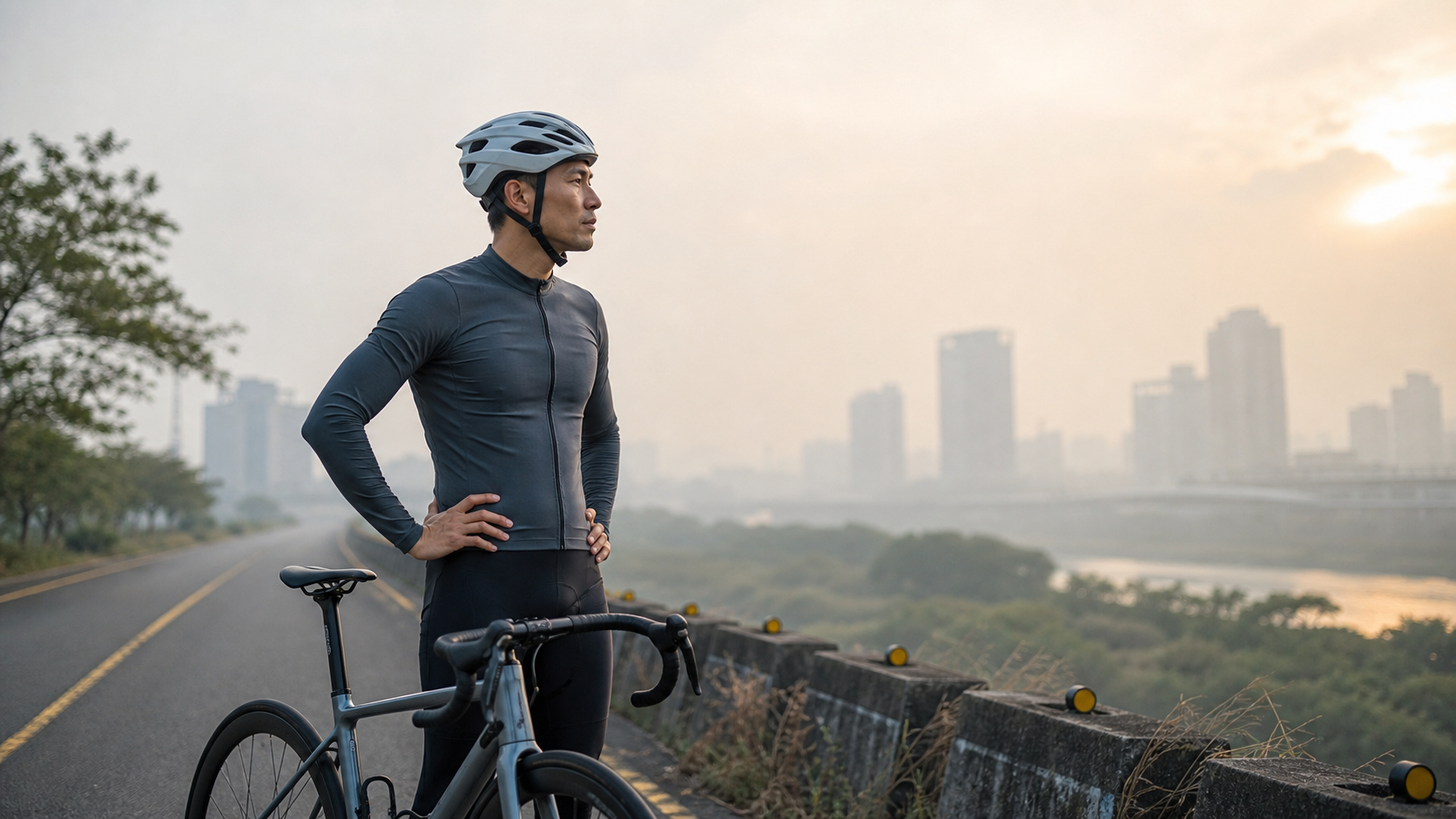
Opening: The Student Who Still Rode Long on a Purple-Alert Day
I’ve been coaching athletes and general fitness enthusiasts for about fifteen years. Every autumn and winter, especially during the weeks when the northeast monsoon stalls and central and southern Taiwan start hitting “purple alerts,” my messages get flooded with the same question: “Coach, the air is really bad today, can I still train?”
A few years ago, there was a student named A-Kai—early forties, five years of cycling experience, decent results in amateur categories. One Saturday morning, PM2.5 at the Kaohsiung monitoring station spiked past purple, with AQI exceeding 200. He still went out and did four hours of intervals according to his original plan. That night he came home with an itchy throat, dry cough, and chest tightness. The next morning he woke up feeling “like someone had sandpapered his windpipe.” He messaged me: “Coach, do I have a cold?” I looked at his training log and that day’s air quality data, and told him: “You don’t have a cold. You just used your lungs as an air purifier for an entire morning.”
This article is about organizing everything I’ve repeatedly told my students over the years: what air pollution actually does to your body during exercise, how you judge whether today is a train day or a rest day, and how to minimize the damage if you absolutely must train. I’ll give you tables and numbers you can actually follow, not the “just don’t go outside when the air is bad” nonsense you already know but can’t actually do.
Here’s the bottom line for those in a hurry: Exercise is not a get-out-of-jail-free card—it actually amplifies your exposure to air pollution. But that doesn’t mean you have to hide indoors the moment the light turns yellow. The key is learning to “read the numbers, know your risk group, adjust intensity, pick your timing, and use protection.” Read on—I’ll break it down item by item.
Why Exercisers Should Care More About Air Pollution
Many people think “people who exercise have stronger lungs, so air pollution affects me less.” That intuition is completely backwards. In reality, every single thing you do during exercise increases the amount of dirty air you pull deep into your lungs.
Ventilation Rate: Rest vs. Exercise Differs by More Than Tenfold
A sedentary adult sitting quietly has a ventilation rate (total volume of air inhaled and exhaled) of about 6 to 10 liters per minute. But when you’re climbing on a bike, running intervals, and pushing your heart rate near maximum, ventilation can surge past 100 liters per minute—more than ten times your resting rate.
What does this mean? Standing in air with the same PM2.5 concentration, an exercising person inhales more than ten times the total pollutants per unit of time compared to someone sitting. You think you’re training your heart and lungs—in reality, you’re also exposing them to double the load.
Mouth Breathing: You’ve Turned Off Your Nasal Filter
At rest or low intensity, we breathe primarily through our noses. The nasal hairs, mucous membranes, and curved passages form a natural filtration system that blocks some larger particles and warms and humidifies the air. But the moment intensity rises and oxygen demand increases, almost everyone automatically switches to mouth breathing.
Your mouth has no filtration function. It’s like removing the filter from your home air purifier and letting air flow straight into your alveoli. PM2.5—fine particulate matter smaller than 2.5 micrometers—is already small enough to penetrate deep into the alveoli and even enter the bloodstream. Mouth breathing during exercise essentially opens a highway for them.
Deeper Breathing: Particles Deposit Deeper
During exercise, breathing doesn’t just get faster—it gets deeper. Tidal volume (the amount of air per breath) increases, allowing inhaled airflow to carry particles deeper into the alveolar regions where gas exchange is most active. The deeper particles deposit, the harder they are to clear through coughing or ciliary action, and the more pronounced the inflammatory response can be.
Add these three factors together—surged ventilation, mouth breathing bypassing filtration, and deeper inhalation—and you’ll understand why I told A-Kai he was using his lungs as an air purifier. The act of exercising itself is an amplifier of air pollution exposure.
A Rough Exposure Analogy
I often use a very rough, non-precise analogy to help students build intuition: imagine two people standing in air with the same PM2.5 concentration—one sitting and scrolling on their phone, the other running intervals. If the interval runner’s ventilation rate is ten times that of the seated person, then in the same one hour, the total pollutants inhaled into the body are also roughly on the order of ten times that of the seated person. This isn’t rigorous science—the numbers vary by individual and intensity—but it gives you an intuitive grasp of one thing: Exposure ≈ Concentration × Ventilation Rate × Time. You can’t control the atmospheric concentration, but you absolutely can control intensity (which affects ventilation) and time. That’s the underlying logic of every protective strategy that follows—when concentrations are high, the levers you can pull are “lower intensity” and “shorten duration.”
How Air Pollution Affects Exercise Physiology: Short-Term and Long-Term
I explain the effects of air pollution to students in two layers—“the session right now” and “the accumulation over time”—so it maps more easily onto your training decisions.
The Session Right Now: Performance Drops, Symptoms Appear
In terms of research direction, short-term exposure to higher concentrations of particulate matter during exercise may produce the following conditions (these are general physiological trends; individual variation is large):
- Decreased aerobic performance: At higher pollutant concentrations, the same power output or pace feels more breathless and harder, and your maximum sustainable output may drop. That interval set you could normally hold just falls apart that day.
- Respiratory irritation symptoms: Dry cough, itchy throat, chest tightness, and a lingering dry cough after exercise are the most common immediate reactions.
- Worsening for asthma or allergy sufferers: Well-controlled asthma may trigger wheezing or breathing difficulty after exercising on high-pollution days.
- Increased subjective discomfort and fatigue: The same workout feels “tired for no reason” that day.
If you experience any of these symptoms after training on a bad air day, it’s not that your “fitness has regressed”—it’s the environment taking points off you. I’ve seen too many students staring anxiously at their power or pace data during a purple-alert week, thinking their training isn’t working, then doubling down and pushing harder—only to make themselves worse. When you face consecutive bad air days and your performance inexplicably declines, suspect the environment first. Don’t rush to doubt your fitness.
The Accumulation: Respiratory and Cardiovascular Risks
The long-term health cost of repeatedly doing large volumes of exercise in highly polluted environments is the part that epidemiology pays more attention to. PM2.5 is associated with elevated risks of medical visits and hospitalizations for respiratory and cardiovascular diseases, with sensitive groups (those with respiratory or cardiac conditions, the elderly, and children) at higher risk.
Here I want to honestly present a balanced view—something I always emphasize to anxious students: The benefits of regular exercise for cardiovascular and overall health are very solid, and most research does not support “just don’t exercise because of air pollution.” For the vast majority of people, the benefits of long-term regular exercise generally outweigh the added exposure risk of exercising under typical air quality. What truly needs careful management is those few high-pollution days, and people who are themselves in sensitive groups.
So our goal has never been “stop exercising for fear of choking”—it’s “smartly avoid the worst few days and keep long-term exposure low.”
Case Studies: Three Completely Different Approaches
Principles alone are too abstract. Let me use three scenarios (data not fabricated, scenarios recombined) to show you how the same situation should be judged differently for different people.
Case One: Xiao-Ting, 32, office worker training for a half marathon. She lives in Taichung, and during the critical eight weeks before her race, she hit a stretch of consecutive orange and red alerts. Her initial reaction was the same as many people’s: “I can’t break my training plan, I’ll run anyway.” After two consecutive quality sessions, she ended up with dry coughing all night and a hoarse throat the next day. I helped her adjust her setup: all weekday tempo runs and intervals were moved to the gym treadmill (that gym has air purifiers and decent ventilation management), and only on weekend mornings when air quality improved did she do outdoor long runs. Eight weeks later, not only did she hold her target pace, but the pre-race “scratchy throat, poor sleep” symptoms completely disappeared. Key point: move quality sessions indoors, leave outdoor time for good weather.
Case Two: Brother Chen, 58, mild hypertension, regular cyclist for ten years. He falls into the sensitive group but doesn’t see himself that way. One red-alert day he rode up to the mountains as usual, and halfway there he started feeling chest tightness and slight dizziness, scaring him into pulling over to rest. I later set the rules firmly with him: on orange days he doesn’t ride, switching to low-intensity indoor trainer work; on red days, complete rest. I also asked him to bring this up with his doctor at his clinic visit to confirm his blood pressure control and exercise plan. He initially thought I was making a big deal out of nothing, but it wasn’t until that chest tightness episode that he truly took the rules to heart. Key point: set stricter thresholds for chronic disease groups, and discuss individually with their physician.
Case Three: A-Jhe, 25, healthy, no medical history, recreational runner running three times a week. He asked me: “Coach, I’m this healthy, can I just ignore air pollution?” My answer: health gives you “more room for error,” but it doesn’t mean immunity. His rules are relatively lenient: run as usual on yellow days, run along the riverside on orange days with shortened duration, and only move indoors on red days and above. This is reasonable for a low-risk individual like him. Key point: low-risk groups can have wider thresholds, but everyone without exception moves indoors on red days and above.
The difference between these three cases comes down entirely to two variables: “population risk” and “training intensity.” Once you think through these two variables, you’ll know which box you belong in.
Understanding Taiwan’s AQI: What Orange and Red Alerts Actually Mean
To make decisions, you first need to understand the numbers. Taiwan’s Environmental Protection Administration Air Quality Index (AQI) converts pollutants such as ozone, PM2.5, PM10, carbon monoxide, sulfur dioxide, and nitrogen dioxide into a composite index, categorized by color. This is your first basis for daily decision-making.
AQI Levels and Activity Recommendations Reference Table
The table below integrates the direction of Taiwan’s EPA and the Health Promotion Administration’s “exercise recommendations for different air quality levels,” giving you a practical reference. Note: the thresholds differ between the general population and sensitive groups—this is where most people get it wrong.
| AQI Range | Color (Flag) | Air Quality Status | General Population Exercise Advice | Sensitive Groups Exercise Advice |
|---|---|---|---|---|
| 0–50 | Green | Good | Normal outdoor exercise, no restrictions | Normal activity, maintain vigilance |
| 51–100 | Yellow | Moderate | Normal outdoor exercise; extremely sensitive individuals watch for symptoms | Reduce prolonged or high-intensity outdoor exercise |
| 101–150 | Orange | Unhealthy for Sensitive Groups | General population may exercise, watch body responses | Reduce strenuous outdoor exercise, switch to moderate/low intensity or move indoors |
| 151–200 | Red | Unhealthy for All Groups | Reduce strenuous outdoor exercise, shorten duration, lower intensity | Stop outdoor exercise, switch to indoor activities |
| 201–300 | Purple | Very Unhealthy | Avoid outdoor exercise, move indoors or rest | Stay indoors, avoid all outdoor physical activity |
| 301+ | Maroon | Hazardous | Avoid all outdoor exercise | Stay indoors, wear appropriate mask if outdoor trips are necessary |
(The above is a directional summary; please refer to the EPA’s real-time announcements and health advisories for actual guidance. Taiwan has tightened its PM2.5 standards starting 2025, with both daily and annual average limits revised downward, meaning the same air may now trigger yellow or orange alerts more easily than before.)
Who Counts as a “Sensitive Group”?
Many people assume this term has nothing to do with them, but the scope is actually quite broad:
- People with respiratory diseases such as asthma, chronic obstructive pulmonary disease (COPD), or chronic bronchitis
- People with cardiovascular diseases such as coronary heart disease, heart failure, or arrhythmia
- Pregnant women
- Adults 65 and older and children
- People with allergic constitutions or prone to rhinitis (symptomatically sensitive)
If you or a family member you’re responsible for falls into any of these categories, move your threshold one level stricter—where others only stop at red, you should pull back at orange.
Practical Judgment: My “Air Pollution Day Decision Flow” for Athletes
Looking at a single AQI number isn’t enough. What I teach my athletes is a process that lets you make a judgment in three minutes before heading out the door.
Step One: Check the Real-Time Value, Not Just the Forecast
Air quality changes quickly—red in the morning can turn yellow by noon and spike again in the evening. What you check before heading out is the real-time monitoring data for “the time period and location where you’ll be exercising,” not yesterday’s news forecast. Taiwan has decent monitoring station density; use the EPA’s air quality monitoring network or a common air quality app to check the station closest to your workout location.
Step Two: Apply Thresholds by Population Group
Using the table above, first confirm whether you’re in the sensitive group, then apply the corresponding threshold. This step determines where your “red line” is for the day.
Step Three: Consider Intensity and Duration
Under the same orange alert, “a 30-minute walk” and “10 km of intervals” have vastly different implications for exposure. The higher the intensity and the longer the duration, the lower the AQI threshold you can tolerate. For a two-hour long ride, I’d apply a stricter standard than for a 30-minute easy run.
Step Four: Ask Yourself About Your Body’s Real-Time Feedback
This is the most overlooked step, but in my opinion the most important. After you start moving, are there any abnormalities in your throat, chest, or breathing? If dry coughing, chest tightness, wheezing, or dizziness appear, regardless of what the AQI reads at that moment, immediately lower intensity or stop. Numbers are a reference; your body is the final judge.
Quick Decision Table for “Should I Train or Not” on Air Pollution Days
| Scenario | Green/Yellow Alert | Orange Alert | Red Alert | Purple Alert and Above |
|---|---|---|---|---|
| General population・High-intensity sessions (intervals/long rides) | As usual | Lower intensity or move indoors | Move indoors or switch to active recovery | Rest or low-intensity indoors |
| General population・Low-intensity aerobic/recovery | As usual | As usual but shortened | Shorten and watch for symptoms | Move indoors |
| Sensitive groups・Any intensity | As usual but vigilant | Move indoors or rest | Low-intensity indoors or rest | Complete rest |
| Children/Elderly | As usual | Reduce volume, avoid strenuous activity | Indoors primarily | Stay indoors |
Remember the spirit of this table: the higher the intensity and the more sensitive the group, the more conservative you should be toward the upper-left corner.
Protective Strategies: How to Minimize Harm When You Absolutely Must Train
Sometimes a race is imminent, the training plan is stuck in a critical week, or you’re simply the type who feels wrong if you don’t move. I understand. Here are the protective measures I actually give my athletes, ranked by priority.
1. Moving Indoors Is the Highest Value-for-Money Move
The most effective protection isn’t toughing it out with a mask—it’s changing the venue. On orange and red alert days, converting outdoor sessions to an indoor trainer (roller/smart trainer), treadmill, or gym is the first thing I recommend.
But note: indoor doesn’t equal clean. If the indoor space has no air purification and the windows and doors are wide open, PM2.5 will drift in just the same. Many older gyms in Taiwan have poor ventilation and high occupancy, and their air quality may not be better than outdoors. Ideally, choose a space with air purification equipment, or run an air purifier at home. This is also why researchers debate whether “indoor exercise is safe”—indoor is merely relatively controllable, not absolutely safe.
2. Adjust Timing: Avoid Pollution Peaks
Taiwan’s air pollution typically follows intraday variation. During morning and evening rush hours, when atmospheric dispersion is poor, roadside pollution tends to be higher; sometimes it drops slightly after noon when dispersion improves. There’s no one-size-fits-all rule, but the principle is: use real-time data to find the relatively lower-pollution window of the day to exercise, rather than rigidly heading out at 6 a.m.
3. Choose Your Location: Getting Away from Traffic Is Key
Roadsides, arterial roads with lots of trucks, and tunnel entrances—these places have far higher real-time exposure than the inside of a park or a riverside area. If you’re going to be active outdoors, run or ride where there are fewer cars, more trees, and more open space, which can significantly reduce the concentration you inhale. Taiwan’s riverside bike paths and green parks are usually much better than urban arterial roads.
4. Lower Intensity, Shorten Duration
If you decide to exercise anyway under slightly worse air quality, change your workout to low intensity, short duration. Drop the intervals, drop the hill sprints, switch to an easy aerobic pace where you can still breathe through your nose, and cut the time shorter. When intensity drops, ventilation drops, the proportion of mouth breathing drops, and exposure follows.
5. Masks: Helpful, but Don’t Over-Relieve on Them
Wearing a mask while exercising is a dilemma. A suitable mask (for example, a medical-grade or higher mask that filters fine particles) can indeed block some PM2.5, but the high ventilation rate during exercise makes breathing resistance very uncomfortable and also increases the re-inhalation of carbon dioxide—at higher intensities, it’s almost unbearable.
My practical advice: masks are better suited for commuting, walking, and low-intensity activities. If you really want to do high-intensity training, rather than toughing it out with a mask, just move indoors or reschedule. Don’t treat a mask as a free pass to run intervals on a purple-alert day.
6. Self-Care Before, After, and Long-Term
- Hydration: Moist respiratory mucosa helps cilia clear particles, so hydrate well before and after exercise.
- Observe for 48 hours after exercise: If you develop a persistent dry cough, chest tightness, or wheezing after training on a polluted day, don’t push through—seek medical attention if necessary.
- Keep long-term exposure low: Instead of obsessing over a single day, build the habit of “flexibly adjusting when the weather is bad” so your total annual exposure drops. What really affects health is “long-term cumulative exposure,” not any single day. You don’t need to feel guilty about missing one workout; what you need is to have avoided the worst high-pollution windows over the course of a full year.
A Sample Week: How to Absorb “Bad Air Quality” into Your Training
Many athletes ask me: “Coach, if I reschedule on bad-air days, won’t I lose volume for the week?” The truth is, as long as you have structure, you can absorb it painlessly. Take a typical week for an advanced runner, assuming Wednesday and Thursday happen to hit red-light conditions:
| Original Plan | Air Quality | Adjusted Plan |
|---|---|---|
| Monday Recovery jog | Green | Outdoor as usual |
| Tuesday Tempo run | Yellow | As usual, choose the riverside |
| Wednesday Intervals | Red | Move to indoor treadmill |
| Thursday Easy aerobic | Red | Move indoors or rest instead |
| Friday Rest | — | Rest as usual |
| Saturday Long run | Yellow to green | Outdoor as usual |
| Sunday Cross-training | Green | As usual |
You’ll notice that by moving quality sessions indoors and shortening or resting on less important aerobic days, you lose almost nothing in weekly training stimulus—but you’ve avoided two days of high-ventilation workouts in red-light conditions. This is what “smartly absorbing bad air quality” looks like—not grinding through, not stopping entirely, but moving the workout to the right place.
Air Pollution Protection “Dose” Comparison (Practical Principles)
| Protection Measure | Suitable Intensity | Effectiveness | Coach’s Notes |
|---|---|---|---|
| Move indoors (with air purification) | All | High | First choice; watch indoor ventilation and purification |
| Avoid peak pollution hours | All | Medium | Based on real-time data, not fixed times |
| Stay away from traffic, choose open areas | All | Medium-high | Riverside and parks beat arterial roads |
| Lower intensity, shorten duration | Medium-high → low | Medium | Drop intervals, switch to easy aerobic |
| Wear a suitable mask | Mainly low intensity | Medium (low intensity) | High intensity creates too much resistance; not recommended to push through |
| Hydration and post-exercise observation | All | Supportive | Seek medical attention if symptoms persist |
Common Mistakes and Corrections
These are the misconceptions I’ve seen and corrected over and over again through the years.
Mistake 1: “I’m fit, so air pollution doesn’t affect me”
As covered earlier, being fit and training more actually means higher exposure. Fitness doesn’t give your lungs a filter. Correction: The more seriously you train, the more seriously you should check air quality.
Mistake 2: “A mask lets me ignore the AQI”
Masks have limited benefit and are uncomfortable during high-intensity exercise; they’re not a get-out-of-jail-free card. Correction: Use masks for low intensity and commuting; for high intensity, prioritize moving indoors or rescheduling.
Mistake 3: “I only check the forecast, not real-time data”
Air quality changes constantly; a green forecast doesn’t mean it’s green the moment you step out the door. Correction: Base your decision on the real-time monitoring station for your exercise time and location.
Mistake 4: “Sensitive groups use the general threshold”
Many people with mild asthma or nasal allergies habitually ignore that they belong to a sensitive group and push through using the general population’s red line. Correction: Sensitive groups should move their threshold up one level—orange light means it’s time to pull back.
Mistake 5: “I push through the workout even when symptoms appear”
Treating post-exercise dry cough or chest tightness as “proof the training worked.” That’s not progress; that’s irritation. Correction: The moment respiratory symptoms appear, lower intensity or stop immediately—don’t fight your body.
Mistake 6: “Indoors is always safe”
Indoor spaces with wide-open windows, poor ventilation, and lots of people can have just as high PM2.5. Correction: Indoors only counts if you pair it with air purification or good ventilation management.
Actionable Advice for Different Reader Levels
Here’s everything above condensed into action plans you can use today, broken down by your role.
General Recreational Exercisers (2–4 sessions per week, health-focused)
- Build the habit of checking real-time AQI before heading out; at orange light or above, switch outdoor high-intensity sessions to low intensity or indoors.
- Don’t force yourself to train just to “not break the streak.” Your goal is long-term health; skipping a few sessions on bad-air days changes nothing.
- Choose riverside areas, parks, and other locations away from traffic.
Advanced / Competitive Athletes (structured training plans, performance-focused)
- Treat air quality as a “training variable” in your weekly plan. On bad-air weeks, schedule key interval sessions on the indoor trainer or treadmill in advance.
- For quality sessions (intervals, threshold, long runs) facing red or orange lights, decisively move indoors or reschedule—don’t do high-ventilation workouts in dirty air.
- If race day has poor air quality, reasonably adjust your pace expectations downward; don’t blow yourself up clinging to a target pace.
Sensitive Groups (asthma, cardiovascular disease, elderly, pregnant women, caregivers of children)
- Move your threshold up one level: at orange light, stay indoors as the primary option; at red light, avoid outdoor physical activity entirely.
- If you have chronic conditions (asthma, hypertension, heart disease, diabetes, etc.), discuss your exercise plan and how to adjust on polluted days with your physician individually, including preparation of rescue medications (such as asthma inhalers).
- Always put your body’s symptoms ahead of the numbers. Any chest tightness, wheezing, or palpitations means stop and seek medical attention as appropriate. Medical care is easily accessible in Taiwan—don’t delay because “it’s just a little breathlessness.”
People Leading Groups or Children (coaches, teachers, parents)
- For group activities, make decisions based on the most conservative member’s threshold, not the strongest person’s.
- On red or orange days, move outdoor sessions indoors or postpone. Children and the elderly have more sensitive respiratory systems—don’t have them do vigorous activity in dirty air.
Taiwan-Specific Context: Seasons, Locations, and Medical Care
Air pollution isn’t evenly distributed year-round; Taiwan has a very clear seasonal and regional rhythm. Once you understand this rhythm, you can plan your entire year’s training cadence in advance, rather than passively gambling on luck every day.
Taiwan’s Four-Season Air Quality and Training Rhythm (General Trends)
The table below is a training rhythm reference I’ve compiled based on Taiwan’s general climate patterns. This is a trend-based description; actual decisions should still rely on daily real-time data, but it’s very useful for annual planning.
| Season | General Air Quality Trend | Central/Southern Risk | Training Rhythm Recommendations |
|---|---|---|---|
| Spring (Mar–May) | Inconsistent, occasional transboundary pollution | Medium | Flexible scheduling; adjust key workouts based on conditions |
| Summer (Jun–Aug) | Generally better; afternoon thunderstorms cleanse the air | Low | Best window for highest outdoor volume, but avoid peak heat hours |
| Autumn (Sep–Nov) | Northeast monsoon picks up; quality deteriorates late autumn | Medium-High | From late autumn, move quality sessions indoors as a backup plan |
| Winter (Dec–Feb) | Pollutants accumulate when dispersion is poor; central/southern often see red/purple alerts | High | Quality sessions primarily indoors; outdoor only on good-air days |
One practical strategy: If you live in central or southern Taiwan and are targeting a winter race, shift your high-volume, high-intensity training blocks earlier into the more stable air-quality months of summer and autumn. During the critical winter period, maintain a “primarily indoor, pick good days for outdoor” approach. This way, you won’t be fighting purple-alert days head-on during the pre-race period when you most need quality training.
Venue Selection: Comparing Common Exercise Environments in Taiwan
- Urban arterial roads: Heavy traffic, high immediate exposure; avoid on polluted days.
- Riverside bike paths / levees: Mostly open and far from traffic; a relatively better outdoor option on polluted days.
- Urban parks and green spaces: More trees, less traffic; suitable for low-intensity outdoor activity.
- Gyms / indoor facilities: Controllable but not absolutely safe; depends on air purification and ventilation management.
- Home trainers / treadmills: When paired with an air purifier, the most controllable option on red/purple alert days.
Medical Care and National Health Insurance: Don’t Let Warning Signs Become Problems
Taiwan’s healthcare access is extremely convenient—this is our advantage, so use it. If you experience persistent dry cough, chest tightness, wheezing, shortness of breath, or palpitations after exercising on a polluted day, don’t brush it off with “I’ll just rest a bit.” See a family medicine, pulmonology, or cardiology physician. If you have asthma, chronic lung disease, or cardiovascular disease, make “exercise adjustments on polluted days” a regular discussion item with your doctor, including the preparation and timing of your rescue medications (e.g., asthma reliever inhalers).
Let me reiterate my position: This article is not intended to provide any medical judgment. Any decision related to illness, medication, or symptoms should be individually assessed by your physician. What I can offer are training principles; leave the medical side to the professionals.
Frequently Asked Questions (FAQ)
These are the questions trainees ask most often, and I’ll answer them clearly here.
Q1: Can wearing a regular mask during exercise protect against PM2.5?
Regular cloth masks have limited filtration efficiency for fine particulate matter. Medical-grade or higher-rated masks that can filter fine particles work better, but the high ventilation rate during exercise significantly increases breathing resistance and may cause rebreathing of carbon dioxide, making them nearly unbearable at high intensity. Bottom line: masks suit low-intensity exercise and commuting protection; for high intensity, prioritize moving indoors or rescheduling.
Q2: Is indoor exercise always safe?
Not necessarily. In indoor spaces with wide-open windows, poor ventilation, and many people, PM2.5 levels can still be high. For indoor to be “relatively safe,” it requires air purification or proper ventilation management. The reason researchers debate “whether indoor exercise is safe and whether PM2.5 exposure should be considered” is precisely because indoor environments are not absolutely clean.
Q3: Can I do intervals when the AQI is yellow?
For generally healthy populations, yellow typically allows normal exercise. However, if you’re highly sensitive, or if the PM2.5 sub-index is elevated that day, pay close attention to your body’s response during high-intensity intervals—if dry cough or chest tightness appears, reduce intensity. Sensitive individuals should consider reducing prolonged or high-intensity outdoor exercise even at yellow.
Q4: Is it normal to have an itchy throat and dry cough for a few days after running on a polluted day?
This is a common reaction to respiratory irritation and should not be mistaken for “training effectiveness.” Occasional occurrence with quick recovery may be acceptable, but if it recurs or persists for several days, it means you’re being overexposed and need to adjust your strategy; if symptoms are severe or persistent, seek medical attention.
Q5: Can I offset air pollution damage with supplements?
No supplement can replace “reducing exposure.” A balanced diet, adequate sleep, and regular routines are inherently beneficial, but don’t pin your hopes on some miracle pill, and don’t self-supplement with large amounts of unverified products. Rather than spending money on supplements to offset damage, put that effort into “moving indoors on bad days and staying away from traffic”—the return on investment is far higher. For individualized nutrition and supplement advice, consult a dietitian or physician.
Q6: What should be done when children’s PE classes coincide with red/orange alerts?
Children’s respiratory systems are more sensitive. On red/orange alert days, vigorous outdoor activities should be moved indoors or reduced in intensity. When leading groups, make decisions based on the threshold of the most sensitive member—this is the approach that protects everyone.
Q7: If only race day has poor air quality, should I withdraw?
This depends on your population risk. For sensitive groups, when air quality is very poor, health always outranks a race—withdraw if needed. For generally healthy individuals who insist on competing, reasonably lower your pace targets, closely monitor body signals during the race, and stop immediately if severe discomfort occurs. No amateur race is worth trading your respiratory system or heart for.
Conclusion: Make Friends with the Air, Don’t Fight It
Back to A-Kai from the beginning. I added an “air quality” column to his training schedule. On bad-air weeks, all key intervals moved to the indoor trainer, leaving only easy recovery rides outdoors, always along the riverside. After one season, not only did his performance not regress, but that nagging “throat feels stuck at season’s end” issue disappeared too. He told me: “Turns out skipping those few dirty-air sessions made no difference at all—and I actually enjoyed training more.”
This is the core concept I want to leave you with: The training decision on a polluted day isn’t a binary “train or don’t train”—it’s “how to train smartly.” Learn to read the AQI, identify whether you’re a sensitive individual, adjust thresholds by intensity and population, prioritize moving indoors, stay away from traffic, and reduce intensity or duration when necessary—do all this, and you can maintain the enormous health benefits of consistent long-term exercise without trading your lungs for a meaningless workout on the worst days.
Taiwan’s air quality has its seasonal rhythm, with autumn and winter in central and southern regions requiring particular attention. Rather than fighting the air head-on, treat it as a training partner you coexist with and respect. Bad weather isn’t the enemy; it’s just a reminder that today calls for a different way to move.
Next time you face a purple-alert day, I hope what comes to mind isn’t “push through,” but “today it’s the trainer; the outdoors can wait for tomorrow.”
This article is educational content and does not replace individualized diagnosis and treatment advice from physicians, physical therapists, or dietitians. If you have asthma, cardiovascular disease, or other chronic conditions, be sure to discuss exercise and air-pollution-day adjustments individually with your physician.
References
- Taiwan Ministry of Environment Air Quality Monitoring Network - Air Quality Index (AQI) Health Impact and Activity Recommendations: https://taqm.epa.gov.tw/taqm/tw/b0201.html
- Taiwan Ministry of Environment Air Quality Improvement and Maintenance Information Network - Air Quality Index: https://air.moenv.gov.tw/envtopics/AirQuality_1.aspx
- Ministry of Health and Welfare Health Promotion Administration “Exercise Recommendations for Different Air Quality Levels”: https://www.hpa.gov.tw/Pages/ashx/File.ashx?FilePath=~/File/Attach/12211/File_13831.pdf
- Ministry of Environment Revised Air Quality Standards (PM2.5 tightened from 2025) Report - Environmental Information Center: https://e-info.org.tw/node/240005
- Public Health Relevance of US EPA Air Quality Index Activity Recommendations (PMC): https://www.ncbi.nlm.nih.gov/pmc/articles/PMC11002695/
- Is Practicing Indoor Physical Activity Safe? Consideration of Exposure to PM2.5 (PMC): https://pmc.ncbi.nlm.nih.gov/articles/PMC10903325/
Related Reading
- Poor Air Quality Day: Train or Not? Decide by “Workout Type” Instead of Just the Red/Orange Light
- Air Quality Index and Outdoor Exercise: The AQI Decision Guide You Must Read Before Riding
- Running in Air Pollution: Training Trade-offs When PM2.5 Hits the Threshold
- Air Pollution and Exercise: How PM2.5 and Ozone Offset Your Training
一個測試有沒有認真練車的方法😂 #公路車
10 個月前
TBA 北高360 逆風爆熱再送空汙 苦行挑戰賽全記錄 4K沈浸式臨空畫質| 公路車 | CT Yeh
3 年前
西進武嶺 免費訓練分析服務 Intervals | 練不夠還是練過頭?你哪一種類型選手?AI模型告訴你! | 備戰神器 | 公路車 訓練 | CT Yeh
4 年前
一日北高前的西濱集訓 | 跟著11小時軍團 | 300W踩不動的大逆風 | 輪車破風差幾瓦?
6 年前
Zwift 元宇宙單車世界 如何與全世界同步騎車運動
6 年前
#公路車 #Vo2Max #最大攝氧量 測驗 體驗 | 心肺測試
6 年前
JJSC南台灣單車走春三日行 DAY 1 / 強度 x 美食 x 節慶體驗 / 公路車 CT Yeh
5 個月前
戰略) Zwift Race 如何咬在第一集團 如何評估自己要開多少推力 (請開1.5倍速看)
7 年前