Exercise and Hand & Wrist Health: From Bike Handlebars to Daily Support, a Coach Shows You How to Build Stable, Pain-Free Wrists
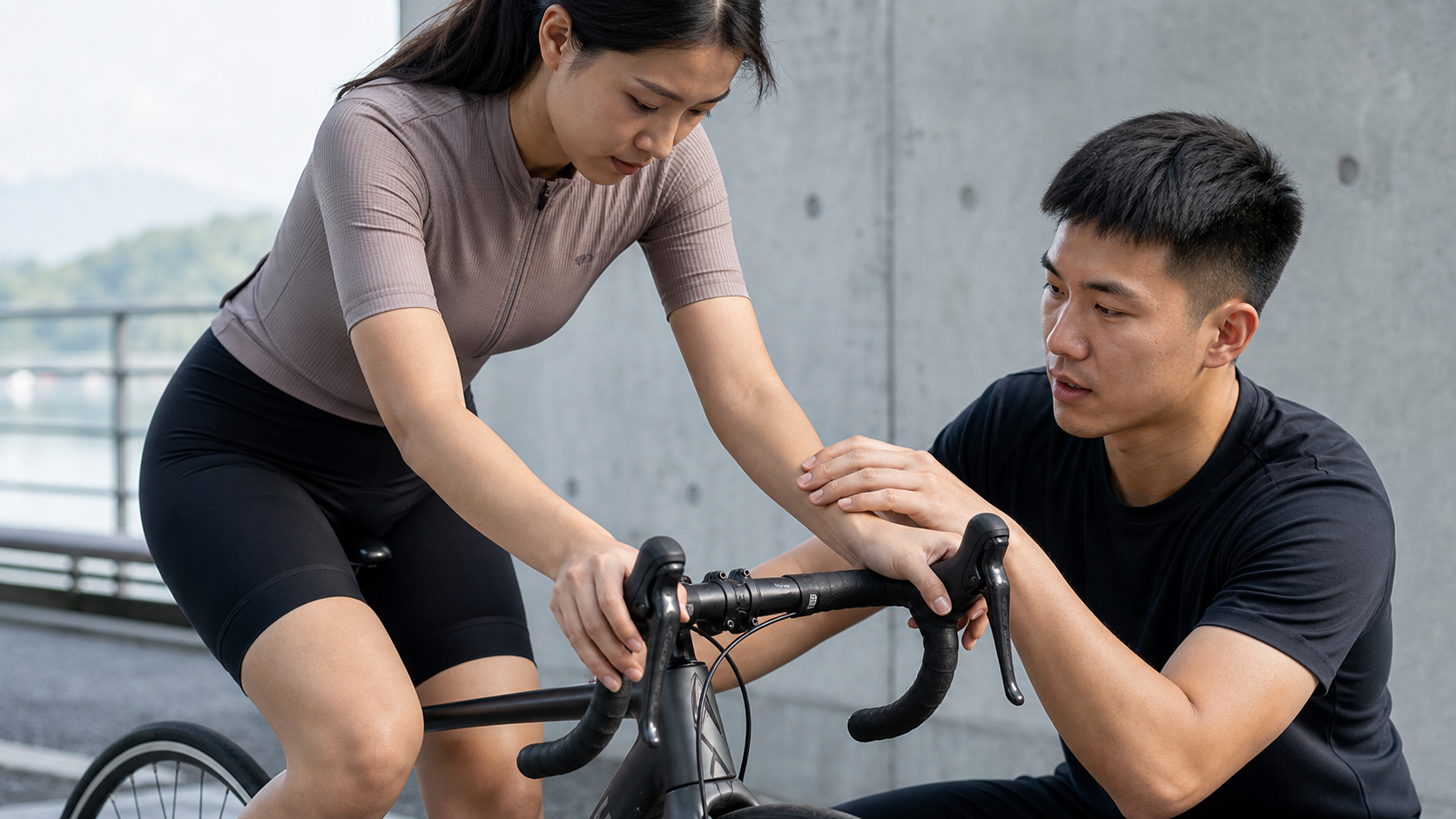
Starting with a Pair of Numb Hands
I once coached an engineer in his early forties—let’s call him A-Kai. He signed up for the Wuling Mountain Climb race and ramped up his training hard, riding over 200 km a week. One day he messaged me: “Coach, when I’m descending, my right pinky and ring finger go completely numb. After squeezing the brakes for a while, I lose strength. Is this a sign of a stroke?”
I asked him to take a deep breath first—this was almost certainly not a stroke. When someone tells me, “The numbness is exactly in the pinky and half the ring finger, and it only happens on long rides when I’m gripping the drops for a long time,” the first thing that comes to mind is the very typical ulnar nerve compression among cyclists, commonly known as “handlebar palsy.” Later, I coached dozens more clients with similar issues—road cyclists, commuters, and people who feel wrist pain doing push-ups, planks, or barbell back squats in the gym. I’ve become increasingly convinced of one thing:
Wrist and hand health is rarely just a problem of the “hand” alone. It’s the combined result of grip position, pressure distribution, supporting muscle strength, mobility, and recovery.
In this article, I want to explain “wrist protection, supporting exercises, and prevention” thoroughly from a coach’s perspective. Whether you’re a cyclist, a gym-goer, or a Taiwanese office worker who types on a computer, scrolls a phone all day, and exercises on weekends, you’ll find something you can put to use right away. Let’s build the concepts first, then move to practical tables, and finally give concrete action plans for people at different levels.
1. First, Understand: How the Wrist and Hand Actually Get Injured
The Wrist Isn’t a Single Bone—It’s a Precision Junction
The wrist is made up of 8 small carpal bones, the ends of the radius and ulna, plus a host of ligaments and tendons. It has to be both “mobile” (allowing your hand to rotate, flex, and extend) and “stable” (so it doesn’t collapse when you bear weight or grip heavy objects). These two demands are somewhat in conflict, which is why the wrist is especially prone to problems when it “needs stability but lacks supporting muscle strength.”
More critically, three important nerves pass through this region:
- Median nerve: Passes through the carpal tunnel and controls sensation in the thumb, index finger, middle finger, and half the ring finger. Compression here is the well-known carpal tunnel syndrome.
- Ulnar nerve: Travels through a channel on the inner wrist called Guyon’s canal, controlling the pinky and half the ring finger. “Handlebar palsy” in cyclists is mainly caused by compression of this nerve.
- Radial nerve: Runs along the outer, back side of the wrist. It’s less often compressed by a single posture, but chronic poor posture can still affect it.
Remembering this “map” is very useful: where the numbness is tells you which nerve is being compressed. Pinky numb → think ulnar nerve; thumb to middle finger numb → think median nerve. This isn’t about self-diagnosing or self-medicating, but about helping you communicate more precisely with your doctor or physical therapist.
Two Common Conditions in Cyclists
Based on the sports medicine and rehabilitation literature, the two most common hand nerve problems in cycling are:
-
Handlebar palsy / Ulnar nerve compression: Prolonged gripping of the handlebars, repeated vibration pounding the base of the palm, and excessive body weight pressing on the hands compress the ulnar nerve at Guyon’s canal. Symptoms include numbness, tingling, and weakness in the pinky and ring finger; in severe cases, fine movements like spreading and pinching the fingers become clumsy. The literature describes it as “compression syndrome of the deep (motor) branch of the ulnar nerve” and specifically emphasizes—individualized adjustment of the handlebars and riding position is key to preventing this type of nerve injury (see references at the end).
-
Carpal tunnel syndrome: Excessive wrist extension (bent upward) or flexion (pressed downward), combined with repetitive pressure from prolonged gripping, compresses the median nerve. Symptoms include tingling and numbness in the thumb, index, and middle fingers, along with hand weakness. From a rehabilitation perspective, when a rider fails to keep the wrist in a neutral position (neither bent up nor down), overextension stretches the median nerve; if the bike fit is too stretched out or the stem is too low, excess pressure is also dumped into the carpal tunnel.
In most cases, both conditions resolve once the compression is removed, but if left untreated with repeated long-term compression, permanent nerve damage is possible. That’s why I always stress to my clients: “Deal with it early, don’t tough it out.”
It’s Not Just Cycling: Daily Life and Gym Training Accumulate Too
Taiwanese people’s wrists are essentially “on duty” all day. During the day, you type on a keyboard and scroll your phone (overuse of the thumb creates the risk of so-called “mommy thumb,” i.e., De Quervain’s tenosynovitis); after work, you hit the gym for push-ups, planks, shoulder presses, and barbell back squats—all of these require the wrist to maintain stability under extension and load. If supporting muscle strength is insufficient and mobility is limited, the wrist is the part that gets sacrificed.
So I often say: If your hand goes numb on the bike, the problem isn’t necessarily just on the bike.
Quick Location Guide: What Numbness Where Means
I’ve organized the most common hand discomforts into a location-based reference table by “position.” One more reminder: this is a tool to help you communicate with medical professionals and judge “whether you should be more alert”—it’s not for self-diagnosis or self-treatment.
| Discomfort Location | Likely Involved Structure | Common Triggering Situations | Warning Signs to Watch |
|---|---|---|---|
| Numbness/weakness in pinky + half of ring finger | Ulnar nerve (Guyon’s canal) | Prolonged time on the drops, palm base pressing on handlebars | Finger spreading and pinching becomes clumsy |
| Tingling from thumb to middle finger | Median nerve (carpal tunnel) | Excessive wrist extension, prolonged gripping, nighttime | Waking up numb at night, declining grip strength |
| Pain at thumb base, radial side of wrist | Tendons (mommy-thumb type) | Phone scrolling, holding a baby, repetitive twisting | Sharp pain with thumb abduction |
| Pain on back of wrist when bearing weight | Joint/ligament load | Push-ups, planks, yoga downward dog | Pain increases with greater weight-bearing angle |
| Forearm soreness/bloating, weakness after prolonged gripping | Muscle overuse | Death-gripping the bars, insufficient grip strength | Improves with rest, recurs repeatedly |
Once you understand this table, you can describe your condition precisely to a rehab doctor or orthopedist, for example: “I have numbness on the pinky side, it flares up after riding on the drops for more than 20 minutes, and it subsides after 10 minutes of rest.” That kind of description is a hundred times more useful than “my hand is numb.”
2. Conceptual Foundation: Protection × Support × Recovery—A Three-Legged Stool, Missing Any Leg and It Falls
I like to think of wrist health as a three-legged stool:
| Leg | Core Concept | What Happens If Neglected |
|---|---|---|
| Protection | Reduce accumulation of pressure, vibration, and poor posture | Nerves repeatedly compressed, inflammation builds up |
| Support/Strength | Build forearm, grip, and wrist stabilizer muscles | Wrist collapses, compensates, can’t handle load |
| Recovery | Give tissues time to repair, address mobility | Chronic overuse, more pain the more you train |
Many people only focus on one leg: they buy expensive shock-absorbing gloves (protection) but never train their forearms (support); or they obsessively squeeze grip trainers (support) but ride hard every day without rest (no recovery). A three-legged stool falls if one leg is missing.
What “Supporting Exercises” Are Actually Supporting
The term “supporting exercises” sounds vague, but it really means the ability to keep the wrist stable, neutral, non-collapsing, and non-wobbling under load. It involves:
- Strength and balance of the forearm flexors and extensors: These two muscle groups are like the two ropes holding up a tent. If one side is too strong and the other too weak, the wrist drifts.
- Grip strength: Grip strength is actually a rough indicator of overall health and the foundation of wrist stability.
- Proprioception: The wrist’s ability to “know where it is”—especially important when bearing weight or balancing.
- Scapular and core linkage: When you bear weight on your hands, force travels from the shoulders and core down to the hands. If the upstream is stable, the wrist doesn’t have to bear the load alone.
That’s why when I program for my clients, I never just tell them to “shake out your hands and rotate your wrists.” Instead, I incorporate scapular stability, core work, and forearm training all together.
Why “Progressive Loading” Matters So Much
Connective tissues like tendons and ligaments have a specific trait: they get stronger in response to regular loading, but they adapt much more slowly than muscles. This means two things. First, your wrist support strength is something you can “train up,” not something fixed at birth—as long as you give it the right stimulus and enough time, it becomes more resilient. Second, it fears “sudden spikes” in load the most—someone who rarely rides suddenly signs up for a 100-plus-kilometer event; or someone who doesn’t usually lift weights walks into the gym and cranks out endless planks and push-ups. When the tissue can’t adapt in time, problems tend to surface at the weak link—often the wrist.
When I work with athletes, I’m very particular about “keeping the increase in volume gradual.” Whether it’s cycling mileage, time spent bearing weight on the hands, or forearm training load, I’d rather have them add slowly and steadily than jump up all at once. This principle doesn’t just protect the wrist—it applies to the knees, lower back, and Achilles tendon too. A large portion of sports injuries essentially boil down to “your body wasn’t ready, but you asked it to take on that much anyway.”
三、Practical Methods (Part 1): A Wrist Protection Checklist for Cyclists
Let’s start with cyclists, because Taiwan has a huge cycling population. From the West Coast Highway, the Sun Moon Lake loop, the Beiyi Highway, to Wuling, the more long-distance riding people do, the more hand problems follow. Here’s the complete checklist I give my athletes.
3-1 Handlebar and Cockpit Setup (Highest Priority)
Literature and clinical experience agree that personalized handlebar and posture adjustments are the most important step in preventing nerve compression. Rather than spending money on accessories, it’s better to get the fit right first.
| Check Item | Ideal State | Common Mistakes |
|---|---|---|
| Wrist angle | Wrist near neutral when gripping, not obviously bent up or pressed down | Wrist excessively extended (dorsiflexed) while resting on the bar |
| Weight distribution | Body weight mainly supported by core and sit bones; hands bear only around 30% of the support feel | Upper body “hangs” on the hands, hands bearing too much weight |
| Stem height | Adjust based on flexibility and riding purpose; don’t blindly lower it | “Slammed stem” for looks, excessive forward lean |
| Brake/shifter lever angle | Thumb web and forearm form a straight line | Levers too low, forcing the wrist to bend downward |
| Saddle fore/aft and tilt | Avoid the body constantly sliding forward and relying on the hands to hold it up | Saddle tilted forward, shifting weight onto the hands |
If you’re not sure how to adjust, many bike shops and sports medicine clinics in Taiwan now offer professional fitting services. Paying once to get it dialed in is far more worthwhile than putting up with numb hands long-term.
3-2 Grip Position and Self-Management While Riding
- Change grip position every 10 to 15 minutes: rotate between the tops, drops, brake/shifter hoods, and aero bars so the pressure points don’t keep landing on the same nerve. This is the most practical trick for preventing cyclist’s palsy.
- Grip the bar “loosely,” don’t “death-grip” it: imagine holding a small bird—don’t let it fly away, but don’t crush it either. A tight grip increases forearm tension and nerve pressure.
- On rough sections with vibration, like corners and descents, keep elbows slightly bent as shock absorbers: if you lock your elbows, all the vibration goes straight into your wrists and shoulders.
- On long rides, always schedule “hands-free” breaks: every 30 to 60 minutes, stop somewhere safe, shake out your hands, open and close your fingers, and rotate your wrists to get blood flow back.
3-3 The Role of Accessories (Supporting Cast, Not the Star)
- Padded gloves: they help distribute pressure on the heel of the palm and reduce vibration, especially beneficial for the ulnar nerve area. But they’re “pressure relief”—they can’t replace posture adjustments.
- Thicker bar tape / grips: moderate thickening can reduce localized pressure, especially noticeable on gravel roads and long distances.
- Suspension seatposts, wider tires with lower pressure: reduce road vibration at the source before it reaches your hands. Road surface quality in Taiwan varies quite a bit, and this makes a real difference on long rides.
I often remind my athletes: accessories are bonus points; fitting and grip technique are the required exam. No matter how expensive your gloves are, if your posture is wrong, you’ll still get numbness.
3-4 Another Case Study: Not Cycling, but Bearing Weight on Hands
Let me share the story of another athlete, Xiao-Shan. She doesn’t ride much—she’s into weight training and yoga. When she came to see me, her issue was, “Every time I do a plank or downward dog, the back of my wrist hurts so much I can’t hold it.” Many people’s first reaction is “your wrist is injured, you need to rest,” but when I watched her move, I found something different: her scapulae weren’t engaging at all, her core was loose, and her entire upper body weight was dumping into her wrists. On top of that, her wrist mobility was tight, so when the weight-bearing angle increased, she hit her limit.
Her wrist itself wasn’t broken—what was broken was the support chain. We did three things: first, we used the four-stage progression from 4-3, starting with fist planks and elevated hand support, to rebuild tolerance in a pain-free range; at the same time, we strengthened her forearm extensors and scapular stability; then we gradually opened up her wrist mobility. In about five weeks, she was back to full palm planks on the floor with no pain.
I’m sharing this case to show you the other side: wrist pain isn’t necessarily “caused” by cycling or a specific movement—often, the shoulders and core upstream fail to absorb the force, leaving the wrist to carry the load for the whole body. If you widen your view to the entire support chain, that’s usually where you’ll find the real solution.
四、Practical Methods (Part 2): Supportive Training Program
Protection is about “reducing the bad”; training is about “increasing the good.” Below is the wrist and forearm support training I actually assign to my athletes. The movements aren’t hard—the key is progressive loading, performed within a pain-free range.
4-1 Mobility and Warm-Up (Before Every Session)
| Movement | How To | Suggested Dose |
|---|---|---|
| Wrist flexion/extension circles | Move wrist up/down, side to side, and in circles, slowly | 10 reps per direction |
| Prayer stretch | Press palms together downward until you feel a stretch in the forearms; reverse with backs of hands together | Hold 15–20 seconds, 2 sets |
| Nerve glides (ulnar/median) | Arm extension combined with wrist and finger open/close, letting the nerve “glide” rather than hard stretching | 5–8 gentle reps |
| Forearm massage/relaxation | Use the other hand or a massage ball to gently press the inner and outer forearm | 30–60 seconds each side |
Note: nerve glides should be “gentle”—if you feel significant tingling or electric sensations, back off a bit. This isn’t a stretching contest.
4-2 Support and Strength Training (2–3 Times Per Week)
| Movement | Training Focus | Starting Dose | Progression |
|---|---|---|---|
| Wrist curl (flexion) | Forearm flexors | Bodyweight or 1–2 kg, 15 reps × 2–3 sets | Gradually increase to 3–5 kg |
| Reverse wrist curl (extension) | Forearm extensors, balance flex/ext | Bodyweight or 1 kg, 15 reps × 2–3 sets | Gradually increase weight |
| Farmer’s carry / kettlebell carry | Grip strength and overall stability | Walk 20–30 meters with a load you can handle per hand | Increase distance or weight |
| Kneeling hand-support forward/back shift | Weight-bearing proprioception, neutral position tolerance | 30 seconds × 2–3 sets | Progress to full plank |
| Plank (forearm or palm) | Scapular-core connection, support chain | 20–40 seconds × 3 sets | Extend time, add dynamic variations |
| Grip training (towel / gripper) | Grip strength | 10–15 open/close reps per hand | Gradually increase resistance |
Programming Principles:
- Pain-free first, then add load: if any movement triggers persistent numbness or pain, regress or stop.
- Balance flexion and extension: most people have overdeveloped forearm flexors (the gripping group) and weak extensors—don’t skip the reverse wrist curls.
- Schedule recovery days each week: tendons recover slower than muscles; don’t hammer your forearms every single day.
4-3 A Progressive Wrist Protocol for “Pain When Bearing Weight on Hands”
Many people who do push-ups, planks, or yoga experience wrist pain the moment they put weight on their hands. Here’s the four-stage progression I give them:
- Fist plank: start with fists (wrist in neutral) for the plank, avoiding extension stress.
- Half-kneeling palm support: in a kneeling position, keep the pressure on the heel of the palm within a tolerable range to build neutral tolerance.
- Elevated hand support: place hands on a chair or step to reduce the wrist extension angle.
- Full palm support on the floor: once the first three stages are pain-free, return to normal floor support.
I’ve used this method on several athletes who “get wrist pain every time they plank,” and typically they see significant improvement within 4 to 8 weeks. The key is don’t skip levels.
五、Common Mistakes and Corrections
After years of coaching athletes, I see the same mistakes repeating. Here are the six most common ones.
Mistake 1: Continuing to ride despite numb hands
Correction: Numbness is your nerves crying for help. Occasional numbness that resolves when you change position can be monitored; but if it is persistent, recurring, or accompanied by weakness, stop and address it—don’t assume “it’ll go away if I keep riding.” Prolonged compression can lead to irreversible nerve damage.
Mistake 2: Only training grip strength, not the extensors
Correction: Imbalance between forearm flexion and extension is a major cause of chronic wrist pain. Every time you train gripping, pair it with a set of reverse wrist curls to keep the “two tent ropes” balanced.
Mistake 3: Treating wrist care as just “shaking your hands out”
Correction: Mobility matters, but if you only stretch without building strength, your wrists still won’t hold up under load. Protection + support + recovery must go together.
Mistake 4: Obsessing over accessories while ignoring bike fitting
Correction: Gel gloves and thicker bar tape are aids. If your weight distribution, wrist angle, and stem height aren’t set correctly, accessories will have limited effect. Get your cockpit setup right first.
Mistake 5: Skipping warm-up and skipping cool-down
Correction: Forearm and wrist tendons are prone to injury when loaded while cold. Doing mobility warm-ups before exercise and relaxing the forearms afterward is the cheapest insurance you can buy.
Mistake 6: Self-prescribing long-term brace use at the first sign of trouble
Correction: Wrist braces and splints are reasonable for support during acute flare-ups or specific activities, but long-term reliance will weaken your stabilizer muscles. Braces are transitional tools—you also need to rebuild your own support strength, and seek medical evaluation if symptoms persist.
6. Actionable Advice for Readers at Different Levels
Everyone starts from a different point. I’ve split common groups into three categories with corresponding approaches.
Beginner: Sedentary office workers, weekend warriors, new cyclists
Your focus is building a foundation and prevention.
- Spend 3–5 minutes daily on wrist flexion/extension circles and prayer stretches—make it a habit like brushing your teeth.
- Twice a week, do 2 sets each of bodyweight wrist curls and reverse wrist curls to establish basic flexion/extension balance.
- Every 45–60 minutes at work, take your wrists off the keyboard/mouse—shake them out and open and close your fingers.
- From the start, build the habit of “changing hand positions every 10–15 minutes” on the bike. Don’t wait until numbness sets in.
Intermediate: Regular exercisers, several hundred km per month, frequent gym-goers
Your focus is balance and progressive loading.
- Incorporate the strength program from Section 4-2 into 2–3 sessions per week, training flexion and extension equally, and add farmer’s carries for overall grip strength and stability.
- If push-ups or planks cause wrist pain, use the four-stage progression from Section 4-3—don’t force full palm-on-floor support.
- Get a proper professional bike fitting to dial in wrist angle, weight distribution, and stem height.
- Before long rides (e.g., around Hualien-Taitung, Taipei-Kaohsiung, Wuling), schedule several “simulated long-duration grip” training sessions so your hands adapt.
Advanced: Racers, ultra-distance riders, coaches
Your focus is fine-tuned management and early detection.
- Keep your own “hand log”: record which road conditions, ride durations, and hand positions trigger numbness or pain to identify your personal thresholds.
- Incorporate nerve glides and forearm relaxation into your daily recovery routine—even more so during race season.
- Pay close attention to “weakness” signals (e.g., difficulty squeezing brakes, clumsier fine motor skills)—these deserve more attention than mere numbness. Seek sports medicine or rehab evaluation early.
- When coaching athletes, make fitting and grip management mandatory curriculum—don’t let athletes rely on willpower alone.
7. Notes Specific to the Taiwan Context
A few practical points that align closely with daily life in Taiwan:
- Climate and vibration: Many suburban and industrial roads in Taiwan have inconsistent surfaces, and vibration accumulates significantly over long rides. Wider tires, slightly lower tire pressure, and padded bar tape and gloves help a lot in reducing palm-base vibration.
- Humidity and heat: In summer, sweaty hands slip easily, making people unconsciously grip the bar harder and increasing forearm tension. Choose breathable, non-slip gloves, dry your hands and hydrate mid-ride—don’t let “fear of slipping” turn into “death grip.”
- Eating out and nutrition: Eating out is common in Taiwan, and a typical bento is heavy on carbs and often short on protein. Tendon and muscle repair requires adequate protein. If your training volume is high, make sure every meal includes a protein source (beans, fish, eggs, meat), and stay hydrated with plenty of fruits and vegetables. I’m not discussing any specific supplements here—balanced eating is the foundation. Rather than obsessing over some miracle food, first nail down the three mundane things: protein at every meal, enough water, and adequate fruits and vegetables.
- Choosing your terrain: For beginners building grip habits and body awareness, I recommend accumulating riding experience on simple surfaces like riverside bike paths or gentle lake-loop routes before tackling rougher mountain roads or gravel with more vibration. Building wrist tolerance gradually is far safer than pushing long distances and harsh terrain from day one.
- Healthcare access: Taiwan’s National Health Insurance makes seeing a doctor easy. Rehab medicine, orthopedics, and neurology can all help evaluate hand numbness and wrist pain. If you experience persistent numbness, significant weakness, or signs of muscle atrophy, don’t delay—seek early evaluation such as nerve conduction studies. That’s far more useful than comparing symptoms online.
Don’t Forget the Desk: The Daily Reality of Taiwanese Office Workers
People in Taiwan spend long hours in front of computers every day. For active individuals, your wrists are already partially “spent” during the eight-hour workday before you even train. I often remind my athletes: don’t let the office desk steal the wrist capacity you need for sports. A few simple principles:
- Keep wrists neutral at the keyboard and mouse: Don’t let your wrists hover extended upward or bent downward for long periods—support your forearms as much as possible. Excessive dorsiflexion is like having your wrists bent upward on the bike; it gradually compresses the median nerve.
- Don’t scroll your phone with the same thumb relentlessly: Prolonged high-frequency use of a single thumb is a common cause of De Quervain’s tenosynovitis (“mommy thumb”). Spread the load across fingers and take regular breaks.
- Take micro-breaks every 45–60 minutes: Stand up, shake your hands out, do a few wrist flexion/extension circles to let blood flow and nerves “catch their breath.”
- Sleep posture counts too: Some people experience hand numbness at night related to prolonged wrist bending during sleep. If your hands are often numb when you wake up, that’s a worthwhile clue to mention to your doctor.
Exercise and daily life are connected. If you treat your wrists better at the office, they’ll have more “capital” to draw on when you ride or lift on the weekend.
When You Must See a Doctor: Red Flag Warning Signs
Most wrist discomfort improves with adjustments and training, but some signals mean you should seek professional evaluation promptly—don’t keep pushing through or comparing symptoms online. I’ve organized them into a red flag table.
| Red Flag Warning Sign | Why It Matters | Recommended Action |
|---|---|---|
| Numbness persists despite rest | May indicate more severe or prolonged nerve compression | Seek medical evaluation; nerve conduction studies may be needed |
| Significant weakness, difficulty holding objects | Signal that motor function of the nerve is affected | Seek care early—don’t delay |
| Hand muscles appear smaller or atrophied | Warning sign of long-term nerve damage | Seek medical attention promptly |
| Wrist swelling, pain, or deformity after trauma | Possible fracture or ligament injury | Orthopedics / emergency evaluation |
| Accompanied by fever, redness, swelling, or heat | Possible infection or inflammation requiring treatment | Seek medical attention promptly |
If you see these, don’t hesitate. Taiwan’s NHI keeps the barrier to seeing a doctor low—one clinic visit for peace of mind and proper direction is well worth it. Any judgment related to disease or nerve damage should be left to physicians and therapists; this article provides only general health education.
8. Frequently Asked Questions (FAQ)
Q1: How long does hand numbness last after cycling?
A: Most temporary hand numbness after riding will gradually subside once pressure is removed and you rest for a while. However, if your hands go numb on every ride, or the numbness persists after rest, it means the compression or posture issue hasn’t been resolved and needs adjustment, with medical attention considered.
Q2: Is it good to wear a wrist brace while cycling or exercising?
A: During acute discomfort or specific high-risk activities, a wrist brace providing support is a reasonable transitional measure. But long-term unconditional reliance is not recommended, as your stabilizing muscles will grow progressively weaker. Combining bracing with strength training is the long-term solution.
Q3: Can I continue training with wrist pain?
A: The principle is “move within a pain-free range.” Mild tightness that doesn’t affect movement can be observed and adjusted; but persistent pain, pain that worsens with training, or numbness and weakness accompanying the pain means you should back off, rest, and seek professional assessment—don’t tough it out through sheer willpower.
Q4: Can grip strengtheners improve hand numbness?
A: Grip training can strengthen gripping and stability and is a helpful component, but hand numbness often involves nerve compression and posture, so grip training alone may not address the root cause. It needs to be handled together with protection (pressure relief, posture) and recovery.
Q5: Is thumb pain from phone use the same as cycling hand numbness?
A: Not exactly. Pain on the thumb side more often involves tendons (such as De Quervain’s tenosynovitis), while pinky numbness from cycling is mostly ulnar nerve compression. The locations differ and the mechanisms differ, but the common principles are the same—reduce repetitive stress, train support, allow recovery, and seek medical care when necessary.
Q6: Will forearm training make my arms bulky and affect cycling?
A: With the dosage in this article (light weight, high repetitions, focusing on stability and balance), the main benefit is improved tolerance and stability—it won’t turn you into a strongman. For the vast majority of athletes, the wrist protection gained from forearm training far outweighs any concern about “getting bulky.”
Q7: Do I have to buy expensive shock-absorbing gloves or ergonomic handlebars?
A: Not necessarily. These accessories do relieve pressure and work well for some people, but they are “aids.” If your fit and grip posture aren’t corrected, the effectiveness of these accessories will be diminished. If budget is limited, start with the free things: adjust your cockpit, change your grip posture, reposition your hands, and schedule rest breaks.
Q8: My wrist mobility is very tight—will forcing it to stretch cause injury?
A: Mobility should be improved “progressively and painlessly,” not forced with brute strength. Movements like prayer stretches and wrist circles should be done slowly within a mild pulling sensation and pain-free range. If stretching causes severe pain or electric-shock numbness, back off a bit and consider seeking guidance from a physical therapist.
Q9: Do children or older adults starting exercise need special attention to their wrists?
A: The principles are the same—progress gradually, stay within a pain-free range, and pay attention to the support chain. For older adults with degenerative joint conditions or other chronic diseases, it’s recommended to consult a physician before starting a new exercise program for individualized assessment, rather than directly applying someone else’s training plan.
Conclusion: Treat Your Wrists as Joints That Need Managing
Back to A-Kai from the beginning. We did three things afterward: re-adjusted his cockpit setup so the brake/shift lever angle aligned with his wrist in a straight line, developed the habit of changing hand positions every 10 minutes; added forearm flexion/extension and grip training twice a week; and always scheduled rest breaks with hand shaking on long rides. About six weeks later, the numbness and weakness when braking downhill had almost disappeared, and he ultimately completed the Wuling challenge successfully.
His story has no magic formula—just steadily propping up each leg of the three-legged stool: protection, support, and recovery. Hand and wrist health works that way—it won’t be permanently solved by buying top-tier gloves, nor is it doomed because you occasionally experience hand numbness. It requires you to manage it with a little daily attention, just like you would your knees or lower back.
If you take away only one sentence today, I hope it’s this: Hand numbness isn’t something to endure—it’s something to understand and address, and the sooner you take it seriously, the better. Change your grip, adjust your fit, do a set of reverse wrist curls, schedule a rest break—these small things, over the long run, are what determine how far your hands can ride with you and how long they can hold on.
Wishing you steady hands, long roads, and rides that are both enjoyable and safe to train. We’ll see you on the next ride and the next training session, whether in the mountains or in the gym.
This article is educational content and does not replace individual diagnosis and treatment advice from physicians, physical therapists, or nutritionists. If you have persistent hand numbness, weakness, muscle atrophy, or any disease-related concerns, please seek medical attention early and receive individualized assessment.
References
- Handlebar palsy — a compression syndrome of the deep terminal (motor) branch of the ulnar nerve in biking(PubMed): https://pubmed.ncbi.nlm.nih.gov/12382163/
- Cyclist’s palsy — Physiopedia: https://www.physio-pedia.com/Cyclist’s_palsy
- Handlebar Palsy also known as Ulnar Nerve Compression — Hand Therapy Academy: https://www.handtherapyacademy.com/diagnoses/handlebar-palsy-also-know-as-ulnar-nerve-compression/
- Carpal Tunnel Syndrome in Cycling — How to Avoid Pain(Ergon Bike): https://www.ergonbike.com/en/magazine/carpal-tunnel-syndrome-in-cycling
- What to Know about Cycling and Wrist Pain(HSS): https://www.hss.edu/article_wrist-pain-cycling.asp
Related Reading
- Wrist and Forearm Stretching: Hand Health Guidelines for Cyclists
- Wrist and Shoulder Protection for Cyclists: A Prevention Guide for Ulnar Nerve Compression and Carpal Tunnel Syndrome
- Cyclist’s Palsy: Causes and Prevention of Ulnar and Median Nerve Compression
- Carpal Tunnel Syndrome and Exercise: Causes, Posture Adjustments, and Prevention—A Wrist Care Lesson for Everyone from Cyclists to Typists
[教學] Premiere 影片 手震 修正 教學 防抖 單眼 影像 GoPro 穩定 Video Stabilization
8 年前
Never Stop 西進武嶺 前後雙機 完整全程錄影 訓練台 實境
8 年前
Insta 360 One 超級防手震技術實測
7 年前
Canyon 公路車斷把手 五年老車特規還能修嗎? 維修保養全記錄 feat. 501單車監理站 | 公路車 | CT Yeh
4 年前
CT 喇低賽) 武嶺牽車 才是王道 西進牽車四小時內秘訣 攝手位置 如何判斷 防抽筋小秘訣
7 年前
實錄) 車隊中 攝影師 是如何用感情拍片的呢? 單車 移動攝影 攝影師的視角 米粉坡 手持 DJI OSMO POCKET Ft. Team Neko
7 年前
洗完單車整隻手黑的解決妙招🤣 #bike
1 年前
2024 如來神掌 百人約騎挑戰!feat. 秘境單車社團 / 神人們太可怕 / 全程錄影 x 完整坡度解析 / 公路車 / CT Yeh
2 年前