Sports Insurance and Sports Safety: Coaches Help You Turn "What Ifs" into Manageable Risk Management
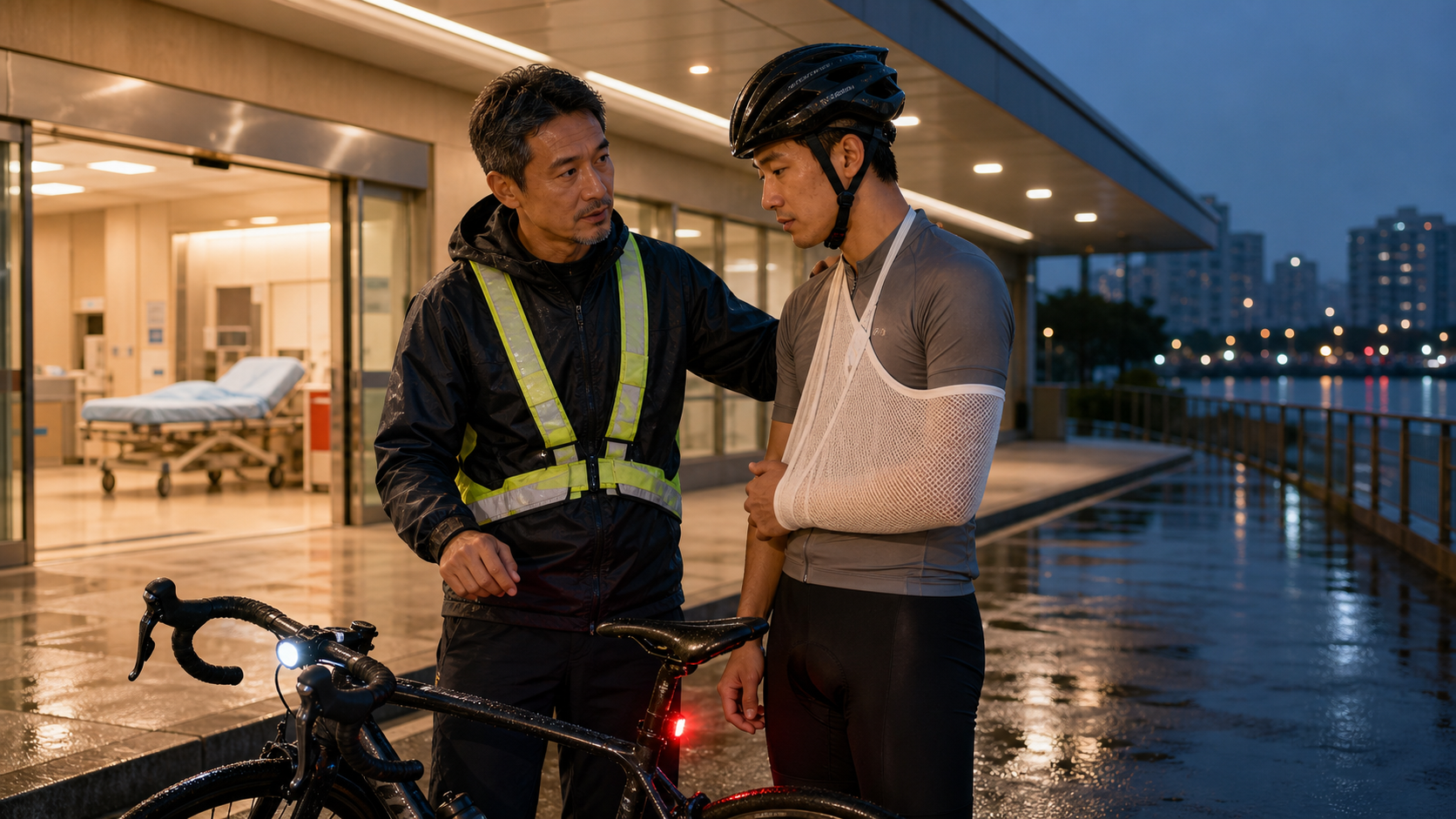
It Started with a Late-Night Phone Call
It was almost 11 p.m. on a Sunday when my phone rang. On the other end was Ah-Hong, a rider I’d been coaching for over two years. His voice was trembling: “Coach, I just crashed on the riverside bike path. I think my collarbone is broken. I’m in the ER now.”
Ah-Hong is the kind of rider who takes things seriously—trainer rides on weekdays, long distances on weekends, logging over 6,000 kilometers a year. He has solid technique and good fitness. But that evening, a thunderstorm had rolled through, leaving a stretch of the riverside path slick with reflective puddles. To avoid a pedestrian suddenly riding against traffic, his front wheel slid out from under him. Broken collarbone, mild concussion—thankfully he was wearing a helmet, or it could have been far worse.
I rushed to the hospital and sat with him through registration and the wait for X-rays. During the lull, he asked me a question that stuck with me: “Coach, does this count as a work injury? Can I file a claim? I never bought any sports insurance.”
In that moment, I realized—I’d spent two years teaching him pedaling, pacing, nutrition, and climbing strategy, but I’d never once had a serious conversation with him about “sports risk management.” I taught him how to ride faster and farther, but I never taught him how to protect his body and his wallet when “what if” actually happens.
This is a blind spot I’ve kept reminding myself about over fifteen years as a coach: we focus so much on “performance” that we often overlook “risk.” And risk management is actually the true foundation that lets you keep exercising happily for a lifetime.
In this article, I want to lay out sports insurance and sports safety clearly from the practical perspective of coaching athletes. Not to scare you, but so that after reading it, you can turn “what if” from a vague fear into something you can actively manage, quantify, and reduce.
A note upfront: This article is educational content and cannot replace individual diagnosis and treatment advice from a physician, physical therapist, or nutritionist, nor can it replace professional planning of your personal policies by an insurance agent or financial advisor. Policy details and claim determinations vary by insurer—always read the terms carefully and confirm with professionals before purchasing.
Foundational Concepts: The Four Quadrants of Sports Risk Management
Many people hear “risk management” and think it sounds corporate and cold. But its logic is actually very intuitive—it just means asking yourself two questions:
- How likely is this bad thing to happen?
- If it does happen, how severe are the consequences?
Plot these two dimensions on a four-quadrant chart, and you can clearly see which strategy to use for different sports risks.
Four Strategies for Risk Management
| Quadrant | Likelihood × Severity | Corresponding Strategy | Sports Scenario Example |
|---|---|---|---|
| High likelihood × Low severity | Happens often but not life-threatening | Accept/Self-manage | Minor scrapes, heavy legs, mild sunburn |
| High likelihood × High severity | Both frequent and serious | Avoid/Eliminate at the source | Riding against traffic, running red lights, unlicensed racing, riding drunk |
| Low likelihood × Low severity | Occasional minor losses | Reduce/Prevent | Small scratches, mild dehydration |
| Low likelihood × High severity | Rare but devastating when it happens | Transfer (insurance) | Major crashes, fracture surgery, disability, death |
Once you understand this table, you’ll see: insurance is a tool specifically designed for the “low likelihood, high severity” quadrant. It’s not there to cover your post-ride massage for sore legs—it’s there to absorb the kind of major accident that could saddle you with hundreds of thousands in medical bills or even cost you your income.
This is why I often tell my athletes: what you’re buying with insurance isn’t “likelihood”—it’s “consequences.” You might ride your whole life without a major accident, but if it happens just once, the bills and the life impact are something you can’t shoulder alone. Spending a little money to transfer that “can’t shoulder it” risk away is the core value of insurance.
Why Athletes Especially Need to Actively Manage Risk
Taiwan’s sports participation has grown dramatically in recent years, especially in cycling, road running, and triathlon. Exercise is certainly good for your health, but any activity that’s outdoors, involves speed, and demands intensity carries objective risk.
Take cycling as an example. According to relevant research data in Taiwan, the number of cycling accident injuries has shown a clear upward trend over several years, and the proportion of cycling deaths among all traffic fatalities is also increasing. This isn’t to scare you off riding—it’s to remind you: as more people hit the road, risk management can no longer rely on “luck.”
Sports Safety: Turning “It Won’t Happen” into “Lower Probability”
Before I talk about insurance, I always talk about safety first. Because insurance is “after-the-fact compensation,” while safety habits are “before-the-fact prevention.” A good coach will tell you: the best claim is the one you never need to file.
Three Lines of Defense for Safety Habits
I break sports safety down into three lines of defense, from the outside in:
Line One: Being Seen (Visibility)
Many crashes and collisions happen because “the other person didn’t see you.” Especially during Taiwan’s evening rush hour, when traffic is heavy and light fades fast, visibility is the key to survival.
- A white front light and red rear light are basic equipment—even in daylight, consider running them in “daytime flashing mode”
- Wear bright or reflective jerseys and ankle reflectors (the up-and-down motion of your feet is what drivers notice most)
- Stay out of the blind spots of large vehicles’ inner wheel paths; at intersections, better to go slow and wait
Line Two: Being Protected (Gear)
For this one, I want to spend some time on helmets, because they offer the highest “return on investment” of any piece of sports gear.
According to a meta-analysis of multiple international studies, wearing a helmet while cycling significantly reduces the risk of head and brain injuries. A 2018 meta-analysis published in Accident Analysis & Prevention (pooling 55 studies from 1989 to 2017) found that helmet use reduced head injuries by about 48%, severe head injuries by about 60%, and traumatic brain injuries by about 53%, while reducing the total number of deaths or serious injuries by about 34%. Local Taiwanese research has also indicated that riders without helmets face a significantly higher risk of poor outcomes (death, vegetative state, severe disability) than those with helmets.
These numbers mean a lot to me. I often tell my athletes: you’ll happily spend NT$30,000 on a wheelset and NT$20,000 on a bike computer, but you balk at spending two or three thousand on a certified helmet and replacing it every five years—that’s putting your resources in the wrong order.
A few practical points about helmets:
- Always buckle it and tighten it—leave about one finger’s width between the strap and your chin; too loose is the same as not wearing one
- Replace it after any crash, even if it looks fine on the outside—the EPS foam’s impact structure may already be crushed and compromised
- They have a lifespan—generally recommended to replace every three to five years, as prolonged sun exposure and sweat degrade the materials
- Newer rotational impact systems (like MIPS) add an extra layer of protection against angled and rotational impacts; worth considering if your budget allows
Line Three: Being in Control (Skill and Judgment)
No matter how good your gear is, nothing beats not crashing in the first place. Technique and reading the environment are the most fundamental safety measures.
- Brake before descents and corners—don’t “brake through the turn”
- On wet surfaces (Taiwan’s afternoon thunderstorms are common), braking distances lengthen, and road markings and manhole covers are especially slippery
- When riding in a group, keep a safe following distance and don’t overlap your front wheel with the rider ahead
- Fatigue, dehydration, and low blood sugar impair judgment and slow reaction times—when you’re tired, rest. Don’t push through that last ten kilometers.
Training Load and Injury Risk: The Safe Half
Many people assume that sports safety is only about “crashes on the road.” In reality, training planning itself is a form of risk management. Overtraining and insufficient recovery allow fatigue to accumulate, immunity to drop, and focus to deteriorate—all of which directly increase the likelihood of “incidents on the road” and “sports injuries.”
I often use a simple principle to remind athletes to control their training load: Don’t increase your weekly training volume too quickly or too aggressively. Suddenly spiking weekly mileage or intensity is a common trigger for overuse injuries like runner’s knee, iliotibial band syndrome, and stress fractures. Giving your body time to adapt is the smart way to progress.
Here are a few practical self-monitoring signals. If any of these appear, it’s time to cut back or rest:
- Morning resting heart rate is noticeably higher than usual (e.g., normally 55 bpm, but jumps above 65 bpm for several consecutive days)
- Poor sleep quality, daytime fatigue or lethargy
- The same intensity feels unusually hard, or heart rate won’t rise or won’t come down
- Low mood, lack of motivation to train
- A specific area remains sore beyond the normal recovery time
Remember: Recovery isn’t wasted time; recovery is part of training. An athlete who knows when to hit the brakes is the one who goes far.
Special Notes for the Taiwanese Context
Taiwan’s sports environment has several unique risk points that I specifically remind my athletes about:
- Climate: Summer heat and humidity are extreme. Heat injuries (heat exhaustion, heat stroke) are silent killers. Avoid riding around midday, and stay on top of hydration and electrolyte intake.
- Afternoon thunderstorms: They arrive suddenly and intensely. Wet roads combined with reduced visibility create peak crash conditions.
- Riverside bike paths: They look safe, but holiday crowds, pedestrians, dog walkers, wrong-way riders, and sudden direction changes are common. Keep your speed in check.
- Mountain roads (e.g., classic routes like Wuling, Beiyi): Long descents test your rims and brakes. Supply points are scarce and cell reception is poor. Always ride with someone or let family and friends know your route.
Practical Approach: How to Choose Sports Insurance
Alright, safety covered. Now let’s get into what gives most people a headache—how to actually buy insurance.
Let’s establish a core principle first: The order of insurance planning is always “major risks first, minor risks second; life and limb first, property second.” In other words, transfer the risks that could financially devastate your family first, then consider property damage like bike theft.
Common Insurance Types for Athletes
In the Taiwanese market, insurance relevant to sports safety can generally be divided into several categories. The table below helps you quickly understand what each one covers:
| Insurance Type | Main Coverage | Significance for Athletes |
|---|---|---|
| Accident Insurance (Personal Injury) | Death and disability resulting from accidents | The foundation of the pyramid; handles the most severe outcomes |
| Accident Medical Insurance | Medical expenses for outpatient care, hospitalization, and surgery caused by accidents | Reimburses actual expenses for crash abrasions requiring stitches, fracture surgeries, etc. |
| Actual Reimbursement Medical Insurance | Out-of-pocket hospital expenses (room differentials, self-paid medical materials, etc.) | Covers the gaps not paid by National Health Insurance |
| Disability Support / Long-Term Care Related | Long-term living support after disability caused by accident or illness | Income replacement if a major accident leaves you unable to work |
| Bicycle / Sports-Specific Additional Insurance | Injury coverage during rides, third-party liability, bike collision and theft | Supplements coverage for specific sports scenarios |
| Travel Insurance (Including Overseas) | Accidents and medical coverage during overseas competitions and cycling trips | Essential for international races or overseas rides |
How I Prioritize for My Athletes
If a beginner athlete asks me, “I have a limited budget; which should I buy first?”, my recommended order is usually:
- Secure basic accident insurance and accident medical insurance first. This is the highest value-for-money and most fundamental layer. In terms of limits, the actual reimbursement for accident medical expenses and hospitalization daily allowance are what you’ll actually use for a fracture from a crash.
- Then look at your family responsibilities. If you are the family’s primary breadwinner, coverage like “disability support” is crucial—because if a major accident leaves you unable to work, the impact hits your entire family.
- Finally, consider sport-specific add-ons, such as bicycle third-party liability insurance (for when you hit someone and owe them compensation) and coverage for bike collision and theft. These are the icing on the cake, but they’re also very practical for owners of high-value bikes or frequent racers.
Insurance Planning for Three Levels of Athletes
Here’s a table outlining a “conceptual” planning direction for athletes at different commitment levels. Note: This is a conceptual illustration, not a product recommendation. For actual limits and products, consult a professional who can tailor them to your income, family situation, and health status.
| Athlete Type | Typical Profile | Planning Focus | Special Reminder |
|---|---|---|---|
| Casual Beginner | Rides 1-2 times a week, commuting or riverside paths | Basic accident insurance + accident medical | Don’t dismiss it just because it’s “only commuting”—commuting actually has the densest traffic |
| Regular Enthusiast | Rides 3-5 times a week, joins weekend group rides and events | Accident + medical + bicycle liability insurance | Consider third-party liability for hitting someone or being hit during group rides |
| Competitive Racer | Regular races, overseas competitions, high-intensity training | Comprehensive accident + disability support + overseas travel insurance | For overseas races, make sure overseas medical coverage and evacuation limits are sufficient |
Three Policy Details You Must Scrutinize
When buying sports insurance, the devil is in the details. Here are three things I always tell my athletes to verify when reviewing a policy:
1. The Definition of “Accident” and Exclusions
In insurance, an “accident” typically means an event that is “external, sudden, and non-illness-related.” Some policies have exclusions or additional premium requirements for “specific high-risk activities” (e.g., racing, extreme sports). If you participate in formal competitions, you must ask clearly whether the competition period is covered. Many people assume they’re covered, only to find out after an incident that competitions were excluded.
2. How the “Limits” and “Daily Allowance” for Actual Reimbursement Work
Accident medical actual reimbursement has an overall cap and caps for each item. Fracture surgeries often involve self-paid bone materials and private rooms, which can be substantial. When reviewing a policy, confirm whether the “miscellaneous expenses (self-paid medical materials)” limit is sufficient—that’s what will actually come into play.
3. “Honest Disclosure” at the Time of Application
Disclosing your health status and medical history when applying is extremely important. If you conceal anything, future claims may be denied. Honest disclosure protects you. Don’t risk a major loss for a minor gain.
Common Mistakes and Corrections
Over years of coaching, I’ve seen the same mistakes repeated over and over in “safety” and “insurance.” Here are the most common ones, along with directions for correction.
Mistake 1: “I’m Skilled, Nothing Will Happen to Me”
This is the most dangerous mindset. The most skilled riders I know often get into incidents not because of their own poor skills, but because of someone else’s mistakes—a pedestrian going the wrong way, a car door suddenly opening, a scooter running a red light. You can control yourself, but you can’t control others.
Correction: Treat safety habits as “buying insurance against other people’s mistakes.” Visibility, defensive riding, and leaving reaction space are all preparations for “when it’s not your fault.”
Mistake 2: Treating “Medical Insurance” as the Be-All and End-All of “Sports Insurance”
Many people think, “I have a medical insurance policy, so I’m covered.” But general medical insurance primarily handles “hospitalization for illness.” It often provides insufficient coverage for “disability caused by accidents,” “loss of income from being unable to work,” and “liability for injuring others.”
Correction: Review whether your policy portfolio covers the three major blocks—“accidental death and disability,” “accident medical,” and “(if needed) third-party liability”—rather than just having a single hospitalization policy.
Mistake 3: Buying Insurance Without Knowing What You Bought
When I ask athletes to pull out their policies, eight out of ten can’t tell me “what their actual reimbursement limit for accident medical is” or “whether competitions are covered.” Buying insurance isn’t a set-and-forget task. You need to know what cards you hold so you know how to use them when something happens.
Correction: Spend 30 minutes once a year organizing the key points of your policies (coverage items, limits, exclusions) into a single table. Keep it on your phone or in the cloud. When something happens, you or your family can find it immediately.
Mistake 4: Wearing a Helmet for Years Without Replacing It, or Not Fastening It Properly
I’ve seen students whose helmet straps were so loose you could fit an entire palm underneath. Wearing it that way means the helmet will fly off in a real crash—equivalent to not wearing one at all. Others have used the same helmet for seven or eight years, even after several crashes.
Fix: Your helmet should be fastened snugly (leave about one finger’s width between the strap and your chin), replaced after any crash, and replaced regularly every three to five years. This is the cheapest life-saving investment you can make.
Mistake 5: Not Knowing the Medical and Insurance Process After an Accident
Many people panic at the scene of a crash, forget to preserve important evidence, and only later discover missing documents when filing a claim.
Fix: Remember this “Post-Accident SOP” below.
What to Do After an Accident: A Practical SOP
If an accident does happen, stay calm and follow this sequence. I’ve organized it into a checklist—I recommend screenshotting it and saving it on your phone.
At the Scene and Seeking Medical Care
- Ensure safety first: If you’re on the road, move to a safe location to avoid a secondary accident. If there are obvious external injuries, head impact, or loss of consciousness, call an ambulance first (119).
- Call the police (if it involves a traffic accident or a third party): If there’s a vehicle collision or a third party injured, you must call the police and keep the accident record. This is crucial for determining liability and subsequent claims.
- Preserve scene evidence: Take photos (of the scene, vehicle damage, injuries, and the other party’s license plate), and note the time, location, and contact information of witnesses.
- Seek medical care and keep all receipts: Taiwan’s National Health Insurance makes medical care convenient, but insurance claims require the original or a certified copy of the diagnosis certificate and medical expense receipts. Be sure to keep them, and when applying for the diagnosis certificate from the hospital, ask the doctor to clearly state the cause and location of the injury.
Claims Stage
- Notify your insurance company: Most policies have a time limit for filing a claim notice—the sooner, the better.
- Prepare all documents: Diagnosis certificate, medical receipts, police report (for accidents), insurance claim application form, etc.
- Confirm claim items: Check your policy to see which items you can claim (hospital daily allowance, actual medical expenses, surgery, etc.).
- Seek professional help if in doubt: If there’s a dispute over claim approval, contact the insurance company’s customer service or agent. If necessary, seek assistance from channels like the Financial Ombudsman Institution.
Post-Accident Medical and Claim Document Checklist
| Document / Action | Completed | Notes |
|---|---|---|
| Scene photos (injuries, vehicle damage, license plate) | □ | Take them immediately at the scene |
| Police accident report | □ | Required if a third party or traffic accident is involved |
| Diagnosis certificate (original or certified copy) | □ | Must state the cause and location of the injury |
| Medical expense receipts | □ | Core for actual medical expense claims |
| Proof of hospitalization days | □ | Used for hospital daily allowance claims |
| Notify insurance company | □ | Be aware of the claim filing deadline |
| Witness contact information | □ | Backup for determining liability |
In-Depth Case Studies: Three Riders, Three Different Costs
Concepts and tables are easy to forget. I’ll use three real-life scenarios (names and details adjusted for privacy, figures are general descriptions) to help you internalize the principles above.
Case A: Commuter Xiao Lin—“It’s Just Commuting, Do I Really Need Insurance?”
Xiao Lin is an office worker who commutes about 8 kilometers round trip by bike daily, with occasional weekend rides along the riverside. He always thought, “I’m not a racer, it’s just commuting—why would I need sports insurance?”
Then one evening on his way home, a car making an illegal right turn didn’t notice him at an intersection and knocked him down. Fortunately, he only suffered a wrist sprain and abrasions, but the multiple clinic visits, X-rays, rehabilitation, plus lost income from taking time off work, added up to a significant expense. Because he didn’t even have basic accident medical coverage at the time, he had to pay for all of it out of pocket.
Coach’s Take: Commuting may seem safe, but it actually exposes you to the densest traffic and intersection conflicts. The more “everyday” your riding, the more you need basic accident and medical coverage as a foundation. Xiao Lin later added basic accident insurance and accident medical coverage, costing him less per year than a single nice meal.
Case B: Weekend Group Rider Lao Wang—“Hitting Someone Else Is the Most Expensive Scenario”
Lao Wang is an enthusiastic weekend rider with a large group of cycling buddies. On one group ride, the rider in front braked suddenly. Unable to stop in time and swerving to avoid hitting the rider ahead, he clipped a pedestrian passing by, who fell and fractured their elbow.
That was trouble—not just his own bike damage, but also facing the other party’s medical bills and potential compensation claims. This kind of third-party liability—“you hit someone else”—is a risk many people never even consider.
Coach’s Take: This is exactly when “bicycle third-party liability insurance” comes into play. When you ride in crowded environments (riverside paths, urban areas, group rides), you’re not just a potential victim—you could also be the “causer.” Liability insurance covers exactly this. Lao Wang’s biggest takeaway afterward was: “I never realized insurance isn’t just about protecting myself—it also protects me from a moment of carelessness dragging down others and my own wallet.”
Case C: Overseas Competitor A-Kai—“Overseas Medical Costs: One Number Will Shock You”
A-Kai is an advanced rider who signed up for an overseas cycling event one year. He had domestic accident insurance and thought, “That should be enough.” But when he crashed on a foreign race course and needed local medical treatment, he realized his mistake.
Medical and evacuation costs abroad are a completely different world from Taiwan’s National Health Insurance system. Fortunately, before he left, a riding buddy reminded him to add overseas travel insurance with medical and emergency evacuation coverage—which prevented that trip from becoming a financial disaster.
Coach’s Take: For overseas riding or racing, domestic policies typically don’t cover overseas medical expenses. Overseas travel insurance (including medical and emergency evacuation) is essential, and you should specifically check the coverage limits for medical treatment and evacuation. These three cases correspond exactly to the planning priorities for the three rider profiles discussed earlier—you can refer back to them.
Frequently Asked Questions (FAQ)
Over years of coaching riders, a few questions about insurance and safety come up constantly. Here are my consolidated answers.
Q1: I already have Labor Insurance / National Health Insurance. Do I still need to buy separate sports insurance?
National Health Insurance covers “medical treatment,” and there are many out-of-pocket items (private rooms, self-paid medical materials, some rehabilitation) it doesn’t cover. Labor Insurance also has its own scope and limitations. Commercial sports insurance fills these gaps, especially income loss from accident-related disability or inability to work, which NHI and Labor Insurance struggle to fully address. The two are complementary, not substitutes.
Q2: What’s the difference between accident insurance and medical insurance?
Simply put: Accident insurance looks at the “cause” (was it caused by an accident?), while medical insurance looks at the “result” (was there hospitalization or surgery?). Accident insurance typically pays for death or disability caused by accidents; accident medical coverage pays for medical expenses resulting from accidents. General (illness) medical insurance, on the other hand, also pays if you’re hospitalized due to illness, not just accidents. Athletes need both, because you could crash (accident) or get sick (illness).
Q3: Is a helmet really necessary? I find it too hot.
Yes, it is—and it’s the most important piece of protective gear. The meta-analysis mentioned earlier shows that wearing a helmet significantly reduces the risk of head and brain injuries (about 48% reduction in head injuries and 60% reduction in severe head injuries). Compared to “staying alive,” the answer to “it’s hot” is clear. Modern helmets have excellent ventilation designs—choose one with plenty of vents that fits your head shape well, and it’ll be much more comfortable.
Q4: Is more insurance always better?
No. Insurance should be “right coverage,” not “maximum coverage.” Spend your money where it matters—first secure adequate coverage for “low-probability, high-severity” major risks, rather than stacking up multiple policies that only cover small medical expenses. Over-insuring will crowd out your other financial goals. Adequate limits, gaps filled, and premiums that don’t strain your lifestyle—that’s good planning.
Q5: How soon after an accident must I notify my insurance company?
Every policy has a time limit for filing a claim notice. The principle is: the sooner, the better. Don’t delay, and don’t assume “it’s a minor injury, no need to claim” and skip the notification—notify first and keep your receipts; whether to file a claim afterward is your right. Check your own policy terms for the specific time limits.
One-Minute Self-Check: Does Your Risk Management Pass?
| Check Item | Passing Standard | Did I Do It? |
|---|---|---|
| Helmet | Certified, fastened, not expired, replaced after any crash | □ |
| Visibility | Front and rear lights + bright/reflective gear | □ |
| Basic accident insurance | Covers accidental death and disability | □ |
| Accident medical coverage | Sufficient actual-expense reimbursement limits | □ |
| Third-party liability (for frequent riders) | Covered or already assessed | □ |
| Overseas coverage (for those traveling abroad) | Travel insurance includes medical and evacuation | □ |
| Accident SOP | Checklist saved on your phone | □ |
| Policy essentials | I can state my coverage and limits | □ |
If you can’t check off more than half of these eight items, then this article hasn’t been read in vain—you now know exactly where to fill the gaps next.
Action Recommendations for Readers at Different Levels
After reading all of the above, you might be thinking, “So what exactly should I do now?” Based on your level of commitment, here are three action checklists you can start today.
If You’re a “Beginner Just Starting to Exercise”
- Check your helmet today: Does it have a certification mark? Is it fastened? Has it exceeded its service life? This is zero-barrier and something you can do immediately.
- Install front and rear lights: Use flashing mode even during the day—visibility is the first step to staying alive.
- Review your existing insurance: First confirm whether you have basic accident and accident medical coverage. If you have none at all, this is the first gap to fill.
- Tell your family about your exercise habits and routes: This is especially important when riding alone.
If You’re an “Advanced Rider Who Exercises Consistently”
- Do a full policy health check: Lay out your accident, medical, disability, and third-party liability coverage side by side to see if there are gaps.
- Build your “post-accident SOP”: Save the checklist above to your phone.
- Upgrade your defensive riding habits: Slow down at intersections, stay out of large vehicles’ blind spots, and brake earlier on wet surfaces.
- Review your training load: Fatigue and overtraining increase the risk of injury and poor judgment—schedule adequate recovery.
If You’re a “Competitor Who Frequently Races or Rides Abroad”
- Confirm whether competition is covered: Many accident policies exclude “racing” as a named exception—be sure to ask about this.
- Always get overseas travel insurance when traveling abroad: Pay special attention to the limits for overseas medical treatment and emergency evacuation—foreign medical costs can be astronomical.
- Fully plan for disability and income protection: Your training investment is high and so is your risk exposure; if a major accident affects your work, the impact is even greater.
- Regularly update your gear and get health checkups: Before high-intensity training, especially if you have a family history of cardiovascular disease, a pre-exercise health assessment is recommended.
Special Reminder: Athletes with Chronic Conditions or Special Circumstances
If you have chronic conditions such as cardiovascular disease, high blood pressure, or diabetes, exercise offers great benefits, but you must be more cautious and more individualized.
- Before starting a new exercise program or significantly increasing intensity, consult your primary care physician first to assess what types and intensities of exercise are appropriate for your cardiovascular and metabolic condition.
- For those with diabetes, be mindful of the risk of hypoglycemia during exercise and carry a source of sugar with you; adjustments to medication and exercise timing must be discussed with your physician—this article cannot and should not provide any medication instructions.
- Those with high blood pressure or heart disease should watch for warning signs during exercise such as chest tightness, shortness of breath, or dizziness—stop immediately and seek medical attention if anything feels abnormal.
- When purchasing insurance, honestly disclosing your medical history is especially important to ensure your future claims are protected.
I want to emphasize again: These all require individualized assessment—what I’m providing here are general principles, not medical advice tailored to you personally. No one knows your body better than you and your medical team.
Conclusion: Let Exercise Carry You Further and Longer
Back to that emergency room in the middle of the night. When A-Hong fractured his collarbone, it took him nearly three months to get back on the bike. Because he hadn’t planned adequate sports insurance at the time, he had to bear the out-of-pocket costs of the surgical hardware and rehabilitation himself.
But that incident completely changed him. After he recovered, the first thing he did wasn’t rushing back to training—it was sitting down and seriously reorganizing his safety gear and insurance policies. He told me, “Coach, now I finally understand what you always meant by ‘for the long haul.’”
That’s the core message I want to convey through this article: The purpose of exercise is to help you live healthier, happier, and longer. Sports safety and sports insurance are the two lines of defense protecting that purpose—one prevents problems beforehand, the other catches them afterward.
They won’t make you ride faster or run farther, but they will ensure you “can keep riding and keep running.” That’s what a truly seasoned athlete does as a long-term investment in themselves.
Turn safety habits into muscle memory, and treat insurance planning like an annual health checkup. When you turn “what if” into something manageable, you can enjoy the beauty of exercise itself with greater peace of mind and focus.
The road is long, and I hope you can ride and run happily for a lifetime. See you out there.
This article is educational content and cannot replace individual diagnosis and treatment advice from a physician, physical therapist, or nutritionist. Insurance product terms, coverage scopes, and claim determinations vary by company—please read the terms carefully and consult a qualified insurance or financial professional before purchasing. For those with personal health issues or chronic conditions, please discuss your exercise plan with your primary care physician first for an individualized assessment.
References
- Liberty Health Net, “Study: Cycling Helmets Effectively Reduce Accident Casualties”: https://health.ltn.com.tw/article/breakingnews/3708115
- PanSci, “The Latest Bicycle Helmet Design MIPS: What’s It All About in Resisting Lateral and Rotational Impacts?”: https://pansci.asia/archives/366278
- Ministry of Health and Welfare, “The Protective Membrane for Your Head: Helmets Can Withstand Over 90% of Impact Force”: https://www.mohw.gov.tw/cp-3162-27892-1.html
- Goodins, “The Cycling Craze and Its Risks: What Should You Insure?”: https://goodins.life/ltdi/12852/bicycleins
- einsure, “Bicycle Injury Insurance Covers Both Rider and Bike”: https://www.einsure.com.tw/blog/15/
Related Reading
- The Science of Sports Injury Prevention: Risk Factors, Load Management, and the Invisible Line
- Exercise-Related Sudden Death: How Real Is the Risk, What the Screening Debate Is About, and How to Spot Body Warning Signs
- Understanding and Preventing Exercise-Related Sudden Death: Causes, Screening, and the Warning Signs That Shouldn’t Be Ignored
- An Insurance Primer for Cyclists: Four Risk Areas, Six Pre-Purchase Principles, and the Liability Gap Most Often Overlooked
摔車後補裝備: 好市多新款單車安全帽& Specialized Romin 北高整路屁股都不痛的坐墊 | 一千元居然有MIPS | CT Yeh | 公路車
4 年前
一日北高/長距離團騎 常見問題補充篇 / 組團或跟團的眉角 / 壯車友容易被瘦車友慢性拉爆 / 原來屁股痛可能是這個原因...? / 風場配速法 / 公路車 / CT Yeh
2 年前
一日北高常見問題大集合 | 攻略 | 路線 | 訓練 | 補給 | 自行車 單車 | 一日雙城 | 雙塔 | TWB北高360 | 屁股痛
6 年前
宇老大滿貫 順騎挑戰失敗 掛彩收場 | 單車險能賠嗎? | 公路車
5 年前
2026 輪霸西濱200K 挑戰VLOG / 第一集團 / 首次參加..經驗不足、膀胱不足 /死守6H內 / AI戰鬥力顯示系統 / 公路車 / CT Yeh
4 個月前
Insta 360 One 超級防手震技術實測
7 年前
爬陡坡被爆胎的車友跑步超車 #cycling #里佳部落
9 個月前
下次拍照前要查清楚啦🤣 #cycling
7 個月前