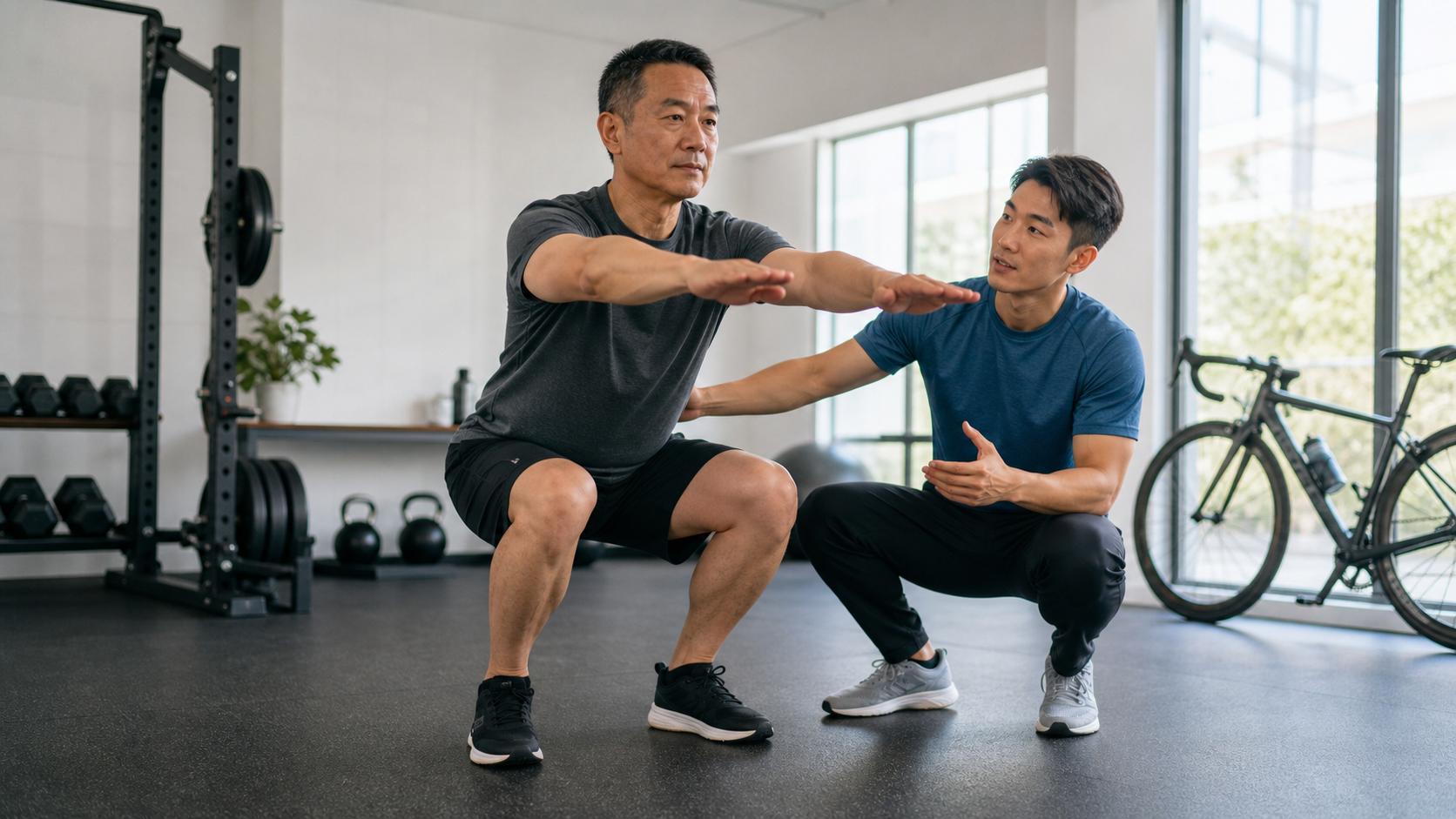
Opening: The 52-Year-Old Engineer Who Couldn’t Get Up
I’ll never forget the first session I had with Ah-Hsiang (pseudonym). He was a 52-year-old engineer working in the Hsinchu Science Park. His reason for coming to me was simple: he’d noticed that when he bent down to pick things up off the floor, his knee would make a “click” sound, and he had to push off his thigh with his hand just to stand back up. His wife teased him about “showing his age,” but inside, he was genuinely worried.
I asked him to do one thing: without any assistance, stand up from a chair and sit back down, five times in a row. By the third rep, sweat was beading on his forehead, and he instinctively reached for the armrest to push himself up. At that moment, I knew—this wasn’t “old age.” This was muscle loss (sarcopenia, a precursor to frailty). And the good news was, this was completely reversible.
Three months later, he could do the same chair-stand movement fifteen times in a row without breaking a sweat. The first thing he said to me was: “Coach, I realize I’m not old. I just hadn’t used my muscles in too long.”
This article is written for everyone like Ah-Hsiang—people who think “strength training has nothing to do with me.” In my 15 years of coaching, I’ve seen too many people picture weight training as some bodybuilder in a gym grunting under a barbell with veins popping out, then quietly tell themselves, “That’s not me.” In this first lesson, I want to tell you: strength training is not the exclusive domain of muscle-bound men. It’s a fundamental ability that every adult who wants to live well into old age should possess.
This article is educational content and provides general exercise guidance. If you have cardiovascular disease, joint injuries, or other chronic conditions, please consult a physician or physical therapist first.
Why You, Starting from Zero, Need Strength Training Even More
Muscle Is an Organ That “Uses It or Loses It”
Let’s establish the most core concept first: Muscle mass is not fixed. It increases or decreases depending on whether you use it.
Human skeletal muscle begins to slowly decline after around age 30. If you do absolutely no resistance training, the average adult loses a significant percentage of muscle mass and strength every decade (the exact numbers vary by individual and are related to diet, activity level, and hormones). This process is almost imperceptible in the early stages, until one day you notice: carrying grocery bags up the stairs makes you winded, your legs feel weak when you stand up after sitting for a long time, you trip easily when walking—none of these are simply “getting old.” They are strength quietly slipping away.
The key point is: this loss is reversible. Even if you start at 60 or 70, your muscles will still respond to training and grow. The oldest trainee I’ve ever coached was a 78-year-old grandmother. At first, she couldn’t even do a proper bodyweight squat. Six months later, she could carry a 5-kilogram bag of rice home from the market without needing a rest.
Seven Major Benefits of Strength Training
Let me clearly organize, in a table, why even people who don’t want to “get bulky” should train strength:
| Benefit Area | Specific Change | Meaning for Daily Life |
|---|---|---|
| Muscle Mass & Strength | Increases skeletal muscle, slows sarcopenia | Carry heavy items, climb stairs, stand for long periods without fatigue |
| Bone Density | Resistance stimulates bone formation | Reduces risk of osteoporosis and fractures from falls |
| Metabolism & Blood Sugar | Improves muscle glucose utilization | Helps stabilize blood sugar, aids weight management |
| Cardiovascular | Combined with cardio, improves circulation | Better overall heart-lung and health markers |
| Posture & Balance | Strengthens core and lower body | Reduces back pain, prevents falls |
| Mental Health | Exercise releases endorphins | Improves mood, sleep, stress resilience |
| Appearance & Confidence | Firmer physique, visible definition | Clothes fit better, positive self-image |
I especially want to emphasize the blood sugar item. Taiwan is a nation of eating out. Many office workers eat all three meals outside the home, with high intake of refined carbohydrates and sugary drinks. Muscle is the body’s largest “sugar warehouse.” When muscle mass is sufficient and regularly used, the body handles post-meal blood sugar better. You can think of muscles as “sponges”—trained muscles more actively absorb glucose from the bloodstream to replenish energy. The more muscle mass you have and the more often it’s used, the bigger and more absorbent these sponges become, and the flatter your blood sugar spikes and dips. For Taiwan’s generally carbohydrate-heavy dietary pattern, this is a very practical health protection. However, I must reiterate—this is a general physiological principle. If you have been diagnosed with diabetes or blood sugar abnormalities, your exercise plan must be discussed with your physician and diabetes educator for individualized adjustment. This article cannot replace medical advice. Especially for those using blood sugar-lowering medications or insulin, exercise can affect blood sugar, so you must work carefully with your medical team.
What Official Guidelines Say
This isn’t just my personal opinion as a coach. The World Health Organization (WHO) 2020 guidelines on physical activity and sedentary behaviour clearly recommend: adults should engage in muscle-strengthening activities at moderate or greater intensity that involve all major muscle groups on 2 or more days per week, as these provide additional health benefits. Additionally, adults should accumulate at least 150 to 300 minutes of moderate-intensity aerobic physical activity per week.
In other words, strength training is not an “advanced option.” It is an internationally recognized, fundamental component of health, on par with aerobic exercise.
The Science: Why Beginners Improve Especially Fast
This is the part I love telling newbies, because it greatly reduces their fear.
In the first few weeks to months of strength training, your strength will improve dramatically—but during this time, your muscles haven’t actually grown much yet. So where does the strength come from? The answer is neuromuscular adaptation.
Simply put, your brain and nervous system learn to “recruit muscle fibers more efficiently.” It’s like when you first learn to ride a bicycle—your whole body is stiff, then after a few days of practice, your body suddenly “clicks.” It’s not that your legs got bigger; it’s that your neural coordination improved. This is why beginners don’t need to lift heavy right away. With moderate loads and proper form, strength will still skyrocket.
This also brings out an important training principle: A beginner’s best investment is “movement quality,” not “weight numbers.” I’ve seen too many people try to show off and lift heavy weights on day one, only to have their form break down, hurt their back, and be out for a month. Slow is smooth, and smooth is fast—this is an iron rule in strength training.
Neuromuscular adaptation also has an inspiring implication: It doesn’t require you to be gifted. It only requires repetition. Every time you perform a squat correctly, your nervous system is building a better “movement pathway.” It’s like walking the same path enough times to wear a trail—the more regularly you train, the clearer and more efficient that “neural pathway for generating force” becomes. This is why I always emphasize consistency—not training until you’re exhausted, but training often enough to give your body the chance to “learn.” For beginners, training twice a week consistently for eight weeks far outperforms cramming five sessions in one week and then disappearing for three.
What “Training Effectively” Means
Many beginners ask me: “Coach, how do I know if I’ve trained enough?”
A practical concept is called Reps in Reserve (RIR). It means: after finishing a set, “how many more reps could you have done.” For beginners, I usually recommend leaving 2 to 3 reps in reserve at the end of each set (meaning you could still do 2 to 3 more reps before reaching failure).
The benefit of this approach: it gives the muscle sufficient stimulus without pushing every set to complete failure, which can cause form breakdown and increase injury risk. Once you have more experience and your form is more stable, you can gradually push closer to failure.
Practical Methods: Six Foundational Movements for Beginners
Human movement can be categorized into several “fundamental movement patterns.” Instead of memorizing a bunch of equipment names, master these patterns first—they cover all the ways you exert force in daily life.
Overview of the Six Movement Patterns
| Movement Pattern | Example Exercise (Bodyweight Version) | Real-Life Equivalent | Primary Muscles Trained |
|---|---|---|---|
| Squat | Bodyweight squat, chair sit-to-stand | Getting up from chair/toilet, squatting to pick something up | Thighs, glutes |
| Hinge | Glute bridge, Romanian deadlift | Bending to lift a box, tying shoelaces | Glutes, hamstrings, lower back |
| Push | Push-up (can be kneeling/wall) | Pushing a door, pushing a shopping cart | Chest, shoulders, triceps |
| Pull | Resistance band row, inverted row | Pulling a suitcase, opening a heavy door | Upper back, biceps |
| Core | Plank, dead bug | Maintaining posture, protecting the lumbar spine | Abs, lower back |
| Carry | Farmer’s carry (carrying two buckets of water) | Carrying groceries, moving water jugs | Full body, grip strength, core |
These six patterns are your “movement alphabet.” As long as you cover each pattern, you’ve trained your entire body.
The Three Movements Beginners Should Master First
If you have no idea where to start, master these three first:
1. Box Squat
Find a sturdy chair. Place your feet shoulder-width apart, toes slightly turned out. Imagine you’re sitting down—push your hips back and down, keeping your knees tracking in line with your toes. Lightly touch the chair seat, then stand up. Key points:
- Don’t let your knees cave inward throughout the movement
- Keep your back neutral, chest up
- Keep your weight on the mid-foot to heel, not on your toes
This movement has almost zero barrier to entry, yet it’s the foundation of all lower-body strength. This is exactly where Ah-Hsiang started.
2. Glute Bridge
Lie on your back with knees bent and feet flat on the floor. Drive through your glutes to lift your pelvis upward until your body forms a straight line from shoulders to knees. Squeeze your glutes at the top for one second, then lower. Key points:
- Drive with your “glutes,” not by arching your lower back
- Don’t over-arch your lower back
This is the golden movement for protecting the lumbar spine and waking up the glute muscles—especially ideal for office workers who sit all day.
3. Wall Push-up
If you can’t do floor push-ups, start at the wall. Face the wall, place your hands on the wall at shoulder width, keep your body straight, bend your elbows to bring your body toward the wall, then push back. Once comfortable, gradually lower your hand position (progress to a table, then a chair), and finally progress to the floor.
Starter Program: How to Train in Your First Month
According to the American College of Sports Medicine (ACSM), the principles for beginners are quite flexible: perform 1 to 3 sets per exercise, cover several major movement patterns, train each set close to but not to complete failure, and train 1 to 2 times per week. The core message is—doing something is always better than doing nothing; there’s no “minimum threshold” that counts.
I want to emphasize this: You don’t need a perfect program. You just need to start.
Here is the first-month starter program I give to complete beginners. It’s all bodyweight and can be done in your living room:
| Week | Frequency | Exercises | Sets × Reps | Rest Between Sets |
|---|---|---|---|---|
| Week 1 | 2x per week | Box squat / Glute bridge / Wall push-up | 2 sets × 8 reps each | 60 to 90 seconds |
| Week 2 | 2x per week | Box squat / Glute bridge / Wall push-up / Plank | First 3: 2 sets × 10 reps; Plank: 2 sets × 15 seconds | 60 to 90 seconds |
| Week 3 | 2 to 3x per week | Squat / Glute bridge / Table push-up / Plank / Farmer’s carry | Main movements: 3 sets × 10 reps; Carry: 2 trips of 20 meters | 60 seconds |
| Week 4 | 2 to 3x per week | Squat / Glute bridge / Table push-up / Plank / Resistance band row | Main movements: 3 sets × 12 reps; Plank: 3 sets × 20 seconds | 60 seconds |
Execution principles:
- Do a 5-minute warm-up before each session (marching in place, joint rotations, easy bodyweight squats)
- Focus on “feeling the target muscle working” throughout every movement, rather than rushing to finish
- Leave at least one day between training sessions to allow muscle recovery
- The goal of the first month is not to “get stronger,” but to “build the habit and learn the movements”
When Should You Add Weight or Progress?
When you can easily complete the target reps in the program, your form is completely stable, and you’re not excessively sore the next day, it’s time to progress. The recommended progression order is:
- First increase reps (e.g., from 8 reps to 12 reps)
- Then increase sets (from 2 sets to 3 sets)
- Finally increase load (start using water bottles, buckets, resistance bands, or dumbbells at the gym)
For those who want to go to the gym, beginners should start with dumbbells or machines. Choose a weight you can do for about 8 to 12 reps, where the last two reps feel somewhat challenging. Don’t chase heavy weights from the start. Remember—during the neural adaptation phase, movement quality is what’s most valuable.
A Three-Month Progressive Roadmap
Many beginners’ biggest confusion isn’t “how to start,” but “where do I go after I start.” I’ve mapped out the most important first three months for beginners into a simple roadmap so you know what to expect:
| Phase | Time | Core Task | Signal You’re Ready for the Next Phase |
|---|---|---|---|
| Habit-Building Phase | Weeks 1 to 4 | Learn movements, build a consistent weekly training routine | Can complete the full routine without looking at notes, no longer feel “so lazy today” |
| Consolidation & Volume Phase | Weeks 5 to 8 | Increase reps and sets, add light load | Bodyweight routine feels easy, craving more challenge |
| Load Progression Phase | Weeks 9 to 12 | Introduce dumbbells/resistance bands, learn progressive overload | Form is stable, can safely handle added weight |
After these three months, you’ll go from “knowing nothing” to “being able to plan your own training.” Many trainees look back and say the hardest part was only the first week—once you get past that, everything else falls into place.
Warm-Up and Recovery: The Two Things Beginners Most Often Overlook
Beginners tend to put 100% of their attention on the “movements” while ignoring the two equally important components around them: warm-up and recovery. Getting these right can dramatically reduce injury risk and accelerate progress.
Warm-Up: Spend 5 Minutes, Save a Month
Jumping straight into working sets is the number one cause of beginner injuries. Cold muscles and joints are like un-warmed rubber bands—pull them and they snap. A simple and effective warm-up routine looks like this:
| Order | Content | Time | Purpose |
|---|---|---|---|
| 1 | March in place or brisk walking | 2 minutes | Raise heart rate and body temperature |
| 2 | Joint circles (shoulders, hips, knees, ankles) | 1 minute | Lubricate joints, increase mobility |
| 3 | Bodyweight movement rehearsal (easy squats, glute bridges) | 2 minutes | Wake up target muscles, review movement patterns |
Special note: Your warm-up should consist of “dynamic” movements, not static stretching. Prolonged static stretching before training can actually temporarily reduce force output. Save static stretching for after training.
Recovery: Muscles Get Stronger “While You Rest”
This is the concept I most want to hammer into every beginner’s head: Training is “breaking down”; recovery is “building up.” You stimulate the muscle during training, but the actual strengthening process happens during rest and sleep afterward.
Three key factors affecting recovery:
- Sleep: Growth and repair hormones are primarily secreted during deep sleep. If you’re chronically sleep-deprived, even the most dedicated training will yield half the results. Try to keep a consistent schedule and get enough hours.
- Protein and Nutrition: Muscle repair needs raw materials. This is why protein is so important (we’ll cover this in more detail in the Taiwan eating-out section later).
- Training Interval: Training the same muscle group hard two days in a row without enough recovery can actually cause regression. For beginners, 2 to 3 sessions per week with rest days in between is just right.
If you feel persistently fatigued after training, your sleep gets worse, and your strength is going down instead of up—that’s not a sign you’re not working hard enough. It means you’re “training too much and recovering too little.” What you should do is rest more, not push yourself harder.
Second Case Study: A Mom Trying to Find Herself After Childbirth
Besides Ah-Hsiang, I’d like to share a very different case—Hsiao-Min (pseudonym), a 34-year-old mother of two, eight months postpartum.
When she came to me, she said: “Coach, I don’t want to lose weight. It’s that my lower back aches terribly just from holding my baby for a little while. I feel like my body isn’t mine anymore.” That statement left a deep impression on me. Her problem was classic: weakened core and pelvic floor muscles after childbirth, plus poor posture from prolonged baby-holding leading to both upper and lower back pain.
I didn’t give her any fancy program. For the first two months, we just did the most basic glute bridges, dead bugs, and light-load squats. The entire focus was on “relearning how to stabilize the body with the core.” At first, she would arch her lower back even during glute bridges. It took me several sessions just to help her truly feel “glute engagement.”
Three months later, she could carry her 10-kilogram second child around the park for an hour without her back aching. She smiled and told me: “I finally feel like this body is mine again.”
This case illustrates two messages: First, the value of strength training goes far beyond appearance—it’s the ability to live your life well. Second, everyone’s starting point and needs are different—postpartum women, post-surgery patients, the elderly, and those with chronic conditions all need more individualized programming. If you fall into one of these special populations, I strongly recommend getting an assessment from a physical therapist or physician first, rather than directly applying a general program.
Common Mistakes and Corrections
This section is a “list of lessons learned the hard way” gathered from countless trainees, to help you avoid unnecessary detours.
Mistake 1: Holding Your Breath and Grinding Through
Many people instinctively hold their breath when exerting force, turning their face red. This causes a sudden spike in blood pressure, which is especially dangerous for those with hypertension.
Correction: Learn your breathing rhythm—exhale on exertion, inhale on the return. Inhale as you descend into a squat, exhale as you stand up; inhale as you lower in a push-up, exhale as you push up. If you have high blood pressure or a history of cardiovascular disease, consult your physician before starting any weight training, and avoid breath-holding at all times.
Mistake 2: Chasing “Soreness as Proof of Effectiveness”
Beginners often treat “being super sore the next day” as a badge of a successful workout. In reality, delayed onset muscle soreness (DOMS) only indicates you did movements your body isn’t used to. It has no direct positive correlation with training effectiveness. Overly chasing soreness can easily lead to injury and hinder recovery.
Correction: The goal is “noticeable but not so painful that you can’t walk the next day.” Mild soreness is normal. Sharp pain or joint pain is a warning sign—stop and review your form.
Mistake 3: Rushing Movements and Using Partial Range of Motion
Doing movements fast and shallow just to “squeeze in more reps” is a common beginner habit. Half-squats and half-push-ups might look like you did a lot, but the stimulus is greatly diminished.
Correction: Better to do fewer, slower, and fuller reps. One complete, controlled squat beats five wobbly half-squats.
Mistake 4: Only Training the Muscles You Can “See”
Many men only train chest and biceps (the muscles they see in the mirror), completely ignoring the back, glutes, and hamstrings. This creates muscle imbalances, poor posture, and even shoulder and back problems.
Correction: Remember the six movement patterns. Push and pull should be balanced; squats and hinges both need to be trained. The body is one integrated unit.
Mistake 5: “Three Days of Fishing, Two Days of Drying Nets” vs. Training Hard Every Day
Both extremes are bad. Some people train hard three days in a row, burn out, and quit. Others train once a week and expect results without consistency.
Correction: Consistency × moderation > occasional intense bursts. Training a fixed 2 times per week for three months far outperforms training seven times in one week and then disappearing for a month.
Self-Check Mistake Table
| What You Observe | Possible Problem | Recommended Action |
|---|---|---|
| Knees caving inward during squats | Weak or unactivated glutes | Slow down, think about pushing knees outward |
| Lower back very sore the day after | Using lower back to compensate, core not stabilized | Check hinge movements, strengthen core |
| Joints clicking and painful during training | Improper movement path or load | Stop that movement, seek medical evaluation if necessary |
| Dizziness after training, heart rate slow to come down | Breath-holding or intensity too high | Lower intensity, check breathing, seek medical attention if necessary |
| No progress at all | Insufficient intensity or inadequate recovery | Progressively add volume, ensure adequate sleep and nutrition |
Practical Advice for Taiwan
Facilities: No Need to Spend Big Money
Many people get stuck on “gym memberships are too expensive.” In reality, you don’t need one at the beginner stage at all.
- At home: A sturdy chair, a set of resistance bands (a few hundred NT$), and a few water bottles filled with water are enough for a complete routine.
- Parks: Many parks in Taiwan have free outdoor fitness equipment. Pull-up bars and parallel bars are excellent tools for training the pulling system.
- Community/Company gyms: Many apartment complexes and tech companies have on-site gyms. Make good use of them.
- Sports centers: The National Sports Centers in various cities and counties have affordable fees and well-equipped weight rooms, making them great for when you progress.
Taiwan’s Climate and Timing
Taiwan’s summers are hot and humid. When training indoors, remember to use a fan or air conditioning and stay hydrated. While weight training doesn’t cause as much sweating as running, a stuffy, hot environment will accelerate fatigue and make you feel like you “can’t train” earlier—don’t mistake this for being weak. In winter, extend your warm-up time. Muscles and joints are stiffer in cold weather, and insufficient warm-up can easily lead to strains, especially in the early morning and at night when temperatures are low. Better to spend an extra two or three minutes warming up than to skip it. As for timing—morning, noon, or evening all work. The key is “a time you can consistently maintain”—a time that fits your daily routine and is less likely to be interrupted is the best training time.
Protein for People Who Eat Out
Protein intake is crucial for strength training results. Taiwan’s convenient eating-out culture actually makes it easy to hit your targets:
| Common Taiwanese Eating-Out Option | Approximate Protein Reference | Coach’s Tip |
|---|---|---|
| One tea egg | About 6 to 7 grams | Readily available at convenience stores |
| One chicken breast bento | About 25 to 35 grams | Choose steamed/grilled over fried |
| One cup of unsweetened soy milk | About 7 to 10 grams | Great breakfast choice |
| One container of unsweetened yogurt/Greek yogurt | About 8 to 15 grams | Convenient post-workout option |
| One serving of braised tofu + seaweed | Depends on portion | Watch sodium levels, don’t overdo it |
The average adult needs a certain range of protein per kilogram of body weight per day. Those who regularly do resistance training have somewhat higher needs (exact numbers vary by individual, weight, and goals; consult a nutritionist if you need precise calculations). The key principle: have a protein source at every meal, and don’t cram all your daily protein into one big dinner blowout.
Medical Care and Safety Net
Taiwan’s National Health Insurance is convenient—this is our advantage. If you have any of the following conditions, it’s recommended to see a physician or physical therapist for an assessment before starting training:
- Chronic conditions such as heart disease, hypertension, or diabetes
- Past injuries to the lumbar spine, knees, or shoulders
- Older age with a long history of no exercise
- Experiencing chest tightness, chest pain, unusual shortness of breath, or dizziness during training
Many major hospitals have sports medicine clinics, and physical therapy clinics can also perform movement assessments. Spending a little time confirming the training approach that’s right for you is the most cost-effective investment you can make.
Action Recommendations for Readers at Different Levels
If You Are Someone Who “Has Never Exercised”
Don’t overthink it. This week, just start with doing 10 chair sit-to-stands every day. No need to change into workout clothes, no need to go to the gym—you can do it while watching TV. First, let your body get re-accustomed to “exerting force.” After two weeks, introduce the Week 1 program from this article. Your first goal isn’t to get strong; it’s to “stop being afraid of exerting yourself.”
If You Have Some Exercise Habits (e.g., Cycling or Running)
You have a cardiovascular base, but you’ve likely neglected strength. Cycling and running are repetitive endurance movements. Over time, they can easily create muscle imbalances (e.g., weak glutes and upper back, common among cyclists). I recommend scheduling 2 strength sessions per week, jumping straight into the Week 2 to 3 program from this article. Focus on strengthening the core, glutes, and the upper-body pulling system. This will actually improve your cycling/running performance and make you less injury-prone.
If You Want to “Seriously Get Stronger”
Treat the first month as laying the foundation. Don’t rush to chase weights this month. Focus on learning the standard versions of the six movements. After a month, consider taking a few sessions with a qualified coach or going to a sports center to start with dumbbells and barbells. With a proper movement foundation, your subsequent progress will be both fast and safe.
Starting Point Comparison for Three Types of People
| Reader Type | Starting Focus | First-Month Goal | Common Pitfall |
|---|---|---|---|
| Never exercised | Rebuild the habit of exerting force | Can consistently complete the bodyweight program | Being too ambitious at the start |
| Has endurance sport base | Address strength imbalances | Add 2 strength sessions per week | Neglecting upper back and core |
| Wants to get seriously stronger | Build a solid movement foundation | Standardize the six movements | Chasing heavy weights too early |
Frequently Asked Questions from Beginners (FAQ)
Over 15 years of coaching, there are some questions almost every beginner asks. I’ve compiled them into a Q&A to address them all at once.
Q1: Will women who lift weights become bulky bodybuilders?
Almost certainly not. Women naturally have far lower testosterone levels than men. Building dramatic muscle mass requires extremely high volume, extremely long duration, and extremely specialized training combined with diet—the training volume of an average person can’t even come close. The “toned, firm physique” you see in women who lift is precisely the result of moderate strength training. Train with confidence—you’ll only look better and become stronger.
Q2: I’m very skinny. Do I need strength training?
Absolutely. Being skinny doesn’t equal being healthy. “Skinny fat” individuals (low body weight but low muscle mass and higher body fat) actually lack protection. By increasing muscle through strength training, your metabolism, physique, and strength will all improve. This has nothing to do with being fat or thin—it’s a fundamental need for everyone.
Q3: Which should I do first, cardio or weights?
If you’re doing both on the same day and your goal is to build strength, I recommend “weights first, then cardio.” This way, you have full energy and good movement quality for lifting. But for complete beginners, I’d actually suggest doing them on separate days. Don’t cram too much into one session—you’ll get exhausted and quit.
Q4: Do I have to take protein powder?
Not necessarily. Protein powder is just a “convenient protein source,” not a magic potion. If you can get enough protein from whole foods (eggs, soy products, meat, fish) across your three meals, you don’t need supplements at all. Protein powder only becomes a convenient option when you’re truly too busy to eat properly. If you have kidney disease or other chronic conditions, please consult your physician or nutritionist before using any supplements.
Q5: I’m sore all over after training. Can I keep training?
With mild soreness, you can do light activity (walking, stretching) to aid recovery—this is called “active recovery.” But if you’re so sore that your form breaks down or you have joint pain, you should rest. Remember: soreness is not a badge of honor. Recovery is what makes you stronger.
Q6: Is it too late to start at my age?
It’s never too late. Research and clinical experience repeatedly prove that even people who start in their 70s or 80s will see their muscles respond to training and grow. My 78-year-old grandmother trainee is the best example. The later you start, the more important it is to start light, slow, and safe, and to seek professional assessment when needed.
Quick Reference for Common Concerns
| Your Concern | Brief Answer |
|---|---|
| No time | 2 sessions per week, 20 minutes each, is effective |
| No equipment | Bodyweight + water bottles + resistance bands are enough to start |
| Afraid of injury | Prioritize movement quality, progress gradually—safest approach |
| Not seeing results | Usually inadequate recovery or intensity too low |
| Too old / too skinny / too fat | All need to train, and all will benefit |
Coach’s Honest Words: Conclusion
Let’s return to Ah-Hsiang from the beginning. He’s now 58, and weight training has become his unshakable weekly habit. He told me that what he notices most isn’t the definition in the mirror, but that “life has become easier”—carrying water, hiking, playing with his grandkids—none of it feels like a burden anymore.
This is the most fascinating thing about strength training. It’s not about competing to see who can lift the most in the gym. It’s about ensuring that when you’re 70 or 80, you can still stand up on your own, walk on your own, and live the life you want. Muscle is the best savings account for your later years, and it’s never too late to start depositing.
Starting from zero is fine. Being older is fine. Having imperfect form is fine—all of these will gradually improve as you begin. The only thing that truly matters is this: stand up right now and do your first squat.
I’ll accompany you through this first lesson. The road ahead is yours to walk, step by step. Don’t chase perfection—just start, and then keep going. That’s the one common thread I’ve seen in every success story over these 15 years.
This article is educational content and cannot replace individual diagnosis and treatment advice from a physician, physical therapist, or nutritionist. If you have chronic conditions, joint injuries, or any physical discomfort, please consult a professional before starting an exercise program and adjust according to your individual situation.
References
- WHO Guidelines on Physical Activity and Sedentary Behaviour: https://www.ncbi.nlm.nih.gov/books/NBK566046/
- World Health Organization 2020 guidelines on physical activity and sedentary behaviour (PMC full text): https://pmc.ncbi.nlm.nih.gov/articles/PMC7719906/
- ACSM 2026 Resistance Training Guidelines Update: https://acsm.org/resistance-training-guidelines-update-2026/
Related Reading
- Exercise and Sarcopenia: A Complete Coach’s Guide to Combating Muscle Loss
- Exercise Science for Older Adults: Sarcopenia, Frailty, and Exercise Prescription—A Practical Guide to Resistance Training, Balance, and Fall Prevention
- A Scientific Guide to Restarting Exercise from Zero: The Complete Approach to Rebuilding After a Sedentary Period, Progression, and Injury Prevention
- The Loss That Cycling Can’t Stop: Why Masters Endurance Athletes Must Lift Weights—A Complete Guide to Sarcopenia Prevention
滑雪新手們慘摔學習全紀錄(請開字幕),滑雪好好玩 | Snowboard + Ski | 岩原 スキー場 | 滑雪APP使用 | GoPro Max
6 年前
西進武嶺 免費訓練分析服務 Intervals | 練不夠還是練過頭?你哪一種類型選手?AI模型告訴你! | 備戰神器 | 公路車 訓練 | CT Yeh
4 年前
一日北高常見問題大集合 | 攻略 | 路線 | 訓練 | 補給 | 自行車 單車 | 一日雙城 | 雙塔 | TWB北高360 | 屁股痛
6 年前
Never Stop 西進武嶺 前後雙機 完整全程錄影 訓練台 實境
8 年前
沉浸室內單車練功房開箱! 100吋大畫面,最便宜的花費? 居然還能K歌!? | 公路車 | CT Yeh
3 年前
一日北高/長距離團騎 常見問題補充篇 / 組團或跟團的眉角 / 壯車友容易被瘦車友慢性拉爆 / 原來屁股痛可能是這個原因...? / 風場配速法 / 公路車 / CT Yeh
2 年前
一個測試有沒有認真練車的方法😂 #公路車
10 個月前
實景訓練台) 彰化經典百K 高強度喵團 90分鐘 跟著一起練功 2019 Indoor workout Changhua Classic 100 Taiwan
7 年前