Riding to the Back of the Mountain: 7.7 Kilometers Through Rokkō's Hidden Side, Hydrangeas, Deep Forest, and a Thousand-Year-Old Hot Spring
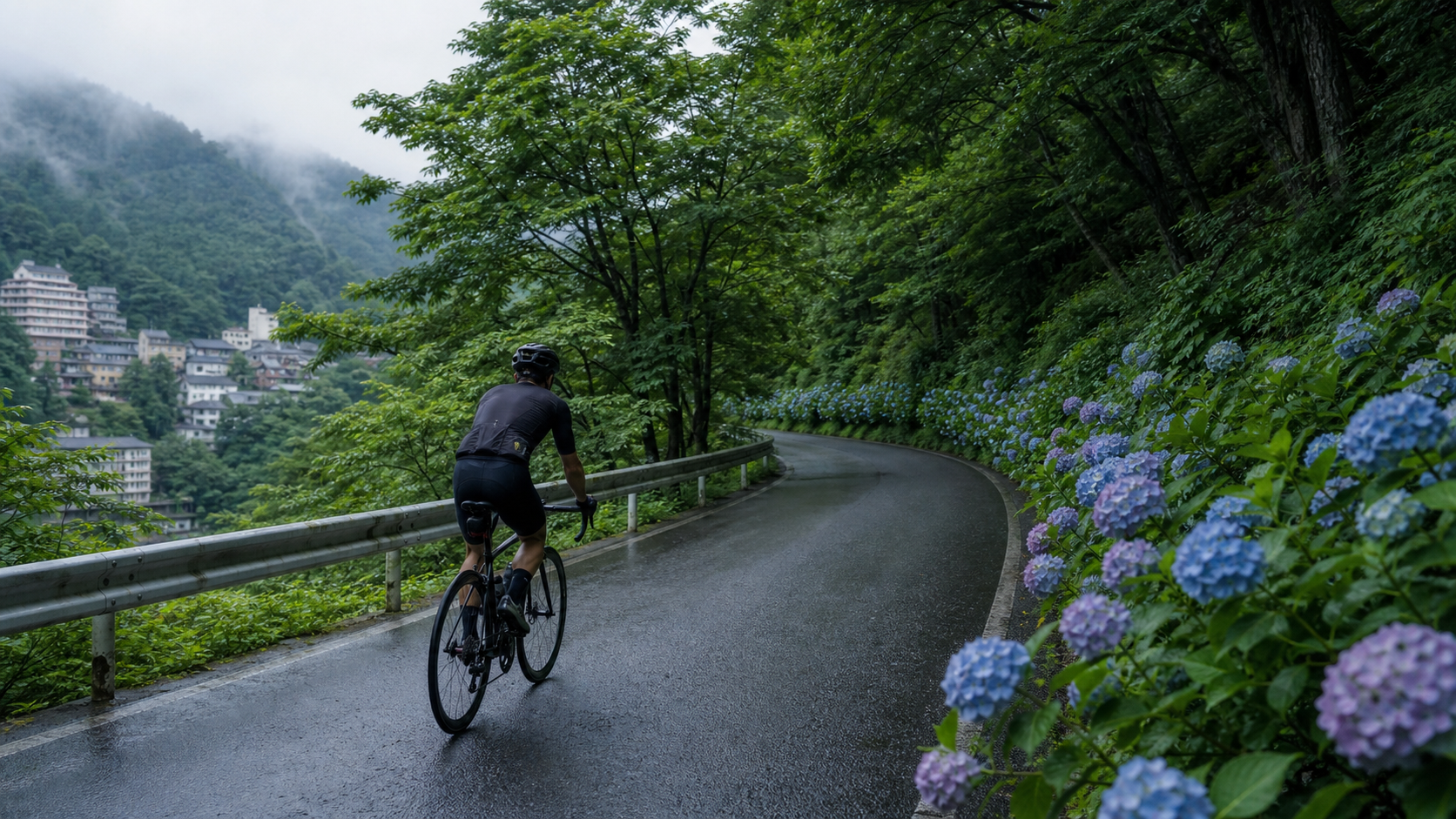
Mount Rokko has two faces.
The side facing Kobe Port, facing the sea and the sun, is the “front” (Omote)—lively, open, looked up to by the city. But the side turned away, facing Arima Onsen, facing the shade and the quiet, is the “back” (Ura). Ura-Rokko, climbing from Arimaguchi all the way to Kinenhidai, 7.7 km, 506 meters of elevation gain, 6.5% average gradient—this is a road that is less flashy, yet far more intriguing.
It doesn’t grab you by the throat from the very start like Omote-Rokko does. It’s more like a quiet old friend, accompanying you steadily on a long road, quietly handing you hydrangeas, the coolness of the forest, and, at the end, a hot spring that washes away your fatigue. This piece isn’t about power or pacing; what I want to talk about is—why so many people would rather go around to the back of the mountain to climb this “Ura” road.
Starting from a Thousand-Year-Old Hot Spring Town
The story of Ura-Rokko cannot be told without “Arima Onsen.”
Arima is one of Japan’s oldest hot spring towns, with a history dating back over a thousand years. Legend has it that it was discovered by the gods, cherished by successive emperors, shoguns, and literati, and Toyotomi Hideyoshi was a frequent visitor. Its “Kinsen” (gold spring) carries a rust-like reddish-brown hue, said to be particularly effective for muscle and joint fatigue; the “Ginsen” (silver spring) is crystal clear. For a cyclist, is there a more luxurious way to end a ride than “climb a mountain, then soak in a thousand-year-old famous spring”?
So riding Ura-Rokko carries a leisurely, unhurried temperament from the very beginning. You’re not there to chase a personal best; you’re there to walk a stretch of road, climb a mountain, and then enjoy a good soak. This mindset perfectly matches the character of this road—it never pushes you; it just climbs steadily upward.
The “Ajisai Road”: A Climb Blooming with Hydrangeas
Ura-Rokko Driveway has a beautiful alias—Ajisai Road (あじさいロード).
Because large numbers of hydrangeas are planted along the route. Every June, when Japan enters the rainy season, while others fret over the rain, Rokko’s cyclists are actually looking forward to it—because this is precisely the peak season for hydrangeas. In the drizzle, blue, purple, and pink hydrangeas bloom in clusters along the edge of the climbing road, water droplets hanging from the petals, making the entire road look as if it has been carefully adorned.
I’ve always felt that climbing Ura-Rokko in the rainy season is a very special experience. The air is moist, the scent of the forest is especially strong, and the hydrangeas appear even more saturated against the gray sky. As you huff and puff your way upward, surrounded by seas of flowers on both sides—the hardship of the climb suddenly gains color.
This is something Omote-Rokko cannot offer. Omote-Rokko has the sea, the night views, the grandeur of the city; Ura-Rokko has flowers, forest, and the smell of rain-soaked earth. Two sides of one mountain, yet so completely different.
The Rhythm of the Forest, and Solitude with Yourself
The gradient of Ura-Rokko is honest—a 6.5% average accompanies you from start to finish. There are no walls steep enough to break you, nor flat sections that let you slack off—just section after section, climbing steadily upward.
This “steadiness” transforms the climb into something close to a meditative state.
When the gradient is even and the road is quiet, your thoughts slowly settle. The first ten minutes might still be occupied with work and life’s worries; ten minutes later, those thoughts are gradually smoothed out by the rhythm of your pedaling, until only your breathing, the sound of the chain, and the ever-receding shadows of trees remain.
The forest shade on Ura-Rokko is deep, especially on the north-facing, sun-shielded sections, where it stays cool even in summer. Sunlight filters through the canopy into dappled patches on the ground, and occasionally a breeze cuts through the woods, carrying the scent of vegetation. At times like this, 7.7 km doesn’t feel long at all—you might even wish it were longer.
Distance markers stand every 100 meters along the roadside, like the forest counting the way home for you. Watching the numbers decrease one by one, you feel a sense of gentle companionship—you’re not climbing alone; this road always knows exactly where you are.
Kinenhidai: A Memorial on the Ridge
When you reach the top, you’ll arrive at Kinenhidai (Memorial Platform).
Behind this name lies a memory from the modern history of Mount Rokko. It commemorates a British merchant, A.H. Groom—in the late nineteenth century, he developed villas and built facilities on Mount Rokko, and is regarded as a key figure in developing Rokko into a modern summer resort. It could be said that the fact that Kobe residents today have such a “city’s backyard garden” owes much to this foreigner from over a hundred years ago.
Standing at Kinenhidai, you realize that the 7.7 km you just climbed wasn’t just a slope—it was a mountain forest carefully cultivated by many people over more than a century. Every inch of asphalt you pedaled over has other people’s stories layered beneath it.
The air on the ridge is cool and the views are expansive. You can rest here for a while, watch the clouds and the mountains, and let the heat from the climb slowly dissipate from your body.
The Reward at the Bottom: A Pool of Thousand-Year-Old Kinsen
The most perfect ending to Ura-Rokko is descending back to Arima Onsen and soaking in a hot spring.
From the side of Kinenhidai, the winding mountain road carries you back to that thousand-year-old hot spring town. Park your bike, step into a bathhouse, peel off your sweat-soaked jersey, and sink your entire body into that pool of reddish-brown Kinsen—the relaxation of that moment is something only those who have ridden up a mountain can understand.
The hot water envelops your legs that were just burning moments ago, dissolving the soreness bit by bit. You recall that two hours ago, you were still gasping for breath among the hydrangeas; and now, you’re soaking in the same hot spring that people soaked in a thousand years ago. Time, mountain, flowers, and water—all connected in this single moment.
After the soak, enjoy a steaming bowl of local cuisine and a cold drink. A day like this is so complete it almost feels unreal.
Ura-Rokko Through the Seasons
- Spring, the mountains are clothed in fresh greenery, the air is crisp, and it’s a great season to start riding again.
- Summer, while others are being steamed by the heat in the city, you enjoy cool breezes in the deep shade of Ura-Rokko; in June, the seas of hydrangeas keep you company.
- Autumn, Rokko dons its autumn colors, and the cool air turns the climb into pure enjoyment.
- Winter, the north-facing Ura-Rokko gets colder, and snow may even accumulate on the mountain, but that stillness carries its own kind of solitary beauty—though it should be left to those with enough experience and gear.
Side Trip: Weaving Mountain, Flowers, Hot Spring, and Food into One Day
The charm of Ura-Rokko lies in how easily it can be woven into an entire day of Kansai cycling.
You can start in the morning from Kobe city, climb Omote-Rokko to the ridge, then descend Ura-Rokko to Arima Onsen; or do it in reverse—climb Ura-Rokko first, enjoy a soak, then loop back to Kobe via another route. However you arrange it, Arima Onsen is that reason that makes you willingly ride a few extra kilometers.
After soaking and eating your fill, slowly ride back toward Kobe along the mountain roads in the evening, watching the sunset paint all of Mount Rokko gold—you’ll feel that going around to the back of the mountain was an incredibly worthwhile decision.
Epilogue: Why Choose the “Ura”
Omote-Rokko has its grandeur—the sea, the city, the million-dollar night views. But there are always those who choose to go around to the back of the mountain, to climb that quiet “Ura” road.
Because what Ura-Rokko offers is something else entirely. It’s the hydrangeas in the June rain, the cool breeze and solitude of the deep forest, a century-old memorial on the ridge, and a thousand-year-old hot spring at the foot of the mountain. It doesn’t shout, but it lingers; it doesn’t push you, yet it makes you not want it to end.
7.7 km, 506 meters of elevation gain. The numbers are unremarkable.
But once you’ve ridden it, you’ll understand—some roads are worth going around to the back of the mountain for.
Route data: Ura-Rokko—Arimaguchi to Kinenhidai, distance 7.7 km, total elevation gain 506 m, average gradient 6.5%, Hyogo Prefecture, Kobe City, north side of Mount Rokko, endurance-style climb, accompanied by hydrangeas along the route and the thousand-year-old Arima Onsen.
Arima Onsen: A Thousand Years of Healing, Hidden Behind the Mountain
To speak of the soul of Ura-Rokko, one cannot avoid the thousand-year-old hot spring town at the foot of the mountain—Arima.
The history of Arima Onsen dates back over 1,300 years, making it one of Japan’s oldest hot springs, ranked alongside Kusatsu and Shirohata as one of the “Three Great Springs of Japan.” Legend has it that it was discovered in ancient times, and successive emperors, nobles, monks, and warlords have visited. Toyotomi Hideyoshi of the Sengoku period was its biggest fan—not only did he visit repeatedly to soak and recuperate, but he also vigorously developed Arima, making it the most renowned hot spring resort of its time. To this day, Arima retains many historical sites and legends associated with Hideyoshi.
Arima’s most famous features are its “Kinsen” and “Ginsen.” Kinsen contains iron and salt, oxidizing to a reddish-brown upon contact with air, and is said to be particularly effective for joint pain and cold extremities—for a cyclist who has just climbed a mountain with swollen legs, it’s practically a tailor-made cure. Ginsen, on the other hand, is crystal clear, containing carbonic acid and the radioactive element radium, with a gentle quality. The most perfect conclusion to an Ura-Rokko ride is to first soak in Kinsen to soothe the muscles, then in Ginsen to relax the body and mind.
When you know that the spring you’re soaking in has soothed the fatigue of countless travelers for over a thousand years—from ancient pilgrims, to Hideyoshi, to you, drenched in sweat today—that feeling of “being connected to history” makes the temperature of this spring feel all the more profound.
The Seasonal Philosophy of Hydrangeas: Finding Beauty in the Rain Others Loathe
The fact that Ura-Rokko is called the “Ajisai Road” itself embodies a very Japanese aesthetic.
Hydrangeas (ajisai) bloom at the height of Japan’s rainy season—the most humid, gloomy time of year, when most people least want to go outside. Endless drizzle, muggy air, clothes that never dry—for many, the rainy season is a time to be “endured.”
But the Japanese found beauty in this most unappealing of seasons—the hydrangea. This flower thrives precisely in the rain; the more abundant the rainfall, the more fully it blooms. Blue, purple, and pink flower clusters, adorned with glistening raindrops, appear all the more vivid and striking against the gray sky. And so, the rainy season is no longer just a season to be endured—it becomes the season for viewing hydrangeas, a uniquely damp and poetic landscape that comes only once a year.
Riding through Ura-Rokko in the rain, I am often moved by this aesthetic. While others hide indoors complaining about the weather, you are experiencing a full, tranquil beauty that exists only here and now, amidst the flowers and the drizzle. This is a wisdom of shifting perspective—not all beauty requires sunshine. Sometimes, the most moving scenery lies precisely in the gloomy rain that others are eager to escape.
Ura-Rokko, with an entire slope blooming with hydrangeas, quietly teaches me this: those who know how to find beauty in imperfect seasons are the ones who can truly possess all four seasons.
The Foreign Memory of Kinenhidai: An Englishman and a Mountain
Kinenhidai, the endpoint of Ura-Rokko, commemorates a late-nineteenth-century British merchant, A.H. Groom.
This piece of history holds a crucial turning point in the modernization of Mount Rokko. After the opening of Kobe’s port, many foreign residents flooded in, and Groom was one of them. He fell deeply in love with Mount Rokko, developing villas, building roads, and establishing facilities on the mountain, even founding one of Japan’s earliest golf courses there. It could be said that it was foreigners like Groom who brought Western summer resort, leisure, and outdoor sports culture to Rokko, gradually transforming this once-simple mountain into the “city’s backyard garden” that Kobe residents are proud of today.
Standing at Kinenhidai, I often think of this connection that transcends borders. A merchant from distant England, because he fell in love with a mountain in a foreign land, bound the rest of his life to it, and is still remembered a century later. Isn’t this another form of “mountain fate”?
And today, I—a cyclist who flew over from Taiwan—am here for the same love of mountains, climbing this mountain once deeply loved by an Englishman. Time and space interweave, yet we are connected by the same love for the mountain. Mountains truly can transcend borders and eras, binding different people together in the purest way.
Ura-Rokko Through the Seasons: Four Moods of One Road
- Spring, the fresh greenery on the north side of Ura-Rokko arrives a little later, but when the young leaves finally blanket the forest, that vitality is all the more precious. The air is crisp and clean—a season of new beginnings.
- Summer, while Omote-Rokko’s cyclists sweat on the sun-facing slopes, the deep forest of Ura-Rokko offers the coolness of its north-facing shade. In June, the seas of hydrangeas accompany you—the most atmospheric climbing time of the year.
- Autumn, Rokko dons its autumn colors, and the north side of Ura-Rokko is painted in layers of red and gold under the cool, dry air. Descending to Arima for a soak while viewing the autumn leaves is the ultimate autumn cycling experience.
- Winter, the north-facing Ura-Rokko is colder than the front side, and snow may even accumulate on the mountain. At this time, Ura-Rokko belongs to the few cyclists who don’t fear the cold—but that stillness and solitude, paired with a steaming hot Arima spring, offers a uniquely unforgettable experience.
After the Epilogue: On “Choosing the Difficult Road”
In life, we often face two choices: a lively, mainstream road recommended by everyone; and a quiet, niche road that requires going a bit out of the way.
Omote-Rokko and Ura-Rokko are, in a sense, metaphors for this. Most people would choose Omote-Rokko—it’s classic, it’s grand, it has the million-dollar night views. But there are always those willing to go around to the back of the mountain, to take that quiet Ura road.
And I’ve gradually come to believe that those willing to take the long way around often see scenery others cannot. The rain on the hydrangeas, the solitude of the deep forest, the healing of a thousand-year-old spring, a mountain connection that crosses borders—these are the gifts Ura-Rokko leaves for those willing to take the detour.
So, if you too often hesitate at life’s crossroads—why not occasionally choose the quiet road that requires going a little out of the way? You might travel a bit slower, but you’ll see a bit deeper. And at the end of the road, perhaps a hot spring awaits, ready to wash away the fatigue of your journey, whispering softly to you: this detour was worth it.
May we all, at life’s crossroads, occasionally be brave enough to choose to go around to the back of the mountain.
The Weight of a Bowl of Soup: Food Memories from Cycling Journeys
If the hot spring is the physical healing of an Ura-Rokko ride, then the cuisine around Arima is its gastronomic full stop.
After climbing the mountain and soaking in the spring, a hungry body craves food with an almost devout intensity. At such moments, any bowl of hot food seems to take on sacred meaning. I particularly enjoy finding a small shop on the hot spring street after my soak, ordering a steaming bowl of noodles or a rice bowl, paired with an ice-cold drink. When the warm broth slides into a stomach emptied by the climb, that satisfaction is something no gourmet feast can provide on an ordinary day.
Cyclists all understand—food always tastes better after exercise. Not because the cooking itself is any more refined, but because your body genuinely “needs” it, because you’ve earned this meal with a full day of sweat. This “deliciousness earned through one’s own effort” is the most moving aspect of cycling cuisine.
The Arima area also has many local specialties worth trying—onsen manju (steamed buns), carbonated senbei (crackers), and various sweets made with local hot spring water. Buy a pack as a souvenir, or simply eat as you stroll along the hot spring street, letting your taste buds remember this journey. Years later, when you taste something similar again, you might recall this day: the rain on the hydrangeas, the cool of the deep forest, the warmth of the Kinsen, and that incredibly delicious hot meal you had when you were utterly exhausted.
Food is the most faithful carrier of memory. And a good cycling journey always leaves a lingering aftertaste in your palate.
To You Who Haven’t Set Off Yet
Perhaps you’re reading this article, weighing whether to include Ura-Rokko in your itinerary. Perhaps you’re a little hesitant—it’s not the most famous road, and the detour takes extra time. Is it worth it?
I’d say: yes, it is.
What Ura-Rokko offers is a beauty that requires a quiet mind to appreciate. It doesn’t overwhelm you instantly with grand scenery; instead, through its long gradient, the coolness of the deep forest, the hydrangeas in the rain, and the warmth of a thousand-year-old spring, it slowly, layer by layer, seeps its goodness into your heart. This kind of beauty requires you to slow down, to be willing to take the detour, to spend an entire day savoring it carefully.
And when you’ve truly ridden it once, you’ll find that the extra distance and time you were willing to spend for it ultimately became the most precious memories. The rain on the hydrangeas will stay in your mind, the warmth of the Kinsen will stay on your skin, and the tranquility of being alone with yourself in the deep forest will stay in your heart for a long, long time.
So don’t hesitate. Pack your bike, your supplies, and your willingness to slow down, and head around to the back of Mount Rokko. Ura-Rokko and the thousand-year-old hot spring town at its foot are quietly waiting, ready to give every traveler willing to take the detour a long-lasting and profound gift.
See you on the back of the mountain.
A Hot Spring in a Foreign Land, Mountains of Home
As a Taiwanese cyclist, soaking in the Kinsen of Arima, I often think of the mountains and hot springs of home.
Taiwan is, in fact, also an island of hot springs. From Beitou and Yangmingshan, to Guguan, Lushan, and Zhiben, we too have our own routes where you can soak in a hot spring after climbing a mountain. But somehow, when soaking in a hot spring abroad, the longing for home becomes especially vivid. Perhaps it’s because when you’re in an unfamiliar environment, the familiar things in your memory are set off as all the warmer.
Soaking in this thousand-year-old spring at the foot of Ura-Rokko, I think of Taiwan’s mountains, Taiwan’s hot springs, and the friends who have ridden with me. I remember how we too would climb a slope on some weekend, then duck into a mountain bathhouse, soaking and chatting about how tough the climb was. Those scenes, separated from this moment in Arima by an ocean, strangely overlap in the shared ritual of “climb + soak.”
This is the magic of cycling—it takes you to faraway places, yet you can always find things in foreign lands that connect to home. Ura-Rokko’s hydrangeas remind me of the wildflowers in Taiwan’s mountains; Arima’s Kinsen reminds me of the sulfur smell of Beitou; the story of the Englishman at Kinenhidai reminds me of the similarly exotic historical traces in Taiwan’s mountains.
Mountains and hot springs are humanity’s shared healing. Whether in Japan or Taiwan, we seek solace from nature in the same way—conquering a slope with our legs, then dissolving our fatigue in a hot spring. This commonality makes me feel not alone in a foreign hot spring.
If you’re also a Taiwanese cyclist, after soaking at Ura-Rokko, take a moment to think of the mountains and springs of home. Then carry that longing back with you, find a weekend, and fall in love again with our own island of hot springs. After all, the best healing is sometimes hidden in the mountain closest to home.
Ura-Rokko taught me to love taking detours, and also taught me to better appreciate looking back at home. This, perhaps, is the most precious harvest of a cycling journey in a foreign land.
Three Things One Road Taught Me
After riding Ura-Rokko, I often wonder what exactly this quiet road has given me. Summing it up, it’s probably three things.
The first thing is patience. Ura-Rokko has no dramatic steep walls; with its 7.7 km of even gradient, it forces you to learn to coexist with monotony and make peace with long processes. This patience quietly seeps into your life—making you more able to endure efforts with no end in sight, and more trusting that as long as you steadily advance one step at a time, you will eventually arrive.
The second thing is shifting perspective. While others complain about the rainy season, Ura-Rokko blooms with hydrangeas in the rain. This road teaches me that beauty has never belonged only to sunny days; those who know how to find beauty in imperfection are the ones who can truly possess all their days. This ability to shift perspective is more valuable than any physical fitness in helping a person ride long and live with openness.
The third thing is knowing how to reward yourself. Climbing Ura-Rokko and descending to soak in a pool of Kinsen is the gentlest lesson this road teaches me—after effort, remember to treat yourself well. We are often too hard on ourselves; the moment one goal is achieved, we immediately chase the next, forgetting to pause and embrace the self that worked so hard. Ura-Rokko and the hot spring at its foot remind me: hard work is for the sake of better enjoyment, and enjoyment itself is one of the meanings of effort.
These three things—patience, shifting perspective, rewarding yourself—sound simple, yet they are insights I’ve earned drop by drop of sweat on countless climbing roads. And Ura-Rokko is the road that taught these three lessons most gently and most completely.
If you ever ride it, may you bring back not just the achievement of a completed climb, but also these three small things that can warm a lifetime. That is the most precious gift a good road can give a cyclist.
Related Reading
- Riding Omote-Rokko: A 4.7 km Dialogue Behind Kobe Port with a Century-Old Mountain
- Riding Above the Three Great Springs of Japan: Tour de Kusatsu-Shirane, a Hot Spring Journey from the Steam of Yubatake to the Snowy Highlands
- Ura-Rokko Guide: Endurance Pacing, Gear Ratios, and Using the 100-Meter Markers on a 7.7 km, 6.5% Average Gradient
- The Untraveled Face of Mount Akagi: From Kiryu Orimachi Riding to Rihei Chaya, a Solitary Eastern Monologue Hidden in the Forest
2025 乘鞍 KOM 登山賽挑戰實錄 / 日本公路最高 ! 賽前探路篇 / 比富士山厲害,無敵絕景!/ 40週年 / 中文YT首發 / 公路車 / CT Yeh #乘鞍ヒルクライム
11 個月前
秘境雪場 日本 八甲田 冰樹探險與滑雪體驗 ft. Q老師 & 運動生活
7 年前
太平山單車員工旅遊 | 這樣玩CP值最高!| 公路車
5 年前
日本公路最高登山賽,台灣首位YT挑戰實錄,乘鞍登山賽40週年,賽前篇完整版,請到我的YT收看 #公路車 #cycling
11 個月前
京都!99%人不知道的秘境玩法!租 E-Bike 騎進探訪宇治抹茶原鄉 刺激好玩絕美的山林古道 鬼滅之刃的場景探訪 / CT Yeh
14 天前
嘉義大埔、阿婆灣挑戰賽,美到以為在日本!ft. 環騎5 Cool 西拉雅188 / 公路車 / CT Yeh
7 個月前
水金九不厭五分 10度寒流冷到不願停!feat. 卡卡 / 公路車 / CT Yeh
6 個月前
4K單車實境) 舊陽金P字道 第1P 仰德大道至小油坑 誤跟武嶺神人們 被拉爆爽飛天 Taiwan Cycling Climb Route Recommend
7 年前