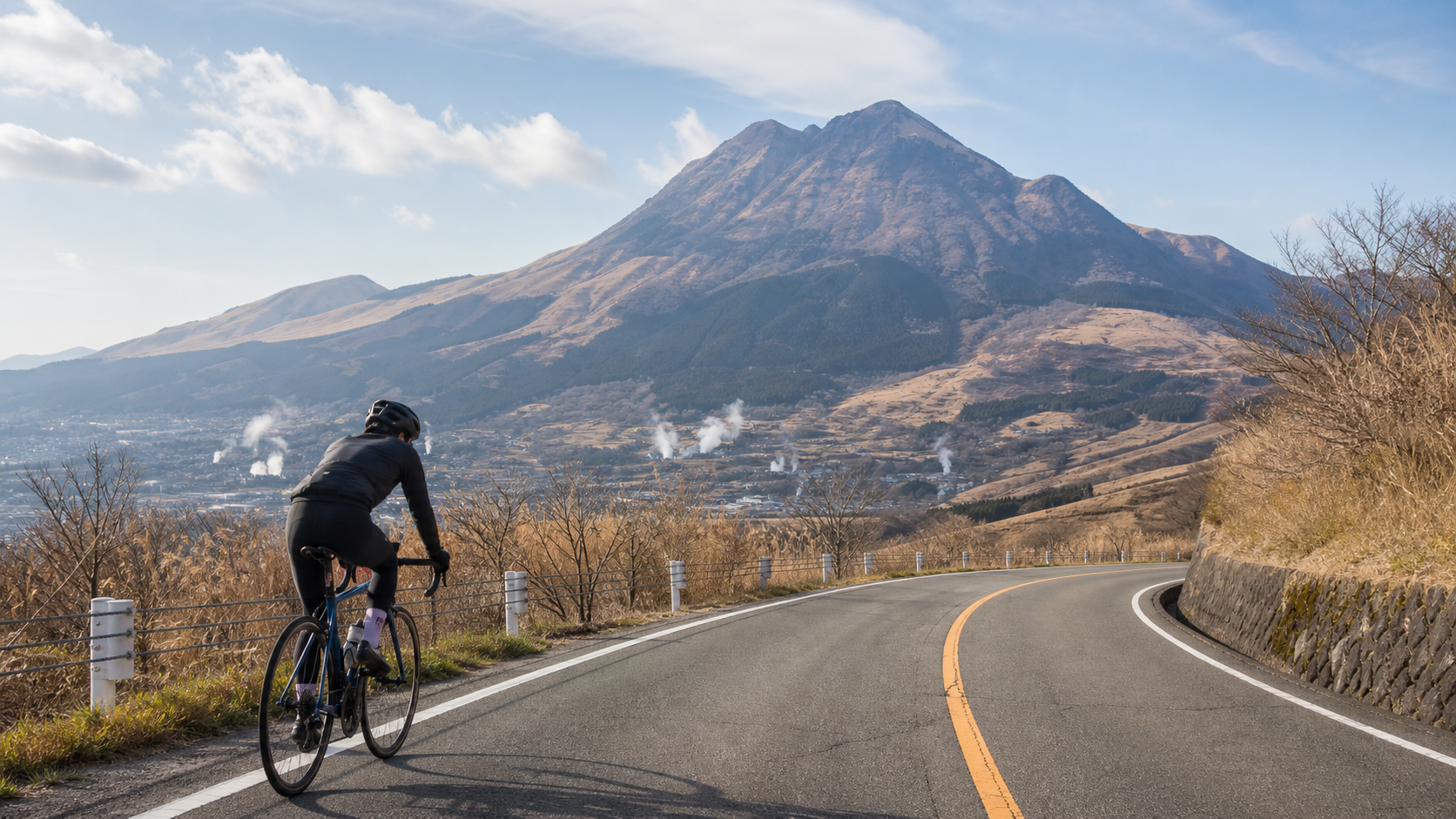
In Oita, you can fall in love with climbing in the gentlest way.
That road starts from the hot spring city of Beppu, faces the majestic Mount Yufu directly, climbs gradually along the Yamanami Highway, and finally glides down into another famous hot spring town—Yufuin. 11.4 kilometers long, 487 meters of elevation gain, 4.3% average gradient. It’s as gentle as a patient teacher, long enough to let you fully experience the rhythm of a climb, yet mild enough not to scare off any beginner.
This isn’t about pacing. What I want to talk about is—why this road, connecting two hot spring towns and facing a famous mountain, is what so many people consider “the most beautiful version of a cycling trip.”
Starting from a “City That Smokes”
Beppu is a truly magical city.
It’s Japan’s premier hot spring resort, with geothermal energy so abundant that the entire city “smokes”—walking down the street, you’ll see white steam rising from cracks in the ground, from rooftop chimneys, from the hillsides, as if the whole city is alive, breathing. Its most famous attraction is the “Hell Tour”—a series of boiling, churning hot spring sources in different colors: blood red, cobalt blue, grayish white, like the earth has lifted a corner to reveal the power beneath.
My ride began in this smoking city. In the early morning, steam from the hot springs still lingered on the street corners. I got on my bike and set off toward that sharply defined mountain in the distance—Mount Yufu.
Mount Yufu: Oita’s Fuji
Not long into the climb, the main character appeared.
Mount Yufu, over 1,500 meters tall, is a symbol of Oita. Because of its symmetrical, imposing form, it’s affectionately called “Bungo Fuji”—Bungo being Oita’s ancient name. It has a distinctive shape: the summit splits into two peaks, like brothers standing shoulder to shoulder, striking and full of tension when viewed from afar.
As I climbed higher and higher, Mount Yufu grew larger and clearer before me. It stood right ahead on the road, as if guiding my way. This feeling is奇妙—you’re not monotonously grinding up a slope; you’re drawing closer, step by step, toward a magnificent mountain. With every pedal stroke, the mountain came nearer, its details sharper: the folds of the ridgeline, the vegetation on the slopes, the outline of the twin peaks at the summit.
The gradient was gentle—a 4.3% average gave me plenty of room to admire it. That’s the most luxurious thing about this road: it doesn’t force you to bury your head and grind; it lets you look up and keep company with Mount Yufu all the way.
The Philosophy of a Gentle Slope: Only When You’re Slow Can You See
I’ve always felt that gentle slopes have an underrated romance.
Steep climbs are intense—they force you to focus entirely on pedaling and breathing, leaving no attention for anything else. Gentle slopes are different—they give you time, give you leeway, give you eyes that can truly see the world.
On Mount Yufu’s gentle slope, I could take my time looking: at the grassy hillsides rippling in the wind, at the white steam rising from hot springs in the distant valley, at cloud shadows slowly gliding across the mountain’s flank, at the leisurely cattle and sheep in the pastures. These details are luxuries on a steep climb, but here they’re everyday sights.
Only when you’re slow can you see. What this road taught me is that climbing doesn’t have to be painful or desperate. Sometimes, climbing can be a long, leisurely conversation with the scenery—just on wheels.
Over the High Point, Gliding into Yufuin
When I crossed the highest point of the route, the view opened up before me—the Yufuin Basin, quietly unfolding in the embrace of surrounding mountains.
From here, the gradient turned gentle or even downhill. The hard work of climbing was done, replaced by an easy, pleasant descent with cool wind on my face, the farmlands and houses of Yufuin drawing closer and closer. That sense of anticipation—“the climb is over, time to descend and soak in hot springs”—is the sweetest emotion in any cycling trip.
Yufuin is a very different hot spring town from Beppu. Beppu is bold, smoking, full of power; Yufuin is artsy, refined, leisurely. The hot spring street here is small and elegant, with galleries, cafés, handmade craft shops, and famous stores selling pudding and gold-award croquettes. Lake Kinrin lies quietly at the edge of town, dreamlike and beautiful when morning mist swirls around it. Mount Yufu stands watch behind the town—you were just gazing up at it from the other side of the mountain; now it’s the backdrop to your resting place.
Soaking in Hot Springs: The Perfect Ending to the Day
Park the bike, step into a bathhouse, peel off the sweat-soaked jersey, and sink your whole body into the warm spring water—this is the perfect ending to a Mount Yufu cycling trip.
The hot water envelops legs that were just pedaling, and the day’s fatigue dissolves little by little into the water. Outside the window might be the silhouette of Mount Yufu, or the farmlands of Yufuin. You soak in the water, reflecting on the day: setting out from smoking Beppu, climbing steadily toward Bungo Fuji, crossing the high point, gliding into this artsy hot spring town—what a complete, wonderful day.
After the soak, stroll down the hot spring street, enjoy a freshly fried croquette, sip a pour-over coffee, buy a Yufuin specialty pudding. The setting sun paints Mount Yufu gold, and the town’s lights gradually come on. You’ll feel that life should occasionally be lived just like this.
Mount Yufu and Two Hot Spring Towns Through the Seasons
- Spring, fresh greenery emerges at the foot of Mount Yufu, and the hot spring towns awaken in the warmth—the most comfortable season.
- Summer, it’s hot and humid below, but cool and pleasant at higher elevations; the refreshment after a hot spring soak is the perfect way to beat the heat.
- Autumn, the slopes around Mount Yufu are dyed in layers of color; autumn leaves paired with hot springs make this the most poetic time of year.
- Winter, the hot spring towns have a special charm in winter—snow falls on Mount Yufu’s summit, steam rises into the cold air—just be extra careful about road conditions when cycling.
Side Trip: Putting Both Hot Spring Towns in Your Pocket
The best thing about the Mount Yufu road is that it strings together Oita’s two great hot spring destinations—Beppu and Yufuin—with a single climb.
You can do the Hell Tour in Beppu in the morning, watching those boiling, colorful hot springs; ride over Mount Yufu at noon; and soak in hot springs and stroll the hot spring street in Yufuin by evening. Extend a bit further, and this road connects to the Aso Panorama Line, stretching onward to Mount Notoro Pass and toward Aso, collecting Kyushu’s spectacular scenery one stop at a time.
Epilogue: The Gentlest Climb
11.4 kilometers, 487 meters of elevation gain, 4.3% average. The numbers on this road aren’t intimidating at all.
But its value lies precisely in that “gentleness.” It lets those who fear steep climbs still enjoy the sense of accomplishment of a long ascent, gives you the leeway to look up and admire the grandeur of Bungo Fuji, and lets you spend a perfect day between two hot spring towns—a day about mountains, about scenery, about soaking in hot springs.
Some people chase the steepest, harshest, most punishing climbs. Mount Yufu reminds us—climbing can also be gentle, can be healing, can be a beautiful journey in the company of a famous mountain, ending in hot springs.
If you want to start falling in love with climbing, I’d say: start here.
Route data: Yufuin TT (Mount Yufu), distance 11.4 km, total elevation gain 487 m, average gradient 4.3%, Beppu City, Oita Prefecture, along the Yamanami Highway, connecting the two great hot spring towns of Beppu and Yufuin, facing Bungo Fuji (Mount Yufu)—a beginner-friendly long climb.
Beppu: A Hell and Heaven of Rising Steam
The starting point of the Mount Yufu cycling trip, Beppu, is a city you’ll never forget.
Beppu’s hot spring output is said to be the highest in Japan. The entire city sits atop abundant geothermal energy. Walking down the streets, you’ll see white steam rising from cracks in the ground, from rooftop chimneys, from the hillsides, as if the whole city is alive, breathing. This sight is extremely rare in the world—Beppu is a city that truly “smokes.”
And Beppu’s most famous attraction is the “Hell Tour” (Jigoku Meguri). The “hells” refer to hot spring sources that are too hot to bathe in and can only be viewed. Each has its own character: “Umi Jigoku” (Sea Hell) is a dreamy cobalt blue, like a pool of sky fallen to earth; “Chi-no-ike Jigoku” (Blood Pond Hell) is a startling crimson, boiling like a sea of blood due to its iron content; “Shiroike Jigoku” (White Pond Hell) is a warm milky white. These “hells” churn and boil, steam rising, as if the earth has lifted a corner to reveal the raw, searing power beneath.
Standing on Beppu’s streets, looking at this city infused with geothermal energy, you’ll feel a strange sense of anticipation for the Mount Yufu ride ahead. Because you know this journey begins with the shock of “hell” and ends in the gentle “heaven” of Yufuin. Setting out from a smoking city of hells, climbing toward a majestic mountain, and finally arriving at an artsy hot spring paradise—that narrative itself is full of dramatic tension.
Bungo Fuji: A Famous Mountain with a Nickname
Mount Yufu is the companion protagonist of this entire ride.
At over 1,500 meters, Mount Yufu is a symbol of Oita. It has a very distinctive shape—the summit splits into eastern and western peaks, like brothers standing shoulder to shoulder, striking and highly recognizable from afar. Precisely because of its imposing, symmetrical form, people affectionately call it “Bungo Fuji”—Bungo being Oita’s ancient name. This nickname reveals the locals’ pride and affection for the mountain: like Mount Fuji, it is the guardian and spiritual symbol of this land.
Cycling toward Mount Yufu is a healing experience. It stands right ahead on the road, as if guiding your way. As you climb higher and higher, Mount Yufu grows larger and clearer before you—the folds of the ridgeline, the vegetation on the slopes, the outline of the twin peaks at the summit, all gradually sharpening. This feeling of “drawing closer, step by step, toward a magnificent mountain” makes the climb anything but monotonous—it becomes an intimate encounter with a famous peak.
The area around Mount Yufu is also excellent for hiking. At its foot, the Yufuin Basin (another spelling of Yufuin) has, under the mountain’s watch, nurtured that hot spring town famous throughout Japan. It could be said that Mount Yufu gives the entire region its soul.
Yufuin: An Artsy Hot Spring Paradise
Crossing the high point and gliding into the Yufuin Basin, you arrive at a hot spring town with a completely different character from Beppu.
If Beppu is bold, smoking, and full of raw power, then Yufuin is artsy, refined, and leisurely. The hot spring street here is small and elegant, lined with galleries, cafés, handmade craft shops, and famous dessert stores. The air carries the aroma of coffee and baked goods, and visitors stroll leisurely, browsing, tasting. There’s no hustle and bustle of a large tourist destination; instead, there’s a slow-living, refined, relaxing atmosphere.
Yufuin’s soul is “Lake Kinrin.” This small lake lies quietly at the edge of town, its waters kept warm year-round by inflowing hot springs. Especially on autumn and winter mornings, when the warm lake meets the cold air, mist rises from the surface—dreamlike, beautiful as an ink-wash painting. And Mount Yufu stands watch quietly behind the town—you were just gazing up at it from the other side of the mountain; now it’s the most beautiful backdrop to your resting place.
In Yufuin, be sure to try the local specialties: freshly baked gold-award croquettes, creamy pudding, and various desserts made with local ingredients. Fresh off the climb, sitting in a small shop on the hot spring street, enjoying a freshly fried croquette and a pour-over coffee while watching Mount Yufu through the window—that sense of comfort and satisfaction is the sweetest part of this ride.
Soaking in Hot Springs: The Perfect Ending to the Day
The perfect ending to a Mount Yufu cycling trip is a soak in a hot spring.
Park the bike, step into a bathhouse, peel off the sweat-soaked jersey, and sink your whole body into the warm spring water—this is the supreme reward for a cyclist. The hot water envelops legs that were just pedaling, and the day’s fatigue dissolves little by little into the water. If it’s an open-air bath, the view outside the window might be Mount Yufu, or the farmlands of Yufuin. You soak in the water, letting the steam rise, thinking of nothing.
Japan’s bathing culture has an almost ritualistic healing quality. It’s not just about washing away sweat; it’s a kind of physical and mental reset. When you reflect on the day while soaking—setting out from smoking Beppu, climbing steadily toward Bungo Fuji, crossing the high point, gliding into this artsy hot spring town—you’ll feel that this was such a complete, wonderful day.
And that wonderfulness is made all the more profound precisely because you “rode” here. People who drive to soak can certainly enjoy the hot springs too, but that satisfaction of “earning this bath with a full day’s sweat” is something only cyclists understand. The effort of the climb is fully redeemed in this pool of hot water, transformed into incomparable comfort.
After the Epilogue: Gentleness Is Also a Kind of Strength
In the world of climbing, we often worship the “steepest, harshest, most punishing” routes. As if the more painful and difficult, the more worthy of pride.
But Mount Yufu reminds me that gentleness is also a kind of strength.
It doesn’t intimidate you with steep walls or torment you with extremes. It uses a friendly, gentle slope to let those who fear steep climbs enjoy the achievement of a long ascent; a majestic mountain to accompany you through every stretch of climbing; and two hot spring towns to tightly bind effort with reward. It proves—climbing doesn’t have to be painful; it can be healing. A cycling trip doesn’t have to be about conquest; it can be about enjoyment.
I’ve gradually come to believe that this “gentle strength” is equally precious in life. We too often push ourselves to challenge limits, to chase the hardest goals, forgetting that sometimes, treating ourselves gently, choosing a friendlier path, giving ourselves more leeway to enjoy the scenery and soak in hot springs—that too is a kind of wisdom, an art of living.
If you too are on the road of climbing, on the road of life, feeling suffocated by the obsession that things “must be harder, faster, stronger”—then by all means, come ride Mount Yufu once. Let it gently remind you: slower, softer, giving yourself a little more reward—that’s good too.
May you, on Mount Yufu’s gentle slopes and in Yufuin’s hot springs, relearn how to treat yourself gently. Because those who understand gentleness are the ones who can go farther—and happier—on both long rides and in life.
Between Beppu and Yufuin, the majestic Mount Yufu awaits, ready to give you, in the gentlest way, a perfect day of mountains, scenery, and hot springs.
Mount Yufu and Two Hot Spring Towns Through the Seasons
The Mount Yufu road has its own beauty in every season, and different seasons suit different cycling moods.
- Spring, fresh greenery emerges at the foot of Mount Yufu, and the hot spring towns awaken in the warmth. Riding at this time carries a freshness of renewal—a good season to start cycling again and plan new goals for the year.
- Summer, it’s hot and humid below, but cool and pleasant at higher elevations; and the refreshment after a hot spring soak is the perfect way to beat the heat. Soaking in a hot spring and enjoying a cold treat on a summer evening in Yufuin is a rare, cool pleasure in the heat.
- Autumn, the slopes around Mount Yufu are dyed in layers of color; autumn leaves paired with hot spring steam make this the most poetic time of year. The autumn colors around Lake Kinrin and the red leaves on the hot spring street make this ride as beautiful as a dream.
- Winter, the hot spring towns have a special charm in winter—snow falls on Mount Yufu’s summit, steam rises into the frigid air, and the morning mist over Lake Kinrin is especially dreamlike. Just be extra careful about road conditions when cycling; higher elevations may be icy. Winter in Yufuin is the ultimate experience of soaking while enjoying the snow.
The same road, the same mountain, the same two hot spring towns—four seasons can give you four completely different experiences. That’s why Mount Yufu is worth returning to again and again—in every season, it’s new.
A Cycling Trip Heals More Than Just the Body
I’ve always felt that a ride like Mount Yufu heals not just the body, but the mind.
Modern people live too tensely. Work pressure, life’s anxieties, the relentless bombardment of information—they keep our minds in a state of chronic tension and exhaustion. And a ride like Mount Yufu—the gentle climb, the magnificent mountain, the tranquil hot springs, the leisurely hot spring street—offers precisely a gentle antidote.
When you focus on pedaling up the gentle slope, work worries temporarily recede; when you look up and see the majestic Mount Yufu, inner restlessness is soothed by the grandeur of nature; when you finally sink into the warm spring water, the fatigue accumulated over a day—or even a longer stretch of time—slowly dissolves in the rising steam. This ride is like a complete “reboot”—returning your tense body and mind to a relaxed, balanced, energized state.
We often think rest means lying down and doing nothing. But sometimes, the best rest is exactly this—using gentle exercise to stretch the body, magnificent scenery to open the mind, and the healing of hot springs to settle the emotions. What Mount Yufu taught me is a kind of “dynamic healing”: through just the right amount of effort and reward, letting body and mind achieve true, deep rest.
So if you too feel tired, tense, in need of a good breath—don’t just lie down. Come ride Mount Yufu. Let this gentle mountain and these two healing hot spring towns give your body and mind a thorough reboot. You’ll go home with abundant energy and calm, ready to face life’s challenges again.
May you, on Mount Yufu’s gentle slopes and in Yufuin’s hot springs, rediscover a long-lost relaxation and balance of body and mind. That is the most precious gift this gentle road can give you.
The Hot Springs of Home: Thinking of Taiwan’s Springs in Yufuin
As a Taiwanese cyclist, soaking in Yufuin’s hot springs, I often think of the springs back home.
Taiwan is also an island of hot springs. From Beitou’s sulfur springs and Yangmingshan’s white sulfur, to Guguan, Lushan, Zhiben, and Guanziling’s mud springs, we have rich and diverse hot spring resources. Moreover, Taiwan has equally wonderful routes where “you can soak right after climbing”—ride up Yangmingshan and you can soak on the mountainside; conquer the slopes around Guguan and hot springs await at the foot of the mountain. In this “combination of mountains and springs,” Taiwan is in no way inferior to Japan.
Yet somehow, when soaking in a foreign land, the longing for home becomes especially vivid. Soaking in this pool at the foot of Mount Yufu, I thought of Beitou’s sulfur-scented springs, of weekends spent diving into bathhouses after climbing Yangmingshan with friends, of Guanziling’s unique mud springs. These images, separated from this moment in Yufuin by an ocean, nonetheless overlap strangely in the shared ritual of “climbing + soaking.”
This made me realize that the healing of mountains and springs is universal to humanity. Whether in Japan or Taiwan, we seek solace from nature in the same way—conquering a slope with our legs, then dissolving the day’s fatigue in hot springs. And this gentle ride on Mount Yufu not only made me fall in love with a foreign land’s hot springs, but also made me miss—and cherish anew—the equally wonderful springs of home.
If you’re also a Taiwanese cyclist, after soaking in Yufuin, take a moment to think of Beitou, Yangmingshan, Guguan back home. Then find a weekend to fall in love again with our own island of hot springs. After all, the best healing is sometimes hidden in the mountain and the pool closest to home.
Mount Yufu taught me to love a gentle cycling trip, and also taught me to better appreciate the mountains and springs of home. That is the warmest takeaway from a ride in a foreign land. May we all, between the hot springs of home and faraway places, find that undying love for mountains, for springs, for life.
Related Reading
- Yufuin TT (Mount Yufu) Guide: Pacing, Gearing, and a Hot Spring Town Ride on a 11.4 km 4.3% Beginner-Friendly Long Climb
- The Untraveled Side of Mount Akagi: Riding from Kiryu to Rihei Chaya, a Soliloquy of the Eastern Face Hidden in the Forest
- A Volcanic Road with 1,300 Years of Hot Spring History: The Springs, Legends, and Wilderness Ride of Nasu-Tōge no Chaya
- Seas of Clouds, Herds of Cattle, and Sculptures on the Grasslands: A Day’s Poem Riding the Utsukushigahara Plateau
台北闊瀨陡坡 騎旅 / 日本單車雜誌編輯車友臨時加入!/ 髮香才是最強的 / feat. 北迴歸線小隊 / 公路車 CT Yeh
6 個月前
京都!99%人不知道的秘境玩法!租 E-Bike 騎進探訪宇治抹茶原鄉 刺激好玩絕美的山林古道 鬼滅之刃的場景探訪 / CT Yeh
14 天前
日本島波海道 EP1 / 五大絕景路線之一! / 私房溫泉 x 豪華單車客棧 / 今治 to 大三島 / 公路車 / CT Yeh
2 年前
爬坡ITT實境)台中 魔王 松鼠坡 首航 6:12 大肚山 大三元 科福路
8 年前
#北橫 + #北進武嶺 最硬的員工旅遊 EP1 | #公路車 #拉拉山 | 明池 | 武嶺 | 武陵農場 | 雲海 | Taiwan Cycling Route Wulin
6 年前
白沙屯媽祖進香在家走!UREVO 坡度自調走步機 / 可連接訓練遊戲APP MyWhoosh / 邊看直播邊走起來 / CT Yeh
11 個月前
觀霧 變好騎了! | 北高車友爆笑大會師 | 公路車 | 單車旅遊 Taiwan Cycling Route GuanWu
6 年前
水金九不厭五分 10度寒流冷到不願停!feat. 卡卡 / 公路車 / CT Yeh
6 個月前