Climbing the Hakone Ekiden Route: National Route 1, Hot Spring Towns, and Mount Fuji over Lake Ashi
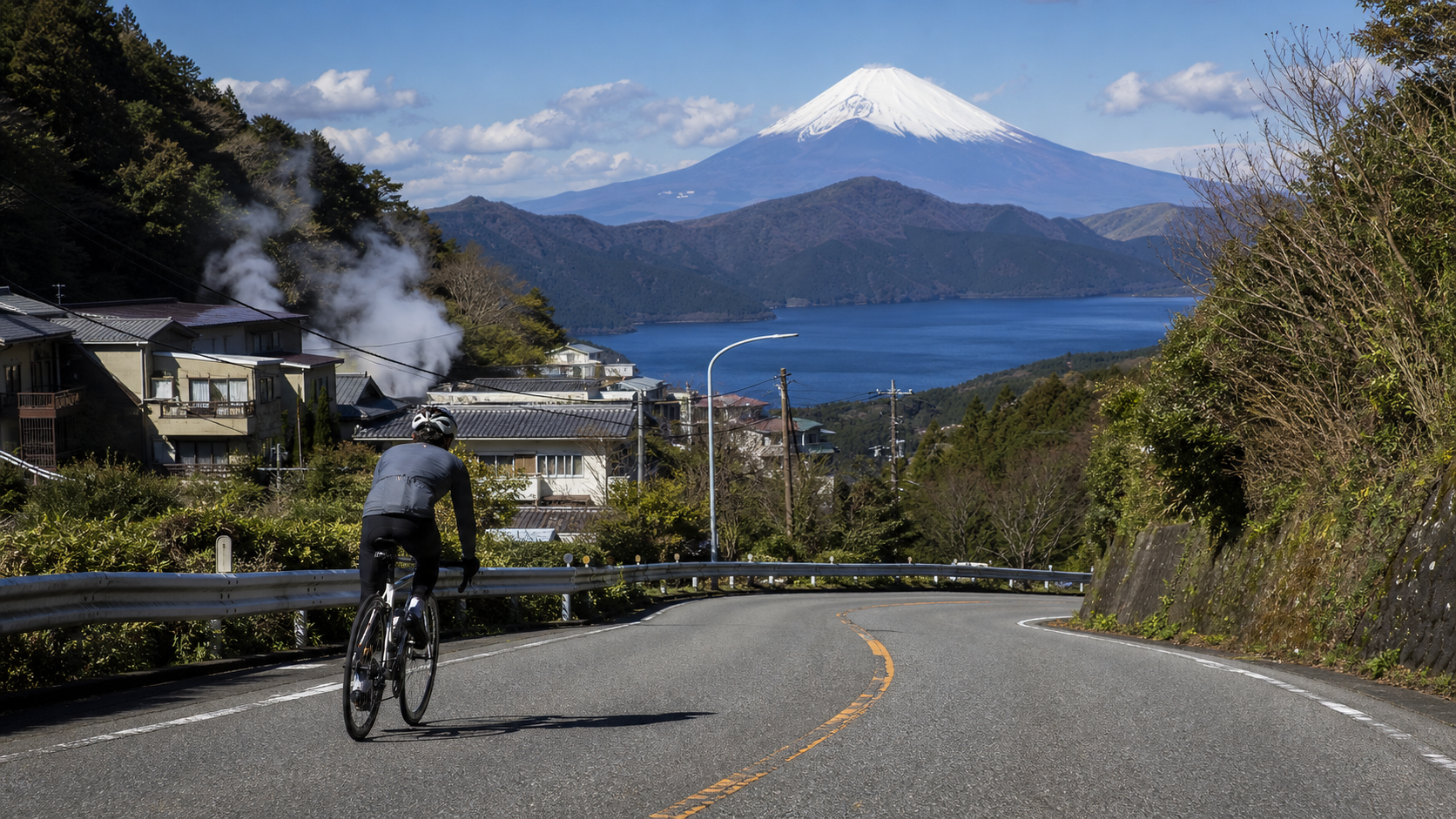
Climbing the Hakone Ekiden Route: National Route 1, the Hot Spring Town, and Mount Fuji over Lake Ashi
Distance 15.6 km, elevation gain 846 m, average gradient 5.3%. The summit is the highest point on National Route 1 at approximately 874 m above sea level. This is the same road the Hakone Ekiden runners race on, and a classic ride leading to hot springs, Lake Ashi, and Mount Fuji.
Every New Year’s Day, all of Japan watches a relay race on television—the Hakone Ekiden. And as the runners, panting white breath, charge up National Route 1 toward Hakone, I always think: one day, I’ll ride this road with my own legs.
A Climb That All of Japan Knows
The National Route 1 route over Hakone Pass is one of the most “famous” climbs in all of Japan, because it is the road taken on the eastern leg of the Hakone Ekiden. This road carries not just terrain, but the New Year’s memories of generations of Japanese people—those images of “mountain section” runners straining upward have long been etched into the nation’s collective consciousness.
The moment I set off from Odawara and stepped onto National Route 1, there was a strange sense of ritual: I was riding on the same asphalt where countless legendary runners had sweated. The full route is about 15.6 km with roughly 846 m of climbing, and the summit is the highest point on National Route 1, at approximately 874 m above sea level.
From Odawara to Yumoto: A Hot Spring Street Through Time
The early section departs from Odawara city center with gentle gradients but heavy traffic. National Route 1 is Hakone’s main artery, with sightseeing buses and self-drive tourists coming and going without end. I’m in no hurry—I treat this stretch as a warm-up, keeping an eye on traffic while watching the scenery gradually transition from city streets to the edge of the mountains.
Soon, Hakone-Yumoto arrives. This is the gateway to the Hakone hot spring district. The air begins to carry a hint of sulfur, and roadside inns and souvenir shops with long-established names line the way. As one of Japan’s premier hot spring resorts, Hakone has welcomed travelers from Edo and Tokyo for centuries. As I pedal through this hot spring street, I suddenly feel like I’ve become part of this ancient travel route myself.
Yumoto to Miyanoshita: The Mountain Truly Begins
Past Yumoto, the road truly “stands up.” The gradient rises to 6–7%, with one continuous switchback after another. This is the main climbing section of the entire route.
I keep my composure, lock my heart rate into a steady zone, and push upward at an unchanging rhythm. The most annoying thing on this stretch isn’t the gradient—it’s the stop-and-go of sightseeing buses. They crawl and pull over on the narrow mountain road, disrupting your rhythm. I learn to anticipate, maintain a safe distance, and bring my focus back to my own pedaling.
Passing through the Miyanoshita area along the way, I see century-old hotels and buildings with an exotic flair—testimony to Hakone’s modern history as an international resort destination. The pain of the climb is diluted considerably by these fleeting scenes.
The Summit and Lake Ashi: If Mount Fuji Deigns to Show Its Face
The final section climbs steadily until reaching the highest point on National Route 1—Hakone Pass, at approximately 874 m above sea level.
Crossing over the summit, the view opens up before you. Following the descent, Lake Ashi spreads out across the valley in a tranquil blue. Occasionally, a replica pirate ship glides slowly across the lake, and in the distance—if the weather is good enough and the clouds are kind—Mount Fuji reveals its irreplaceable silhouette on the far shore of the lake.
At that moment, every meter of climbing is rewarded. Mount Fuji over Lake Ashi is a “textbook-grade” image of Japanese scenery, and you’ve delivered yourself to the best seat in the house for that view with your own two legs.
Discipline in Traffic
I have to be honest: National Route 1 has a lot of traffic. That’s its fate as the stage for the Ekiden, and the reality every rider must face. Don’t cut across the outside line on corners, don’t overspeed on descents, and maintain respect for tour buses—these disciplines matter more than any performance metric.
If you want a more secluded climb, Hakone offers another option: the Old Hakone Road (Old Tokaido), with sparse traffic and deeper history. That’s another story.
The Collective Memory of New Year’s
To understand what this Hakone climb means to the Japanese, you first need to know the “Hakone Ekiden.”
Every January 2nd and 3rd, television across Japan broadcasts this university relay race—roughly 217 km round-trip from Tokyo to Hakone, run in stages by teams of university runners. The most anticipated of these is the “mountain section (Stage 5),” which is precisely the climbing leg from Odawara up National Route 1 to Hakone. Those images of runners gasping white breath and straining upward in the winter wind are the shared New Year’s memory of generations of Japanese. The title “Mountain God” is reserved for the runners who create legends on this climb.
So when I ride up this National Route 1 on my bike, I’m not just climbing an ordinary hill—I’m riding a road that carries the emotions of a nation. Every inch of asphalt beneath my wheels has been soaked by the sweat of countless legendary runners. This feeling of “traveling alongside legend” gives the Hakone climb a weight you won’t find anywhere else.
Riding Through a Hot Spring Street Is Riding Through Centuries
Departing from Odawara, the early section follows National Route 1 through the city with gentle gradients but heavy traffic. Soon, Hakone-Yumoto arrives.
This is the gateway to the Hakone hot spring district. The air carries a faint scent of sulfur, and long-established ryokan and souvenir shops line the road. As one of Japan’s premier hot spring resorts, Hakone has welcomed travelers from Edo and Tokyo for centuries—people who crossed mountains and valleys for the sole purpose of soaking in a hot spring and washing away the dust of their journey.
As I pedal through this hot spring street, I suddenly feel a strange sense of time overlapping. Hundreds of years ago, people arrived here on foot, by palanquin, or on horseback; I arrive on two wheels. What has changed is the mode of transport; what hasn’t changed is this mountain’s eternal pull on travelers.
Yumoto to Miyanoshita: The Mountain Truly Stands Up
Past Yumoto, the road truly “stands up.” The gradient rises to 6–7%, with one continuous switchback after another. This is the main climbing section of the entire route.
I keep my composure, lock my heart rate into a steady zone, and push upward at an unchanging rhythm. The most annoying thing on this stretch isn’t the gradient—it’s the stop-and-go of sightseeing buses. They crawl, pull over, and start again on the narrow mountain road, genuinely disrupting your rhythm. I learn to anticipate their movements, maintain a safe distance, and bring my focus back to my own pedaling.
Passing through the Miyanoshita area along the way, I see hotels with over a century of history and buildings with an exotic character. This is testimony to Hakone’s modern role as an international resort—as early as the Meiji era, it welcomed many foreign visitors. The pain of the climb is diluted considerably by these fleeting historical scenes.
If Mount Fuji Deigns to Show Its Face
The final section climbs steadily until reaching the highest point on National Route 1—Hakone Pass, at approximately 874 m above sea level.
Crossing over the summit, the view opens up before you. Following the descent, Lake Ashi spreads out across the valley in a tranquil blue. Occasionally, a replica pirate ship glides slowly across the lake, and in the distance—if the weather is good enough and the clouds are kind—Mount Fuji reveals its irreplaceable silhouette on the far shore of the lake.
At that moment, every meter of climbing is rewarded. Mount Fuji over Lake Ashi is a “textbook-grade” image of Japanese scenery, appearing in countless postcards, calendars, and paintings. And right now, I’ve delivered myself to the best seat in the house for that view with my own two legs. This sense of satisfaction that comes from “arriving on your own strength” is something no sightseeing bus can provide.
Discipline in Traffic, and Another Option
I have to be honest: National Route 1 has a lot of traffic. That’s its fate as the stage for the Ekiden and as Hakone’s main tourist artery, and the reality every rider must face. Tour buses, self-drive tourists, and motorcycles flow without end. Don’t cut across the outside line on corners, don’t overspeed on descents, and maintain respect for large vehicles—these disciplines matter more than any performance metric. After all, the scenery returns year after year, but you only get one chance at safety.
If you want a more secluded, more historic climb, Hakone hides another road: the Old Hakone Road, with sparse traffic, steeper gradients, and directly following the old Tokaido of the Edo period. That’s a completely different experience—one rides alongside modern tourism, the other converses with ancient history. But that’s another story.
After finishing the Hakone climb, I sat by Lake Ashi for a long time, watching pirate ships trace ripples across the water while Mount Fuji appeared and disappeared in the distance. I thought of those Ekiden runners straining up the slope on television, and of the travelers who crossed the mountains for hot springs over the centuries, and I suddenly felt like I’d become a small footnote in this road’s long story. What makes this road moving has never been just the climb itself, but everything it carries—the efforts, dreams, and yearnings of so many people. And now, I’ve quietly left my own small mark here too.
The “National-Level” Weight Behind the Numbers
Back to the numbers: 15.6 kilometers, 846 meters of climbing, an average gradient of 5.3%, and a summit at roughly 874 meters. These figures define the “shape” of this climb, yet they cannot define its “weight” in the hearts of the Japanese.
Because the weight of Hakone National Route 1 is cultural. It is the stage of the Hakone Ekiden, the gateway to a premier hot-spring town, and an exceptional balcony for viewing Mount Fuji—these three identities elevate it far beyond the meaning of an ordinary climb. When you ride this road, you are not just battling a 5.3% gradient; you are simultaneously stepping into Japan’s sporting memory, its tourism traditions, and its landscape aesthetics. This layered depth is something many obscure mountain roads simply cannot offer.
For this reason, riding Hakone National Route 1 never buys you just a climb; it buys you an entire “Japanese classic” experience package—history, hot springs, Mount Fuji, and ekiden legend, all packed into those 15.6 kilometers.
Hot Springs: Made for Weary Legs
After riding Hakone, not soaking in an onsen would be a sheer waste.
Hakone is one of Japan’s most renowned hot-spring towns, a place where travelers have rewarded themselves after crossing the mountains since the Edo period. The springs here are diverse, from milky-white sulfur baths to clear carbonated ones, each with its own therapeutic properties. And for a rider who has just climbed over 800 meters with legs full of lactic acid, nothing soothes the muscles and washes away fatigue quite like sinking into a pool of warm spring water.
Imagine this: you have just conquered Hakone Pass, coasted down the descent back into the hot-spring town, parked your bike, peeled off your sweat-soaked jersey, and slowly lowered yourself into a steaming bath. Outside the window, perhaps a mountain view or a starry sky; your muscles loosen inch by inch in the warmth, and all the day’s effort transforms into pure indulgence in that moment. This perfect “climb + onsen” combination is a luxury unique to Hakone, and it is the reason countless riders willingly return again and again. (Please confirm actual bathhouse availability and operating hours on site.)
Lake Ashi and Mount Fuji: A Date with Luck
Mount Fuji seen from the shores of Lake Ashi is the most magnificent surprise Hakone offers riders—but it is a date with luck.
Mount Fuji is inherently “shy,” often veiled by clouds; whether you get a clear view of it depends entirely on the weather’s mood. Clear, dry days with high visibility offer the best odds; and when winter air is crisp, it is actually the best season for viewing Fuji (though the summit will be very cold).
I will never forget the moment I first saw Mount Fuji from Lake Ashi’s shore. The fatigue from the climb, the anticipation of the scenery, and the sheer “jackpot” joy when Fuji actually revealed itself—all of it intertwined. The blue of the lake, the white of the distant mountain, the clarity of the sky—that scene was as beautiful as a painting under a spell. And I knew it was my own legs that had carried me to the front row of that picture. That emotion, where achievement and beauty merge, is worth gambling on countless days of good weather.
For Those Planning a Pilgrimage
Hakone National Route 1 is one of the routes I most recommend to those “challenging their first classic Japanese climb.” The reason is simple: it condenses the essence of cycling in Japan into a single road.
Here are a few sincere suggestions for you:
First, choose a clear day. For the sake of Mount Fuji at Lake Ashi, this bet is absolutely worth it.
Second, start early. National Route 1 carries heavy traffic and many tourists; setting off at dawn lets you avoid the crowds and traffic while enjoying fresher air.
Third, be sure to leave time for the hot springs. The climb is the first half, the onsen is the second half; a Hakone trip without the hot springs is incomplete.
Fourth, safety comes first. This is a bustling tourist artery with many large vehicles and many curves. Set aside any obsession with time; getting home safely is always the most important thing.
After riding Hakone, sitting by Lake Ashi, watching the pirate ships glide across the water and Fuji appearing and disappearing in the distance, you will sincerely feel: this trip was worth it. This climb, carrying the ekiden legend, hot-spring culture, and the beauty of Mount Fuji, truly lives up to its status as a classic in the hearts of Japanese riders. And now, you too have become a small yet genuine protagonist in this classic story.
The Complete Memory of That Day
I chose a clear winter morning, coming specifically for Mount Fuji at the shores of Lake Ashi.
Winter air is the clearest, making it the best season for viewing Fuji, though the summit is very cold. I assembled my bike in front of Odawara Station, exhaling white breath as I carefully layered my windproof gear. Traffic on National Route 1 was still light in the early morning; I followed the gentle opening stretch, passing through the just-awakening streets, heading toward Hakone.
When I reached Hakone-Yumoto, the hot-spring town was drifting with faint white steam and the scent of sulfur. The long-established ryokan were still immersed in morning stillness, and most of the shutters of the souvenir shops had not yet been raised. I slowed down, savoring this hot-spring street that has carried the memories of travelers for centuries, imagining how the travelers of the Edo period must have felt arriving here.
Past Yumoto, the mountain rose in earnest. A 6–7% gradient paired with continuous switchbacks formed the main challenge of the entire route. The nuisance was the stop-and-go of sightseeing buses; I had to constantly anticipate, maintain distance, and pull my focus back to my own rhythm. Passing through Miyanoshita, the century-old hotels and buildings with exotic flair added a touch of interest to the monotony of the climb.
The final stretch climbed steadily until Hakone Pass at roughly 874 meters. The moment I crested the summit, the view opened up before me—Lake Ashi lay quietly nestled in the valley, its water a pure, pristine blue. I held my breath and looked toward the far side of the lake.
Mount Fuji was there.
In the crisp winter air, Mount Fuji revealed its clear, complete, snow-covered silhouette, reflected on the calm surface of Lake Ashi. That scene was almost too beautiful to be real, like an enchanted ukiyo-e painting. I stood by the lake, speechless for a long time, feeling only that all the climbing and all the cold of the past moments had turned into something worthwhile. It was my own legs that had carried me to the front row of Japan’s most classic landscape.
In Closing: On “Classics”
After riding Hakone, soaking in the hot spring as my aching legs slowly unwound, I thought about the word “classic.”
Some roads become classics not because they are the hardest, the most thrilling, or the most unique, but because they achieve a state of perfect completeness in what they do. Hakone National Route 1 is exactly that—it seamlessly stitches together “the achievement of the climb, the depth of history, the healing of the hot springs, and the breathtaking beauty of Fuji” into a single road, composing an impeccable riding experience.
A classic is something that withstands the test of time. For centuries, people have come to Hakone for different reasons—to cross the mountains, to bathe in the springs, to see Fuji, for the glory of the ekiden. And now, we arrive on bicycles, joining this long procession. What we seek is, in essence, no different from what travelers sought hundreds of years ago—to find physical and spiritual satisfaction and solace after a hard journey.
That is the power of a classic. It transcends eras and tools, connecting generation after generation. And to personally set foot on such a classic road, to continue its story in your own way, is itself a form of happiness. Hakone is, without question, the eternal classic in the hearts of Japanese riders.
For Those Who Want to Come
- Season: Spring (fresh greenery) and autumn (autumn leaves) offer the most beautiful scenery, but also the heaviest crowds and traffic; an early start is recommended. Summer is cooler in the mountains but prone to afternoon thunderstorms. Winter can bring low temperatures and icy conditions at the summit.
- Bonus: On clear days, Mount Fuji can be seen from the summit and Lake Ashi—worth gambling on good weather for it.
- Safety: National Route 1 carries heavy traffic; safety always takes priority over performance.
- Side trips: The hot-spring streets of Yumoto and Miyanoshita, and the Lake Ashi cruise, are all worth scheduling time for (please confirm actual operations on site).
After riding Hakone, I sat by Lake Ashi for a long time. I thought of those ekiden runners on television straining up the slope, and suddenly understood—this road moves people not just because of the climb, but because it carries the effort and dreams of so many. And now, I have left a piece of my own on this road as well.
Traveler Q&A: Practical Planning for This Ride
How much time should I allow?
Between the climb, the round trip, Lake Ashi, and the hot springs, I recommend setting aside a full day, or even one night and two days, so you can leisurely experience the complete “climb + onsen + Fuji” package. Rushing through and leaving immediately would be a waste.
How difficult is it? Who is it suitable for?
With an average gradient of 5.3% and roughly 846 meters of elevation gain, the difficulty is moderate, making it an excellent “classic entry-level” route. What truly demands attention is not the gradient but the traffic on National Route 1; safety discipline matters more than fitness.
How do I get there?
From Tokyo, take the Odakyu Romancecar or JR to Odawara—transportation is extremely convenient, making it a popular starting point for bike travel. This also makes Hakone one of the favorite weekend destinations for cyclists in the Tokyo area.
Final Thoughts
Hakone National Route 1, to me, is the perfect embodiment of the word “classic.” It stitches together the achievement of climbing, the depth of history, the healing of hot springs, and the breathtaking beauty of Mount Fuji into a single road, composing an impeccable riding experience.
For centuries, people have come to Hakone to cross the mountains, to soak in the hot springs, to see Fuji, and for the glory of the ekiden relay. Now we arrive on bicycles, joining this long procession. What we seek is no different from what travelers sought hundreds of years ago—that sense of physical and mental fulfillment and solace after a hard journey.
If you’re thinking of challenging your first “classic Japanese climb,” Hakone is my most sincere recommendation. Pick a clear day and gamble on good weather for Mount Fuji at the shores of Lake Ashi; leave early to avoid the traffic; and after the climb, be sure to soak in a hot spring and let your aching legs relax in the steam. When you sit by the lake, watching the pirate ships glide across the water and Fuji appearing and disappearing in the distance, you’ll feel from the bottom of your heart—this ride was worth it. And you, too, have become a real protagonist in the long story of this classic road.
Afterword: Mount Fuji, and Those “Worth-the-Wait” Beauties
I often feel that Mount Fuji at the shores of Lake Ashi is a life lesson Hakone gives to every rider.
It’s “shy,” it “depends on the weather,” it “doesn’t guarantee a showing every time”—which means you might finish a grueling climb and see nothing but clouds. But precisely because of that, when it does reveal itself on some crystal-clear day, showing its snow-capped silhouette in full and reflected on the calm lake surface, the ecstasy of “hitting the jackpot” is all the more intense and unforgettable.
The finest things in life are often like this—they’re not guaranteed, not certain, they require waiting, and even a bit of luck. True love is like this, dreams are like this, and so are those truly moving encounters and landscapes. And it’s precisely this “lack of guarantee” that makes them feel especially precious the moment they come true.
So don’t be afraid to gamble on good weather for Mount Fuji, and don’t fear coming up empty. Because on the road to pursuing those “worth-the-wait beauties,” the journey itself—the sweat of the climb, the anticipation of the scenery, the repeated attempts—is already part of the meaning. And when that beauty finally arrives, you’ll be sincerely grateful to the version of yourself that didn’t give up and was willing to try once more. This is what Hakone and Fuji want to tell every rider.
Related Reading
- Hakone Pass (Route 1) Practical Guide: Segment Pacing and Gear Ratios for 15.6 km with 846 m of Climbing
- Walking the Road of Edo Travelers: Time on Hakone’s Old Road, Nanamagari, and the Stone Pavement
- Standing on the Roof of Kyushu: Riding the Yamanami Highway, the Scenic Plateau from Chojabaru to Makinoto Pass
- Riding to a Cloudtop Bakery: A Journey of Volcanoes and Snow Walls on Shibutoge, Yokoteyama, and the Shiga-Kusatsu Road
2025 乘鞍 KOM 登山賽挑戰實錄 / 日本公路最高 ! 賽前探路篇 / 比富士山厲害,無敵絕景!/ 40週年 / 中文YT首發 / 公路車 / CT Yeh #乘鞍ヒルクライム
10 個月前
2025 乘鞍岳登山賽 比賽全紀錄篇 / 完整路線攻略介紹 / 日本版武嶺 公路最高點 / 高山空拍絕景 / 明年會開團! / 公路車 / CT Yeh
10 個月前
日本島波海道 EP1 / 五大絕景路線之一! / 私房溫泉 x 豪華單車客棧 / 今治 to 大三島 / 公路車 / CT Yeh
2 年前
日本公路最高登山賽,台灣首位YT挑戰實錄,乘鞍登山賽40週年,賽前篇完整版,請到我的YT收看 #公路車 #cycling
10 個月前
小野田真的存在!日本赤城山爬坡公路賽 台灣首發團完全實錄 | 頭文字D真實賽道! | 看完東奧自行車賽後好想再去騎一次啊! | 公路車 | CT Yeh
4 年前
超激烈!2025 南庄仙山KOM 賽事精華 / 男菁英A x 女菁英A / 公路車 / CT Yeh
9 個月前
台北闊瀨陡坡 騎旅 / 日本單車雜誌編輯車友臨時加入!/ 髮香才是最強的 / feat. 北迴歸線小隊 / 公路車 CT Yeh
6 個月前
2024富士山KOM!兩萬人規模參賽!報到篇 / 台灣車友擠爆機場/超震撼會場!/ 公路車 / CT Yeh
2 年前