Riding to the Place Closest to the Sky in Fukushima: The Volcanic Wasteland of the Bandai-Azuma Skyline
Riding to the Place Closest to the Sky in Fukushima: The Volcanic Wasteland of Bandai-Azuma Skyline
Distance 13.9 km, elevation gain 824 m, average gradient 5.9%, finishing at Jododaira at approximately 1,600 m above sea level. Spiraling up from Takayu Onsen, passing through a volcanic wasteland strewn with strange rocks, arriving at “the restaurant closest to the sky in Fukushima Prefecture.”
Some road names paint a picture on their own. “Bandai-Azuma Skyline”—the road of the skyline. When I first read this name, what came to mind was a road spiraling among the clouds. When I later rode up it myself, I realized it was even closer to the sky than I had imagined.
A Scenic Road to the Sky
The Bandai-Azuma Skyline is a mountain scenic road connecting Takayu Onsen and Tsuchiyu Onsen, approximately 29 km in total length, with its highest point at about 1,622 m. It winds through the Azuma mountain range and is one of the most renowned scenic roads in the Tohoku region.
I chose the section starting from the Takayu Onsen side, about 13.9 km with 824 m of elevation gain and an average gradient of 5.9%. The finish is Jododaira, at approximately 1,600 m above sea level—a place the locals have given a beautiful title: “the restaurant closest to the sky in Fukushima Prefecture.” Just that name alone is enough to make you push down on the pedals.
Setting Out from a Hot Spring Town
Takayu Onsen is a famous white, turbid sulfur spring in Fukushima, nestled in the forest at the foot of the mountain. The stretch from Fukushima City to Takayu Onsen has an average gradient of about 7%, making it the relatively steeper part of the entire route.
I reminded myself: don’t push hard in the early section. This road is long; I need to ration my energy. The scent of sulfur lingered faintly in the air, reminding me that I was climbing from a hot spring town of the human world toward a higher, more alien realm.
Thinner Air and Stranger Scenery with Every Meter
Past Takayu Onsen, the gradient eases to an average of about 5%, but the elevation keeps climbing. There’s a phenomenon here that your body honestly reflects: as altitude increases, the air thins and temperatures drop, making the same gradient feel “heavier.” It’s not that you’ve gotten weaker—it’s the normal effect of altitude. I eased my pace a bit more, giving my body extra leeway.
What truly gave me goosebumps, though, was the dramatic change in landscape around 1,500 m in elevation.
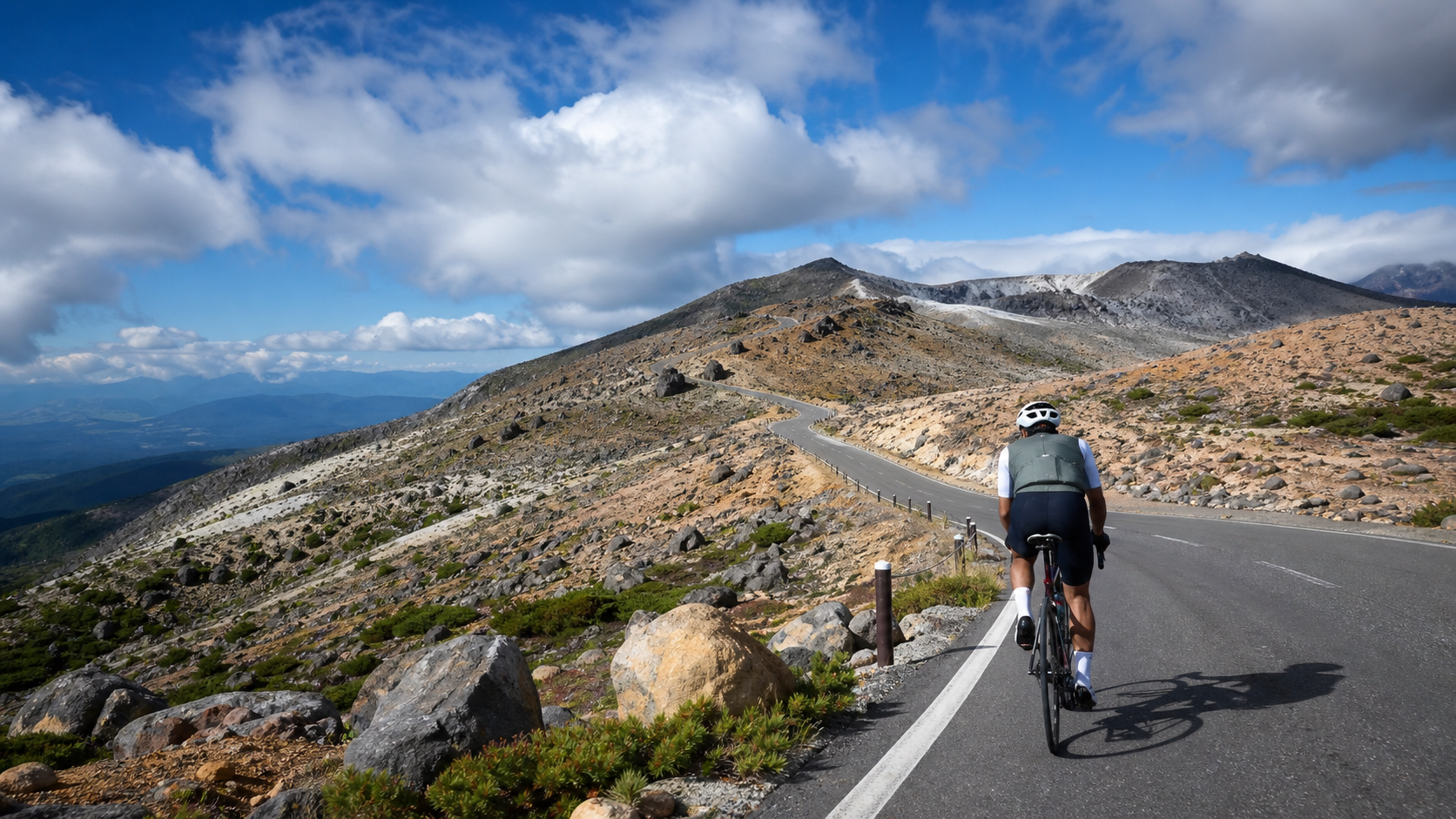
The forest disappeared. In its place was a volcanic wasteland—rugged rocks jutting out, sparse vegetation, the earth showing shades of grayish-white and ochre red, with even signs along the way reading “Caution: Volcanic Gas.” At that moment, I felt like I had ridden onto another planet. This is the mark left by the active volcano Mount Azuma—a rare “alien landscape” in all of Japan. I followed the signs, didn’t linger in the gas warning zones, and as I pedaled, I was utterly awestruck by this desolate yet magnificent scene.
With no trees to block the view, the sightlines opened up to the extreme. Looking back at the road behind, mountain ridges layered into the sea of clouds. The feeling of standing on the “skyline” was, at that moment, truly名副其实.
Jododaira: A Rest Closest to the Sky
When I finally reached Jododaira, at about 1,600 m above sea level, the sign reading “the restaurant closest to the sky in Fukushima Prefecture” was right before me.
I leaned my bike against the rack, walked in, ordered hot food, and held the warm tray in my hands as I watched clouds and mist drift through the mountains outside the window. The hands that had gone numb with cold on the wasteland gradually warmed up. This sense of satisfaction—“climbing to the clouds on your own legs, then sitting down to enjoy a proper hot meal”—is a luxury that no one who drives up the mountain can ever experience.
If you take the full loop starting from Fukushima Station, the total distance is about 80 km with roughly 1,700 m of elevation gain—a solid and magnificent mountain journey.
The Temperature of the Sky
To ride this road, you have to respect its altitude. The temperature difference between the summit and the base often exceeds 10 degrees. When I started climbing, I was too warm in short sleeves, but by Jododaira I was shivering from the cold. Before any long descent, I always put on a windbreaker—this isn’t a matter of preference; it’s a necessity. The cold up in the mountains, on a descent at 40 to 50 km/h, pours into your body with doubled intensity.
A Road Whose Name Paints a Picture
“Bandai-Azuma Skyline”—the Bandai-Azuma skyline road. Some road names, just by saying them aloud, conjure an image.
Skyline. When I first read this name, a road spiraling among the clouds, seemingly about to meet the sky, immediately came to mind. When I later rode up it myself, I discovered it was even closer to the sky than I had imagined. This mountain scenic road, winding through the Azuma mountain range and connecting Takayu Onsen and Tsuchiyu Onsen, spans about 29 km with its highest point at roughly 1,622 m, and is one of the most celebrated scenic roads in the Tohoku region. Its terminus, Jododaira, at about 1,600 m above sea level, has been given a moving title—“the restaurant closest to the sky in Fukushima Prefecture.”
Just that title alone is enough to make any cycling enthusiast willingly push down on the pedals.
Setting Out from the Hearth of the Human World
Takayu Onsen is a famous white, turbid sulfur spring in Fukushima, tucked away in the forest at the foot of the mountain, and one of the finest hot springs in Tohoku. The stretch from Fukushima City to Takayu Onsen has an average gradient of about 7%, making it the relatively steeper part of the entire route.
I reminded myself: don’t push hard in the early section. This road is long; I need to ration my energy. The scent of sulfur lingered faintly in the air, accompanying me all the way up. It was a very peculiar feeling—I was climbing, inch by inch, from the warm, smoky hot springs of the human world toward a higher, colder, more alien realm. The warmth of the hot spring was the last trace of human life on this journey; once past it, another world lay ahead.
Thinner Air with Every Meter
Past Takayu Onsen, the gradient eases to an average of about 5%, but the elevation keeps climbing.
There’s a phenomenon here that your body honestly reflects: as altitude increases, the air thins and temperatures drop, making the same gradient feel “heavier.” It’s not that you’ve gotten weaker—it’s the normal effect of altitude: with lower oxygen levels, your engine’s output naturally takes a hit. I eased my pace a bit more, giving my body extra leeway, and didn’t try to fight the mountain head-on.
This is also a unique experience of high-altitude climbing: you’re not just battling the gradient—you’re battling altitude itself. For every hundred meters you rise, the world grows quieter and colder by a degree. This gradual “sense of leaving the mundane world behind” is something a low-elevation climb can never give you.
Riding into a Foreign Planet
What truly gave me goosebumps was the dramatic transformation of the landscape around 1,500 m in elevation.
The forest, gone. In its place was a volcanic wasteland—rugged rocks jutting out, sparse vegetation, the earth showing interwoven shades of grayish-white and ochre red, with even signs along the way reading “Caution: Volcanic Gas.” The smell of sulfur grew intense here. At that moment, I felt like I had ridden onto another planet—a desolate, primordial, yet breathtakingly magnificent alien world.
This is the mark left by the active volcano Mount Azuma—a rare “alien landscape” in all of Japan. I followed the signs, didn’t linger in the gas warning zones, and as I pedaled, I was utterly overwhelmed by this primordial realm. With no trees to block the view, the sightlines opened up to the extreme; looking back at the road behind, mountain ridges layered into the sea of clouds. Standing on this “skyline,” I felt for the first time, truly—that a road really can carry you away from the familiar world, to a place that borders on myth.
Jododaira: A Hot Meal Closest to the Sky
When I finally reached Jododaira, at about 1,600 m above sea level, the sign reading “the restaurant closest to the sky in Fukushima Prefecture” was right before me.
I leaned my bike against the rack, walked into the rest stop, ordered hot food, and held the warm tray in my hands as I watched clouds and mist drift through the mountains outside the window. The hands that had gone numb with cold on the wasteland gradually warmed up. This sense of satisfaction—“climbing to the clouds on your own legs, then sitting down to enjoy a proper hot meal”—is a luxury that no one who drives up the mountain can ever experience.
I particularly love the name “Jododaira.” It draws from the Buddhist imagery of “Jodo” (Pure Land)—a place transcending the mundane world, serene and majestic. And when you’ve struggled up this volcanic wasteland and sit in the mist-shrouded rest stop, you feel the name couldn’t be more fitting. It truly is like a pure land on earth—far from the noise, with only the mountains, the clouds, the wind, and yourself.
The Temperature of the Sky, and Respect
To ride this road, you must respect its altitude.
The temperature difference between the summit and the base often exceeds 10 degrees. I was still too hot in a short-sleeve jersey at the start, but by the time I reached Jododaira, I was shivering from the cold. Before any long descent, I always add a windproof jacket—this isn’t being fussy; it’s a necessity. The cold on the mountain, during a descent at 40 to 50 km/h, pours into your body with doubled intensity. Hypothermia is never a joke.
Equally deserving of respect is the volcanic nature of this mountain. In the volcanic gas warning zones, be sure to follow the signs and do not linger; in the afternoon, the mountain area is prone to thunderstorms and dense fog, and visibility can change in an instant. The beauty of this road is built upon respect for the rules of nature—the more you understand how to revere it, the more willing it is to show you its finest side.
When I left Jododaira, I looked back at that wasteland and the sea of clouds in the distance, unwilling to look away for a long time. What the Bandai-Azuma Skyline gave me was far more than just a climbing result—it was a complete journey of “riding toward the sky”—from the earthly warmth of the hot spring town, to the primordial vastness of the volcanic wasteland, to a warm meal in the clouds. This skyline road deserves to be ridden by every rider who loves the mountains, on some clear summer day in their lifetime. You will understand that a bicycle can not only take you to distant places, but also bring you closer to the sky.
The “Sky Feeling” in the Numbers
Back to the numbers: 13.9 kilometers, 824 meters of elevation gain, an average of 5.9%, and a summit at approximately 1600 meters. Among these figures, the most striking isn’t the gradient—it’s that “1600 meters” of summit elevation.
An average gradient of 5.9% is moderate for a climb, not overly brutal. But it’s precisely this “not-too-steep” quality that makes the Bandai-Azuma Skyline a scenic route where “you can enjoy the view while climbing”—you don’t have to expend all your attention fighting the gradient; you still have the capacity to look up and admire the scenery that grows more magnificent and closer to the sky with every pedal stroke. And the 1600-meter summit guarantees this journey has sufficient “vertical depth” to carry you through forests, through the volcanic wasteland, all the way to the height of the clouds.
This is also why I’ve always felt this road is a “scenic” rather than a “competitive” climb. Its value lies not in how fast you can ride it, but in how beautiful, how high, and how far beyond the mundane world it can take you. The numbers are responsible for getting you up there, and the scenery is responsible for making all that effort utterly worthwhile.
One Mountain, Four Faces Across the Seasons
The high altitude of the Bandai-Azuma Skyline gives it four distinct seasons, each with its own deeply moving face.
Late spring to early summer, when the winter-closed road has just reopened, lingering snow might still dot the high wasteland, forming a stark contrast with the fresh greenery—a beauty that is both rugged and refreshing.
Midsummer, when the lowlands are scorched by heat, the summit at Jododaira remains pleasantly cool—an excellent climbing destination for escaping the heat. Under the summer sun, the volcanic wasteland displays its most vivid alien hues, a grandeur that takes your breath away.
Autumn, when the autumn colors of Tohoku arrive early. By early to mid-October, the trees at higher elevations have already turned layer upon layer of red. From the base to the summit, you feel as though you’re riding through an entire gallery of shifting colors—this is Bandai-Azuma’s most splendid season.
Winter, when the road closes and heavy snow seals the mountain. The mountain returns to slumber, keeping its purest tranquility for itself.
One mountain, four faces. This also means you can return here again and again for different scenery. Each time, it will offer you new emotions with different colors and temperatures.
The Hot Spring: The Perfect Ending to This Journey
Takayu Onsen, the starting point of the Bandai-Azuma Skyline, is by no means merely the beginning of the route—it should also be the perfect conclusion to this journey.
Takayu Onsen is one of Tohoku’s finest hot springs, renowned for its milky-white turbid waters, rich in sulfur content, which is highly effective for soothing muscles and relieving fatigue. Imagine this: you’ve just descended all the way from the 1600-meter cloudline back to the base, your legs stiff and sore from the climb and the cold descent. At that moment, you sink into a steaming pool of thick, milky sulfur water—that sensation of warmth rising from deep within your bones, fatigue melting away inch by inch, is simply heavenly. (Please confirm the actual bathhouse and operating status on-site.)
“Climb toward the sky, then soak in a hot spring”—this contrast of cold and hot, high and low, forms the most complete and memorable arc of the Bandai-Azuma Skyline experience. At the highest point, you witness nature’s most desolate and magnificent face; at the lowest point, you enjoy the earth’s most gentle and generous gift. Only then is this journey truly complete.
To You Who Long for the Sky
If your riding list is still missing a road that “can bring you closer to the sky,” I wholeheartedly recommend the Bandai-Azuma Skyline to you.
It won’t torment you with extreme gradients, but it will utterly awe you with its one-of-a-kind volcanic wasteland landscape and the 1600-meter height of Jododaira. You’ll set off from the sulfur-scented hot spring town, ride through lush forests, climb into a volcanic wasteland that feels like an alien planet, and finally enjoy a warm meal amid swirling clouds at “Fukushima’s restaurant closest to the sky.” The richness of layers and the intensity of contrasts on this journey are among the finest of Japan’s climbing routes.
A few suggestions for you: be sure to verify the road opening period (typically from around mid-to-late April to mid-November, per official announcements); bring ample warm and windproof clothing, as the temperature difference between the summit and base often exceeds 10 degrees; in volcanic gas warning zones, be sure to follow the signs and do not linger; afternoon thunderstorms and fog are common, so try to start early and return early; and finally, be sure to leave time to soak in the Takayu Onsen, adding the warmest finishing touch to this “ride toward the sky.”
As I left, I gazed at that skyline road appearing and disappearing through the clouds and mist, my heart filled with gratitude. The Bandai-Azuma Skyline made me understand that the meaning of cycling has never been merely about movement—it’s about arrival. Arriving at the depths that cars cannot reach, arriving at the scenery that only sweat can earn the right to see, arriving at the place closest to the sky and closest to oneself.
The Complete Memory of That Day
I chose a midsummer morning to ride the Bandai-Azuma Skyline, to escape the lowland heat and to witness with my own eyes that legendary volcanic wasteland.
When I set off from Takayu Onsen, the forest was still wrapped in the morning chill. The faint scent of sulfur drifted in the air, reminding me that this is a land that lives in symbiosis with a volcano. On the early section averaging 7%, I held back, rationing my strength, because I knew this road to the sky was still long.
Past Takayu Onsen, the gradient eased, but the altitude continued to climb. I could clearly feel that the same gradient was becoming “heavier”—the air was thinning. I relaxed my pace, giving my body more leeway, refusing to fight the mountain head-on. As the altitude rose, the forest gradually thinned, the temperature dropped degree by degree, and the world grew quieter and colder.
Then, at around 1500 meters above sea level, the landscape transformed dramatically.
The trees vanished. Before me unfolded a volcanic wasteland I had never seen before—jagged rocks, sparse vegetation, the earth displaying an alien palette of gray-white and ochre-red interwoven. Signs reading “Caution: Volcanic Gas” lined the road, and the sulfur smell grew intense. I felt as though I had stepped onto another planet—a desolate, primordial, yet breathtakingly magnificent alien world. I followed the signs, careful not to linger in the warning zones, pedaling while utterly awestruck by this primordial realm.
With no trees to block the view, the panorama opened up to its absolute limit. I looked back and saw mountain ranges layered into the distant sea of clouds. Standing on this truly named “skyline,” I felt for the first time, with real clarity—that a road can indeed carry a person away from the familiar world, to a height that borders on myth.
Arriving at Jododaira, at approximately 1600 meters above sea level, I walked into the rest stop, ordered a hot meal, and held the warm tray in my hands, watching the clouds and mist drift among the mountains outside the window as my frozen-red hands slowly warmed. That sense of satisfaction—“climbing to the clouds on your own legs, then sitting down to a hot meal”—is a luxury that no one who drives up the mountain can ever understand.
In Closing: On “Arrival”
Coasting down the long descent back to Takanoyu Onsen, I sank into the milky-white sulfur springs, letting my stiff legs slowly loosen in the steam, and I thought about the word “arrival.”
What is the meaning of cycling? In the past, I thought it was speed, results, becoming faster and stronger. But Bandai-Azuma Skyline told me that the true meaning of cycling is “arrival”—arriving at the depths that cars cannot reach, arriving at scenery that only sweat earns the right to see, arriving at the place closest to the sky and closest to yourself.
The primordial volcanic wasteland, the mist of Jododaira, that hot meal closest to the sky—none of these were earned through speed, but through one step at a time, one pedal stroke at a time, honestly “arriving.” Every ounce of pain, every degree of cold, every thought of giving up along the way ultimately became the reason “arrival” felt so precious.
This philosophy of “arrival” applies to life as well. We are always chasing speed, yet we often forget that some of the most beautiful scenery and deepest insights cannot be rushed—they can only be reached step by step, with our feet firmly on the ground. Bandai-Azuma Skyline, with its complete journey from a hot-spring town to a volcanic wasteland and then to the clouds, gently reminded me of this. And I know that as long as I can still ride, I will return to this skyline road, once again, honestly, riding toward the sky.
For Those Who Want to Come
- Opening Period: Closed in winter; usually open from around mid-to-late April to mid-November. Actual dates follow official announcements—be sure to verify before your trip.
- Season: In summer, the summit is cool while the lowlands are hot, making it a great place for climbing to escape the heat. In autumn, the Tohoku region’s foliage turns early; by early-to-mid October the higher elevations are already ablaze with color, but mornings are near freezing.
- Warmth: The temperature difference between the summit and the base often exceeds 10°C. Be sure to add a windbreaker before the long descent.
- Safety: Follow the signs in volcanic-gas warning zones and do not linger. Afternoons are prone to thunderstorms and dense fog.
As I left Jododaira, I looked back at that wasteland and the sea of clouds in the distance. What Bandai-Azuma Skyline gave me was not just a climb, but an experience of “riding toward the sky”—from the everyday warmth of a hot-spring town, to the primordial vastness of a volcanic wasteland, to a hot meal above the clouds. This skyline road deserves to be ridden in person by every rider who loves the mountains.
Traveler Q&A: Practical Planning for This Ride
The most important question: When can you ride it?
This road is closed in winter, usually opening around mid-to-late April and closing in mid-November, subject to official announcements. Be sure to verify the opening period before planning—this is the key to whether this trip can happen.
How difficult is it? Who is it suitable for?
With an average grade of 5.9% and a climb of about 824 meters, the difficulty is moderate. Combined with the fact that it’s a “scenic” route, it’s quite friendly for riders who want to challenge high-altitude vistas. The real challenges are altitude—thinner air makes the latter half feel heavier—and the low temperatures at the summit. Manage your pacing and dress warmly, and you’ll be fine.
What should you watch out for regarding warmth and safety?
The temperature difference between the summit and the base often exceeds 10°C, so be sure to add a windbreaker before the long descent. Follow the signs in volcanic-gas warning zones and do not linger. Afternoons are prone to thunderstorms and dense fog, so try to start early and return early. After the climb, don’t forget to soak in the hot springs at Takanoyu Onsen to put a warm finishing touch on your journey.
Final Words
Bandai-Azuma Skyline, for me, was a lesson in “arrival.” It made me understand that the true meaning of cycling has never been just speed or results, but “arrival”—arriving at the depths that cars cannot reach, arriving at scenery that only sweat earns the right to see, arriving at the place closest to the sky and closest to yourself.
The primordial volcanic wasteland, the mist of Jododaira, that hot meal closest to the sky—none of these were earned through speed, but through arriving honestly, step by step. Every ounce of pain and cold along the way ultimately became the reason “arrival” felt so precious.
If your riding checklist is still missing a road that can take you “closer to the sky,” seriously consider adding Bandai-Azuma Skyline. Starting from the sulfur-scented hot-spring town, passing through lush forests, climbing into a volcanic wasteland that feels like another planet, then enjoying a hot meal above the clouds before returning to the base for a soak in milky-white hot springs—the layers and contrasts of this journey are among the finest of any climbing route in Japan. And it will remind you in the gentlest way: as long as you can still ride, there will always be a higher, more beautiful sky waiting for you to honestly arrive at.
Related Reading
- Bandai-Azuma Skyline (Takanoyu Onsen Side) Practical Guide: Segment-by-Segment Pacing and Gear Ratio Breakdown for 13.9 km with 824 m of Climbing
- Riding to the Highest Reachable Point on Mount Fuji: Fuji Skyline, Hoei Crater, and a Cloudtop Journey Through the Forest Belt
- Ishizuchi Skyline Guide: 12 km of Sky-High Climbing Straight to Tsuchigoya, Gateway to Western Japan’s Highest Peak
- A Volcanic Highway with 1,300 Years of Hot Springs: Riding the Nasu-Tōge no Chaya Route Through Springs, Legends, and Wasteland
台北闊瀨陡坡 騎旅 / 日本單車雜誌編輯車友臨時加入!/ 髮香才是最強的 / feat. 北迴歸線小隊 / 公路車 CT Yeh
6 個月前
#北橫 + #北進武嶺 最硬的員工旅遊 EP1 | #公路車 #拉拉山 | 明池 | 武嶺 | 武陵農場 | 雲海 | Taiwan Cycling Route Wulin
6 年前
日本島波海道 EP1 / 五大絕景路線之一! / 私房溫泉 x 豪華單車客棧 / 今治 to 大三島 / 公路車 / CT Yeh
2 年前
嘉義大埔、阿婆灣挑戰賽,美到以為在日本!ft. 環騎5 Cool 西拉雅188 / 公路車 / CT Yeh
7 個月前
2025 乘鞍 KOM 登山賽挑戰實錄 / 日本公路最高 ! 賽前探路篇 / 比富士山厲害,無敵絕景!/ 40週年 / 中文YT首發 / 公路車 / CT Yeh #乘鞍ヒルクライム
10 個月前
京都!99%人不知道的秘境玩法!租 E-Bike 騎進探訪宇治抹茶原鄉 刺激好玩絕美的山林古道 鬼滅之刃的場景探訪 / CT Yeh
12 天前
2025 乘鞍岳登山賽 比賽全紀錄篇 / 完整路線攻略介紹 / 日本版武嶺 公路最高點 / 高山空拍絕景 / 明年會開團! / 公路車 / CT Yeh
10 個月前
半日 小台灣 極限單車路線挑戰實錄
7 年前