Riding to the Cloudtop Bakery: A Journey Through Volcanoes and Snow Walls on Shibutoge, Yokote-yama, and the Shiga Kusatsu Road
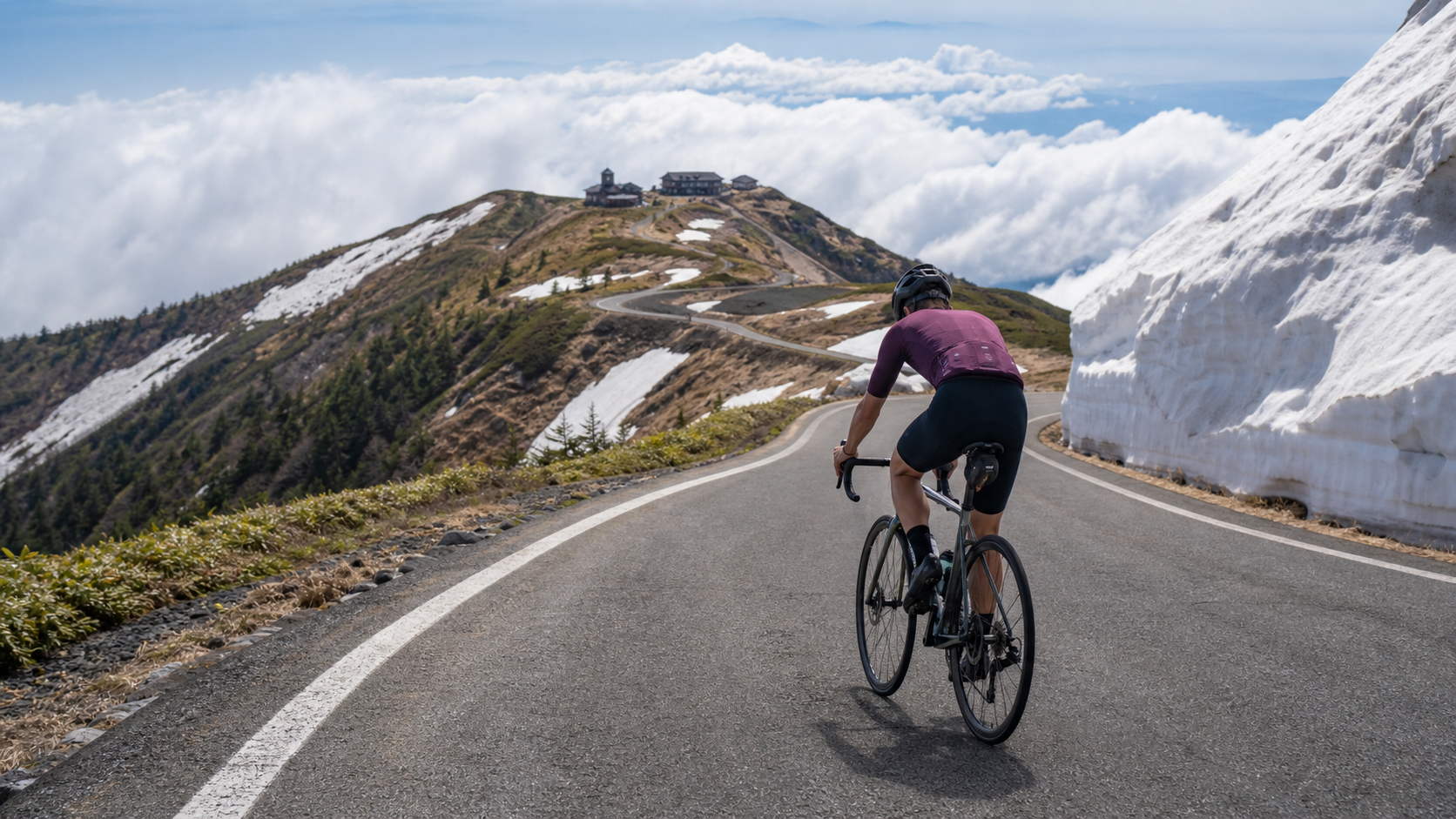
Some roads, you ride for the data. Others, you ride for that feeling of “standing at the edge of the world.” Shibu Pass gives you both.
At 2,172 meters, it’s the highest point on a national highway in Japan. That title sounds like a challenge thrown down for hardcore riders, but when you’re actually turning the pedals, lifting yourself meter by meter to cloud level, you’ll find Shibu Pass’s appeal goes far beyond “climbing high.” Here, there’s an old hotel straddling two prefectures, the aroma of bread hidden in the clouds, snow-white tunnels available only after the road reopens in spring, and an active volcano still breathing beneath your feet. In this piece, we won’t talk about pacing—only about the story this road wants to tell you.
One Pass, Two Prefectures, the Ceiling of a National Highway
Shibu Pass sits at the highest point of National Route 292—known locally as the “Shiga-Kusatsu Road” or the “Shiga-Kusatsu Highland Route”—straddling the prefectural border between Yamanouchi Town in Nagano Prefecture and Kusatsu Town in Gunma Prefecture. This isn’t just any prefectural boundary; it’s the highest point of any national highway section in all of Japan.
Think about how romantic that is: Japan has countless national highways crisscrossing this island chain, and the highest point of all those roads combined is right under your wheels. When you ride up here, you’re not just climbing a mountain—you’re ascending to the very top of an entire national road system. This “ultimate summit of it all” is Shibu Pass’s one-of-a-kind identity.
The best symbol of this “border-crossing” romance is the Shibu Pass Hotel (渋峠ホテル). The hotel’s building sits right on the prefectural line—you could be standing in the lobby with your left foot in Nagano and your right foot in Gunma. The hotel issues a “Certificate of Arrival at Japan’s Highest National Highway Point” for just 100 yen, and many riders make the trip specifically to collect one. Some take care to write the date on the certificate, sealing the ride into a piece of collectible time. The hotel also has a mascot dog named “Marcus” who has become an unexpected star in travelers’ photos. Being able to sip a hot drink while straddling two prefectures and grabbing a certificate—these details give the summit of Shibu Pass an extra layer of ceremony.
A bit further up stands the stone monument by the roadside reading “Japan’s Highest National Highway Point, Elevation 2,172m.” Almost everyone who rides up Shibu Pass stops here, props up their bike, and takes a photo with the monument. Not because of check-in culture, but because at that moment you truly know: there is no national highway above this.
The Aroma of Bread in the Clouds: Yokote Mountain Summit Hut
Beside Shibu Pass lies an unforgettable taste memory—Yokote Mountain (横手山), at 2,307 meters. At the summit sits the Yokote Mountain Summit Hut (横手山頂ヒュッテ), known as the “Cloudtop Bakery” and billed as Japan’s highest-altitude bakery.
Imagine this: you’ve just finished a long climb in thin air, lungs still heaving, and then you sit in front of a wooden hut at 2,300 meters, holding a freshly baked, still-warm artisan loaf, with a sea of clouds churning before you and the ridgeline of the Northern Alps in the distance. This “flavor earned through altitude” is something no bakery at sea level can give you.
Running a bakery at such an elevation is itself a romantic and demanding endeavor. All ingredients and fuel have to be hauled up by hand, the road is impassable under deep winter snow, and the operating season is severely limited. Precisely because of that, this shop has never just sold bread—it sells an attitude of “living life with refinement even in the most extreme places.” For riders who are cold, hungry, and fresh off a long climb, that warm persistence is especially moving.
Why does bread taste special at this altitude? Part of it is physiological—after prolonged exercise, your body’s craving for calories is amplified, and the carbohydrate aroma of warm bread becomes extraordinarily enticing. Part of it is psychological—you got yourself to this height on your own legs, and this “reward earned through effort” adds meaning to every bite. The bread here is very popular and often requires queuing in peak season, but the experience of “eating bread in the clouds” is itself the gentlest chapter in the story of Shibu Pass.
The summit also features the Manten Observation Deck (満天観景台), with superb views from the west to the south side. On clear days, your gaze can sweep across Mount Kasaga, the Five Northern Shinshu Peaks, and stretch all the way to the Northern Alps. For those who don’t want to ride up, a ropeway from “Nozoki” or Shibu Pass can take you to the summit. Sitting on the observation deck, watching clouds drift beneath your feet, you get the illusion that “time has slowed down”—that’s the healing the highlands offer.
The Living Volcano Beneath Your Feet: The Breathing of Mount Kusatsu-Shirane
What makes Shibu Pass most unique—and what outsiders most often overlook—is its geological identity. The Mount Kusatsu-Shirane that this road crosses is an active volcano. On the mountain lies the famous crater lake “Yugama,” whose eerie milky-green water, stained by sulfur, is the most magical sight on this highland—and the clearest reminder that “the earth is still moving.”
Because it is alive, an eruption warning level is in place here. In recent years, sections of the road have been closed due to elevated warnings—in the summer of 2025, the warning was raised to Level 2 and the area around Yugama was closed; it wasn’t until May 2026 that it dropped back to Level 1 and the entire road reopened. For riders, this means Shibu Pass is not a road that “will always be there waiting for you,” but one that requires you to ask the earth for permission before you can pass. That uncertainty, in turn, makes every successful ride to the summit carry an extra sense of reverence for being “allowed through.”
This is also what sets Shibu Pass apart from other famous passes. Most climbing routes challenge the limits of human physical endurance, but Shibu Pass reminds you of something else: in the face of nature, human plans always carry variables. You can train as hard as you like, tune your bike as perfectly as you want—but if that volcano doesn’t want you up there today, you’ll have to come back another day. This humility is the invisible gift this road gives to every rider.
The milky-green crater lake Yugama is the most direct symbol of that power. Its color comes from sulfur and minerals dissolved in the water—a strange hue somewhere between emerald and milky white that is exceptionally rare in the world. Standing where you can see it, you become acutely aware: this is not a tamed landscape, but land that is still active, still changing. And it’s precisely this “aliveness” that makes every passage through Shibu Pass feel like a brief negotiation with the earth—you are permitted to pass, you carry gratitude, and you bring that reverence back down the mountain. This is what makes Shibu Pass most different from other famous climbs, and most unforgettable.
Looking down from the pass, you can also see the vast Yomogihira Wetland (芳ヶ平湿原)—forest and marshland woven together into a green carpet, spreading an unexpected softness amid the volcano’s ruggedness. The coexistence of ruggedness and softness is the geological poetry of Shibu Pass.
Spring Opening Exclusive: The Snow Tunnel
If you come at the right time, Shibu Pass gives you a seasonal gift—the snow walls (雪の回廊).
The Shiga-Kusatsu Road closes in winter, typically shutting down around mid-November and reopening in late April. In the period right after the road reopens through around Golden Week, snowplows pile up towering walls of snow on both sides of the road, and vehicles and bicycles pass through this white “snow tunnel.” The officially marked snow-wall section is about 2.4 kilometers round trip. This is a sight you can only see in early spring—warming air on one side, unmelted winter snow on the other, and you riding in the seam between seasons.
Riding between snow walls is an experience that’s hard to describe. On both sides, snow walls tower above head height; cold air seeps from the snow surface, yet the sunlight already carries spring’s warmth. You feel winter and spring at the same time—this superimposition of seasons is a romance unique to temperate highlands. For riders from subtropical Taiwan, the sight of “riding between snow walls in April” is a rare spectacle indeed. Think about it: down in the city, spring flowers are already in full bloom, yet on the same day you can ride into a white tunnel carved from accumulated snow—this stark seasonal contrast alone is reason enough to plan a dedicated trip.
Come autumn, the pass changes to another palette. The highland’s autumn leaves, the withered gold of the wetlands, the deep gray of volcanic rock—layer upon layer, it’s the signature Shibu Pass scene for photographers. In every season, Shibu Pass is almost a different road.
Summer at Shibu Pass, meanwhile, is a refuge from the heat. While the lowlands of Honshu swelter in midsummer, the highlands around Shibu Pass stay pleasantly cool, with a chill in the air above 2,000 meters. That’s why summer is the most popular riding season on this road—everyone wants to escape the lowland heat and breathe a few gulps of cool air in the cloud-level highlands. Lush green in high summer, lingering snow walls in early spring, and forests painted in autumn hues—Shibu Pass answers riders who visit in different seasons with three completely different faces. Whatever time you come, that’s the Shibu Pass you’ll meet—and that’s precisely the captivating reason it keeps riders coming back, ride after ride, never tiring of it.
A Gentle Descent into Warmth: Kusatsu’s Famous Springs and Shiga Kogen
After climbing Shibu-toge, don’t rush off. Hidden in the mountains below lies some of Japan’s finest hot spring culture.
On the Gunma side, at the foot of the mountain, lies the renowned Kusatsu Onsen — one of Japan’s three great hot springs, famous for its central steaming “Yubatake” (hot water field). After a full day of climbing long slopes and being chilled by the high-altitude winds, soaking in Kusatsu’s scalding, sulfur-scented waters is the most healing finish imaginable. The smell of sulfur, the steam rising from the wooden Yubatake, the lights of the old hot spring town — these sensory memories will bind themselves to your climb that day. Years later, when you think of Shibu-toge, it will feel as if the scent of Kusatsu’s sulfur still lingers in your nose.
Along the way to Yokote-yama, there’s also Kumanoyu Onsen, while on the Nagano side, the historic Yudanaka-Shibu Onsen-kyo awaits. Whichever side you descend, a famous hot spring is waiting for you.
Japan’s hot spring culture shares a natural affinity with cycling. Long climbs leave muscles tight and lactic acid accumulated, and a hot bath is exactly what’s needed to ease it all. Moreover, the springs in this area are no ordinary ones — they are direct products of active volcanic geothermal activity, their water quality and scent carrying the personality of this land. Soaking in Kusatsu’s scalding sulfur springs, watching the steam rise, you’ll feel your connection to this volcanic highland deepen by another layer. This complete cycle — “measuring the volcano with your legs by day, soaking in its geothermal heat by night” — is the uniquely healing rhythm of a Shibu-toge cycling trip.
A single ride over Shibu-toge thus becomes a complete narrative arc: setting out from the forests of Shiga Kogen, crossing the ridgeline of an active volcano, reaching the highest point of a national highway, eating a bread roll above the clouds, and finally soaking in a famous hot spring at the mountain’s foot. This is not merely a climb — it’s a full day of highland wandering.
Shiga Kogen: The Prototype of Japanese Alpine Resorts
To understand Shibu-toge, you must first understand the land beneath it, called “Shiga Kogen.” Shiga Kogen is one of Japan’s largest alpine resort areas — a ski destination in winter, and a paradise for summer retreats and hiking. Scattered across this highland are lakes, marshes, and forests of all sizes, with elevations climbing from over a thousand meters all the way up to Shibu-toge’s two thousand-plus meters.
Cycling across this highland, you’ll feel a very Japanese atmosphere of “nature and resort coexisting.” Along the roadside, you’ll periodically see the steel cables of ski lifts, signs for highland hotels, and carefully maintained trailheads. This is not a desolate, uninhabited mountain wilderness, but a highland deeply loved and visited by generations. As you ride past Maruike Pond, past highland lakes reflecting the sky, you are riding through an entire history of the Japanese people’s emotional relationship with mountains.
Precisely because it’s a resort area, tourist traffic along the route is a daily sight on Shibu-toge. For cyclists, this is a double-edged sword: on one hand, the roads are well-maintained and supply points are relatively plentiful; on the other, you must constantly watch for oncoming vehicles, especially near curves and scenic overlooks. Treat yourself as part of this highland ecosystem — stay to the side, yield, stay focused — and you can safely enjoy the road.
From Volcano to Marshland: A Geology Lesson Along the Way
The road to Shibu-toge is, in a sense, a condensed geological journey. In sequence, you’ll pass the ridgeline of an active volcano (Mt. Kusatsu-Shirane), a crater lake (Yugama), a highland marsh (Yokobatake), and an entire highland terrain shaped by volcanic activity.
The volcano gave this land its skeleton — it was ancient eruptions that piled up the height of this highland; the hot springs are the residual warmth of volcanic activity left at the surface — Kusatsu, Kumanoyu, and other famous springs are, at their core, gifts of geothermal heat; the marshland is proof of this highland’s ability to retain water and nurture unique vegetation. When you string these landscapes together during your ride, Shibu-toge becomes more than just a climb — it’s a geology textbook spread open before you, readable with your wheels.
This is also why so many people, after riding Shibu-toge, develop a feeling toward this land that transcends “exercise.” You haven’t just burned calories — you’ve personally traversed a long breath of the earth itself.
What This Road Means to Cyclists
What makes Shibu-toge unforgettable is not that it’s the steepest, nor that it’s the longest, but that it places “extremity” and “gentleness” on the same road.
It reminds you of your smallness with its 2172-meter elevation, yet catches that smallness with a bread roll above the clouds, a certificate of arrival, and a famous hot spring at the mountain’s foot. It teaches you humility with the warnings of an active volcano, and rewards your persistence with early-spring snow walls and autumn foliage.
In the minds of many cyclists, Shibu-toge is the kind of road that “merits a dedicated flight, even a return visit.” It’s not the highest, not the steepest, not the longest — but it possesses a completeness that’s hard to replicate: geology, seasons, food, hot springs — all condensed into this 27-kilometer ascent. You’re not just climbing in elevation; you’re riding the full soul of a highland. For Taiwanese cyclists, this is a dream route that satisfies both the “desire for challenge” and the “desire for travel” at once: you can claim the achievement of “Japan’s highest national highway point,” and in the surrounding itinerary, gather the forests of Shiga Kogen, the famous springs of Kusatsu, and the bread of Yokote-yama all into one memory. A road like this — it would be a shame not to ride it at least once.
When you stand your bike beside that stone monument and look back at the winding national highway you’ve climbed, you’ll understand: you haven’t just ridden to the highest point of Japan’s national highways — you’ve ridden into a highland story written jointly by volcanoes, snow, the aroma of bread, and hot spring waters. And that story will warm you anew every time you think of Shibu-toge.
Who Is a Shibu-toge Ride For?
Not every notoriously hard climb suits everyone, but Shibu-toge has one special quality: its “average gradient isn’t brutal,” making it more “approachable” than many steep famous climbs — as long as you have a solid foundation in long-distance climbing, and come equipped with low gearing and warm clothing, it’s far from unreachable. Its real threshold lies in the high altitude and logistics, and these can be compensated for with preparation.
Therefore, Shibu-toge is especially suited to several types of cyclists: those who want to collect the achievement of “the highest point on a national highway” (it’s the ceiling of Japan’s national highways — that title alone merits a dedicated trip); those who love combining sport with travel (the hot springs, bakeries, and highland scenery along the way make it not just a workout but a journey); and those who want to experience high-altitude riding in a relatively safe environment (compared to higher, harder famous mountains, Shibu-toge is an excellent entry-level choice for high-altitude riding).
If you’re planning a cycling trip to Japan and looking for a signature climb that is “rich in story, scenery, and a sense of achievement, yet not so grueling as to be intimidating,” Shibu-toge is almost the perfect answer. It strikes a rare balance between difficulty and accessibility, allowing cyclists of varying levels to find their own rhythm and safely reach that 2172-meter stone monument.
Leave Time for the Summit
One last thought: when riding Shibu-toge, don’t rush.
Too many people treat a climb as a race against their bike computer — sprint to the top, snap a photo, and descend immediately. But Shibu-toge deserves more of your time. Sit down at the cloud-top bakery and slowly finish that warm bread roll; walk out to the Manten Observatory and watch the clouds flow beneath your feet; stand before that 2172-meter monument and take a few deep breaths of the air at Japan’s highest national highway point.
These moments of “stopping” are often what you’ll truly remember about Shibu-toge years later. Speed will be forgotten, but the look of the sea of clouds, the warmth of the bread, the smell of sulfur, the whiteness of the snow walls — these sensory memories will stay with you for a very long time. What Shibu-toge gives is never just a climbing statistic, but an entire stretch of highland time worth savoring again and again.
Side Trip Suggestions
- Kusatsu Onsen: At the foot of the mountain on the Gunma side. Soak in the springs, stroll around Yubatake — an overnight stay is ideal.
- Yokote-yama Summit: Take the ropeway up, enjoy the bread above the clouds and the Manten Observatory — an unmissable dual treat of taste and sight on a Shibu-toge cycling trip.
- Shiga Kogen: A highland resort area — a summer retreat, autumn foliage destination, and ideal cycling base, also suitable for hiking and lakeside strolls.
- Yudanaka-Shibu Onsen-kyo: An old hot spring town at the foot of the mountain on the Nagano side. The rustic bathhouse pilgrimage has its own charm, making it a perfect stop before or after riding, to experience Shinshu’s hot spring culture.
- Yokobatake Marshland: The marsh landscape viewed from the pass is a great spot for photography and quiet contemplation.
- Yugama Crater Lake: The milky-green crater lake of Mt. Kusatsu-Shirane. When open, it’s a rare volcanic landscape (access may be restricted depending on the volcanic alert level — check before you go).
For Those Planning Their First Shibutoge Trip
If you’re thinking of adding Shibutoge to a cycling trip in Japan, here are a few planning suggestions. First, treat Shibutoge as a “two-to-three-day highland journey” rather than a “one-day climb mission”—this land deserves you to take your time. Arrange a night’s stay in Shigakogen or Kusatsu, giving yourself ample time to cope with changes in mountain weather, and also leaving room in your itinerary for hot springs, strolls, and savoring local cuisine.
Second, keep a close eye on weather and volcanic advisories. Access to Shibutoge is affected by both of these—checking a day ahead before you set off can save you the disappointment of discovering a road closure on site. Third, bring plenty of warm clothing—this is what out-of-town riders most often underestimate. Even if the sun is shining and it’s warm at the foot of the mountain when you depart, the 2,172-meter summit is always another world.
A final reminder before you go: be sure to check the latest eruption warning level for Kusatsu-Shirane and road access notices before departing—this still-breathing volcano will determine whether you get to meet Shibutoge today. Bring warm clothing, because even if it’s midsummer at the base, the 2,172-meter summit and the cloud-top bakery always keep a hint of highland coolness waiting for you. May you, in the right season and the right weather, successfully ride up this highest road of Japan’s national highways, and personally store away in your memory a highland story written by volcanoes, snow, bread, and hot springs.
Related Reading
- Shibutoge Practical Guide: 26.97 km Climbing to Nagano’s Sacred Ground at 2,172 Meters, the Highest Point on Japan’s National Highways
- Open Only Half the Year: Shibutoge, the Ceiling of Japan’s National Highways You Must Catch Within the Seasonal Window
- Standing on the Roof of Kyushu: Riding the Yamanami Highway, the Spectacular Highlands from Chojabaru to Mount Homan Pass
- The Sacred Mountain That Awakens Only in Summer: A Ride Up Mount Norikura, a Conversation to 2,720 Meters in the Clouds
2025 乘鞍 KOM 登山賽挑戰實錄 / 日本公路最高 ! 賽前探路篇 / 比富士山厲害,無敵絕景!/ 40週年 / 中文YT首發 / 公路車 / CT Yeh #乘鞍ヒルクライム
10 個月前
台北闊瀨陡坡 騎旅 / 日本單車雜誌編輯車友臨時加入!/ 髮香才是最強的 / feat. 北迴歸線小隊 / 公路車 CT Yeh
6 個月前
2025 乘鞍岳登山賽 比賽全紀錄篇 / 完整路線攻略介紹 / 日本版武嶺 公路最高點 / 高山空拍絕景 / 明年會開團! / 公路車 / CT Yeh
10 個月前
小野田真的存在!日本赤城山爬坡公路賽 台灣首發團完全實錄 | 頭文字D真實賽道! | 看完東奧自行車賽後好想再去騎一次啊! | 公路車 | CT Yeh
4 年前
帶「咩」一起騎玩日本熊本 上天草市 / 單車旅行、賞海豚、釣魚、高空滑索通通有!/ 公路車 / CT Yeh /
1 年前
嘉義大埔、阿婆灣挑戰賽,美到以為在日本!ft. 環騎5 Cool 西拉雅188 / 公路車 / CT Yeh
7 個月前
京都!99%人不知道的秘境玩法!租 E-Bike 騎進探訪宇治抹茶原鄉 刺激好玩絕美的山林古道 鬼滅之刃的場景探訪 / CT Yeh
13 天前
#北橫 + #北進武嶺 最硬的員工旅遊 EP1 | #公路車 #拉拉山 | 明池 | 武嶺 | 武陵農場 | 雲海 | Taiwan Cycling Route Wulin
6 年前