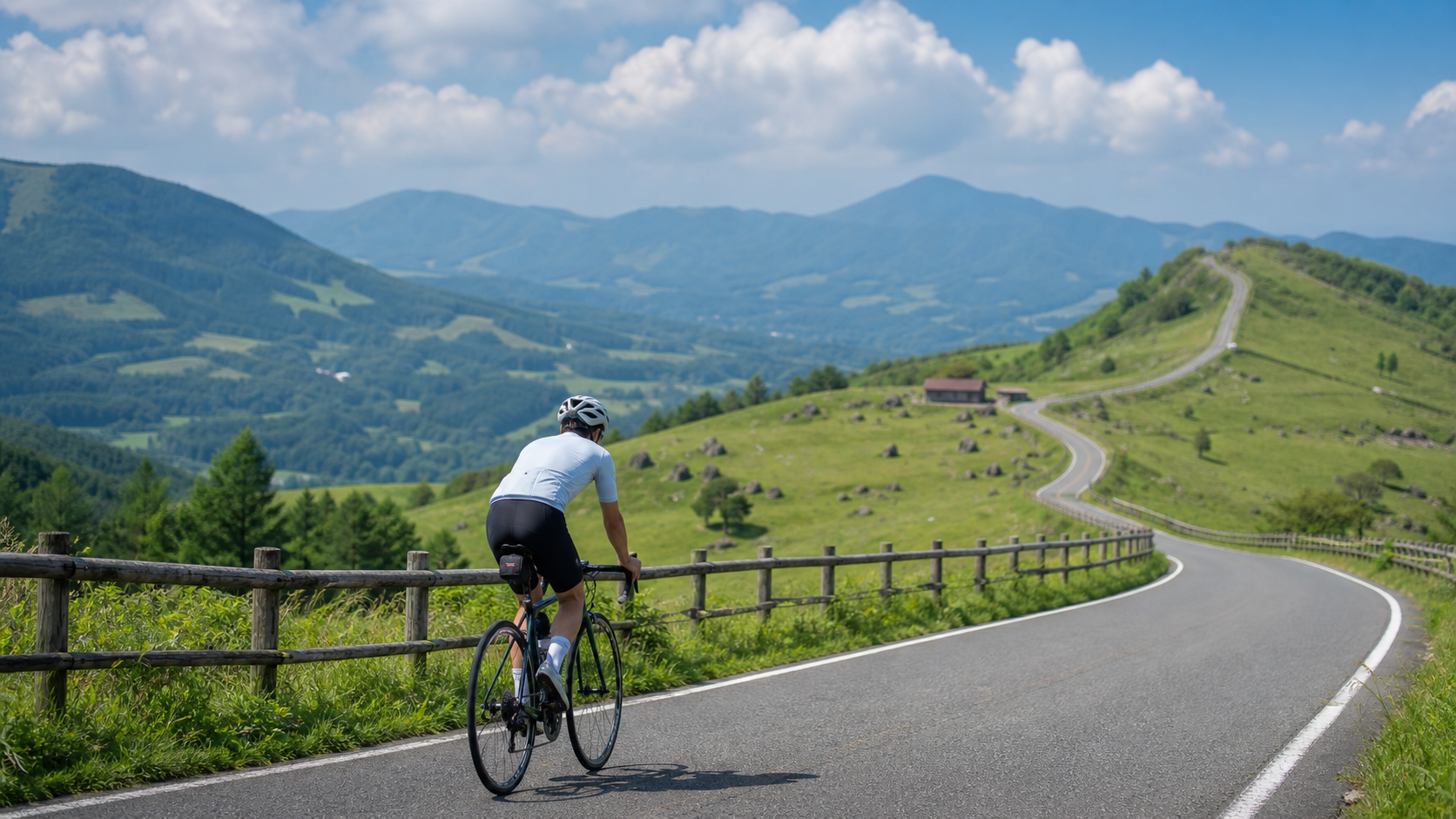
Stretching across the border between Tottori and Okayama prefectures lies a pastoral highland—the Hiruzen Highlands. This climb toward Dizo-toge and Kime-dai is a “scenery-first” highland route, rewarding every rider who ascends with ranchlands, distant mountains, and seas of clouds. It’s not the kind of punishing, teeth-gritting climb that demands sheer grit; rather, it’s a healing road that invites you to relax, savor the highland views, and enjoy the local cuisine.
Let’s start with the data and geography. The climb segment featured here has a distance of approximately 7.19 km, an elevation gain of approximately 395.8 meters, and an average gradient of 5.5%—a medium-length, gentle-to-moderate climb that is friendlier than the short, steep sections at the foot of Mount Daisen and easier than the long ascent of Mount Ishizuchi. Its positioning leans toward “highland scenic riding” rather than pure racing.
Among this batch of famous Japanese mountain routes, the Hiruzen Highlands road has the most “approachable” character. It lacks the despair-inducing steep ramps of the Fuji Azami Line, the long climb of Mount Ishizuchi that demands strict pace management, or the grueling battle of the full Mount Daisen loop that gains over 2,000 meters in elevation. It’s simply a 7-plus-kilometer highland road with a gentle gradient, suitable for riders of all levels and ideal for riding with a relaxed mindset, with “enjoying the scenery” as the primary goal. If the previous routes ask you to “conquer,” then the Hiruzen road invites you to “enjoy.” This difference in positioning is the key to understanding riding in the Hiruzen Highlands.
A brief geographical clarification is needed: the main body of the Hiruzen Highlands lies in Maniwa City, Okayama Prefecture, at an elevation of approximately 500–600 meters, at the foot of the “Three Hiruzen Peaks” (Shimo-Hiruzen, Naka-Hiruzen, and Kami-Hiruzen, all exceeding 1,000 meters). This Strava climb, however, starts from the Kurayoshi City direction and administratively falls on the Tottori Prefecture side, linking the prefectural-border highland road network of “Hiruzen—Oku-Daisen—southern foot of Daisen.” It functions more as a climb segment toward Kaga-naru and Dizo-toge, with its landscape seamlessly connected to the Hiruzen Highlands.
This “spanning two prefectures with an interwoven road network” geographical characteristic is the most confusing aspect of this area for out-of-town riders. Simply put, you can understand this region as a “highland road network”—the Hiruzen Highlands (Okayama side), the southern foot of Mount Daisen (Tottori side), and the Kaga-naru, Dizo-toge, and Hiruzen Daisen Skyline that connect them, together forming a highland cycling world that spans the Tottori-Okayama prefectural border. This 7.19 km climb is one segment threading through this network, taking you from the Kurayoshi direction deeper into the highlands. Understanding the overall concept of this “highland road network” is more helpful than obsessing over the precise administrative归属 of any single place name, and it will better enable you to grasp the riding appeal of this region when planning.
1. Route Overview and Actual Data
| Item | Data |
|---|---|
| Distance | Approximately 7.19 km |
| Elevation Gain | Approximately 395.8 meters |
| Average Gradient | 5.5% |
| Location | Tottori/Okayama prefectural-border highlands |
| Starting Direction | Kurayoshi City direction (Tottori Prefecture side) |
| Difficulty Rating | Medium length, gentle-to-moderate gradient (highland scenic cruising type) |
2. Geographical Clarification: Dizo-toge, Kime-dai, and the Prefectural-Border Highland Road Network
The place names in this area are easily confused, so let’s clarify:
- Three Hiruzen Peaks: Shimo-Hiruzen, Naka-Hiruzen, and Kami-Hiruzen, lined up from east to west, all exceeding 1,000 meters. They are the protagonists of this highland’s views and the natural backdrop to the pastoral scenery.
- Hiruzen Daisen Skyline: A scenic road connecting Hiruzen (Okayama) and Daisen (Tottori), approximately 9.3 km long, opened in 1970, now designated as Okayama Prefectural Route 114 “Daisen Kamifukuda Line.” The highest viewpoint is the Kime-dai (Kimendai) Lookout Rest Area (elevation approximately 900 meters, located on the Okayama/Tottori prefectural border, offering 360-degree views with Mount Daisen to the north and the Hiruzen Highlands to the south).
- Dizo-toge: A short, steep pass with consecutive hairpin turns on the Mount Daisen loop road on the Tottori Prefecture side.
- Kaga-naru: A mountain wetland at approximately 920 meters elevation, serving as a connection node from Hiruzen to Oku-Daisen and the Mount Daisen loop road, with serene and tranquil scenery.
- Shiogama Cold Spring: One of Japan’s 100 Famous Waters near the Naka-Hiruzen trailhead, with clear spring water flowing year-round at approximately 11°C, especially refreshing in summer.
Dizo-toge and the Kime-dai lookout are different nodes within the same highland road network, not the same point. When writing about or planning routes, it’s best to understand this as a scenic climb that “starts from the Kurayoshi direction, travels across the Tottori-Okayama prefectural-border highlands, and showcases views of the Three Hiruzen Peaks.”
Incidentally, there are many passes named “Dizo-toge” throughout Japan, which is another reason this place name is easily confused. The Dizo-toge in this area, located on the Tottori Prefecture side of the Mount Daisen loop road, is a short, steep pass with consecutive hairpin turns, and it also has an entry in Kurayoshi’s tourism information. When planning routes in this area, the key is not to precisely distinguish the administrative归属 of each place name, but to understand that they all belong to the same “Hiruzen—Oku-Daisen—southern foot of Daisen” highland road network. Once you grasp this overall concept, you can flexibly string these nodes together into routes that suit you, without being tripped up by the details of individual place names.
3. Segment-by-Segment Guide
Segment 1: Highland Start (Gentle Warm-Up)
Starting from the Kurayoshi City direction, this segment has a gentle gradient and open views, making it a comfortable warm-up zone. The 5.5% average gradient means this is a road where “you can enjoy the scenery while riding,” without the need to grit your teeth like on steep ramps. Key principle: start at an easy aerobic intensity and fully enjoy the openness and tranquility of this highland.
This is where this road differs most from the previous ones. Whether it’s the steep ramps of the Fuji Azami Line or the short, steep slopes of Mount Daisen, both carry a sense of “battling the gradient”; the Hiruzen segment, by contrast, has a completely different character—it’s gentle, open, and full of pastoral charm, a road that lets you relax and savor the highland scenery. So don’t ride it with an “attacking the climb” mindset, but rather with a “cruising” mindset. Slow down your pace, look up at the Three Hiruzen Peaks, breathe in the highland air, and let this climb become an enjoyment rather than a battle. This is the right way to open up the Hiruzen Highlands.
Segment 2: Main Ascent (Steady Progression)
The middle section is the main climbing block, with the gradient still staying within the gentle-to-moderate range, without putting too much pressure on you. This segment is best tackled with a steady rhythm, maintaining a relaxed cadence of 75–85 rpm. Along the way, the pastoral highland scenery will continuously unfold before you—the distant Three Hiruzen Peaks and the open grasslands are all part of this road’s appeal.
On this kind of scenery-first segment, I particularly recommend “using your eyes more and looking at your bike computer less.” The value of this road lies not in how fast you ride, but in what you see, what you feel, and what you remember. So don’t bury your head and grind away; instead, look up from time to time, letting the ridgelines of the Three Hiruzen Peaks, the open highland pastures, and the leisurely grazing cattle all come into view. When you’re tired, find a safe spot to stop, take in the surrounding scenery, snap a few photos, and then continue on. This rhythm of “stop-and-go, riding and admiring” is the true way to absorb the beauty of the Hiruzen Highlands. After all, this is a highland worth savoring slowly—rushing through would be a shame.
Segment 3: Reaching the Viewpoint (Spectacular Finish)
As you climb higher, the views open up dramatically, leaving you feeling refreshed and exhilarated. If your route connects to the Kime-dai Lookout (elevation approximately 900 meters), this is a 360-degree spectacle—Mount Daisen to the north, the Hiruzen Highlands to the south, and in autumn, it’s a renowned spot for seas of clouds. This is the most magnificent finish to this road, worth stopping to fully appreciate the panorama of this prefectural-border highland.
Standing at Kime-dai, you’ll take in the scenery of two famous mountains at once: to the north, the rugged and imposing Mount Daisen (Hoki Fuji); to the south, the gentle and expansive Hiruzen Highlands. This experience of “one viewpoint, two completely different landscapes” is the unique charm of Kime-dai and the most rewarding, most breathtaking finishing prize of this highland route. The lookout also features rest facilities and sells local products and produce, making it an ideal rest and resupply point. Pausing here for a while, having a drink of water, taking a few photos, and then setting off again or turning back will make this highland ride even more fulfilling. And if you visit on an autumn morning and happen to catch a sea of clouds filling the valley below, that’s a rare and extraordinary sight that will become the most unforgettable image of your cycling journey.
4. Gearing and Equipment
This route has gentle gradients and moderate distance, so gearing requirements are quite forgiving—no special preparation is needed for brutal steep climbs:
- Chainrings: A compact 50/34 is more than sufficient; standard configuration on a typical road bike handles it with ease.
- Cassette: An 11–32T is enough for most riders, and even smaller gearing can manage these mild gradients.
- Cadence: Maintain a relaxed cadence of 75–85 rpm and enjoy the plateau riding at a leisurely pace—there’s absolutely no need to go all out.
Precisely because this route makes few demands on equipment, it’s especially well-suited as a relaxed touring ride or a family outing. You don’t need a top-tier climbing bike or ultra-light gearing—a well-maintained road bike, or even a comfortable touring bike, will let you complete this plateau ride with pleasure. This quality of “low barrier, high enjoyment” is precisely the charm of Hiruzen Highlands.
As for gear, although the plateau’s elevation isn’t particularly high, the viewpoint at around 900 meters will still be cooler than the lowlands, and with wind chill on descents, a light jacket is recommended. This route is all about the scenery, so don’t forget your camera or phone to capture the pastoral landscapes and panoramic views along the way—the ridgeline of the three Hiruzen peaks, the open grasslands, and the sea of clouds at Kijōdai are all worth framing in your lens. If you enjoy photography, you could even treat this ride as a moving photo tour, stopping as you please to slowly capture the beauty of the plateau from different angles and in different light.
5. Supplies and Hydration
- Before departure: eat plenty of carbs and carry enough water.
- The Hiruzen Highlands area has tourist facilities and shops, making resupply relatively convenient (this is one point where this route is friendlier than Daisen or Ishizuchi), but supply points become scarcer once you’re up on the plateau section, so it’s advisable to bring plenty with you.
- Kijōdai Viewpoint Rest Area has a rest facility selling local produce and fruit, and also has restrooms—it’s an ideal spot for a break and resupply.
- The supply pressure on this route is relatively low, but don’t let your guard down completely—once you leave the tourist areas on the plateau section, shops will noticeably thin out, so the water and supplies you need should still be prepared in advance.
6. Seasons and Weather
- Winter closure: Plateau sections such as the Hiruzen-Daisen Skyline are closed in winter (approximately December to March), reopening each spring (for example, late March one year, mid-April another—varying slightly year by year). Be sure to check the opening date for the current year in advance so you don’t show up to a closed road.
- Best season: Spring to early summer is the most comfortable for riding, with fresh greenery on the plateau and vibrant life on the pastures; in autumn, the sea of clouds at Kijōdai is a famous sight and the most enchanting time in this area.
- Plateau weather is changeable; pay attention to afternoon changes and visibility, and it’s ideal to schedule your riding during the more stable morning hours.
Who This Route Suits
Precisely because the gradients are gentle and the scenery beautiful, this Hiruzen route is especially suited to several types of riders:
- Those who want to ride easy and enjoy the views: This route won’t torment you with steep climbs; it will only heal your body and mind with its open pastoral scenery.
- Those who want to combine food with riding: Hiruzen yakisoba, Jersey milk, and Genghis Khan barbecue will fill this ride with gustatory delight and satisfaction.
- Those riding with family or companions: Combined with the gentle Hiruzen Highlands cycling path, it suits riders of all levels and ages to enjoy together.
- Those who want a breather from hardcore climbing: If you’ve just finished a brutal Fuji climb or the steep slopes of Daisen, Hiruzen is just the gentle remedy to let your tense body and mind unwind.
Conversely, if what you’re after is the thrill of steep climbing challenges or extreme long-distance elevation gain, then this Hiruzen route may not be what you’re looking for—but neighboring Daisen in this area will fully satisfy your appetite for challenge. Knowing what you want at this moment and choosing the right route is the way to have a thoroughly enjoyable time without regrets.
7. Common Mistakes and DNF Risks
- Ignoring the winter closure: The plateau section is closed in winter (approximately December to March); be sure to check the opening status for the current year so you don’t show up during the closure period.
- Treating a scenic route as a race course: The charm of this route lies in its scenery; forcing the pace only makes you miss its best parts and goes against the invitation of this plateau.
- Insufficient warm clothing: The plateau viewpoints are cool and descents bring wind chill; even if it’s warm at the base, you still need to bring a light jacket.
- Confusing place names: Mixing up Jizō-tōge, Kijōdai, and Kagamigaseki can lead to route-planning errors—remember they are different nodes within the same plateau road network.
- Focusing only on climbing and missing the food: Coming to Hiruzen without eating yakisoba or tasting Jersey milk means missing half the soul of this plateau.
8. Target Times for Riders of Different Levels
The following are reference times for the climb section (approximately 7.19 km with about 396 m of elevation gain):
| Rider Level | Reference Completion Time |
|---|---|
| Advanced competitive | Approximately 25–30 min |
| Steady cruiser | Approximately 32–40 min |
| Sightseeing challenger | Approximately 42 min or more (including stops for photos) |
However, for a scenic route like this, time is actually the least important metric. Rather than chasing seconds, it’s better to spend your time stopping to admire the scenery, take photos, and savor the atmosphere of the plateau. What’s truly worth recording isn’t how fast you rode, but the sea of clouds you saw at Kijōdai, the herd of leisurely cows you encountered by the pasture, and the taste of that steaming plate of yakisoba after the ride. Let go of your obsession with time, and this route will give you even more in return.
9. Treating Hiruzen as a “Plateau Scenic Ride”
The right way to approach the Hiruzen area is as a “scenic ride” rather than a “racing challenge.” This area is primarily about touring rides and cycling paths—the Hiruzen Highlands has an officially promoted cycling path (Hiruzen Highlands Cycling Path) suited for pastoral riding with views of the three Hiruzen peaks and Daisen. By comparison, the closest formal time trial in this area is the neighboring “Hill Climb in Daisen” (Hiruzen itself is primarily oriented toward touring rides; no formal time trial bearing the Hiruzen name was found—if you want to challenge yourself in a race format, the Daisen event is the most representative choice).
This positioning of “touring and scenery first” is in fact the most precious quality of the Hiruzen Highlands. In a cycling world filled with various climbing time trials and KOM challenges, Hiruzen offers a distinctly different kind of riding—it doesn’t urge you on, doesn’t rank you; it simply spreads a beautiful plateau before you and invites you to experience it at your own pace. This “pressure-free riding” is, for riders long immersed in training and competition, a rare form of healing and refreshment.
So if you come to Hiruzen, why not slow down and treat it as a plateau ramble combining climbing, scenery, and food—rather than a race against your bike computer. That way, you’ll truly absorb the charm of this highland.
The existence of the Hiruzen Highlands Cycling Path perfectly echoes this “leisurely riding” positioning. This officially promoted cycling path lets riders safely and comfortably gaze at the three Hiruzen peaks and distant Daisen while enjoying pastoral plateau scenery. For those with family, or those who simply want a relaxed ride, this cycling path is a friendlier and more comfortable choice than racing up a climb. You can combine “climbing the road toward Kijōdai” with “riding the Hiruzen Highlands Cycling Path” to compose a complete plateau tour that has both challenge and leisure, letting companions of different abilities each find their own enjoyment.
10. Fitting Hiruzen into a Larger Plateau Cycling Tour
The plateau road network where Hiruzen sits is actually ideal for planning a two-to-three-day in-depth cycling tour. You can link the Hiruzen Highlands, Kijōdai, Kagamigaseki, and the adjacent southern foothills of Daisen into a plateau route spanning the Tottori and Okayama prefectural border.
Such a plan has several advantages: first, you can take in the finest plateau scenery of this region in one go—the pastoral views of the three Hiruzen peaks, the sea of clouds at Kijōdai, and the majestic presence of Daisen all before your eyes; second, you can fully experience the area’s rich dairy cuisine and hot spring culture, eating your way from Hiruzen yakisoba to Jersey milk, from Daisen milk to Genghis Khan barbecue; third, combining sections of different character (Hiruzen’s gentle slopes, Daisen’s steep climbs) makes the tour more varied and well-paced, with both the tension of challenge and the ease of relaxation. Of course, don’t forget that the plateau sections in this area are closed in winter, and the best riding season is spring through autumn. Plan the season, route, and logistics well, and this plateau spanning the Tottori and Okayama prefectural border will give you an unforgettable in-depth cycling tour combining challenge, scenery, and food.
11. Highland Cuisine: The Perfect Companion for Riding
The Hiruzen area is best enjoyed together with its local cuisine. This region is famous across Japan for dairy farming and B-grade gourmet food, offering a rich selection of rewards after climbing—extending the satisfaction of the ride to your taste buds.
Hiruzen Yakisoba (蒜山焼きそば) is the signature dish of this highland—seasoned with a secret miso-based sauce, it delivers a rich, unique flavor that is savory and robust, and has won honors at the B-1 Grand Prix (B-1 グランプリ). For riders who are hungry and exhausted after the climb, a piping-hot plate of yakisoba brimming with sauce aroma is the most substantial carbohydrate refuel and a treat for the palate.
Jersey Milk and Soft-Serve Ice Cream are the flavors you absolutely cannot miss in this area. Hiruzen is the largest Jersey cattle-raising region in Japan; the milk from these reddish-brown, gentle-tempered cows is high in butterfat and rich in flavor, and the soft-serve ice cream made from it is exceptionally creamy—the perfect refreshing reward after a highland ride. Enjoying a Jersey soft-serve in front of a shop on the plateau after the climb is the sweetest reward of this cycling trip.
In addition, the local Genghis Khan grilled lamb (ジンギスカン) is also a popular dish, and eating grilled meat in abundance on the highland has its own special charm. Naturally combining “riding” with “food” is the very essence of a Hiruzen highland cycling trip—you’re not here to chase a personal best; you’re here to enjoy the scenery with your legs, savor the highland with your taste buds, and let both body and mind be fully nourished.
Conclusion
The 7.19 km, 5.5% climb over Hiruzen Highland’s Dōzō Pass is a prefectural-border highland route where “pastoral takes priority.” With its gentle gradient and moderate distance, it links the sweeping views of the three Hiruzen peaks and the spectacular sea of clouds at Kijōdai, making it ideal for riders who enjoy “climbing + scenery + food.” Bring a friendly gear ratio, check the winter road conditions in advance, pack a camera and a light jacket, slow down your pace, and you’ll be able to fully savor this pastoral highland that spans the Tottori and Okayama prefectural border. The moment you stand at the Kijōdai observation point, looking north at Mount Daisen and south at the Hiruzen peaks, you’ll understand that the value of this highland ride has never been about speed, but about the scenery and the state of mind.
Let me sum up the essence of riding the Hiruzen highland in one sentence: Slow down, use your eyes, pair it with good food, and enjoy the pastoral. This is not a road that asks you to prove anything; it’s a road that invites you to relax, heal, and fall in love with cycling all over again. In this era obsessed with data and results, the Hiruzen highland reminds us that the simplest joy of riding is the wind on your face, the open scenery before your eyes, and the satisfaction of a good meal after the ride. Carry this mindset and go ride Hiruzen—it will, in the gentlest way, let your body and mind be fully stretched and nourished. This is the warmest gift that Hiruzen, the land of Jersey cows and yakisoba, leaves for every rider.
Related Reading
- The Land of Jersey Cows and Yakisoba: Riding Memories of Hiruzen Highland, Kijōdai Sea of Clouds, and Prefectural-Border Pastoral Scenes
- Hsinchu Jianshi Township Mountain Routes: A Climbing Training Route Guide Through Indigenous Mountain Communities
- Hsinchu Emei to Beipu Hakka Route: The Complete Guide to a Rolling Hills Ride Through Hakka Culture
- The Coming-of-Age Ride for Kanto Cyclists: Yagimine Pass, a Sacred Ground That Measures Your Fighting Spirit
台北闊瀨陡坡 騎旅 / 日本單車雜誌編輯車友臨時加入!/ 髮香才是最強的 / feat. 北迴歸線小隊 / 公路車 CT Yeh
6 個月前
新竹羅平 x 天湖部落 大禹嶺級變態陡坡! 4K超高畫質 空拍 | 公路車
5 年前
爬坡ITT實境)台中 魔王 松鼠坡 首航 6:12 大肚山 大三元 科福路
8 年前
日本🇯🇵岡山&島波海道 單車之旅 (上集) / 機場停車省錢秘笈?/ 旅館有單車組裝室 / 差點上不了機場捷運 / 公路車 / CT Yeh
2 年前
大禹嶺 到 武嶺牌樓 全程前後實況錄影 | 北進武嶺 | 東進武嶺 | KOM | 訓練台 | 坡度分析 | Taiwan KOM Last 10 km HARD | 公路車
6 年前
2025 乘鞍 KOM 登山賽挑戰實錄 / 日本公路最高 ! 賽前探路篇 / 比富士山厲害,無敵絕景!/ 40週年 / 中文YT首發 / 公路車 / CT Yeh #乘鞍ヒルクライム
10 個月前
大武山後門26%歡樂陡坡!JJSC南台灣單車行Day2 / 被颱風追著跑 / 公路車 / CT Yeh
2 年前
新竹白蘭部落! 爬陡坡還能講笑話...? 廢物伙伴の約騎 | 公路車 | CT Yeh
4 年前