Cycling Memories of Jersey Cows and Yakisoba Country: The Hiruzen Highlands, Kijōdai Sea of Clouds, and Pastoral Borderland Melodies
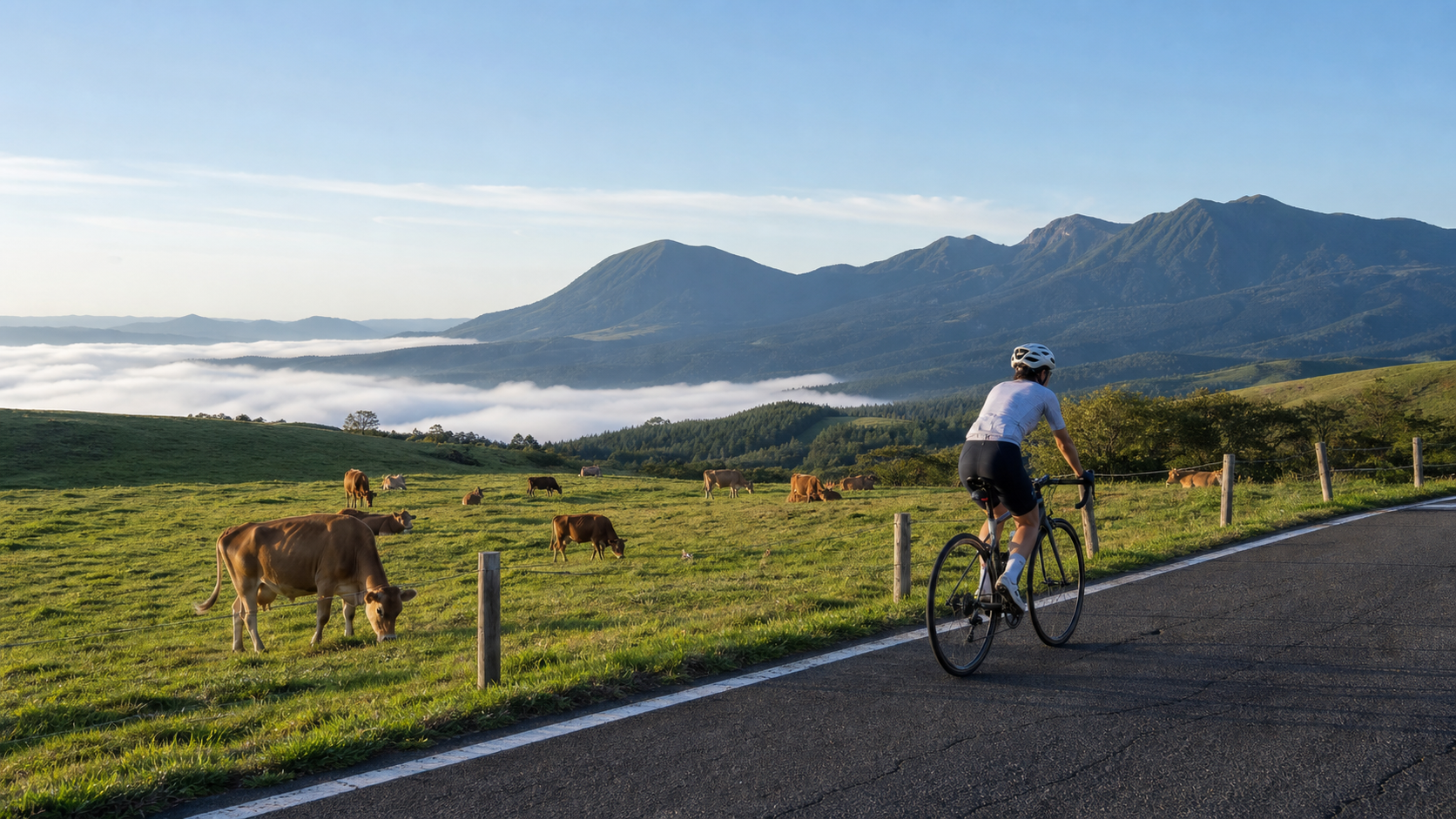
Some highlands awe you with ruggedness, others soothe you with pastoral charm. Hiruzen Highlands belongs to the latter—with its open pastures, leisurely cattle, and overflowing milk fragrance, it offers cyclists a journey so gentle you’ll be reluctant to speed up. This is a route that speaks not of conquest, but of enjoyment.
Hiruzen Highlands (ひるぜんこうげん), located in Maniwa City, Okayama Prefecture, sits at an elevation of approximately 500–600 meters, spreading across the foothills of the “Three Hiruzen Peaks” and connecting with the highland road network along the Tottori Prefecture border. This is one of Japan’s most representative highland pastures and the birthplace of B-grade gourmet food and Jersey milk. In this article, we set aside the cycling computer and step into the dairy farming culture, breathtaking scenery, and flavors behind this highland.
Among this batch of famous Japanese mountain routes, Hiruzen Highlands is the most “distinctive.” While Fuji’s brutal gradients, Ishizuchi’s punishing faith climbs, and Daisen’s rugged circuit all challenge your fitness and willpower in their own ways, Hiruzen chooses a different path—with its open pastures, leisurely cattle, and overflowing milk fragrance, it invites you to slow down and unwind. This is a “healing” highland route, perfect for riding with a relaxed mindset, feeling the wind, admiring the views, and savoring the food. If you need a ride that isn’t so hardcore yet completely rejuvenates your body and mind, Hiruzen Highlands is the perfect choice.
The Three Hiruzen Peaks: Stars of the Pastoral Highlands
The visual centerpiece of Hiruzen Highlands is the Three Hiruzen Peaks—Shimo-Hiruzen, Naka-Hiruzen, and Kami-Hiruzen—lined up from east to west, all three summits exceeding 1,000 meters with gentle, graceful ridgelines.
These three mountains form the backdrop for all the scenery of Hiruzen Highlands. No matter where you ride across the highland, you’ll almost always see their steady ridgelines when you look up. They aren’t rugged and jagged like Daisen; instead, they carry a soft, rounded highland character that, together with the open pastures and leisurely cattle beneath, forms a complete pastoral picture. Riding under the watch of the Three Hiruzen Peaks, you’ll feel a rare sense of calm—there are no aggressive gradients here, only openness and tranquility that let you relax.
This calm is actually something very precious in modern life. Most of the time, we live in haste and anxiety, pushed forward by various goals and pressures. Hiruzen Highlands, with its open pastures, gentle slopes, and steady distant mountains, presses a pause button for you. Riding here, you don’t need to prove anything or chase anything—you simply exist and simply feel. The wind blows across the pastures, carrying the scent of grass and earth; the Three Hiruzen Peaks stand quietly in the distance; cattle move slowly across the meadows. All of this creates a nearly meditative cycling experience—your breathing slows down, and your heart slows down too. This, perhaps, is the most healing aspect of Hiruzen Highlands.
Japan’s Largest Home of Jersey Cattle
What Hiruzen is most proud of is its Jersey cattle (ジャージー牛).
Hiruzen is Japan’s largest Jersey cattle farming area—raising them since the 1950s, today approximately 2,000 of Japan’s roughly 10,000 Jersey cattle are in Hiruzen. Jersey cattle have reddish-brown coats, smaller frames, and friendly temperaments. The milk they produce is high in butterfat and rich in flavor, making it the hallmark of Hiruzen’s dairy farming culture.
Riding through Hiruzen Highlands, you’ll see groups of reddish-brown Jersey cattle grazing leisurely in the pastures. Their gentle, approachable demeanor is one of Hiruzen’s most healing sights. And the Jersey milk and Jersey soft-serve ice cream produced by these gentle cattle are flavors you absolutely cannot miss when visiting Hiruzen—rich, creamy, with the distinctive freshness of a highland pasture. After climbing, stopping at a highland shop for a Jersey soft-serve is the sweetest reward of this cycling journey.
This dairy farming culture gives Hiruzen a warmth unlike any other. It isn’t a rugged terrain meant to be conquered, but a gentle land of cattle, milk, and pastoral songs. When you ride along the pastures, catching the faint scent of grass and milk in the air, you’ll understand why Hiruzen is called the “healing homeland of the highlands.”
The Jersey breed itself has an endearing quality. They’re smaller than typical dairy cows, with warm reddish-brown coats, big gentle eyes, and a friendly disposition. Since the 1950s, Hiruzen’s farmers have been raising these dairy cows originally from Jersey Island in England. Through decades of dedicated effort and generational succession, this place has become Japan’s largest home of Jersey cattle—of Japan’s roughly 10,000 Jersey cattle, about 2,000 are in Hiruzen, a proportion that speaks volumes about the deep bond between this highland and Jersey cattle. Behind this number lies the profound affection that generations of Hiruzen dairy farmers have poured into this land and these cattle. When you encounter these gentle cows on the highland, you’re meeting not just livestock, but living witnesses to a dairy farming culture built with care and passed down through generations over decades. The way they lower their heads to graze, the occasional glance they cast your way—these are the most moving everyday scenes of Hiruzen Highlands.
Kimendai: Sea of Clouds and Border Vistas
The scenic highlight of Hiruzen is the Kimendai (きめんだい) Observation Rest Area.
Kimendai sits on the Hiruzen-Daisen Skyline at an elevation of about 900 meters, right on the prefectural border between Okayama and Tottori. This Hiruzen-Daisen Skyline, approximately 9.3 kilometers long and opened in 1970, is a scenic road connecting the two great highlands of Hiruzen and Daisen, and Kimendai is the finest viewpoint along the way. It offers a 360-degree panorama—Daisen to the north, Hiruzen Highlands to the south—bringing the splendor of two of the Chugoku region’s most famous mountains into a single view. Its most renowned feature is the autumn sea of clouds: when conditions align, clouds spread across the valley like a surging white ocean, and you stand above the clouds watching sunlight paint them gold.
Standing at Kimendai, you’ll simultaneously experience Hiruzen’s gentleness and Daisen’s ruggedness—the pastoral Hiruzen Highlands to the south, the imposing Hoki-Fuji to the north. This “one viewpoint, two landscapes” experience is Kimendai’s unique charm. The rest area also sells local produce and vegetables, making it an ideal stop for cyclists to rest, resupply, and take photos.
What haunts visitors’ dreams most about Kimendai is the sea of clouds on autumn mornings. When conditions align—typically on clear autumn mornings with large temperature differences between day and night—dense fog rises from the valley, spreading into a surging white ocean, and you stand above the clouds watching the sunrise gradually paint them gold and pink. The awe of standing above the clouds, overlooking an entire sea of clouds, is something no photograph can fully convey. Many photographers and cyclists will make a point of heading up in the dark on autumn mornings just to capture that fleeting, breathtaking moment. Of course, the sea of clouds is a natural phenomenon that can’t be guaranteed—it depends entirely on the day’s weather conditions. But precisely because of its uncertainty and rarity, the moment you actually encounter it feels especially precious and unforgettable. Even without the sea of clouds, Kimendai’s 360-degree daytime panorama of highlands and famous peaks is more than enough to leave you thoroughly satisfied.
The Home of B-Grade Cuisine: Hiruzen Yakisoba
Hiruzen isn’t just about milk—it’s also home to an unforgettable B-grade delicacy.
Hiruzen Yakisoba (蒜山焼きそば) is the signature dish of this highland and has won acclaim at the B-1 Grand Prix (B級美食大賞). It uses a secret miso-based sauce, delivering a rich, unique, and savory flavor that makes it the most representative dish of Hiruzen’s local cuisine. For cyclists who are hungry and exhausted after climbing, a piping-hot plate of Hiruzen yakisoba, fragrant with sauce, tastes like heaven.
What makes this yakisoba special isn’t just its distinctive, rich miso sauce—it’s also the local memories and warmth of everyday life it carries from the Hiruzen highlands. It wasn’t invented as a fancy dish for tourists; it’s an everyday meal enjoyed in households and streets across this plateau. It’s precisely this simplicity and familiarity that give it such warmth. When you step into an unassuming little shop in Hiruzen and order a hot plate of yakisoba, what you taste isn’t just flavor—it’s the most authentic daily life and heartfelt hospitality of this land. And the fact that it won a national B-grade cuisine award proves that this “everyman’s deliciousness” has the power to win over anyone’s palate.
Beyond yakisoba, the local Genghis Khan grilled lamb (ジンギスカン) is also a popular regional dish. Imagine this: after cycling across a pastoral highland, you sit down to feast on yakisoba and grilled meat, then top it off with a Jersey cow soft-serve ice cream—Hiruzen, with its abundant food, turns the fatigue of cycling into pure happiness. This experience of “scenery and cuisine in one” is what makes Hiruzen so captivating.
In cycle touring, food is never just about filling your stomach. It’s a way of connecting with a place, and the key to making cycling memories vivid, warm, and worth savoring again and again. Years later, when you look back on Hiruzen, you may have forgotten how many kilometers you rode or how much elevation you climbed, but you’ll definitely remember that plate of fragrant yakisoba, that melt-in-your-mouth Jersey cow soft-serve, and the contentment of feasting in front of a highland shop, surrounded by cattle and distant mountains. These memories woven from taste and scenery are what the Hiruzen highlands truly leave you with. That’s why, when you come to Hiruzen, don’t just focus on riding or rushing through—be sure to set aside time to sit down and savor the flavors of this plateau. That’s the other half of a complete Hiruzen journey.
Famous Spring Water and Wetlands: The Clarity of the Highlands
Hiruzen also hides a famous spring—Shiogama Reisen (塩釜冷泉), located near the trailhead of Naka-Hiruzen. It’s one of Japan’s 100 Famous Waters (日本名水百選), with clear spring water flowing year-round at around 11°C, serving as the finest testament to the purity of this highland’s water. On a hot summer day, this icy-cold famous spring is a refreshing gift from the plateau. Imagine pausing mid-ride at the foot of the three Hiruzen peaks, cupping your hands to drink the year-round cool spring water, letting its chill wash away the heat and fatigue—this direct, intimate contact with nature is a rare experience in urban life and a delightful interlude on a Hiruzen highland ride.
At the junction between the highlands and Mount Daisen, there’s also Kagamiganaru (鏡ヶ成)—a mountain wetland at approximately 920 meters above sea level. Together with the three Hiruzen peaks and Kijōdai, this wetland forms the rich highland landscape of the area. Clear streams, wetlands, pastures, distant mountains—Hiruzen weaves these natural elements into a highland world that relaxes both body and mind.
Famous springs like Shiogama Reisen also speak to the purity of this plateau. Being selected for Japan’s 100 Famous Waters means the water quality has passed rigorous certification; and this clear water is precisely what nurtures high-quality pasture grass, which in turn raises high-quality Jersey cows. You see, on the Hiruzen highlands, water, grass, cattle, and milk are all interlinked, forming a complete and beautiful ecological cycle. When you scoop up a handful of clear water from Shiogama Reisen during a summer ride, that cool sensation will make you deeply feel the purity and vitality of this plateau. These natural treasures scattered across the highlands—famous springs, wetlands, pastures, and the three peaks—together form the foundation of why Hiruzen is so healing and so enchanting.
What This Road Means to Cyclists
The significance of the Hiruzen highlands to cyclists lies in its reminder: riding doesn’t always have to be about pushing hard.
In this era of chasing KOMs and PBs, we often forget that the original joy of cycling is actually simple—the comfort of wind on your face, the healing of open scenery before your eyes, and the satisfaction of a good meal after a ride. The Hiruzen highlands are exactly the kind of place where you can rediscover that simple joy. The slopes here aren’t steep, the roads aren’t dangerous; it doesn’t demand you prove anything, only invites you to slow down and truly feel.
Think about why we fell in love with cycling—for many, the initial reason wasn’t about results or data, but about that feeling of “freedom”: riding to places you’d never normally reach, seeing scenery you’d never normally see, feeling the wind, the sun, and the earth. But the longer and more deeply we ride, the more we often find ourselves unconsciously shackled by power, heart rate, and rankings, turning cycling into one self-validation after another. The Hiruzen highlands, however, are like a gentle mirror, reflecting the purity with which we first fell in love with riding. Here, you can temporarily set aside all goals and pressure, simply ride, simply look, simply enjoy. This experience of “returning to the original heart” is the most precious gift the Hiruzen highlands offer to weary competitive cyclists.
When you ride under the watch of the three Hiruzen peaks, watch reddish-brown Jersey cows grazing leisurely, overlook the sea of clouds from Kijōdai, and finally wrap up with a plate of yakisoba and a milk soft-serve, you’ll understand: the value of this ride was never in the numbers on your cycling computer, but in the relaxation and fulfillment, from the inside out, that this highland gives you. This is the gentlest gift Hiruzen leaves for every cyclist.
A Highland Made for “Slowing Down”
Among these famous Japanese mountain routes, the Hiruzen highlands are the most unique. The others—Fuji’s brutal slopes, Ishizuchi’s pilgrim ascent, Daisen’s rugged loop—all “challenge” you in their own ways; Hiruzen, by contrast, invites you to “slow down.”
This difference actually reflects the diversity and richness of cycling itself. Sometimes we ride to push our limits, prove ourselves, and enjoy the sense of accomplishment from overcoming difficulty; but other times, we ride simply to escape the noise and stress of daily life, letting our tense minds and bodies fully unwind. Both needs are legitimate, and both are part of cycling’s joy. The Hiruzen highlands are a world tailor-made for the latter need. It doesn’t rush you or judge you; it simply spreads a beautiful highland before you, letting you feel the wind, admire the views, savor the food, and let your mind wander at your own pace.
If you’re a cyclist long immersed in training and competition, an occasional “healing ride” to a place like Hiruzen can be excellent balance—it might even help you rediscover your passion for cycling. It will gently remind you that the original joy of riding is actually simple—not about data or rankings, but about the ease and freedom of being close to the wind, the scenery, and the land. On the long road of chasing results, this reminder is itself a very precious gift.
Seasons and Timing
The highland sections of Hiruzen (such as the Hiruzen-Daisen Skyline) are closed in winter, so the visiting season runs from spring to autumn, with each season offering its own charm.
In spring, after the snow melts, the highland pastures turn green and the farms awaken—a season full of vitality and hope, with crisp, pleasant air perfect for leisurely rides. In summer, the high altitude keeps Hiruzen cool and comfortable, making it an ideal escape from the heat of the lowlands. Jersey cows graze lazily on the pastures, the pastoral scenery is at its most vivid, and it’s the most refreshing, delightful season for enjoying a Jersey cow soft-serve ice cream. Autumn is Hiruzen’s most enchanting time—the highlands take on autumn colors, pasture grass turns golden, the distant mountains blaze with fall foliage, and the sea of clouds at Kijōdai is a renowned spectacle that draws countless photographers and cyclists to hike up before dawn to wait. Standing above the sea of clouds, watching the sunrise paint the clouds gold, is for many the most beautiful memory of Hiruzen. No matter the season, Hiruzen welcomes every cyclist with its gentle, ever-changing highland scenery.
Planning a Highland Tour Around Mount Hiruzen
The network of highland roads around Mount Hiruzen is perfect for planning a leisurely two-to-three-day cycling trip. You can link together the Hiruzen Highlands, Kijo-dai, Kagami-ga-naru, and the southern foothills of Mount Daisen on the adjacent Tottori side, creating a highland route that crosses the Tottori and Okayama prefectural border.
Such a plan lets you experience two distinctly different riding flavors in a single trip: the Hiruzen side offers gentle pastoral highlands, ideal for relaxed cruising; the Daisen side features rugged loop roads and steep climbs to satisfy your craving for a challenge. One soft, one hard; one gentle, one steep—this adds greater depth to your cycling journey. And what ties it all together is the shared dairy cuisine and hot spring culture of the region—from Hiruzen yakisoba and Jersey milk to Daisen milk and Genghis Khan barbecue. Eat your way through it all, and let your taste buds embark on a highland journey of their own.
When planning such a trip, don’t forget a few key points: first, the highland sections are closed in winter, with the best season being spring through autumn—be sure to check the road opening status; second, make time to savor the local cuisine rather than just rushing through, because the food is half the joy of this journey; third, slow your pace down entirely, because the value of this highland lies precisely in “slowness.” Approach your planning with that unhurried mindset, and this highland journey across the Tottori and Okayama prefectures will become an especially gentle and unforgettable chapter in your cycling memories.
Suggested Side Trips
- The Three Hiruzen Peaks: Mount Shimohiruzen, Mount Nakahiruzen, and Mount Kamihiruzen—the protagonists of the highland views and the natural backdrop to the pastoral scenery.
- Kijo-dai Lookout Rest Area: A scenic spot on the prefectural border, famous for autumn sea-of-clouds views, with a 360-degree panorama of the Hiruzen Highlands and the majestic Mount Daisen.
- Hiruzen Kogen Cycling Road: An officially promoted bike path that is gentle and friendly, suitable for riders of all levels to enjoy a pastoral ride.
- Shiogama Cold Spring: Located near the Mount Nakahiruzen trailhead, this is one of Japan’s 100 Famous Waters, refreshingly cool in summer.
- Kagami-ga-naru and Okudaisen: A highland connector zone toward Mount Daisen, allowing you to extend into even richer routes.
- Local Cuisine: Hiruzen yakisoba, Jersey milk and soft-serve ice cream, and Genghis Khan barbecue—everything you need for the perfect reward after a ride.
Ride Hiruzen with a Relaxed Mind
If you decide to visit the Hiruzen Highlands, the advice I most want to give you is just two words: relax.
Let go of your fixation on performance, let go of your pursuit of speed, let go of every goal and pressure that keeps you tense. When you come to Hiruzen, the only thing you should do is fully enjoy everything this highland offers you—the solid presence of the Three Hiruzen Peaks, the openness of the grasslands, the gentleness of the Jersey cows, the breathtaking views at Kijo-dai, and the taste of that plate of yakisoba and that milk soft-serve.
Ride a little slower, stop a few more times, take a few more looks. When you’re tired, sit down by the pasture, watch the cows, feel the breeze, and let your mind wander. When you’re hungry, find a small shop and savor the local food. These pauses that might seem like “wasting time” are actually the very essence of a Hiruzen trip. Because the value of the Hiruzen Highlands has never been about how fast or how far you ride—it’s about how thoroughly your body and mind are stretched and nourished by this gentle highland.
Seasonal reminder: Highland sections such as the Hiruzen-Daisen Skyline are closed in winter (roughly December to March), with the best riding season being spring through autumn; highland weather can change quickly, so bring a light jacket. Ride this pastoral highland—the home of Jersey cows and yakisoba—with a relaxed mind, and it will, in the gentlest way, make you fall in love all over again with the pure freedom of cycling.
Related Reading
- Hiruzen Kogen Jizo-toge Guide: A 7.2 km Pastoral Climb on the Tottori-Okayama Highland
- Cycling Lishan Fushoushan Farm: The Majestic Experience of a High-Mountain Farm on the Central Cross-Island Highway
- Standing on the Roof of Kyushu: Riding the Yamanami Highway, a Spectacular Highland from Chojabaru to Notoro-toge
- Riding into a Land of Myth and Volcanoes: A Cycling Account of Ebino Highlands, a Highland Pilgrimage Through the Kirishima Mountain Range
嘉義大埔、阿婆灣挑戰賽,美到以為在日本!ft. 環騎5 Cool 西拉雅188 / 公路車 / CT Yeh
7 個月前
台北闊瀨陡坡 騎旅 / 日本單車雜誌編輯車友臨時加入!/ 髮香才是最強的 / feat. 北迴歸線小隊 / 公路車 CT Yeh
6 個月前
日本🇯🇵岡山&島波海道 單車之旅 (上集) / 機場停車省錢秘笈?/ 旅館有單車組裝室 / 差點上不了機場捷運 / 公路車 / CT Yeh
2 年前
秘境雪場 日本 八甲田 冰樹探險與滑雪體驗 ft. Q老師 & 運動生活
7 年前
京都!99%人不知道的秘境玩法!租 E-Bike 騎進探訪宇治抹茶原鄉 刺激好玩絕美的山林古道 鬼滅之刃的場景探訪 / CT Yeh
12 天前
2025 乘鞍 KOM 登山賽挑戰實錄 / 日本公路最高 ! 賽前探路篇 / 比富士山厲害,無敵絕景!/ 40週年 / 中文YT首發 / 公路車 / CT Yeh #乘鞍ヒルクライム
10 個月前
東眼山 x 角坂山 / 冰沙季又來了 一次買兩杯 + 私房豆花 / 廢物伙伴小約騎 / 公路車 / CT Yeh
2 年前
大武山20%魔王陡坡【JJSC南台灣遊騎Day2】!屁股真的要裂開了...凡士林抹滿也沒用?神秘金教堂還有超便宜夜市
3 個月前