Changhua County Route 139 Fengshan Temple Guide: 4.7 km, 153 m Elevation Gain, an Introductory Climb Suitable for Both Beginners and Intermediates
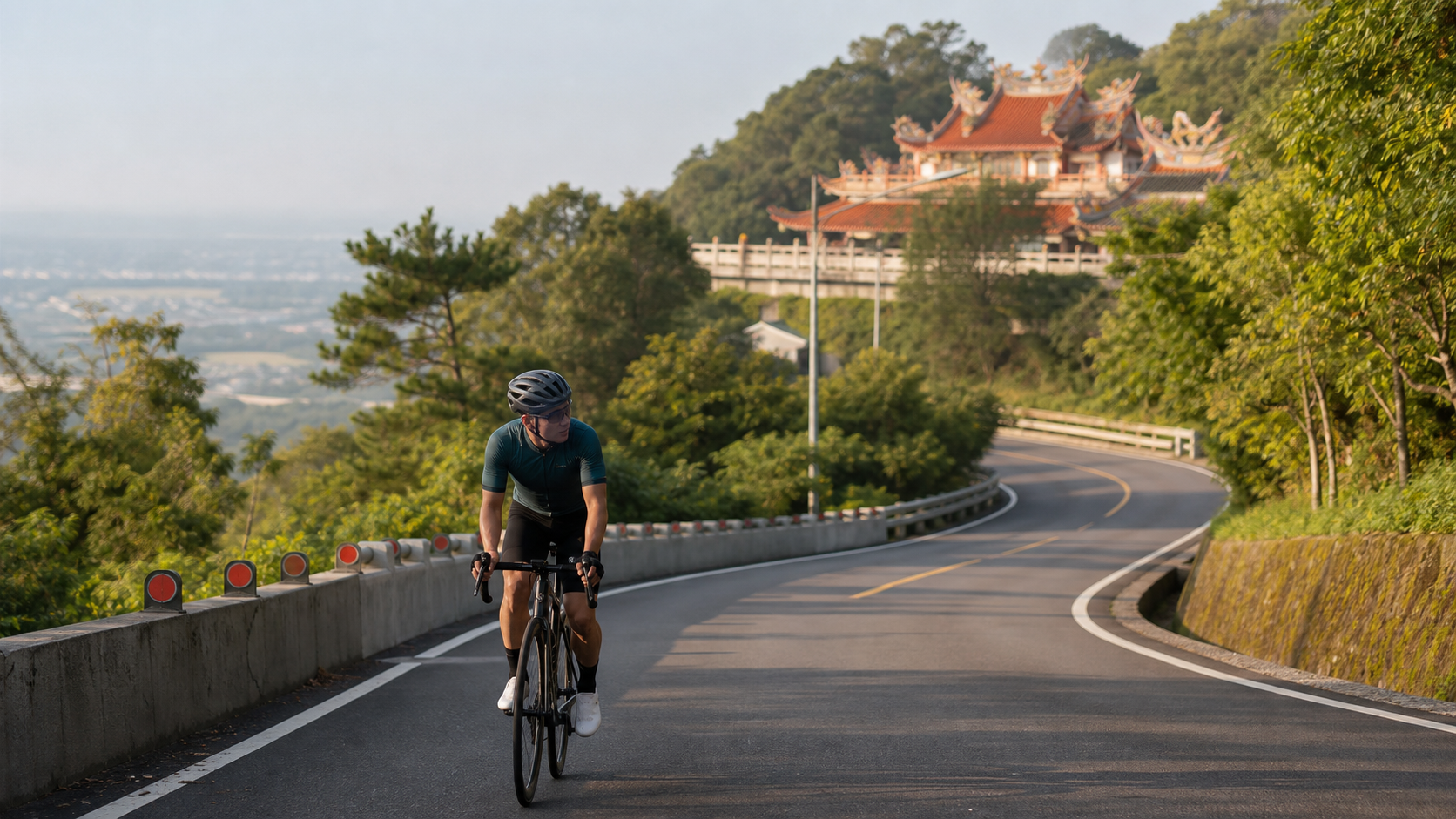
Route Overview and Data Analysis
Changhua County Route 139 is widely recognized in central Taiwan’s cycling community as the “textbook for climbing.” The Fengshan Temple segment (measured from the traffic light) analyzed in this article is a relatively gentle yet highly representative section among the many segments of Route 139: starting from the traffic light intersection at the foot of the hill to Fengshan Temple, it spans 4.75 km in total length, with a cumulative elevation gain of 153.2 m and an average gradient of 3.2%.
Let’s break down the numbers first. An average gradient of 3.2%, put in the simplest terms, means that for every 100 m ridden, you climb 3.2 m vertically—this falls within the “moderate climb” category in cycling climb classifications. It is far from brutal, and is actually much gentler than many well-known climbs that Taiwanese cyclists are familiar with. But “moderate” does not mean “easy,” because 4.75 km is not a short distance. If a rider is unfamiliar with pacing, it is easy to lose speed in the middle section and have legs fade toward the end.
Let’s verify the route data with simple physics: distance of 4746.2 m, gradient of 3.2%, theoretical elevation gain should be 4746.2 × 0.032 = 151.9 m, which almost perfectly matches the recorded 153.2 m in the database, with the discrepancy falling within a reasonable GPS measurement range (GPS altimeters themselves have a normal error of ±5-10 m). This indicates that the gradient distribution along this route is relatively uniform, without dramatic swings between flat and steep sections. It is a highly predictable route where “you ride it as it comes,” making it ideal as a first climbing lesson for beginners, as well as a warm-up or recovery ride option for experienced riders.
Route 139 itself is an important cross-ridge road through the Bagua Mountain Range in Changhua, connecting Changhua City with several townships in the Nantou area. Thanks to its varied terrain, consistent road surface quality, and relatively lighter traffic compared to other provincial highways, it has long been a popular venue for group rides and individual training in central Taiwan. The Fengshan Temple segment sits at one of the route’s well-known landmark nodes, and many cyclists include “riding up to Fengshan Temple” as part of their regular weekend training menu.
Segment-by-Segment Guide: From the Traffic Light to the Fengshan Temple Gate
Segment 1 (0-1.5 km): Warming Up and Testing the Gradient
The traffic light intersection at the start is the officially recognized starting point for this route. After passing through the intersection, the gradient immediately becomes apparent, but the increase is modest, mostly falling between 2-3%. The focus of this section is not on speed, but on getting your body and cadence into rhythm. Riders are advised to deliberately keep heart rate low here, use a relatively easy gear ratio, and maintain a cadence of 85-95 rpm, allowing the thigh muscles to gradually adapt to the climbing load, rather than starting with a sprint mentality that spikes intensity. Most riders who struggle on this route do so not because the gradient is too steep, but because they start too fast, causing muscles to accumulate anaerobic waste prematurely in the middle and later stages.
Segment 2 (1.5-3 km): Fluctuating Gradient Zone—A Test of Pacing Discipline
The middle section features the most noticeable gradient changes on the entire route. Some parts present short steep pitches around 5%, immediately followed by a brief easing or even a slight descent. This “breathing rhythm” of the gradient is a hallmark of the Route 139 system—not a sustained, constant long climb, but one that undulates like a heartbeat. What riders should do here is use power or heart rate as a pacing anchor, rather than relying on visual assessment of the gradient or riding by feel. If using a power meter, aim to keep output in the 75-85% of FTP range; without a power meter, use the self-check indicator of “still able to breathe smoothly through the nose, breathing hard when talking but able to complete short sentences” as the upper intensity limit.
Segment 3 (3-4.75 km): The Final Push to the Fengshan Temple Gate
Entering the final 1.75 km, the route gradually settles into a more consistent climbing angle until the gentle finish before the Fengshan Temple gate. Because energy is largely depleted by this point, this is the stage where riders are most prone to “losing speed without realizing it.” It is recommended to shift mindset here, adopting the strategy of “maintain cadence, abandon the pursuit of speed”—shift attention from the bike computer to the smoothness of breathing and pedaling, ride the final stretch with a steady rhythm, and after reaching Fengshan Temple, do a brief cool-down on the spot or at the roadside before turning back.
Gear Ratio and Equipment Recommendations
Given the 3.2% average gradient paired with occasional short steep sections around 5%, this route is not particularly demanding for a modern road bike’s standard setup. With a 34/50T compact crankset paired with an 11-28T or 11-30T rear cassette, the vast majority of riders will find a suitable pedaling rhythm without needing to switch to mountain-bike-level super-low gearing.
- General riders: A compact crankset (50/34T) paired with an 11-28T rear cassette is recommended; the 34×25 or 34×28 combination will handle the mid-section steep pitches with ease.
- Weaker riders or beginners new to climbing: Consider an 11-30T or 11-32T rear cassette to maintain a cadence above 90 rpm and reduce strain on the knee joints.
- Competitive riders training power: A 53/39T standard crankset paired with an 11-25T throughout the route can deliberately raise intensity as part of interval training.
As for tire pressure, given the good road surface condition, standard road tire pressures (approximately 90-110 psi) are recommended based on body weight and tire width—no need to lower pressure specifically for gravel or potholes.
Nutrition, Hydration, and Seasonal Weather Recommendations
Given the scale of less than 5 km in total length and approximately 150 m of climbing, a single ride on this route will take most riders roughly 15-25 minutes, with weaker riders potentially needing over 30 minutes. At this length, there is essentially no need for mid-route nutrition; just ensure your water bottle is full and you are properly hydrated before setting off.
However, it is worth noting that Route 139 in Changhua runs through mountainous terrain with inconsistent shade. During summer midday hours, the combination of reflected road heat and climbing effort can make the perceived temperature noticeably higher. Recommendations:
- Summer (June-September): Avoid the high-temperature window from 10 a.m. to 3 p.m.; ride in the early morning or evening instead, and increase hydration frequency.
- Plum rain season (May-June): Afternoon thunderstorms are common in mountainous areas; check real-time radar reflectivity before heading out and avoid riding during periods of strong convective activity.
- Autumn/Winter (October-February): Cool temperatures are ideal for chasing speed, but dense fog and slippery road surfaces occasionally occur in the mountains during early morning; pay attention to braking distance and tire grip.
Common Mistakes and Risk Reminders
The first common mistake is “misjudging the 3.2% average gradient as easy throughout.” As analyzed earlier, the middle section of this route does feature localized steep pitches around 5%. If riders see only the average and let their guard down, they can be caught off guard on the steeper sections, forced to stand and grind, which disrupts pacing.
The second common mistake is beginners treating this as a race route, sprinting at near-maximal intensity from the start, leading to lactic acid buildup and loss of leg strength in the middle and later stages, leaving them to struggle through to the finish at a crawl. The most suitable way to ride this type of route is instead to “maintain a sustainable moderate intensity and ride it through steadily,” treating it as a base-building aerobic endurance segment rather than an anaerobic sprint course.
The third reminder concerns shared road use. Motorcycles and small trucks occasionally pass along Route 139, and some sections have limited sightlines. Riders are advised to wear reflective accessories and stay alert, especially during low-visibility early morning or dusk hours.
Target Time Reference for Riders of Different Levels
The following times are for reference only; actual performance will vary depending on individual fitness, wind direction, and temperature on the day:
| Rider Level | Estimated Completion Time | Average Speed | Notes |
|---|---|---|---|
| Beginner / Recovery ride | 25-30 minutes | Approx. 9.5-11 km/h | Easy pedaling throughout, no pace chasing |
| General recreational rider | 18-22 minutes | Approx. 13-16 km/h | Steady moderate intensity |
| Rider with training base | 14-17 minutes | Approx. 17-20 km/h | Primarily in power zone 3 |
| Competitive / front-of-group rider | 10-13 minutes | Approx. 22-28 km/h | Near or at FTP-intensity effort |
With its compact scale and friendly gradient, this route is well suited as a “warm-up and cool-down” segment for regular weekend training, and is also ideal for introducing beginner friends to the joy of climbing for the first time. Once riders become familiar with this route, they are encouraged to take on other longer, more challenging segments of Route 139 to progressively build climbing strength.
Power and Heart Rate Training Framework: Turning the Fengshan Temple Segment into a Repeatable Training Tool
For riders with a systematic training routine, the greatest value of this route lies not in “checking in once,” but in the fact that its length and gradient combination fall precisely within an ideal range for repeated training and quantifying progress. At 4.75 kilometers with 153 meters of climbing, most riders complete it in 15 to 30 minutes—which corresponds directly to the interval length commonly used in exercise physiology for “Threshold Training.”
If you have a power meter, you can set this route as a fixed training session: target 88% to 95% of your FTP (Functional Threshold Power) as the goal zone, ride the entire segment, and record both completion time and average power. After four to six weeks of consistent training, the same power output should theoretically translate into a shorter completion time—this is the most intuitive progress indicator. If you don’t have a power meter, heart rate can serve as a substitute metric, with a recommended target zone of 82% to 90% of maximum heart rate. However, be aware that heart rate response lags behind actual intensity changes (heart rate drift), so it should not be used as the sole basis for real-time intensity adjustments.
Breaking it down further, this route is also well-suited for “climbing interval” training—for example, after completing the full segment, turn around on the spot and ride it again, completing 2 to 3 repetitions total, with 10–15 minutes of easy flat riding or coasting between efforts to recover heart rate. This training method is particularly effective for improving anaerobic threshold and climbing economy, making it especially suitable as a specific preparation phase before tackling longer climbing routes (such as Wuling, Hehuan Mountain, or the Beiyi Highway).
Positioning Within the Broader Context of County Road 139 Segments
Changhua County Road 139 spans multiple administrative districts, with several well-known climbing segments of varying difficulty distributed along its length. The Fengshan Temple segment is merely one relatively moderate section within this network. When laying out the famous segments of County Road 139 side by side for comparison, the positioning of this route within the overall difficulty spectrum becomes clear:
| Segment Characteristics | Distance | Average Gradient | Difficulty Rating |
|---|---|---|---|
| Fengshan Temple (this route) | 4.75 km | 3.2% | Beginner / Gentle |
| Other notable long climbs on County Road 139 | Varies by segment | Commonly 5-8% | Medium-High Difficulty |
| Mountain crossing segments on County Road 139 | Varies by segment | Locally reaching double digits % | High Difficulty / Challenging |
This comparison is not meant to diminish the value of the Fengshan Temple segment—quite the opposite. Precisely because its gradient is gentle, the route is clearly defined, and the risks are relatively manageable, it serves as an excellent “touchstone” for riders before tackling the more hardcore segments of County Road 139. If you can complete this route and still have energy left—even maintaining a steady pace throughout—then you already possess the basic fitness threshold to take on the intermediate segments of County Road 139. Conversely, if this route already feels strenuous, it’s recommended to use it as your primary training ground, accumulating several weeks of regular climbing mileage before moving up to greater challenges.
Equipment Maintenance and Pre-Ride Inspection Checklist
Climbing routes place greater demands on a bicycle’s mechanical systems than flat riding, particularly on the drivetrain and braking systems. Before heading out to the Fengshan Temple segment, the following checks are recommended:
- Brake pads and disc pads: Confirm sufficient wear margin. The descent back down will require sustained and consistent braking force, so be mindful of brake fade.
- Chain and drivetrain: Frequent shifting occurs during climbs. If the chain is dry or heavily worn, it can skip gears at critical moments. It’s recommended to lubricate before departure and test all gear combinations for smoothness.
- Tire pressure and condition: Check for cracks or embedded debris. Proper tire pressure balances rolling efficiency with grip.
- Bottles and nutrition: Even though the route is short, carrying at least one 500ml bottle is recommended; in summer, increase to 750ml–1000ml.
- Phone and navigation devices: Signal reception is unstable in parts of the mountain area. Download offline maps or familiarize yourself with the route in advance to avoid getting lost.
Complementary Surrounding Routes and Extended Ride Planning
The Fengshan Temple segment is compact in scale, and many riders incorporate it into a larger weekend ride plan rather than riding it as an out-and-back in isolation. Common extended plans include:
- Warm-up + Main Climb + Cool-down Model: Use flat riding as a warm-up, arrive at the foot of County Road 139, complete the Fengshan Temple segment as the main climbing intensity session, then use gentle terrain for cool-down. Total ride distance can be extended to 40–80 kilometers depending on individual fitness.
- Consecutive Segment Challenge Model: For riders with an established climbing foundation, the Fengshan Temple segment can be linked with other nearby segments of County Road 139 for a combined challenge, experiencing the full character of the mountain crossing route. However, this requires more substantial fitness and nutrition planning—carrying portable food and spare inner tubes is recommended to handle unexpected situations during extended mountain riding.
- Group Training Session: Many central Taiwan cycling teams include the Fengshan Temple segment in their regular group training menu as a weekly fixed climbing intensity day, using group riding dynamics to push each other and progressively raise the team’s overall climbing capability.
Whichever planning approach you choose, the Fengshan Temple segment qualifies as a “high value-for-money” training route—short in distance, relatively manageable in risk, friendly in gradient yet not lacking in training intensity. It is a pocket route worth revisiting repeatedly for central Taiwan cyclists.
Safety Essentials for the Descent and Turnaround
Most riders choose to descend back the same way after completing the climb up the Fengshan Temple segment. This descent may look easy, but it is actually the portion of the ride where risk is most easily underestimated. Exhausted energy and diminished focus from the climb, combined with the centrifugal forces of higher speed and accumulated brake heat on the way down, are all details that require special attention.
First is mastering braking rhythm. Many riders habitually squeeze the brakes continuously throughout the descent. While this may seem safe, it actually causes the pads and rims (or rotors) to generate heat through constant friction, and over a long descent, this can lead to the “brake fade” phenomenon where braking power diminishes. The correct approach is “pulse braking”—moderately decelerate before corners, release the brakes through the apex to let the bike carry naturally through the turn, then reapply as needed after exiting, giving the braking system room to breathe and dissipate heat.
Second is anticipating sightlines and line choice. Several sections along County Road 139 have significant blind spots, and agricultural vehicles or motorcycles may stop or turn unexpectedly. It’s recommended to anticipate road conditions beyond each corner before entering it, avoiding situations where excessive speed leaves insufficient reaction time. This is especially important through shaded sections and tree-covered areas, where the risk of slippery pavement and sudden visibility drops increases—moderate your speed accordingly.
Finally, body position on the descent deserves attention. Riders are advised to shift their center of gravity slightly rearward with elbows slightly bent to absorb vibration, avoiding numb hands or compromised handling from rough pavement. If riding with novices, an experienced rider should lead and demonstrate braking and cornering rhythm, keeping the entire group’s descent speed within a safe and consistent range to avoid rear-end collisions caused by excessive speed differences between individual riders.
Mental Preparation and Real-World Sensations for First-Time Beginners
For beginners who have never tackled a sustained climbing route, the Fengshan Temple segment is an ideal “first time.” Many riders new to road cycling harbor an inexplicable fear of climbing, assuming it’s the exclusive domain of fitness monsters. In reality, as long as you manage proper cadence and mental pacing, most healthy adults can complete this route without difficulty.
The most important mental preparation for a first attempt is “giving up comparing speed with others.” The most detrimental mindset on a climb is accelerating whenever you see another rider overtake you—this reactive acceleration often leaves beginners exhausted before they’ve even reached the halfway point. Beginners are advised to focus on their own breathing rhythm and cadence, setting the goal as “ride the entire segment smoothly without having to get off and walk,” rather than chasing a specific completion time.
In terms of actual physical sensation, most beginners will begin to feel noticeable soreness and burning in the thigh and gluteal muscles after completing the first section (0–1.5 km). This is a normal physiological response, indicating the body is adapting to climbing load. When entering the middle section with fluctuating gradients, breathing rate will noticeably quicken—at this point, it’s recommended to slow cadence, shift to an easier gear, and give the body time to regulate. Upon reaching the final gentle slope before the Niaoshan Temple gate at the summit, many beginners experience a sense of “emotional release”—this is precisely the unique source of accomplishment that climbing offers, and a key reason why so many people fall in love with climbing.
After completing the first attempt, beginners are advised to record their completion time and perceived exertion rating (e.g., RPE on a 1–10 scale) as a reference baseline for future progress. After three to five repeat rides, most beginners will clearly feel improvements in fitness and pacing mastery. This quantifiable, perceptible progression is precisely why this route serves as an ideal starting point for long-term training.
Traffic and Parking Safety Reminder
As County Road 139 is one of the main thoroughfares connecting the mountainous area of Changhua, small trucks, agricultural utility vehicles, and scooters are common along the route, and traffic speeds are generally not slow. Riders are advised to check that their front and rear lights and reflective accessories are in good working order before setting off. Even when riding during the day, keeping the front white light and rear red light in steady flashing mode can effectively increase how far away motorists can spot you, reducing the risk of rear-end collisions.
As for parking and gathering, there is usually roadside space near the traffic light intersection at the foot of the mountain where you can temporarily stop to sort out your gear. However, it is advisable to avoid occupying the shoulder for extended periods or obstructing other road users’ sightlines. When the group assembles, try to choose a wider alley or legal parking space near the intersection, and complete equipment checks and warm-ups before officially setting off, to reduce the need for unscheduled stops on the main route.
Conclusion: Add the Fongshan Temple Section to Your Training Map
With its 4.75 km length, 153 m of elevation gain, and 3.2% average gradient, the Fongshan Temple section of Changhua County Road 139 is relatively approachable yet still offers solid training value among Taiwan’s many well-known climbing routes. Whether you are new to road cycling and looking for a safe introductory climb, or already have a training base and want a venue where you can repeatedly quantify your progress with threshold workouts, this route has you covered. We recommend adding this route to your routine training map and tracking it long-term with power or heart-rate data—you will find that your progress on climbs comes faster and more noticeably than you ever imagined.
Finally, a reminder to all riders: data is always just a reference, and your body’s actual sensations should take priority during real rides. If you are not in good form on the day, are short on sleep, or had a heavy training load the day before, moderately lowering the intensity and treating the ride as a recovery spin is far more commendable than pushing through to chase numbers. In the long run, being able to return to the same route consistently and regularly, repeatedly honing your climbing technique and cardiovascular endurance, is the true training philosophy that builds strength and prevents injury. We wish every rider the chance to find their own rhythm and enjoyment on the Fongshan Temple section.
Appendix: FAQ
Q1: What level of road bike is required to take on this route?
No top-tier race bike is needed; general entry-level to mid-range road bikes are more than capable. What truly affects the riding experience is not the frame grade, but whether the gearing suits your fitness, and whether the wheelset and braking system are well maintained.
Q2: For first-timers, is it recommended to ride with company?
Highly recommended. Experienced riders can provide immediate assistance with pacing, road condition warnings, and handling unexpected situations. This is especially true during the descent and turnaround phase, where riding together significantly reduces risk.
Q3: Is this route suitable as a long-term training base?
Very much so. With its short distance, friendly gradient, and stable road conditions, it is one of the few climbing routes that can be visited repeatedly at high frequency with low risk, making it particularly well suited as a weekly fixed intensity workout or recovery ride option.
Through the complete data analysis, section-by-section strategy, equipment recommendations, and FAQ above, we hope every reader can plan their ride on the Fongshan Temple section of Changhua County Road 139 with greater confidence and safety.
Related Reading
- Breezes and Bells on Bagua Mountain: A Morning Conversation Riding to Fongshan Temple on Changhua County Road 139
- County Road 139 and the Bagua Mountain Bike Path: Central Taiwan Riders’ Favorite Training Route
- 3 Classic Climbs on Nantou’s Bagua Mountain: Full Analysis of County Roads 139B, 137B, and 154
- Changhua Bagua Mountain Traverse Route: A Diverse Riding Guide to Central Taiwan’s Hill Country
彰化 139縣道 單車 穩定測試
10 年前
台北闊瀨陡坡 騎旅 / 日本單車雜誌編輯車友臨時加入!/ 髮香才是最強的 / feat. 北迴歸線小隊 / 公路車 CT Yeh
6 個月前
大武山後門26%歡樂陡坡!JJSC南台灣單車行Day2 / 被颱風追著跑 / 公路車 / CT Yeh
2 年前
半日 小台灣 極限單車路線挑戰實錄
7 年前
單車 梅山36灣 坡度介紹 路段介紹 空拍 (相關遊記影片,請參考說明或我的頻道喔,歡迎訂閱)
6 年前
單車 一日北高 ( 雙城 ) 肥宅雙人瘋狂行 紀錄片 REACTO
10 年前
那瑪夏x茶山 阿里山系深山單車行 Day2 累積爬升6000M | 🥶超陡連續下坡 整路看隊友刷 | 爬升一座西進武嶺 | JJSC | 公路車 | CT Yeh
3 年前
大武山20%魔王陡坡【JJSC南台灣遊騎Day2】!屁股真的要裂開了...凡士林抹滿也沒用?神秘金教堂還有超便宜夜市
3 個月前