A Secluded, Serene Long Climb: Solitary Moments on County Road 47 and the Shiding–Pingxi Mountain Paths
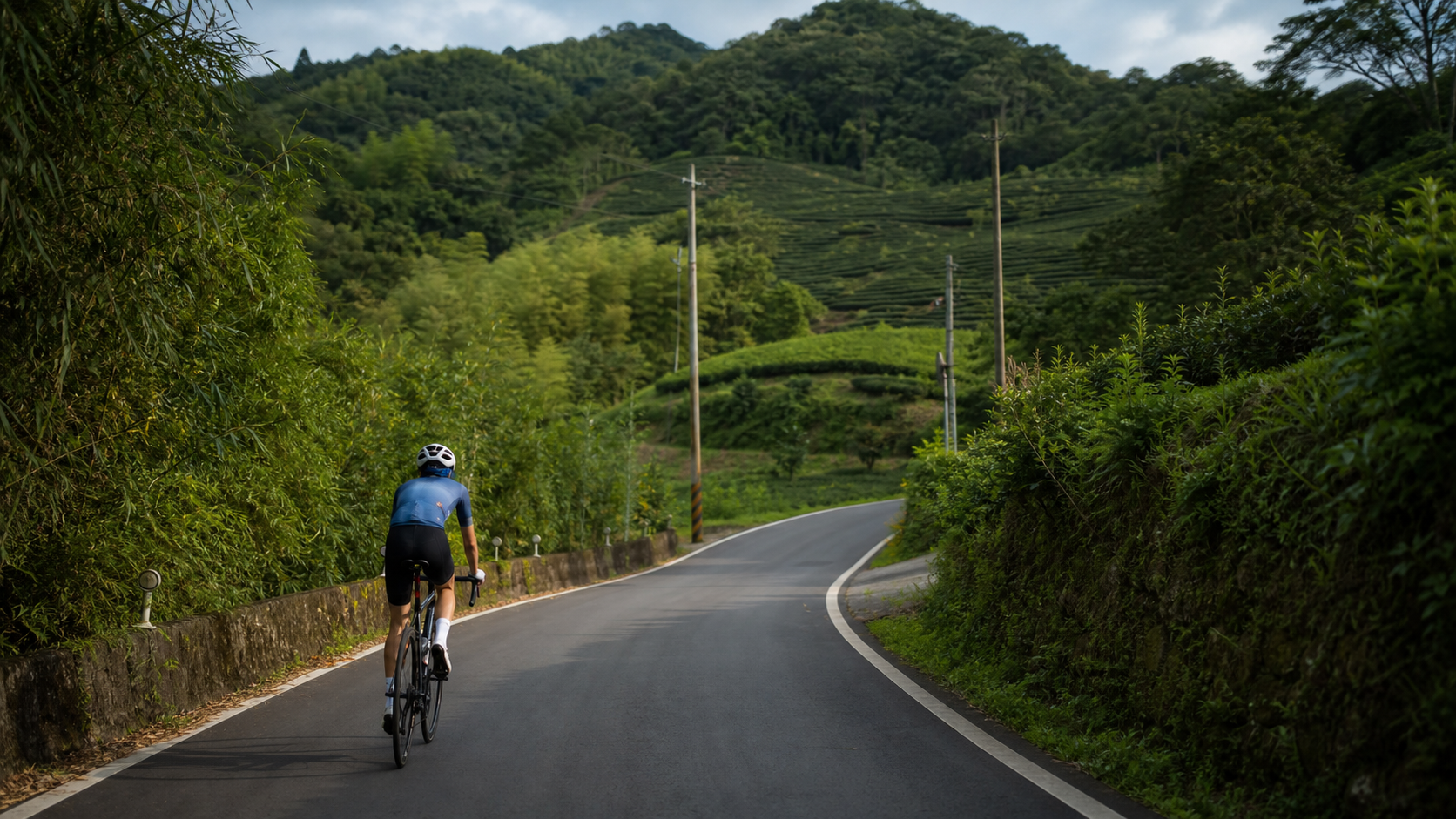
On a rare mid-July weekend with no afternoon thunderstorms, I pointed my handlebars toward Shiding, my destination a county road so obscure it’s barely known even among local cycling circles—County Road 47. There were few ride reports to consult, no wealth of riding logs to compare, only a vague impression: a long, gentle climb where you’d almost never encounter another soul. As it turned out, that impression was entirely accurate, and that “almost never encountering anyone” quiet was the most precious takeaway of the entire ride.
1. Shiding: An Old Tea Town Hidden in the Valley
To understand the geography of County Road 47, you first need to understand Shiding. Shiding is a quintessential hilly mountain town under New Taipei City, with rugged, fragmented terrain. In the early days, the topography restricted transportation links, which ironically fostered a unique settlement pattern—most famously the old Shiding Street built into the cliffside of the river valley. The houses are stacked layer upon layer following the terrain, creating the distinctive “roofless street” architecture, a rare example in Taiwan of building wisdom adapted to valley topography. Shiding is also one of northern Taiwan’s key tea-producing areas, sharing with nearby Pinglin the distinction of being a core production region for Wenshan Baozhong tea. The terraced tea gardens cascading across the hillsides are among the most iconic landscapes of this area (for actual tea garden locations and visiting information, it’s best to consult local tea houses or official tourism sources).
County Road 47 sits on the fringe of this tea-growing terrain, serving as a local industrial road connecting the mountain settlements of Shiding and Pingxi. County roads of this designation are not uncommon in New Taipei’s mountain road network—most were built in earlier times to serve scattered mountain villages and agricultural transport needs. The roads are narrow with plenty of curves, yet this is precisely what has preserved a relatively pristine, undeveloped mountain landscape untouched by large-scale tourism. Compared to Jiufen or Fengguizui, which have been pedaled into “classic route” status by countless cycling groups, County Road 47 feels more like a hidden gem that hasn’t yet made it into the mainstream route guides.
2. Departure: The Transition from Urban Bustle to Valley Silence
Riding from the city toward Shiding, you can still feel the holiday traffic and the lively atmosphere of suburban settlements. But once you turn onto the entrance of County Road 47, the world of sound seems to have a mute button pressed. The asphalt road stretches ever upward, flanked by layered secondary forests and the occasional bamboo grove peeking through. Cicadas replace engine noise as the only persistent background sound. This instant scene shift is the most captivating and therapeutic quality of the mountain routes near Taipei—you don’t need to ride deep into remote mountains; just turn onto the right side road, and the clamor is left behind.
About ten minutes into the road, I truly grasped the weight of the phrase “rarely traveled.” Over the entire 8-plus kilometers, I encountered no more than five vehicles, no other cyclists, and even local residents were a rare sight. This level of quiet is an increasingly rare experience in the Taipei suburbs—most famous holiday climbing routes are already filled with endless convoys of cyclists and motorcyclists, but County Road 47 feels like a mountain path forgotten by time, quietly waiting for the few willing to take the longer way to visit.
3. Rhythm and Breath on a Long Climb: A Conversation with Yourself
At 8.26 kilometers with an average gradient of 4.5%, this ride offers few moments demanding explosive out-of-the-saddle efforts, yet it provides a rare experience of “sustained focus.” The early section is gentle, the body gradually settling into a steady pedaling rhythm, breathing replacing mental noise as the clearest presence in your awareness. This state known as “flow” is perhaps the real reason many seasoned riders love long climbs—when the body is busy managing a continuous ascent, the mind gains precious breathing room.
Around the four- or five-kilometer mark, the road enters a relatively straight, steady climb, with tree cover on both sides creating a deep, tunnel-like feel. I remember barely glancing at my cycling computer on that stretch, letting my cadence settle naturally into a comfortable rhythm as my thoughts drifted toward some unresolved work worries. Curiously, these problems that never seemed to resolve themselves at my desk slowly began to take clearer shape amid the steady, rhythmic pedaling. This is perhaps the most unexpected added value of long endurance riding—it’s not just physical training; it’s a form of dynamic meditation.
Compared to steep climbs that demand full concentration to handle sudden changes, the long, steady gradient of County Road 47 is far better suited for “thinking things through.” When the body has the capacity to maintain mechanical, regular motion, the mind has room to wander, settle, and reorganize. By the time I neared the end of the road that day, I had indeed thought through that pending decision—a reward no amount of time staring at a computer screen in an office could ever deliver.
4. The Silent Presence of Mountain Settlements
County Road 47 isn’t entirely devoid of human habitation. Occasionally you’ll pass a few homes built into the hillside, or small tea gardens and vegetable plots scattered across the slopes. These scenes show no signs of touristification, no decorations designed to cater to visitors—just the simplest, most everyday slices of mountain village life: an elderly person tidying farm tools in their courtyard, a few stray dogs ambling about, clothes drying on bamboo poles swaying gently in the breeze. This unpolished authenticity is itself a rare sight for those who have long lived in the rhythm of the city.
As I rode past these scattered settlements, I deliberately slowed down—partly out of courtesy, partly because I didn’t want to rush past too quickly. Mountain roads are narrow and primarily serve the daily commuting needs of local residents; cyclists are, after all, visitors to this land. Maintaining humility and yielding right-of-way is the most basic—yet most easily overlooked—etiquette when riding such obscure county roads.
5. The Value of “Quiet”
In modern life, “quiet” is becoming a scarce resource. There is almost no true silence in the city—even in the dead of night, distant traffic, the hum of air conditioners, or the buzz of phone notifications fill every corner of the senses. What County Road 47 offers is this nearly luxurious purity of silence—no chatter from fellow riders, no tourist clamor, and even the sound of wind through the treetops becomes strikingly distinct.
I’ve gradually come to understand why some seasoned riders deliberately avoid popular routes in favor of these obscure yet solid stretches. Popular routes certainly have their social atmosphere and photo-op appeal, but a secluded long climb offers a more introspective, private experience—you spend time alone with the road, with your body, with the thoughts circling in your mind. This experience cannot be replicated or easily described; it can only be lived.
6. The Risks of Solitude and Self-Care
Of course, the flip side of “rarely traveled” is corresponding risk. There are almost no shops or supply points along this road, and mobile network signals are unreliable on some sections. If any unexpected situation arises mid-ride, the difficulty of getting immediate help is considerably higher than on popular routes. Before setting out that day, I made a point of informing my family of my planned route and expected return time, and confirmed that my supplies and tools were all in order before heading off with peace of mind.
This “solitude you can only enjoy after thorough preparation” is perhaps another lesson these obscure routes teach me—true freedom and quiet are built on solid preparation, not reckless unpreparedness. The more I ride, the more I appreciate that the joy and responsibility of solo mountain riding are two sides of the same coin. Only when risk awareness is fully in place can you truly surrender yourself to this quiet mountain road.
7. Shiding Old Street and Further Thoughts on the Tea Hills
After descending from County Road 47, I made a brief detour to Shiding’s town center. From a distance, I could see the old street settlement built into the hillside, stacked layer upon layer. Even without time to explore it in detail, just that silhouette conveyed the centuries of accumulated living wisdom on this land. As an important production area for Wenshan Baozhong tea, Shiding’s terraced tea gardens scattered across the slopes share the same geographic character as the quiet long climb I had just ridden—both are ways of finding coexistence with nature amid rolling hills.
If you have time to spare after riding County Road 47, consider setting aside a moment to wander through Shiding’s town center and experience the town’s unique architectural texture and tea-town atmosphere (for actual shops, opening hours, and tour information, please refer to on-site or official announcements). This combination of “sweating on the bike first, then soaking in the culture on foot” makes for a more complete and well-rounded visit.
8. County Road 47 Under the Turning Seasons
The Shiding–Pingxi area is one of Taiwan’s most well-known rainy regions, and this route presents distinctly different faces across the seasons. Summers are muggy, but the mountain shade is dense; riding in the early morning or toward dusk, the cool breeze threading through the trees is the best way to beat the heat. Cicadas call in waves, offering the most direct way to feel the vitality of a midsummer forest. In autumn and winter, moisture carried by the northeast monsoon often shrouds the entire valley in a thin mist. Visibility is limited, but the image of a mountain path wrapped in clouds and fog carries its own hazy poetry—though riding difficulty and safety risks rise accordingly, so caution is essential. Spring is when the mountain comes alive most vigorously: fresh green growth everywhere, with occasional mountain mists slowly rising from the valley floor—the ideal season for photography and for appreciating the layering of the landscape.
9. A Note to Myself for the Next Visit
That day, after finishing the full route, I looked back at the quiet mountain forest I had just passed through, and what welled up was not the sense of accomplishment from “checking off a training target,” but a deeper kind of calm—as if I had spent nearly an hour seriously being with myself. County Road 47 holds no grand titles, no place on any leaderboard, and even its name recognition is quite limited. But it is precisely this quality of being “unnoticed” that preserves a rare purity.
If you also live in Taipei or New Taipei and happen to be looking for a mountain road where you can truly be alone, undisturbed by traffic and human noise, I sincerely recommend finding a weekday or an off-peak afternoon to go meet County Road 47. No need to rush, no need to worry about pacing—just let this quiet, long climb accompany you through a stretch of time that is entirely your own.
10. A Reflection on Long Climbs and Mental Resilience
After finishing this ride, I often found myself wondering why some routes with modest gradients and no “impressive” credentials leave a deeper mark on the heart than certain famous hard climbs. Eventually, it clicked: the answer may lie in the “sense of time.” Short, steep climbs test instantaneous explosive power; the moment you finish, adrenaline is still surging through your body, and the memory tends to linger on that intense physical stimulation. But a long, steady climb like County Road 47 tests sustained focus and patience over thirty to forty minutes. This experience is closer to a slowly unfolding inner journey, leaving behind not a flash of excitement but a lingering afterglow.
This kind of mental resilience training is, in some ways, rarer than pure physical improvement. It teaches you how to maintain a steady rhythm and mindset while the task is still unfinished and the endpoint is not yet in sight. That ability extends far beyond cycling itself—into work, relationships, and everything in life that requires long-term cultivation before results appear.
11. The Aesthetics of Riding Solo
That day I set out alone, which made the entire ride feel even more pure. Riding solo carries a particular kind of freedom—no need to match a companion’s pace, you can stop anytime to take photos, zone out, or simply pause at a bend and listen to the wind passing through the bamboo groves. County Road 47’s low traffic volume and scarcity of other riders perfectly enabled this aesthetic of solitude. I’ve since thought that if I brought a friend back to this road, the experience would be completely different—lively, accompanied, mutually encouraging—but the almost private quiet I had that day might no longer exist.
Neither way of riding is superior to the other; they simply offer different rewards. For me, County Road 47 will remain on the “visit alone” list in my mind, becoming the first option that surfaces whenever I want to settle my thoughts in the future.
12. Imagining the Road Network of This Mountainous Region
The Shiding–Pingxi hills where County Road 47 sits actually harbor an entire network of roads that mainstream route guides have yet to fully explore. The terrain here is fragmented and rolling, with county roads intersecting and connecting in ways that offer plenty of segments worth slowly discovering for riders willing to invest the time. County Road 47 may be just one episode within this network, but it sparked a much greater curiosity in me about this mountain area—next time, I want to try linking it with neighboring county roads to see how many more landscapes worth remembering this quiet hill country still holds.
13. A Few Reminders for Travelers Who Love Off-the-Beaten-Path Routes
If you, like me, prefer seeking out relatively obscure routes with scant information, here are a few small reminders: be sure to do basic route reconnaissance and supply planning before setting out, since there are almost no shops along the way to bail you out; try to avoid times of poor weather or limited visibility, as mountain county roads lack the drainage and lighting standards of urban roads; and it’s also wise to let friends or family know your planned itinerary, because in places rarely visited by people, response times will be longer if you ever need help. With these preparations in place, you can truly relax and enjoy this rare solitude rather than letting caution become a dampener.
14. A Sound Map of the Mountain: Details That Stay in Memory Without Any Visual
If I had to describe the most profound sensory memory of that ride, it wasn’t the scenery I saw with my eyes—it was the sounds I heard with my ears. Cicada calls formed the dominant background, but listening closely, there wasn’t just one species singing—some voices were sharp and continuous, like an elongated electric hum; others came in waves, rising and falling with brief pauses in between. At a certain point midway up the climb, the shade suddenly grew denser, and the cicada chorus became more three-dimensional, as if the entire forest were resonating. Occasionally, the call of an unidentified bird cut through—short and crisp, piercing the wall of cicada sound, reminding me that this mountain forest was not a static backdrop but a living, functioning ecosystem.
Along one stretch, bamboo groves on both sides were especially dense, and the rustling of wind through the bamboo tips, mixed with a faint, distant stream sound (the exact water source and terrain features are subject to on-site conditions), created an almost white-noise effect that was surprisingly conducive to relaxation—of course, in a psychological sense; physically, my legs were still maintaining a steady power output. At one bend, I also heard rustling in the undergrowth—perhaps a squirrel or other small wild animal startled into a quick escape. Though I never saw what it was, that brief brush with the wild gave me a jolt, and served as a reminder that this mountain area is ultimately wildlife habitat, and humans are merely occasional passersby.
Rather than “seeing” the scenery with my eyes, this ride was more about “hearing” it with my ears. Without the interference of car and motorcycle engines or the chatter of other riders, the senses naturally amplify, and subtle sounds that would normally go unnoticed surface one by one into awareness. This experience of being forced—or perhaps permitted—to slow down the sensory pace may well be the most unexpected and precious gift that a quiet route offers a rider.
15. On Changing Perspective: What a Single Ride Brought Back
Back home, after showering and collapsing onto the sofa to replay the ride in my mind, I realized that what I had brought back was not just sweat and sore legs, but also a subtle shift in perspective. Before setting out, I still unconsciously carried a leaderboard-style standard for judging whether a route was “worth visiting”—enough elevation gain, steep enough gradients, high enough recognition. But County Road 47 told me, in its own way, that a route’s value need not be measured by these quantitative metrics.
What it taught me was to rediscover an appreciation for the “process” itself, rather than fixating on “achievement.” In the past, I often cared about how much elevation I’d accumulated, what personal records I’d broken, where a route ranked on the charts. But that day on County Road 47, those thoughts barely surfaced. In their place was a purer, more present-focused attention—on cadence, on breathing, on the cicadas in my ears, on the mountain breeze occasionally brushing my face. This shift may sound a bit clichéd, but having experienced it firsthand, I truly understand how rare it is to realize that “riding can be like this too.”
This has also led me to re-examine how I habitually plan my riding routes. Perhaps not every outing needs to chase data breakthroughs. Occasionally deliberately choosing an obscure, quiet route with little to no guide available, letting your body lead you into spontaneous exploration, might just recover something that was unknowingly lost in the pursuit of numbers. For me, County Road 47 was exactly that—an unexpected and profound reminder.
16. Random Thoughts on Gear and Mindset
That morning before setting off, I deliberately kept my gear as simple as possible—no precise power meter pacing targets, just a phone to record the route, a bottle of water, and a lightweight camera. This intentional “lightening” was, in a way, also a form of mental decluttering. When you stop being chased by numbers and goals, you find it easier to notice the texture of the road surface, the angle at which light and shadow fall, and the sound of birdsong drifting up from the valley below.
Of course, I’m not trying to dismiss the value of data-driven training—if your goal is to systematically build an endurance base, tracking heart rate, power, and pace remains an indispensable tool, as the earlier guide article made clear. But what County Road 47 in Pingxi taught me is another thing: the same road can be approached with completely different mindsets. Sometimes it’s a precisely calculated training session; other times it’s simply a corner where you can let down your guard and catch your breath in quiet. That flexibility is perhaps the real reason a route deserves to be revisited again and again.
17. Memories of Light, Shadow, and Scent on the Road
Riding through the shaded sections of County Road 47, sunlight filtered through gaps in the branches and scattered across the asphalt in dancing patches of light. The tree shadows swaying with the breeze gave the entire stretch a breathing rhythm of its own. The air carried a mix of damp earth and vegetation—that cool, fresh sensation found only in the mountains, utterly different from the stifling heat radiating off city asphalt. These memories woven from scent and sight tend to linger in the mind far longer than mere landscape photos.
I remember reaching a certain stretch where I passed a small open hollow in the hills, offering a distant view of layered ridges and mist slowly drifting through the valley. At that moment I stopped the bike, stood by the roadside for a few minutes, took no photos, and thought of nothing in particular—just letting my eyes rest and my body breathe. This kind of purposeless pause is almost a luxury in the rush of daily life, yet it’s the easiest unexpected gift to receive when riding a quiet route like this one.
18. To Those Still Hesitating About Making the Trip
If you’re still debating whether to make a dedicated trip to County Road 47, here’s my advice: if what you’re after is grand scenery, thrilling gradients, or the lively atmosphere of a group ride, this road may not meet your expectations; but if what you crave is a stretch of time to sit quietly with yourself and sort through your thoughts, this road is a rather ideal answer. There’s little homework required beforehand—just prepare basic supplies and safety measures, and the rest is simply handing yourself over to this gentle climb of over eight kilometers, letting body and mind settle in sync.
Writing this far, the meaning of this article perhaps isn’t about convincing anyone that they must ride this road, but rather leaving behind an honest record—a record of how a nearly unknown country road, on an ordinary July afternoon, caught a rider longing for quiet with its long, steady gradient. May everyone who reads this find, on a familiar or unfamiliar mountain road, their own pure joy of simply pedaling forward without needing a reason.
19. Afterword: To Those Searching for a Quiet Corner
If you also feel that the pace of life is leaving you breathless, consider finding a road like County Road 47—one that doesn’t chase fame or social media check-ins, but simply offers a climb long and steady enough to keep your body busy while your mind slowly settles. The Shiding–Pingxi mountain area has many more such stretches, quietly waiting for those willing to take the long way around. Perhaps next time, it will be you riding up this quiet, gentle slope, finding your own rare stillness around some bend.
20. Conclusion: A Road Without Rankings, Yet With Its Own Weight
County Road 47 will never appear on any “Top 10 Climbing Routes in New Taipei” list. It’s too quiet, too low-key, and even its official route name doesn’t roll off the tongue as easily as “Tung Blossom Road” or “Fengguizui.” But it’s precisely this anonymity that preserves a rare purity—no crowds coming to take photos for social media, no flood of online recommendations, only the quiet asphalt, layer upon layer of mountain forest, and the few travelers willing to take the detour.
The quiet and focus I felt on County Road 47 that afternoon became an image I’ve returned to again and again during many weary moments. This, perhaps, is cycling’s most private and precious meaning—it doesn’t need to be written into any official recommendation list; it only needs, on some ordinary afternoon, to quietly catch a rider in need of solitude, and send him back down to the bustling everyday world with his thoughts sorted.
Related Reading
- Pingxi County Road 47 Practical Guide: Full Analysis of an 8.3km, 376m Elevation Gain Serene Long Gentle Climb
- Shiding and Pinglin Tea Country Rides: Mountain Road Experiences in Northern Taiwan’s Tea Culture
- White May on Tung Blossom Road: Slow Riding Notes and Local Scenery on the Xidi Road
- The Lonely Steep Slope Deep in Tea Country: A Solo Slow Ride on Pinglin North Road 42 and Notes on the Reservoir Hill Town
台北闊瀨陡坡 騎旅 / 日本單車雜誌編輯車友臨時加入!/ 髮香才是最強的 / feat. 北迴歸線小隊 / 公路車 CT Yeh
6 個月前
虎豹潭!日本老師來台一日約騎 台灣車友熱情招待私房路線 / CT Yeh
20 天前
太平山單車員工旅遊 | 這樣玩CP值最高!| 公路車
5 年前
一定要騎一次!阿里山最深處:里佳部落!單車旅行 | 2800m爬升 | 深度部落體驗:嗨翻晚會、螢火蟲、銀河 | feat. JJSC & 廢物伙伴 | 公路車 CT Yeh
9 個月前
密境!雙灣自行車道 / 環法日月潭 x YAKIMA 百人大約騎 / 公路車 / CT Yeh
11 個月前
水金九不厭五分 10度寒流冷到不願停!feat. 卡卡 / 公路車 / CT Yeh
6 個月前
里佳部落 阿里山單車深度旅遊! | 竹山/草嶺/來吉/奮起湖 | 無敵銀河絕景 全新路線探索! 驚險狀況百出! | 4K沉浸式畫質 | 公路車 | CT Yeh
3 年前
大武山後門26%歡樂陡坡!JJSC南台灣單車行Day2 / 被颱風追著跑 / 公路車 / CT Yeh
2 年前