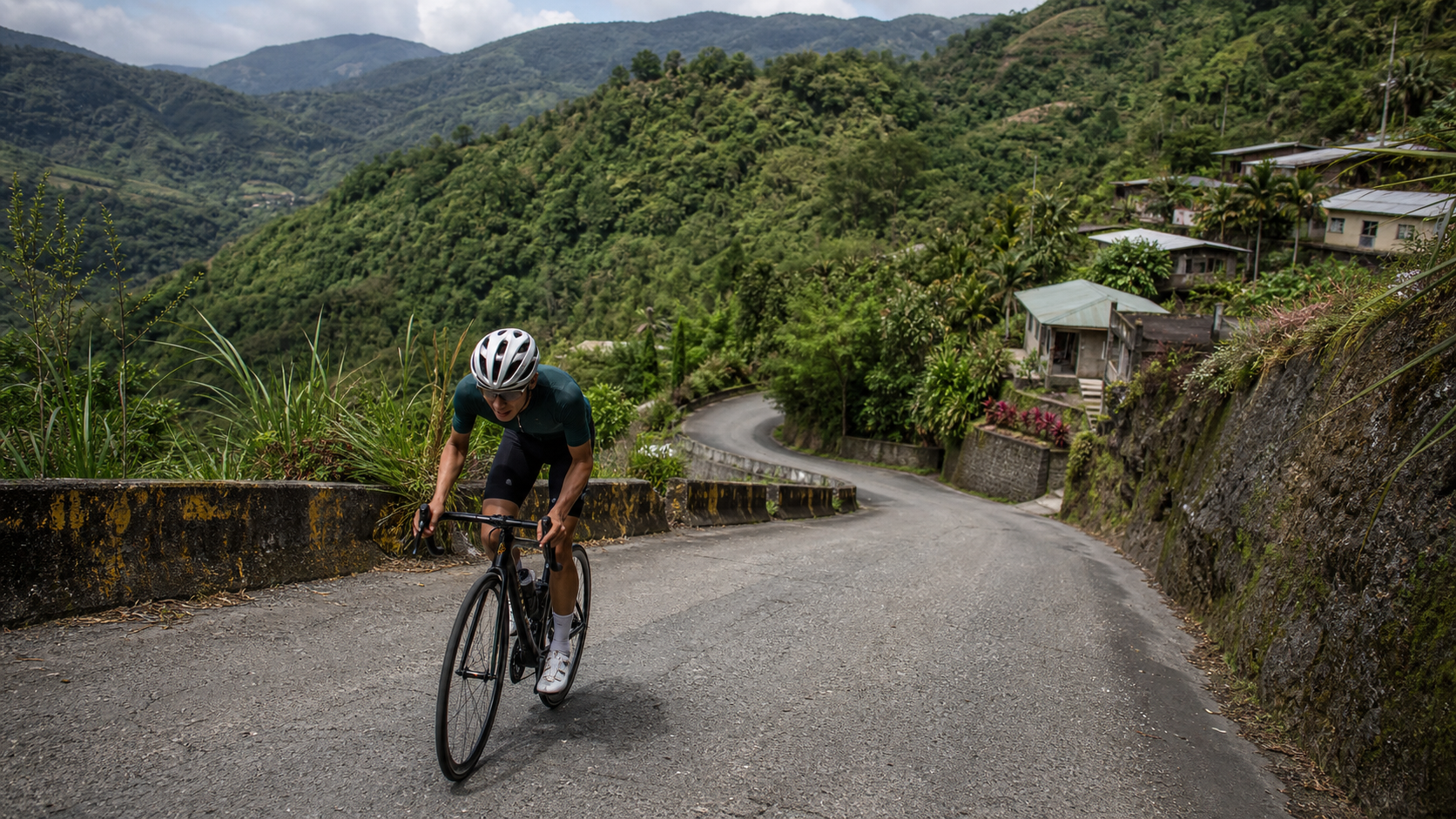
Route Overview and Real Data Analysis
Taiwu Back Gate is the route with the most intense gradient density among this batch of Pingtung mountain indigenous township routes. At just 5.18 km in total length, it accumulates 413.8 meters of elevation gain with an average gradient of 7.9%, classified as Category 3 on Strava. To understand this data in the most intuitive way: a distance of just over 5 kilometers with an average gradient of nearly 8% is already the threshold that Taiwan’s road cycling community recognizes as a “hard climb.” If there are sections with gentler gradients mixed in, it means the steepest parts are highly likely to hit 12% or even 15% and above—a solid, unrelenting hard climb that allows no room for distraction from start to finish.
Taiwu Township is one of three mountain indigenous townships in Pingtung County. Its population is predominantly Paiwan, accounting for approximately 94% of the total. The township administers six villages: Wan’an, Jiaping, Wutan, Pinghe, Taiwu, and Jiaxing, with the township seat located in Jiaping Village (which is also the starting point of another route in this series, Beidawu Jiaping). The terrain of Taiwu Township is often described as “rugged” and “with poor soil.” To some extent, these geological and topographical characteristics explain why the road system in this mountainous area commonly features steep gradients and dense, tight switchbacks.
The name “Back Gate” is likely a colloquial term used by the local cycling community or residents for this access road, rather than an official road designation. This phenomenon of naming roads in a colloquial manner is not uncommon in Taiwan’s mountain access road systems, and it typically reflects the road’s role as a “side entrance” or “rear passage” relative to the main connecting thoroughfare, based on its geographic location or functional purpose. Riders planning their trips are advised to rely on actual GPS tracks and on-site road conditions rather than getting overly hung up on the formality of the road name. The focus should be on how to safely and efficiently complete this solid climbing challenge.
Core Data Summary:
| Item | Value |
|---|---|
| Total Distance | 5.18 km |
| Total Elevation Gain | 413.8 m |
| Average Gradient | 7.9% (dense steep gradients throughout, with even steeper local sections) |
| Strava Category | Category 3 |
| Administrative Area | Taiwu Township, Pingtung County |
| Ethnic Composition | Paiwan people account for approximately 94% of the township’s population |
It is worth noting that during Typhoon Morakot in 2009, Taiwu Township recorded a staggering single-day rainfall of 1,145 mm—a figure that ranks among the most extreme rainfall events in Taiwan’s meteorological history. This historical background serves as a reminder to riders that this mountainous road system has weathered severe natural forces. When riding after heavy rain or during typhoon season, be sure to pay extra attention to the latest road condition announcements.
Segment-by-Segment Guide from Start to Finish
Stage 1 (0–1.5 km): A Tough Opening. Taiwu Back Gate offers almost no warm-up section; you’ll enter sustained, noticeable gradients shortly after setting off. Riders are advised to complete a thorough dynamic warm-up before departure. In the first few hundred meters after getting on the bike, confirm your condition at low-to-moderate intensity, then settle into a steady rhythm you can sustain, avoiding the mistake of going all-out at the start and running out of energy later.
Stage 2 (1.5–3.5 km): The Core Steep-Gradient Zone. Expect the steepest sections of the entire route here, with gradients potentially holding above 10% for extended periods, and some hairpin turns possibly spiking to 15–18%. A strategy of “steady seated output with intermittent standing to relieve pressure” is recommended, keeping cadence around 70 rpm to avoid excessive lactate buildup from grinding overly heavy gears. Also pay close attention to road conditions in this section—mountain access roads may have falling rocks, moss, or potholes, and be sure to slow down at corners.
Stage 3 (3.5–5.18 km): The Sustained Finish. As altitude rises, the gradient may ease slightly, but by this point your energy is largely depleted. This stage truly tests your willpower and breathing rhythm management. Use a fixed breathing cadence to stabilize core tension, and avoid sprinting excessively just because the finish is in sight, which could lead to cramping or heat exhaustion. After reaching the top, ride at an easy pace for a few minutes to let your heart rate gradually come down before heavy breathing or sitting down to rest.
Gearing and Equipment Recommendations
Facing a route with 413.8 meters of climbing in 5 kilometers, an average gradient of nearly 8%, and local sections possibly exceeding 15%, equipment setup must prioritize low gear ratios:
- Crankset: A compact crank (50/34T) is strongly recommended, or even a lighter mountain-oriented setup.
- Cassette: An 11-32T is the minimum recommendation; recreational riders with average fitness should go straight to 11-34T to ensure they can handle the dense steep sections within a short distance.
- Braking System: The descent on this route is equally steep, so disc brakes are strongly recommended to ensure braking stability and heat dissipation on long downhills.
- Tire Pressure and Width: Durable tires between 25C and 28C are recommended, with tire pressure adjusted slightly lower based on on-site road conditions to increase grip.
Nutrition and Hydration Strategy
At just 5.18 km, most riders will complete the route in roughly 20 to 40 minutes, so heavy nutrition isn’t theoretically necessary. However, given the dense gradients and concentrated intensity, your body will deplete water and electrolytes rapidly in a short time. Be sure to be fully hydrated before departure and carry at least 500 ml of water with you. If you’re incorporating this route into a larger multi-route itinerary, plan a comprehensive nutrition strategy based on the overall plan. Village shops in the Taiwu Township mountains are limited, so complete your main resupply in the lowlands before entering the mountain area.
Weather and Seasonal Recommendations
Afternoon convective cloud systems develop vigorously in the Taiwu Township mountains, with a high probability of summer thunderstorms. It’s recommended to tackle this route in the early morning hours. As mentioned earlier, Taiwu Township once recorded an extreme single-day rainfall of 1,145 mm, which reminds riders to avoid the area during typhoon season or heavy rain advisories. After rainfall, also confirm road conditions before setting out.
Common Mistakes and DNF Risks
Mistake 1: Underestimating the intensity of a short route. The surface-level figure of 5 kilometers can easily lull riders into complacency, overlooking the actual intensity represented by a nearly 8% average gradient.
Mistake 2: Insufficient gearing. A standard crankset paired with a typical cassette can easily force an average rider to dismount and walk on this kind of gradient density.
Mistake 3: Ignoring road conditions. The surface quality of access roads varies; falling rocks, moss, and potholes can all be overlooked while focused on climbing. Stay alert at all times.
High DNF-Risk Section: The core steep-gradient zone in Stage 2 (1.5–3.5 km) is the area where riders are most likely to choose to dismount and walk. First-time challengers are advised to prepare mentally in advance.
Target Time References for Different Rider Levels
| Rider Level | Estimated Completion Time | Recommended Preparation |
|---|---|---|
| Beginner / Occasional Rider | 30–45 min | Build up short-distance, high-intensity climbing experience first |
| Advanced Recreational Rider | 18–28 min | An FTP of 3 W/kg or above is recommended for greater comfort |
| Competitive / Club-Level Rider | 10–16 min | Suitable as an interval climbing training benchmark route |
| Professional / Semi-Professional | 7–10 min | Can serve as a short-distance explosive power test route |
Relationship with Other Routes in Taiwu Township
Taiwu Back Gate and Beidawu Jiaping are both located within Taiwu Township, and both routes have geographic ties to Jiaping Village, the township seat. If you plan to link the two routes into a combined challenge, it’s recommended to schedule Taiwu Back Gate—with its steeper gradients and shorter distance—in the earlier part of the itinerary while your energy is still abundant, while Beidawu Jiaping, with its higher total elevation gain and longer endurance demand, can be flexibly arranged based on overall itinerary and physical condition. Regardless of how you plan it, be sure to prepare a detailed route sheet and resupply plan in advance—the limited resupply resources in the Taiwu Township mountains remain the same regardless of route length.
Training Planning and Fitness Testing Recommendations
With its remarkable gradient density, Taiwu Back Gate serves as an excellent benchmark route for testing a rider’s short-distance explosive power and gradient tolerance. It’s recommended to include it in your regular training checklist and re-challenge it periodically to track the progress of your climbing ability. For training planning, incorporate repeated climbing interval sessions—find slopes near your home with gradients of 7–10% and lengths of 500 meters to 1.5 kilometers for simulation, gradually building your body’s tolerance for this kind of high-intensity short-duration output before formally taking on the actual conditions of Taiwu Back Gate.
Conclusion: Immense Power in a Compact Form
Taiwu Back Gate condenses one of the most densely graded challenge sections among these Pingtung mountain indigenous routes, with 5.18 kilometers of distance and 413.8 meters of climbing. Whether you are a competitive rider chasing personal records, or a cultural enthusiast hoping to gain deeper insight into the Paiwan tribal culture of Taiwu Township and the historical context of Typhoon Morakot, this route delivers a solid riding experience. With proper attention to the gear ratio configuration, segment strategies, and nutrition planning mentioned in this article, Taiwu Back Gate will prove to be a short yet uncompromisingly tough test on your Pingtung mountain indigenous route challenge list.
In-Depth Analysis: Why Average Gradient Figures Can Easily Mislead
Many riders habitually use “average gradient” as the sole criterion for judging difficulty when planning mountain routes, but this approach can actually lead to miscalculation on short, high-density routes like Taiwu Back Gate. Taking this route’s 7.9% average gradient as an example: if the gradient distribution were relatively uniform throughout, 7.9% would fall into the moderately hard range—still within the sustainable output zone for most experienced riders. However, if the gradient distribution is uneven—for instance, gentler at the start, extremely steep in the middle, then tapering off again—the actual gradient of the middle section may far exceed the average, reaching 12% or even higher.
This “average value trap” is quite common on many mountain industrial roads across Taiwan, primarily because these roads are typically built following the natural contours of the terrain rather than being deliberately designed with uniform gradients. As a result, localized sections far exceeding the average gradient are not uncommon. When planning equipment and mental preparation, riders are advised to use more conservative and stringent assumptions (for example, assuming the steepest sections reach 15% or above) rather than relying solely on average gradient figures and underestimating the actual challenge.
The Scientific Basis for Gear Ratio Selection
Why is a low gear ratio configuration particularly emphasized for short, high-intensity routes like this? From a sports physiology perspective, when gradients exceed 10% or approach 15%, insufficient gear ratios force riders to maintain pedaling with excessively heavy gears and overly low cadence. This pedaling pattern subjects muscles to greater instantaneous tension, rapidly depleting phosphocreatine and glycogen stores in the muscles, and more readily causes excessive fatigue or even cramping in localized muscle groups—particularly the quadriceps and calf muscles.
Conversely, with an appropriate gear ratio configuration, riders can maintain a relatively higher cadence (for example, 70 to 85 rpm) even on steep gradients. Through more frequent yet comparatively easier pedal strokes, tension per stroke is distributed, while the cardiorespiratory system can continue supplying energy in a manner closer to aerobic metabolism, delaying the premature onset of the anaerobic threshold. This is why this article recommends a compact crankset paired with a wide-range cassette—even though it may appear to be “very light gearing,” it is in fact the most efficient configuration strategy for tackling these short, high-density steep climbs.
Taiwu Township’s Ethnic Population Structure and Cultural Context
With 94% of its population being Paiwan, Taiwu Township is an administrative district with relatively high ethnic homogeneity among all mountain indigenous townships in Pingtung County. This highly concentrated ethnic population structure, to some extent, means that the tribal lifestyle, cultural traditions, and even everyday language use within Taiwu Township retain relatively complete and profound Paiwan traditional elements. As the township seat, Jiaping Village also serves as the starting point for another route in this series, North Dawu–Jiaping. This dual significance—administrative and cultural—positions Taiwu Township as holding considerable importance within the broader cultural landscape of Pingtung’s mountain indigenous regions.
When riders traverse the industrial roads within Taiwu Township, brief exchanges with local residents or paying attention to indigenous language place-name signs along the way are valuable opportunities to gain deeper understanding of the cultural context of this land. At the same time, it is essential to remember that any form of cultural observation and exchange should be built on a foundation of respect and humility, avoiding a voyeuristic or superficial mindset toward this land and its people, who carry profound cultural heritage.
Typhoon Morakot’s Rainfall Record and Its Significance
What exactly does the 1,145-millimeter single-day rainfall record set in Taiwu Township during Typhoon Morakot represent in terms of extremity? For comparison, the average annual rainfall in many Taiwanese cities falls between approximately 1,500 and 2,500 millimeters. The rainfall from this typhoon in Taiwu Township meant that in a single day, the area received precipitation equivalent to half a year or more of accumulated rainfall in an average city. The impact of such extreme rainfall events on mountain geological structures and road systems is often structural and long-term—slope sliding, roadbed loss, and slope collapse are all common disaster patterns following such extreme precipitation.
Understanding this history has practical reference value for riders planning their trips—even industrial roads that have been passable for years and appear stable may still face the risk of sudden road condition changes in an era of increasingly frequent extreme climate events. This is why this article repeatedly emphasizes that before heading to such mountain routes, riders must first confirm the latest road conditions and weather forecasts, and should not set out rashly based solely on past experience or existing impressions.
Practical Advice for First-Time Challengers
If this is your first time challenging Taiwu Back Gate, it is recommended to complete the following preparations in advance: First, confirm in advance whether your physical condition can handle short-duration, high-intensity output; if recent training volume is insufficient, it is advisable to first accumulate experience on routes with gentler gradients. Second, ensure your gear ratio configuration can handle localized sections exceeding 15%; before departure, test the feel of your lowest gear ratio on flat ground. Third, carry sufficient water and basic repair tools—mountain areas have limited resupply and rescue resources, and self-preparedness is always the first line of defense for safe riding. Fourth, inform family and friends of your complete itinerary, especially if challenging solo; timely external support mechanisms are particularly important.
Finally, and most importantly: do not equate “finishing” with “never putting a foot down.” On a route with extremely high gradient density like Taiwu Back Gate, even experienced riders occasionally choosing to walk a short section of the steepest stretch is entirely reasonable and worthy of respect. Safety and riding within one’s limits are always the core principles of mountain cycling, more important than any personal record.
Safety Reminders for Descending Sections
When planning mountain routes, many riders tend to focus on climbing strategy while overlooking that descending sections also require careful risk management. On a route like Taiwu Back Gate, where gradients are dense and corners may be equally frequent, improper speed control on descents—combined with limited visibility through corners and variable road surface conditions—carries a crash risk no less than accidents caused by physical exhaustion during climbs.
It is recommended to use an “intermittent braking” approach on descents, avoiding prolonged continuous braking that can cause brake system overheating and reduced stopping power. Be sure to slow down well before entering corners rather than braking urgently within the corner, which can easily cause tire slippage or loss of traction. Additionally, mountain industrial roads are typically single-lane, two-way roads with limited passing space; maintain appropriate speed on descents and always reserve sufficient margin for reaction and braking. Especially on consecutive blind corners, always assume a vehicle may be approaching from the opposite direction.
Practical Application of Heart Rate and Power Data
For riders equipped with heart rate monitors or power meters, a short, high-intensity route like Taiwu Back Gate is an ideal venue for power and heart rate data analysis. It is recommended to confirm your functional threshold power (FTP) and maximum heart rate zones before the challenge. During the ride, dynamically adjust output intensity based on real-time heart rate or power data, avoiding excessive sprinting in the early stages of the climb that leads to a “blow-up”—a significant drop in power or heart rate in the latter stages.
Generally speaking, for a short climbing challenge that can be completed in around five minutes, it is recommended to target an average power output slightly above FTP (for example, 105% to 115% of FTP). For first-time challengers or those still building fitness, a target zone of 90% to 100% of FTP is advised, avoiding sacrificing riding safety and completion quality in pursuit of excessive speed. After completing the challenge, it is recommended to review the entire ride’s power curve and heart rate data through training software as an important reference for subsequent training adjustments.
Common Characteristics of Short, Steep Climbing Routes in Pingtung’s Mountain Indigenous Regions
Comparing Taiwu Back Gate with Dewen Mountain, also introduced in this series, reveals similar characteristics in gradient density—both are short, hard climbing routes of approximately 5 kilometers that concentrate considerable elevation gain. This route type, to some extent, reflects that Pingtung’s mountain indigenous regions are generally situated on the rugged southern remnants of the Central Mountain Range, where access roads must overcome substantial elevation differences within limited distances to connect mountain tribes with lowland settlements.
For riders seeking to systematically challenge the routes of Pingtung’s mountain indigenous regions, understanding this “short-distance, high-density” terrain characteristic helps in making more accurate difficulty assessments and equipment preparations when planning training and trips, rather than judging a route’s challenge level solely by distance.
Vehicle Maintenance and Long-Term Usage Recommendations
If you plan to incorporate high-intensity climbing routes like Taiwu Back Gate into a long-term, fixed training regimen, the frequency of regular vehicle maintenance should also be increased accordingly. High-intensity climbing causes faster wear on shifting cables, braking systems, chains, and cassettes compared to typical flat-road cruising. It is recommended to check chain stretch and brake pad wear after every few high-intensity climbing challenges, to avoid accidents on critical sections due to mechanical aging. At the same time, it is also recommended to regularly lubricate the drivetrain to ensure precise shifting accuracy, which is especially important on routes that require frequent gear changes to respond to gradient variations.
Closing Remarks: Continued Exploration of This Route
As a relatively low-profile route lacking detailed official documentation, Taiwu Back Gate, to a certain extent, retains more space for riders to personally explore and experience. The guide and recommendations provided in this article are reasonable estimates based on existing data and the general characteristics of climbing routes in Taiwan’s mountainous regions. Actual riding experiences may still vary due to season, weather, and road maintenance conditions. It is recommended that every rider who takes on this route maintain an open and observant attitude, accumulating their actual riding insights and discoveries as an important reference for continuously refining this guide in the future.
Related Reading
- A Back Gate to Taiwu Township: Reading Resilience and Life Wisdom on Rugged Land
- Beidawu Jiaping Climb Full Guide: Pingtung’s Hardcore Challenge—12.9 km with 1,300 m of Elevation Gain
- Beidawu Gate Practical Guide: Pingtung’s 10.56K, 677m Climb—Southern Taiwan’s Tough-Guy Slope, Full Data Breakdown
- Dewen Mountain Climb Guide: Sandimen Township’s Hardcore Route—5 km Packing 652 m of Elevation Gain
大武山後門26%歡樂陡坡!JJSC南台灣單車行Day2 / 被颱風追著跑 / 公路車 / CT Yeh
2 年前
大武山20%魔王陡坡【JJSC南台灣遊騎Day2】!屁股真的要裂開了...凡士林抹滿也沒用?神秘金教堂還有超便宜夜市
3 個月前
台北闊瀨陡坡 騎旅 / 日本單車雜誌編輯車友臨時加入!/ 髮香才是最強的 / feat. 北迴歸線小隊 / 公路車 CT Yeh
6 個月前
單車 梅山36灣 坡度介紹 路段介紹 空拍 (相關遊記影片,請參考說明或我的頻道喔,歡迎訂閱)
6 年前
那瑪夏x茶山 阿里山系深山單車行 Day2 累積爬升6000M | 🥶超陡連續下坡 整路看隊友刷 | 爬升一座西進武嶺 | JJSC | 公路車 | CT Yeh
3 年前
半日 小台灣 極限單車路線挑戰實錄
7 年前
大禹嶺 到 武嶺牌樓 全程前後實況錄影 | 北進武嶺 | 東進武嶺 | KOM | 訓練台 | 坡度分析 | Taiwan KOM Last 10 km HARD | 公路車
6 年前
藤枝二集團 單車行 Day1 | 南部小武嶺 | 爬坡爬到罵罵叫 | JJSC | 公路車 | CT Yeh
3 年前