Trackside Know-How: The Complete Guide to Spectating a Triathlon
“My husband is doing a triathlon this weekend, and I want to go cheer him on, but… I have no idea how to watch this kind of race.” This is one of the most common questions in Taiwan’s triathlon community. Unlike baseball or basketball, you can’t just sit in one spot and watch the whole thing unfold. A triathlon spans three sports and lasts anywhere from a few hours to over ten hours, with a course that can stretch tens or even hundreds of kilometers. Without planning ahead, you could easily spend the whole day running around the venue and never once catch a glimpse of the athlete you came to support.
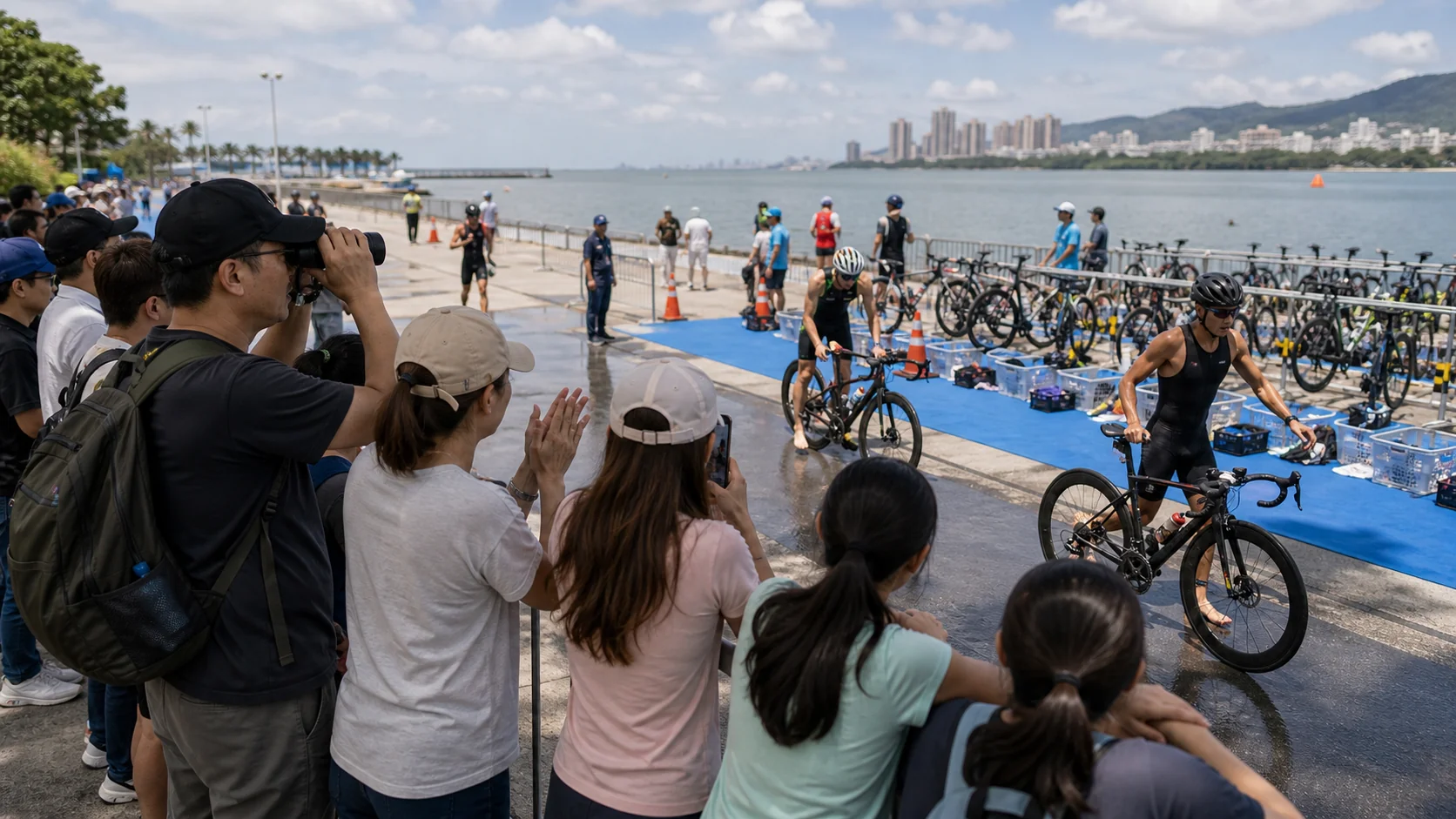
This guide will help you become the most well-prepared triathlon spectator possible — whether you’re supporting family, friends, or simply soaking up the race-day atmosphere, you’ll get the best possible experience.
Homework Before Race Day
Understand the Race Distance and Estimated Time
First, you need to know what distance the race you’re watching covers, and roughly how long the athlete you’re following will take to finish.
| Race Type | Swim | Bike | Run | Typical Age-Group Finish Time |
|---|---|---|---|---|
| Sprint | 750m | 20km | 5km | 1-2 hours |
| Olympic | 1.5km | 40km | 10km | 2-4 hours |
| 70.3 (Half Iron) | 1.9km | 90km | 21.1km | 4.5-8 hours |
| Ironman (Full) | 3.8km | 180km | 42.195km | 9-17 hours |
Study the Course Map
Before the race, download or print the course map. Mark the following key locations:
- The swim start and exit points
- The transition areas (T1 and T2)
- Bike and run sections that are easy for you to reach as a spectator
- The finish line location
- Parking and traffic-control zones
Ways to Track Your Athlete
Most official triathlon events offer a live tracking system. A timing chip on the athlete’s ankle records their time at each checkpoint, letting you check their position and estimated arrival time in real time via an app or website.
Common tracking methods:
- Ironman Tracker App: Works for all Ironman-branded events
- Official event apps: Such as the Challenge Family App
- Live results webpages: Most events provide these on the official race site
- Facebook event livestreams: Some events broadcast live video coverage
Planning Your Spectating Route
The Best Strategy: Three Points, Three Windows
Based on the advice of experienced triathlon spectators, the most effective strategy is to pick three key locations and position yourself there ahead of your athlete’s estimated arrival time.
Location One: Swim Exit / T1 Transition (20-90 minutes after race start)
The moment an athlete emerges from the water is one of the most dramatic in the race. They stagger out of the water, legs wobbly, and make their way toward transition. Standing along the route from the swim exit to T1 lets you see the athlete’s condition right after the swim — and lets them hear you cheering.
Location Two: Mid-Run or the Turnaround Point (depending on race distance)
The run leg is where athletes need spectator support the most. After the toll of the swim and the bike, every step of the run is a grind. If the run course has a turnaround point, that’s the ideal spot to watch from — you’ll see the athlete twice, and the turnaround is often where they’re at their most mentally vulnerable.
Location Three: The Finish Line (mid-to-late race through the finish)
There’s no question about it — the finish line is where you need to be. However you plan your route, make sure you’re at the finish line before your athlete’s estimated finish time.
Sample Spectating Timeline by Race Distance
Take a 70.3 (half-iron) race as an example, assuming your athlete’s estimated finish time is 6 hours:
| Time | Location | Action |
|---|---|---|
| 06:30 | Swim start | Watch the start |
| 07:10 | T1 transition | Watch the swim-to-bike change |
| 07:20-10:30 | Free time | Grab breakfast, browse the athlete village |
| 10:30 | T2 transition | Watch the bike-to-run change |
| 11:00 | Run turnaround point | Cheer |
| 12:00 | Finish line | Welcome them across the finish |
The Art of Cheering
Effective Ways to Cheer
Call out their name: If you know the athlete’s name, shout it loudly. Hearing your own name amid a sea of unfamiliar cheers has a surprisingly powerful effect. Many athletes write their names on their race kit, so even strangers in the crowd can cheer them on by name.
Specific encouragement: “Your running form looks great!” “Your pace looks so steady!” “Just three more kilometers!” Specific encouragement makes an athlete feel truly seen, far more than a generic “go, go, go!”
A sense of humor: “You’re running faster than I drive!” “Pain is temporary, Ironman is forever!” A well-timed joke can bring a smile to an athlete’s face even in the depths of suffering.
Music and props: Homemade signs, drums and cymbals, upbeat music — all of these add energy and excitement to the course atmosphere.
Things to Avoid When Cheering
- Don’t say “almost there” if they actually have a long way to go — this creates a psychological letdown that can crush morale instead of boosting it
- Don’t comment on poor performance — “Why are you so slow?” is one of the most hurtful things you can say
- Don’t block the course — spectators crossing the course line is one of the most dangerous things that can happen, especially on the bike leg
- Don’t hand out random food or drinks — athletes follow their own nutrition plan, and unfamiliar food can cause stomach issues
- Don’t shout “go, this is the last lap!” to strangers — unless you’re certain it really is their last lap
Spectator Gear Checklist
A full day of spectating requires solid preparation:
Essentials:
- Sun protection (hat, sunscreen, sunglasses)
- Plenty of water and food
- Fully charged phone and a portable battery
- A course map (paper or digital)
- A lightweight folding chair (for long waits)
- Cash and small bills (some venues may not accept electronic payment)
Cheering props:
- Homemade signs (big letters, bright colors work best)
- A whistle or cheer sticks
- A small Bluetooth speaker (for music)
For the athlete:
- A clean towel
- A change of clothes
- Their favorite post-race food
- A warm jacket (body temperature can drop later in the race)
Watching with Kids
If you’re bringing children along to spectate, here are a few tips:
- Start with shorter races: A sprint triathlon takes only 1-2 hours, making it the best choice for watching with kids
- Let kids join in the cheering: Let them hold up the sign or blow the whistle — it helps them feel like an important part of the team
- Plan for breaks and entertainment: Athlete villages usually have booths and activities to keep kids from getting bored during the wait
- A teachable moment: A triathlon is a great opportunity to teach kids about persistence, willpower, and sportsmanship
Warm Gestures After the Race
Once the race is over, here are some things you can do to make the athlete feel truly appreciated:
- Don’t rush to ask about their time or ranking — start with “Congratulations, you did it!”
- Have their favorite post-race food ready — that first meal after finishing might be the thing they’ve looked forward to all day
- Share the photos and videos you took — trackside photos are a keepsake more precious than any medal
- Listen to their race stories — even if you don’t quite understand what “negative power split” or “heart rate drift” means, listening attentively is the best support you can offer
- Help them stretch and give them a massage — tired muscles need gentle care
A triathlon isn’t just about the athlete out there alone. Every spectator cheering trackside, every homemade sign, every heartfelt shout of “you’ve got this” is an indispensable part of the race. Once you learn how to be a great spectator, you become another kind of iron athlete on the course.
Related Reading
- Heroes on the Other Side of the Course: The Moving Experience of Triathlon Volunteers
- The Complete Beginner’s Guide to Triathlon: A Training Plan From Zero
- Triathlon Gear Checklist for Beginners: A Complete Guide From Scratch
- The Complete Guide to the Triathlon Bike Leg: From Road Cyclist to Triathlete
Live) 備戰2019彰化經典百K 賽前攻略 (已完賽請看新影片
7 年前
福隆鐵人團練隨拍
8 年前
CT 喇低賽) 武嶺牽車 才是王道 西進牽車四小時內秘訣 攝手位置 如何判斷 防抽筋小秘訣
7 年前
一日北高/長距離團騎 常見問題補充篇 / 組團或跟團的眉角 / 壯車友容易被瘦車友慢性拉爆 / 原來屁股痛可能是這個原因...? / 風場配速法 / 公路車 / CT Yeh
2 年前
2019 夏季KOM 5小 完賽心得 準備攻略 東進武嶺 夏季登山王之路 Taiwan KOM Challenge
7 年前
2023桃園團體繞圈賽 / 海鷗繞圈賽 | 全程空拍數據版 | 公路車 | CT Yeh
2 年前
[防寒衣體驗] 鐵人魂 三鐵 防寒衣試穿會 於松運 深水游泳池 鯨魚池
8 年前
一日北高常見問題大集合 | 攻略 | 路線 | 訓練 | 補給 | 自行車 單車 | 一日雙城 | 雙塔 | TWB北高360 | 屁股痛
6 年前