Yoga and Cycling: Improving Riding Posture and Preventing Injuries with Flexibility Training
When riding a bicycle for extended periods, the body maintains a forward-leaning posture for a long time: hips flexed, spine curved, shoulders rolled forward. Although this fixed position meets aerodynamic demands, it is also a major cause of chronic pain for many cyclists. Yoga offers a highly complementary training method that comprehensively addresses the physical imbalances caused by riding through stretching, strengthening, and breathing exercises.
Common Physical Issues for Cyclists
Before discussing yoga poses, let’s first understand the typical effects of the riding posture on the body:
Tight Hip Flexors
The iliopsoas is the primary hip flexor, continuously contracting while riding. A chronically tight iliopsoas pulls the lumbar spine into an anterior tilt, causing lower back pain, and also limits the full extension angle during the pedal stroke, reducing power output.
Stiff Thoracic Spine
The forward-leaning riding posture causes the thoracic spine (upper back) to habitually curve, leading to decreased thoracic mobility over time. This not only affects the ability to adjust riding posture but also causes compensation in the shoulders and neck, triggering pain.
Tight Hamstrings
The pedaling motion primarily engages the quadriceps, while the hamstrings (back of the thighs) act as stabilizers and tend to become tight due to imbalanced usage, affecting the fluidity of the pedaling motion.
Shoulder and Neck Fatigue
With the hands supporting body weight and the head lifting against gravity, the shoulder and neck muscles remain in a state of isometric contraction for long periods, making this one of the most common sources of fatigue after riding.
Yoga Sequence for Cyclists
The following sequence is recommended to be performed after riding or in the evening on training days. Hold each pose for 30–60 seconds, with the entire sequence taking about 20–30 minutes.
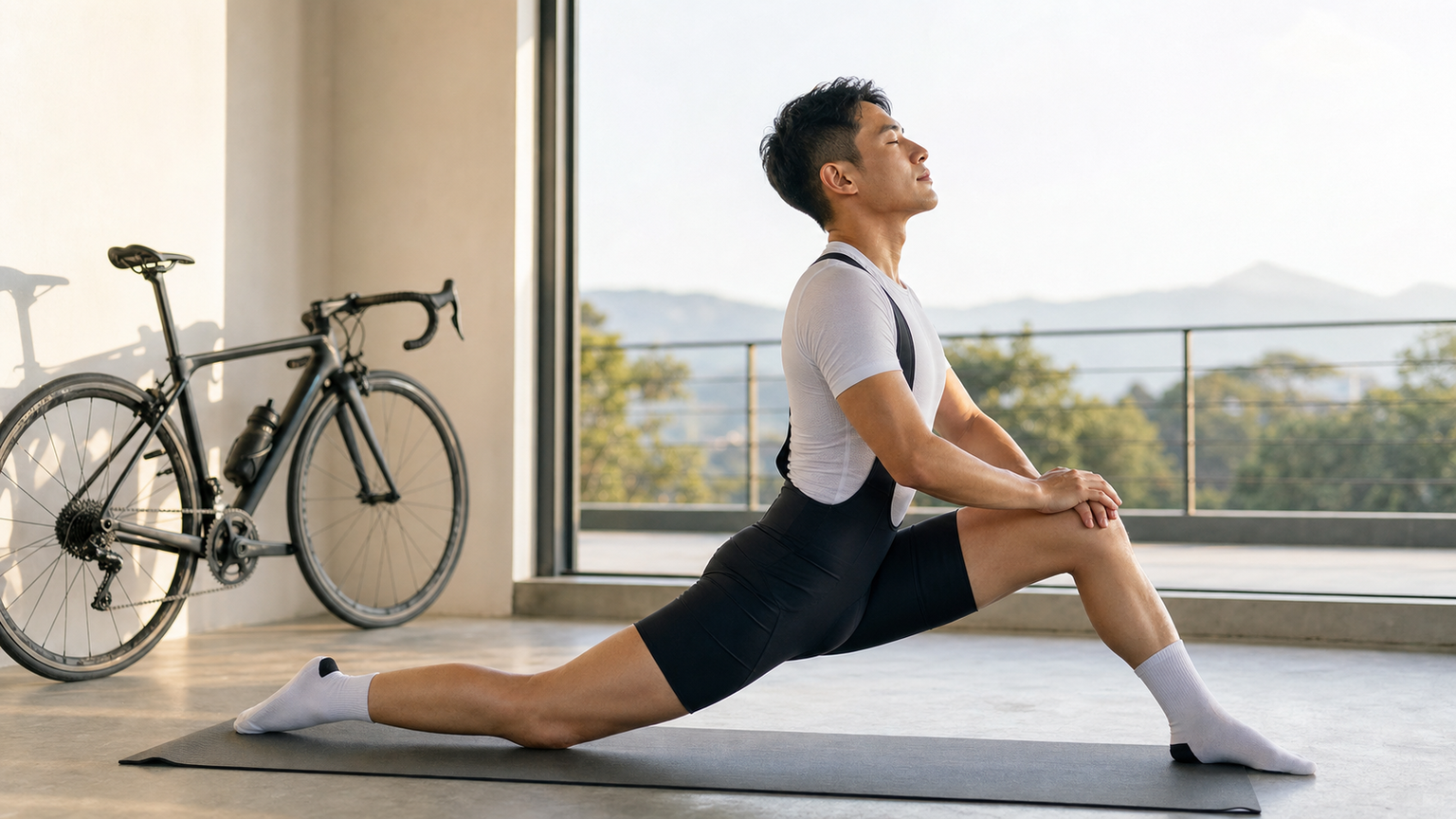
1. Low Lunge (Anjaneyasana)
Target Muscles: Hip flexors, front of the quadriceps
Starting from a standing position, step the right foot forward, bend the right knee to 90 degrees, and lower the left knee to the ground. Place both hands on the right knee or raise them overhead, feeling the stretch in the left hip flexor. This is one of the most effective poses for releasing tension in the iliopsoas.
2. Pigeon Pose
Target Muscles: Gluteus maximus, piriformis, hip external rotators
Starting from a tabletop position, bring the right knee forward to the outside of the right wrist, with the right ankle near the left wrist. Fold the body forward, feeling a deep stretch in the right gluteal area. After long rides, the hip external rotators are often tighter than expected.
3. Child’s Pose
Target Muscles: Lower back, spinal extension, shoulders
Kneel with both knees on the ground, sit the hips back toward the heels, and extend the arms forward while lowering the body down. This pose opposes the forward-leaning direction of riding, effectively releasing spinal pressure and allowing space to return to the intervertebral discs.
4. Cat-Cow
Target Muscles: Spinal mobility, core control
From a tabletop position, alternate between spinal flexion (Cat) and extension (Cow) in coordination with the breath. This is the most gentle and effective way to awaken thoracic mobility, and is recommended as a warm-up before morning rides.
5. Cobra Pose
Target Muscles: Thoracic extension, abdominal stretch, front of the shoulders
Lie face down with the hands placed beside the chest, lifting the upper body using the back muscles (not arm pushing force). This pose directly counteracts the curved posture of riding and is a core movement for improving thoracic stiffness.
6. Thread-the-Needle
Target Muscles: Thoracic rotation, outer shoulders
From a tabletop position, thread the right arm under the left arm, lowering the right shoulder to the ground, feeling a rotational stretch in the upper back. Since the spine undergoes almost no rotation while cycling, this stretch helps restore rotational mobility to the thoracic spine.
7. Seated Forward Fold (Paschimottanasana)
Target Muscles: Hamstrings, calves, lower back
Sit on the mat with both legs extended, folding the body forward. Avoid rounding the back; the focus is on hinging from the hip joints, feeling the stretch along the back of the thighs.
8. Supine Twist
Target Muscles: Spinal rotation, hips, lower back
Lie on the back, bend the right knee and twist it to the left side, extending the right arm to the right. Gentle spinal rotation relaxes the paraspinal muscles that are tight after riding, and also helps improve digestion and nervous system relaxation.
Additional Benefits of Breathing Training
Yoga is not just about stretching; breath control (Pranayama) is equally beneficial for cyclists:
- Diaphragmatic breathing: Increases diaphragm mobility, improving the efficiency of lung capacity utilization with each breath.
- Nasal breathing practice: Trains nasal breathing at low to moderate intensity, improving oxygen absorption efficiency and reducing respiratory muscle fatigue.
- 4-7-8 breathing technique: Calms the nervous system after races, accelerating recovery.
Recommended Training Frequency
| Training Day | Recommended Yoga Type | Duration |
|---|---|---|
| After high-intensity rides | Restorative stretching sequence | 20–30 minutes |
| Rest days | Full yoga session | 45–60 minutes |
| Before long-distance rides | Dynamic warm-up (Cat-Cow, Low Lunge) | 10–15 minutes |
Conclusion
Yoga and cycling may seem to belong to completely different worlds, but they are perfectly complementary on a physical level. Cyclists who regularly practice yoga typically experience better riding comfort, smoother pedaling motion, and a lower rate of chronic injuries. Investing 30–60 minutes per week in yoga practice is one of the most cost-effective investments for improving overall riding quality.
Related Reading
- Flexibility Training for Cyclists: How Yoga Improves Riding Posture
- Flexibility Training for Cyclists: How Yoga and Stretching Enhance Riding Performance
- Stretching and Flexibility Training for Cyclists: Key Movements for Injury Prevention
- Shoulder Pain in Cyclists: Muscle Strengthening Strategies for Prolonged Weight Support
一日北高/長距離團騎 常見問題補充篇 / 組團或跟團的眉角 / 壯車友容易被瘦車友慢性拉爆 / 原來屁股痛可能是這個原因...? / 風場配速法 / 公路車 / CT Yeh
2 年前
一日北高常見問題大集合 | 攻略 | 路線 | 訓練 | 補給 | 自行車 單車 | 一日雙城 | 雙塔 | TWB北高360 | 屁股痛
6 年前
靠單車減肥35公斤 心得分享與整理
7 年前
#公路車 #Fitting 靠人工智慧APP 幫你調整單車
6 年前
[教學] Premiere 影片 手震 修正 教學 防抖 單眼 影像 GoPro 穩定 Video Stabilization
8 年前
訓練台體驗) 2019台北自行車展 三大家 訓練台體驗 Tacx Neo Flux 2 Xepdo Apx Wahoo Kickr
7 年前
CT 喇低賽) 單車 比賽總是沒照片? 攝影師的觀點大公開 姿勢就是力量! 請加速1.25倍收看
7 年前
Insta 360 One 超級防手震技術實測
7 年前