The Specific Impact of Core Training on Pedaling Efficiency: Scientific Research and Practical Exercises
The Specific Impact of Core Training on Pedaling Efficiency: Scientific Research and Practical Exercises
In discussions about cycling training, “strengthening the core” is a piece of advice that is frequently mentioned yet rarely explained in depth. How exactly does the core affect pedaling efficiency? What does scientific research tell us? Which exercises are most worth practicing? This article will systematically answer these questions.
Defining the Core Musculature: More Than Just Abs
The “core” is often misunderstood as being only the rectus abdominis (six-pack muscles). In reality, the core is a cylindrical structure composed of multiple layers of muscles:
- Anterior: Rectus abdominis, external obliques, internal obliques
- Deep layer: Transversus abdominis (innermost layer, most critical for spinal stability)
- Posterior: Erector spinae, multifidus, gluteal muscles
- Top and bottom caps: Diaphragm (top), pelvic floor muscles (bottom)
This “core cylinder” absorbs forces from the lower limbs with every pedal stroke and stabilizes the spine to prevent unnecessary rocking.
Findings from Scientific Research
Study One: Core Fatigue and Power Output
A study published in 2014 in the Journal of Strength and Conditioning Research had subjects ride a bike while in a state of core fatigue (after exhausting core strength through specific core exercises). The results found:
- Power output decreased by 5–8%
- Pedaling efficiency declined (increased proportion of ineffective upward pulling)
- Increased knee valgus angle, raising the risk of improper joint loading
Study Two: Core Stability and Cycling Economy
A 2017 study compared amateur cyclists with high versus low core stability. At the same power output, subjects with higher core stability:
- Had approximately 3–5% lower oxygen consumption (rode at the same speed with less effort)
- Showed significantly less lateral pelvic sway
- Maintained power output better in the latter half of long-distance rides
Study Three: Core Training Intervention Research
An 8-week core training intervention for triathletes, adding three 30-minute core sessions per week, resulted in:
- An average 2.1% improvement in 40 km cycling time trial performance
- Even more pronounced improvements in running efficiency after the transition (bike-to-run)
Together, these data point to one conclusion: core strength is an independent determining factor in cycling performance.
The Specific Demands of Core Training for Cyclists
Core training for cyclists differs from general fitness core training. The key focus areas are:
- Anti-rotation stability: Every pedal stroke generates rotational torque, and the core must resist this rotation to allow force to be transmitted effectively.
- Isometric endurance: During riding, the core does not perform large-range movements but rather maintains a stable posture for extended periods, requiring training of muscular isometric endurance.
- Maintaining stability while breathing: During high-intensity riding, breathing becomes rapid, and the core must maintain spinal stability while breathing—an ability many people overlook.
Practical Core Training Exercises
Foundational Isometric Training
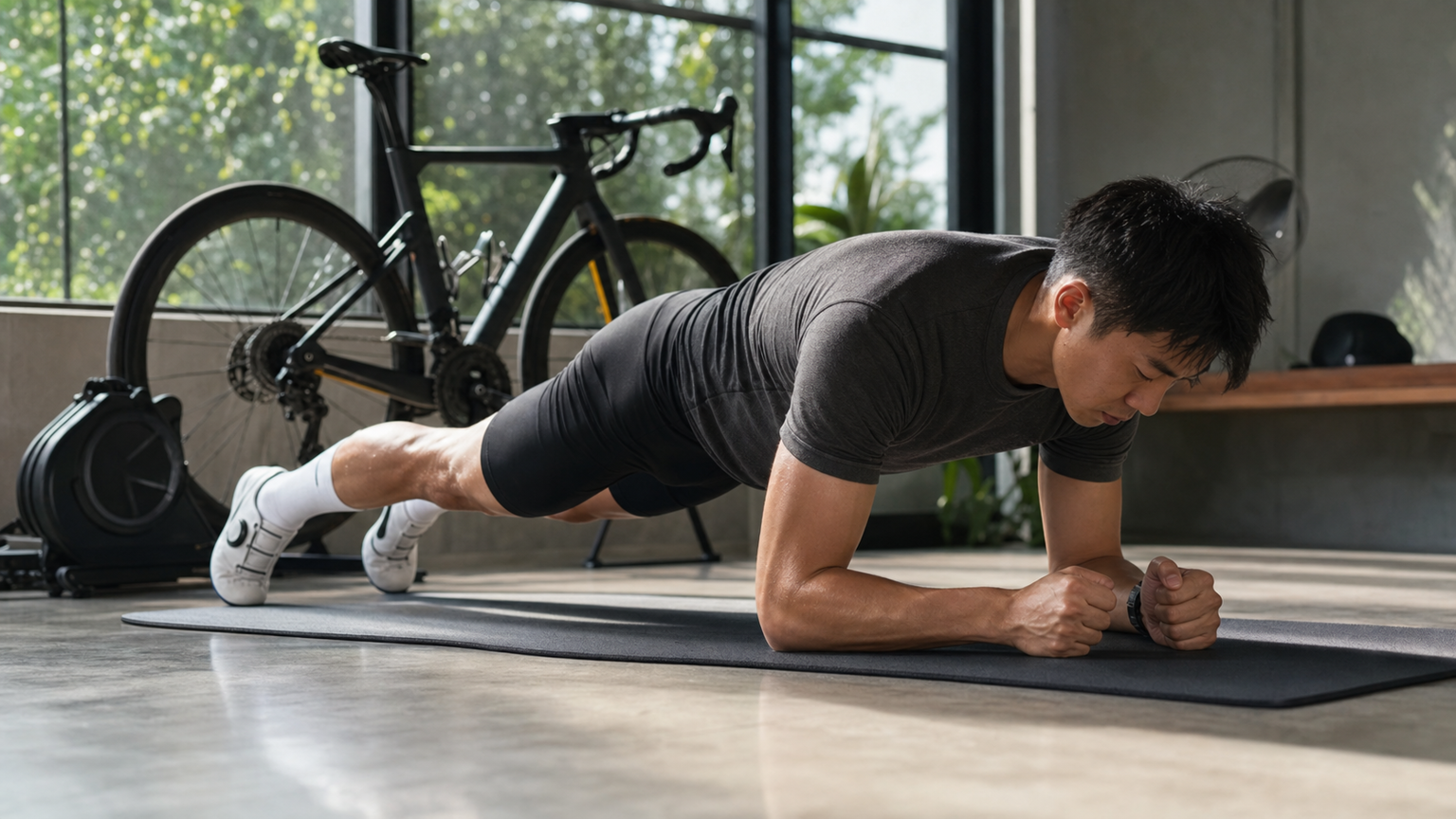
1. Advanced Plank
- Basic version: Hold for 60–90 seconds, ensuring the hips do not sag or pike up
- Advanced version: Alternating leg lifts (hold each leg lift for 3 seconds, keeping the pelvis from rotating)
- Highest version: Plank with alternating opposite arm and leg extensions (Dead Bug Plank)
2. Side Plank
- Hold for 45–60 seconds per side
- Key points: Do not let the pelvis sag; maintain a straight line from head to feet
- Advanced: Move the bottom leg forward and backward
Anti-Rotation Training
3. Pallof Press
Using a resistance band or cable machine, anchor the resistance to the side of the body, press both hands forward, then bring them back. This is the most direct exercise for training anti-rotation ability and closely mimics the demands of pedaling.
4. Bird Dog
Starting on all fours, extend the opposite arm and leg simultaneously, hold for 3–5 seconds, then return to the starting position. The key point is that the pelvis must not rotate at all—this is harder than it sounds.
Dynamic Functional Training
5. Dead Bug
Lie on your back with arms extended upward and legs raised with knees bent at 90 degrees. Lower the right arm backward and extend the left leg forward while keeping the lower back pressed into the floor, then switch sides. This exercise trains limb movement while the torso remains fixed, highly relevant to the cycling movement pattern.
6. Farmer’s Walk
Walk while carrying weight in one hand or both hands to train core stability under asymmetrical loading. Choose a weight approximately 25–30% of your body weight and walk 20–30 meters per set.
7. Turkish Get-Up
Using a light kettlebell (4–8 kg for women, 8–16 kg for men), slowly rise from a supine position to standing, then lower back down. This movement integrates nearly all core muscles while also training shoulder stability, making it one of the most functional core exercises.
Training Program Recommendations
Weekly frequency: 2–3 times, 15–20 minutes per session
Sample combination (choose 4 exercises per session):
| Exercise | Sets | Time/Reps |
|---|---|---|
| Dead Bug | 3 sets | 10 reps/side |
| Bird Dog | 3 sets | 10 reps/side |
| Pallof Press | 3 sets | 10 reps/side |
| Side Plank | 2 sets | 45 seconds/side |
Training Timing
- Avoid scheduling core training at the end of high-intensity riding days (core fatigue affects safety)
- The best time is after training on light riding days, or as a standalone session on rest days
- Avoid high-intensity core training within 48 hours before a race
Conclusion
Core training is not an optional supplementary exercise but a scientific pathway to improving cycling performance. From scientific research to practical application, a strong core means more efficient force transfer, a lower risk of injury, and the ability to maintain efficiency in the latter half of long distances. By investing 45–60 minutes per week in core training, you will feel the tangible difference of “pedaling more steadily and with less effort.”
Related Reading
- The Impact of Core Musculature on Cycling Efficiency: Biomechanical Analysis and Functional Training Recommendations
- Core Stability Yoga: Building the Power Engine of a Cyclist
- Core Training for Road Cyclists: A Home Workout Plan to Improve Pedaling Efficiency
- Core Training for Cyclists: The Stability Foundation for Boosting Power Output
大家都在開箱的...單車用藍芽對講耳機真的有幫助嗎? SENA BiKom 20 長距離旅遊 & 海鷗繞圈賽 實際體驗心得 / 公路車 / CT Yeh
9 個月前
#公路車 #Fitting 靠人工智慧APP 幫你調整單車
6 年前
西進武嶺 免費訓練分析服務 Intervals | 練不夠還是練過頭?你哪一種類型選手?AI模型告訴你! | 備戰神器 | 公路車 訓練 | CT Yeh
4 年前
一日北高/長距離團騎 常見問題補充篇 / 組團或跟團的眉角 / 壯車友容易被瘦車友慢性拉爆 / 原來屁股痛可能是這個原因...? / 風場配速法 / 公路車 / CT Yeh
2 年前
一日北高常見問題大集合 | 攻略 | 路線 | 訓練 | 補給 | 自行車 單車 | 一日雙城 | 雙塔 | TWB北高360 | 屁股痛
6 年前
鉅齒紋輪組!? ControlTech MEG-T50 EVO 碳纖維幅條輪組/ 功率對比實驗 / 公路車 / CT Yeh
2 年前
Fitting訓練兩用功率車 ! Thinkrider ST900 完整實測!/ 坡度升降 / 鄰居測試/ smart bike/公路車/ CT Yeh
2 年前
如果Pogačar騎西進武嶺可以多快?會破2嗎?各種情況深度推估探討 / 公路車 / CT Yeh
2 年前