Stretching and Flexibility Training for Cyclists: Key Movements to Prevent Injury
Cycling holds the body in a fixed position for long periods: certain muscle groups stay contracted (quadriceps, hip flexors) while others are held in a lengthened position (glutes, lower back, chest). If this imbalance isn’t corrected through stretching, it will eventually lead to postural problems, power loss, and even injury.
The Most Common Muscle Imbalances in Cyclists
| Overly Tight | Overly Lengthened / Weak |
|---|---|
| Hip flexors (iliopsoas) | Gluteus maximus |
| Quadriceps | Hamstrings |
| Pectoralis major | Rhomboids, mid/lower trapezius |
| Front of shoulder | Posterior rotator cuff |
| Back of calf | Tibialis anterior |
| Front of neck | Posterior neck extensors |
Key Post-Ride Stretches (15 Minutes)
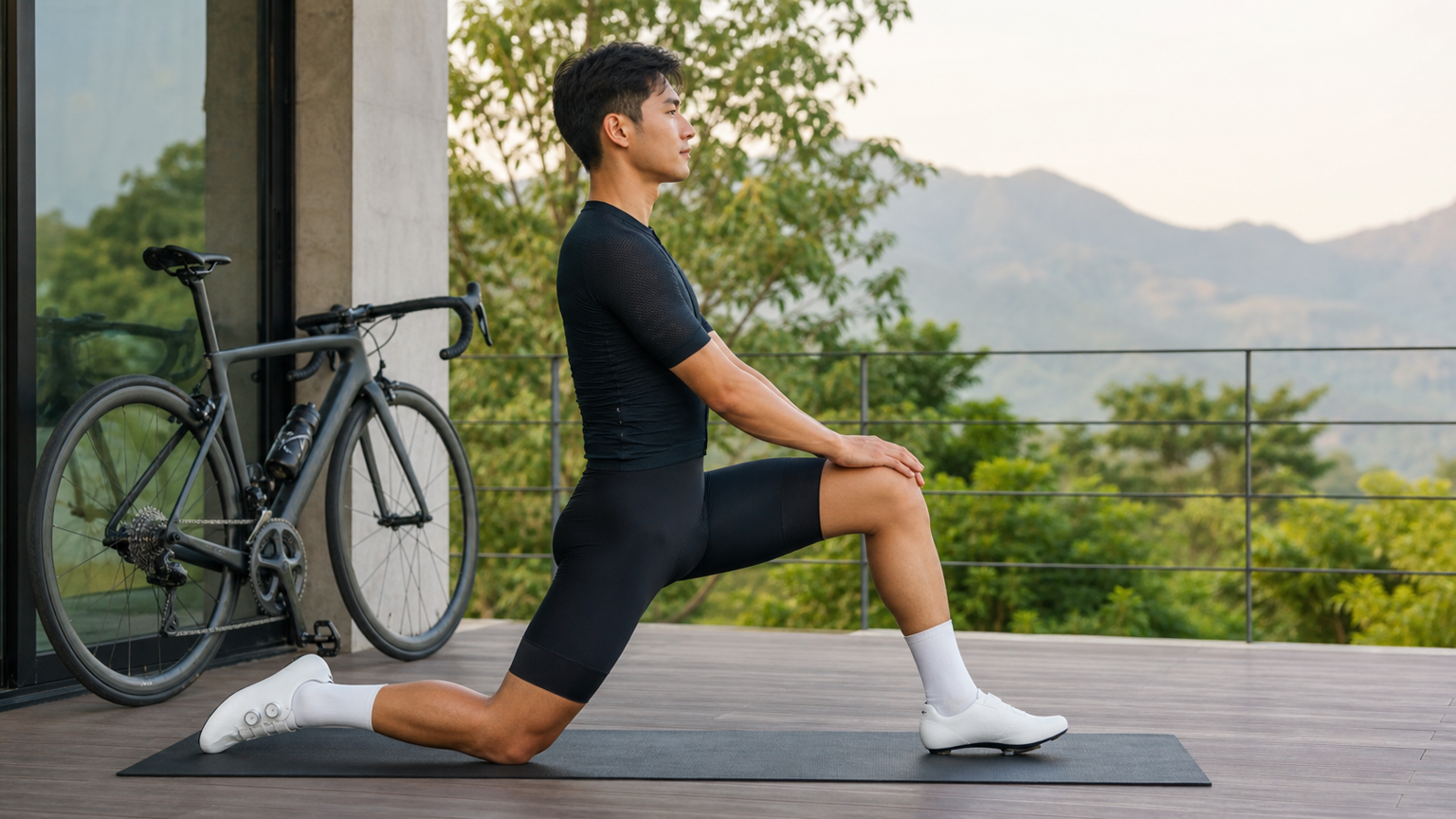
1. Hip Flexor Stretch (Lunge)
Target muscles: Iliopsoas, rectus femoris
Movement:
- Kneel on one knee with the front foot planted on the ground (lunge position)
- Rest the back knee on the ground and push the pelvis forward
- Feel the stretch along the front of the back leg (from groin to upper thigh)
- Place a mat under the back knee to reduce pressure if needed
- Hold for 30-45 seconds, then switch legs
Why it matters: Tight hip flexors limit your pedal stroke range and cause the lower back to compensate by arching, leading to lower back pain.
2. Glute Stretch (Pigeon Pose)
Target muscles: Piriformis, gluteus maximus
Movement:
- Sit on the ground with your right leg bent in front of you (knee and ankle in line)
- Extend your left leg straight back
- Lean your upper body forward and feel the deep stretch in the right glute
- Hold for 30-60 seconds, then switch sides
Why it matters: Tight glutes are a common root cause of knee and hip problems in cyclists.
3. Hamstring Stretch
Target muscles: Biceps femoris, semitendinosus, semimembranosus
Movement:
- Sit on the ground with both legs extended straight
- Lean your torso forward (keep your back straight — don’t round it)
- Reach your fingers toward your toes and feel the stretch along the back of the thigh
- Hold for 30-45 seconds
Note: Keep your back upright. Rounding your back shifts the stretch to the lower back instead of the hamstrings.
4. Chest Opener (Doorway Stretch)
Target muscles: Pectoralis major, front of shoulder
Movement:
- Stand next to a doorway with your arm raised to 90° (elbow higher than shoulder)
- Place your forearm against the door frame and gently lean your body forward
- Feel the stretch across the chest and front of the shoulder
- Hold for 30 seconds, repeat twice
Why it matters: The forward-leaning riding position shortens the chest muscles over time, leading to rounded shoulders and neck problems.
5. Lower Back Release (Child’s Pose)
Target muscles: Paraspinal muscles, glutes
Movement:
- Kneel down and sit your hips back toward your heels
- Reach your arms forward and let your upper body fold toward the floor
- Breathe deeply and feel the release through the spine and glutes
- Hold for 45-60 seconds
6. Neck Release
Target muscles: Upper trapezius, levator scapulae
Movement:
- Sit upright and tilt your right ear toward your right shoulder
- Gently rest your right hand on top of your head to deepen the stretch
- Hold for 20-30 seconds, then switch sides
- Tilt your head forward and clasp your hands behind your neck to feel the stretch along the back of the neck
Advanced Training to Improve Flexibility
The Benefits of Yoga for Cyclists
Research shows that two yoga sessions per week can significantly improve a cyclist’s flexibility and core stability within six weeks. Especially recommended poses include:
- Downward Dog: Stretches the entire posterior chain (hamstrings → glutes → lower back)
- Warrior I: Opens the hip flexors and chest
- Supine Twist: Rotates and releases the spine
- Fish Pose: Extends the thoracic spine, counteracting cyclist’s hunch
Dynamic Warm-Up (Before Riding)
Static stretching is not recommended before riding, as it can temporarily reduce muscle strength. Use a dynamic warm-up instead:
- Leg swings (10 per leg)
- Walking lunges (10 steps)
- Glute bridges (15 reps)
- Arm circles (10 per direction)
- High knees in place (20 seconds)
Self-Myofascial Release (Foam Rolling)
Use a foam roller after training to release tight muscles:
| Area | Rolling Technique | Duration |
|---|---|---|
| Outer thigh (IT band) | Lie on your side, roll from outer knee to hip | 30-60 sec/side |
| Quadriceps | Lie face down, roll from above the knee to the hip | 30 sec/leg |
| Calves | Sit with legs extended, roller under the calf | 30 sec/leg |
| Upper back | Lie on your back, roller placed across the upper back | 30-60 sec |
Overall Injury Prevention Recommendations
- Do 15 minutes of stretching after every ride: Don’t skip it just because you’re tired
- One full flexibility session per week (30-45 minutes)
- Get a professional bike fit periodically: Ensure your riding position is correct
- Core training: A strong core reduces the load on your lower back and arms
- Pay attention to pain signals: Pain is your body’s warning sign — don’t push through it
Conclusion
Stretching is one of the training elements most cyclists overlook, yet it’s just as important as any other training for long-term cycling health and performance. Treat those 15 minutes of post-ride stretching as a non-negotiable part of training, not an optional extra, and you’ll be able to ride longer and more comfortably for years to come.
Related Reading
- Flexibility Training for Cyclists: How Yoga and Stretching Improve Riding Performance
- The Complete Post-Ride Stretching Routine: 12 Key Movements to Protect Your Flexibility
- Off-Season Flexibility Training: A Complete Stretching Plan to Unlock a Stiff Rider’s Body
- Yoga and Cycling: How Flexibility Training Improves Posture and Prevents Injury
一日北高/長距離團騎 常見問題補充篇 / 組團或跟團的眉角 / 壯車友容易被瘦車友慢性拉爆 / 原來屁股痛可能是這個原因...? / 風場配速法 / 公路車 / CT Yeh
2 年前
[教學] Premiere 影片 手震 修正 教學 防抖 單眼 影像 GoPro 穩定 Video Stabilization
8 年前
單車 一日北高 ( 雙城 ) 肥宅雙人瘋狂行 紀錄片 REACTO
10 年前
靠單車減肥35公斤 心得分享與整理
7 年前
一日北高常見問題大集合 | 攻略 | 路線 | 訓練 | 補給 | 自行車 單車 | 一日雙城 | 雙塔 | TWB北高360 | 屁股痛
6 年前
碟煞公路車 銑面器 !? 原來銑完差這麼多! 降低蹭碟機率! | TIME 公路車 保養小記錄 | CT Yeh
3 年前
Insta 360 One 超級防手震技術實測
7 年前
#公路車 #Fitting 靠人工智慧APP 幫你調整單車
6 年前