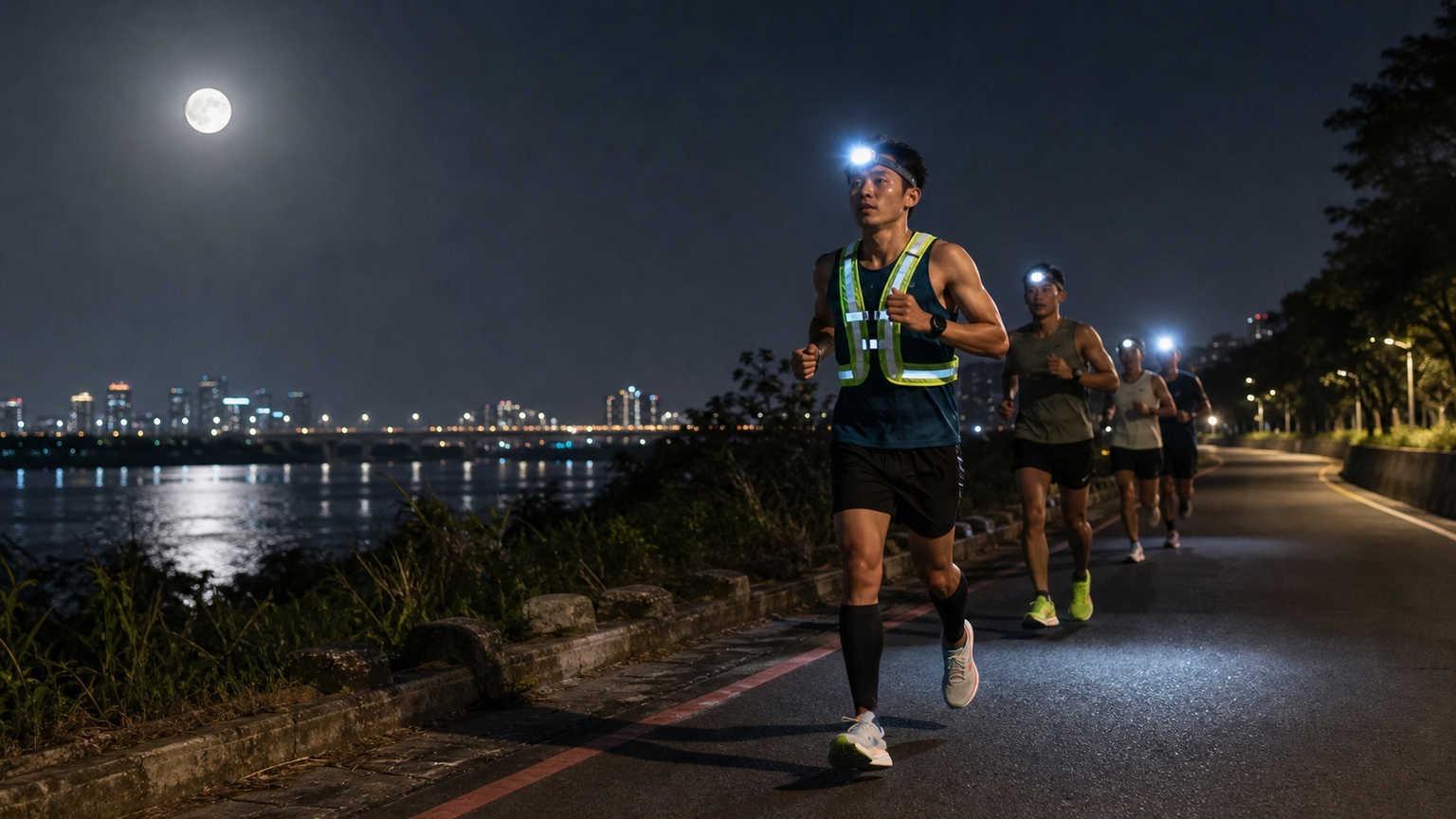
Full Moon Marathon: Special Preparation Advice for Night Races
The Full Moon Marathon—just hearing the name feels poetic. On the night of the fullest moon, thousands of runners gather in a corner of Taiwan, running 42 kilometers under the stars and moonlight. This is an experience that no daytime race can replicate. However, night races place special demands on a runner’s physiology, psychology, and gear. Only with thorough preparation can you fully enjoy this marathon celebration under the night sky.
The Physiological Challenges of Night Races
Circadian Rhythm Disruption
The human circadian rhythm regulates multiple physiological functions, including sleep, body temperature, and hormone secretion. Running at night goes against the body’s “rest signals,” which can lead to:
- Delayed heart rate response: The rise in heart rate at night may be 5–8 bpm lower than during the day
- Slower energy mobilization: Glycogen breakdown rate is slightly reduced
- Earlier perceived fatigue: The brain’s fatigue perception is more sensitive at night
Visual Load
Running in low-light conditions places a greater workload on the visual system. The eyes continuously search for obstacles on the road, which can cause tension in the head and neck muscles. Accumulated over a long distance, this may affect posture and efficiency.
Adaptation Training 2 Weeks Before the Race
Sleep Schedule Adjustment
Start adjusting your routine 1–2 weeks before the race:
- Go to bed 30–60 minutes later each day to gradually adapt your body to nighttime activity
- Push evening training sessions to 8–10 PM to practice your nighttime running rhythm
- Rest fully the day before the race; don’t lose sleep over nerves
Key Night-Running Training Points
Headlamp Training: Run with a headlamp at least 3–4 times to get your eyes and body accustomed to judging road conditions within a limited beam of light.
Dark Adaptation: Sit quietly in a dark environment for 15 minutes before running to let your eyes fully adapt to the darkness and improve night vision.
Gear Checklist: Essentials for Night Races
| Gear | Recommended Specs | Reason |
|---|---|---|
| Headlamp (primary) | 300+ lumens, 8+ hour battery life | Primary lighting to ensure you can see the road clearly |
| Headlamp (backup) | Lightweight, 100–150 lumens | Backup in case the main light runs out of power |
| Reflective vest | 360° reflective strip design | Ensures runners and vehicles behind you can see you |
| Warm jacket | Lightweight, windproof, compressible | Prevents body heat loss during aid station stops |
| Electrolyte supply | Extra amount on hand | Nighttime hydration judgment may be duller than during the day |
Pacing Strategy: Special Considerations for Night Marathons
The Temptation at the Start
Night races have a peculiar psychological phenomenon: because you can’t see the full course or the situation of runners around you, some runners unconsciously speed up. It’s recommended to strictly monitor your pace with a GPS watch and not get carried away by the atmosphere or the rhythm of runners ahead and behind you.
The Doubled Importance of Aid Stations
At night, your perception of thirst and energy needs is duller than during the day, so you must enforce a fixed-interval fueling strategy:
- Hydrate every 5 km, even if you don’t feel thirsty
- Take a gel or solid fuel every 10 km
- Electrolyte replenishment must be strictly followed—although nighttime sweat volume is lower, electrolyte loss still occurs
Mental Strategies: Staying Motivated in the Dark
Setting Segment Goals
During a night marathon, the psychological feeling of “not being able to see the finish line” is stronger than during the day. It’s recommended to break the race into 5–10 km segments, giving yourself a mental reward each time you complete one.
The Power of Music
Many runners rely heavily on music during night races. It’s recommended to prepare a “night running playlist” in advance, focusing on songs with a steady rhythm, and use music to maintain your cadence during moments of fatigue.
The Importance of a Partner
If you can find a fellow runner with a similar pace, the loneliness of a night race drops significantly. Talking with each other not only provides emotional support but also helps monitor each other’s condition—if one person starts rambling incoherently or reacting slowly, it could be a sign of heat exhaustion or low blood sugar.
Special Post-Race Care
After finishing a night marathon, your body’s recovery rhythm differs from a daytime race:
- Don’t eat a large meal immediately before bed: The race may end late at night, and your digestive system is also in “rest mode”
- Prioritize warmth: Temperatures drop at night; put on warm clothing immediately after finishing
- Restore your routine: Your sleep schedule may be disrupted for 2–3 days after the race; allow yourself an extra day of sleep
On the night of the full moon, run. The feeling of running under the moonlight is something only those who have experienced it can understand.
Related Reading
- Preparation and Race-Day Strategies for Taiwan’s Ultramarathon (24-Hour Race)
- Nutrition Planning During Marathon Training: Dynamically Adjusting Training Load and Calorie Intake
- Marathon Race-Day Strategy: Scientific Pacing and Fueling Plans
- What to Eat and How Many Hours to Sleep the Night Before a Marathon: The Critical 12-Hour Pre-Race Checklist
Live) 備戰2019彰化經典百K 賽前攻略 (已完賽請看新影片
7 年前
2018 田中馬拉松 全程健跑 VR 360 環景錄影 體驗現場狂野加油氣氛! Insta 360
7 年前
一日北高前的高裝檢 | 北高 360 | 挑戰11小時的裝備 | 一日雙塔 | 補給
6 年前
西進武嶺 免費訓練分析服務 Intervals | 練不夠還是練過頭?你哪一種類型選手?AI模型告訴你! | 備戰神器 | 公路車 訓練 | CT Yeh
4 年前
實景訓練台) 彰化經典百K 高強度喵團 90分鐘 跟著一起練功 2019 Indoor workout Changhua Classic 100 Taiwan
7 年前
單車 一日北高 ( 雙城 ) 肥宅雙人瘋狂行 紀錄片 REACTO
10 年前
2023桃園團體繞圈賽 / 海鷗繞圈賽 | 全程空拍數據版 | 公路車 | CT Yeh
2 年前
2025 海鷗團體繞圈賽 網路直播 超激烈裁判長視角 / EIPC 李廷威、Waypoint 等眾多高手競爭 / feat. 卡密兒主持 / 海鷗繞圈賽
9 個月前