Westward Wuling, Kunyang to Wuling: Survival Tactics for the Final 2K
From Kunyang to Wuling is only 2 kilometers, but the average grade is 8% and the altitude climbs from 3,100m to 3,275m. For many Wuling riders, these 2 kilometers are the lowest point of their lives — and also their most glorious victory.
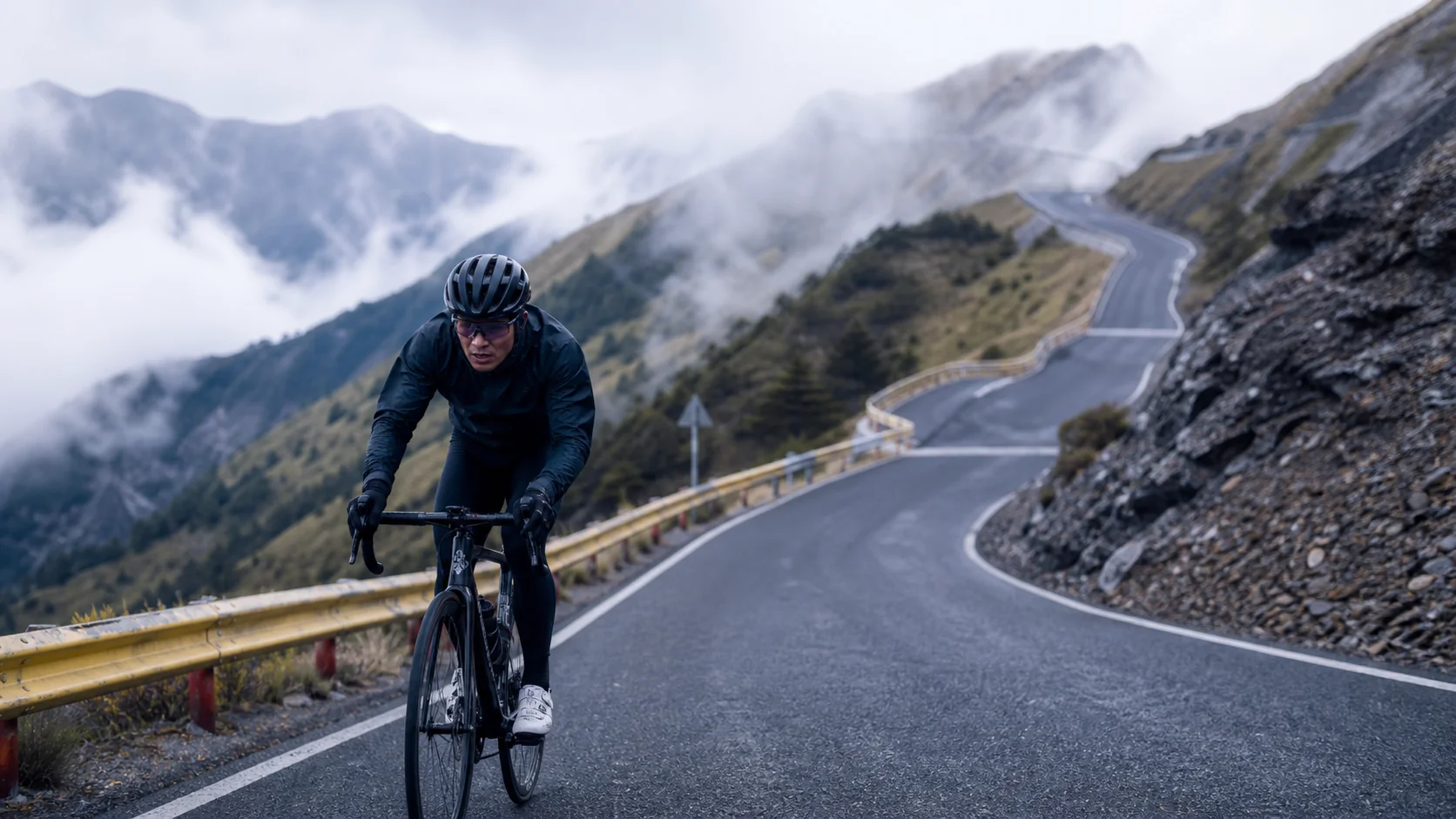
The Physical Conditions
Objective Data
- Distance: 2 km (about 1.2 miles)
- Altitude: 3,100m → 3,275m
- Elevation gain: 175m
- Average grade: 8%
- Steepest sections: 10-12% (short stretches)
- Temperature: 12-18°C (summer), 0-8°C (winter)
Environmental Challenges
- Oxygen concentration: roughly 68% of sea level
- Air pressure: roughly 70% of sea level
- Wind: gusts of Beaufort force 5-8 are possible
- Visibility: frequent fog in spring and autumn
Your Body’s Condition at This Point
By the time you reach here, you have already
- Ridden for 4-5 hours
- Climbed 53 km worth of elevation
- Burned 3,000-3,500 kcal
- Sweated out 3,000-5,000 ml of fluid
Physiological Responses
- Glycogen stores below 30%
- Accumulated micro-tears in muscle tissue
- Dehydration possibly reaching 2-3%
- Core body temperature fluctuating
- Mental fatigue setting in
Why These 2 Kilometers Are So Brutal
1. The Hypoxia Blow
At 3,100m, VO2max drops 15-20%. Your maximum oxygen uptake capacity is nowhere near what it is at sea level.
2. Final Sprint vs. Staying Conservative
Many riders think, “Only 2K left, let’s push hard.” But at this point your legs and cardiovascular system are already maxed out — pushing all-out can actually cause you to blow up.
3. The Steep Grade
On a continuous 8% grade, if your gearing isn’t light enough, your cadence will drop below 50, and muscle soreness will double.
4. Psychological Pressure
The anticipation of “almost there,” the anxiety of “I can’t give up now,” and the despair of “I can’t keep going” — all three emotions coexist.
Survival Tactic 1: Shift to Your Lightest Gear
Standard Recommendation
- Front chainring: 34T or lighter (30T / 32T)
- Rear cassette: 34T or 36T
Target Cadence
- Keep it at 70-80 rpm, don’t let it drop below 60
- Low cadence = more muscle soreness
- High cadence = more cardiovascular strain (but recoverable)
Pre-Race Check
Four weeks before your event, test your gearing setup:
- Find your steepest training climb (10%+ grade, continuous 2 km)
- Use your race gearing
- Can you maintain a 75 rpm cadence?
- If not — switch to a lighter gear ratio
Survival Tactic 2: Rhythmic Breathing
Sea-Level Breathing
- Inhale 2 seconds, exhale 2 seconds (4-second cycle)
- 15 breaths per minute
3,000m Breathing (needs adjustment)
- Inhale 1.5 seconds, exhale 1.5 seconds (3-second cycle)
- 20 breaths per minute
- Shorter, quicker, but steady
Avoid
- Holding your breath (worsens hypoxia)
- Overly deep breathing (hyperventilation causes dizziness)
- Erratic, broken breathing (destabilizing)
Survival Tactic 3: Mental Mantras
Effective Mantras
- “One pedal stroke at a time” (don’t think about the whole segment)
- “I’ve already made it this far” (affirm your past effort)
- “My family/friends are waiting for me” (concrete motivation)
- “In 10 minutes I’ll be at the top of Wuling” (time-bound)
Ineffective Mantras (Avoid)
- “This hurts so much, I’m so tired” (reinforces negativity)
- “I can’t do this” (collapses your belief)
- “Why did I even come” (counterproductive mindset)
Survival Tactic 4: Break It Into Time Segments
2K ≈ 12-15 minutes
Split it into four 3-4 minute segments:
- Segment 1: “The launch” — maintain your rhythm
- Segment 2: “The middle” — the hardest part
- Segment 3: “Sight of the finish” — the Wuling parking lot comes into view
- Segment 4: “The final push” — you can see the timing mat
At the end of each segment, tell yourself, “Another checkpoint done.”
Survival Tactic 5: Standing Intervals
On the steepest sections (10%+), you can occasionally stand up out of the saddle:
- 10-15 seconds at a time
- Activates different muscles, changes the force angle
- Don’t exceed 30 seconds continuously (it consumes more oxygen)
Warning: If you’re already extremely fatigued, standing may actually wear you out further. Only use this technique when you’re feeling relatively strong.
Survival Tactic 6: Don’t Watch Your Speed
On this stretch, your speed will be 6-9 km/h — watching it will only demoralize you.
Look at instead:
- Cumulative distance
- Altitude (watching the number climb feels rewarding)
- Heart rate (make sure it isn’t spiking too high)
- The road markers ahead (a sign you’re getting closer)
Survival Tactic 7: Fueling (Limited)
Timing
- Take one energy gel before Kunyang
- Sip small amounts once or twice during this stretch (50-100ml each)
- Don’t eat solid food (your digestive system won’t absorb it)
Recommendations
- A caffeinated energy gel (you need the mental boost on this stretch)
- Warm or lukewarm water (cold water shocks your stomach)
- Electrolyte tablets dissolved in your mouth (replenish sodium)
Survival Tactic 8: Visual Motivation
Where to Focus Your Eyes
- The road surface 20-30m ahead
- Don’t look far into the distance (the summit will feel impossibly far away)
- Don’t look down at your feet (it will make you dizzy)
- Glance around every 30 seconds to keep your spatial awareness
Find Landmarks
- Utility poles, streetlights, kilometer markers
- Each landmark = a small victory
- “Just ride to the next utility pole”
Warning Signs (When You Should Stop and Rest)
Signs You Must Stop Immediately
- Numbness or weakness in your fingers (hypoxia + dehydration)
- Blacking out or flickering vision (blood pressure issue)
- Intense nausea (possible vomiting)
- Confusion (altitude sickness)
What to Do When You Stop
- Find a safe spot on the roadside
- Sit down and breathe deeply for 2-3 minutes
- Drink 200ml of warm water
- Eat an energy gel
- Continue only once you feel recovered
Don’t think of stopping as a failure. A 3-minute rest is far better than pushing through and collapsing.
Mindset Adjustment: After You Cross the Finish
Immediate Actions
- Slow down and come to a stable stop (don’t brake suddenly)
- Dismount and walk to flat ground
- Take deep breaths for 1 minute
- Put on more clothing (you’ll get cold once the adrenaline fades)
- Drink water and refuel
Don’t Rush Into
- Taking photos (wait for your heart rate to drop)
- Posting online (save your phone battery)
- Descending immediately (risk of hypothermia)
Preparing for the Descent
Spend 10-15 minutes at Wuling to:
- Put on a windbreaker, leg warmers, and gloves
- Eat something hot (event aid station food or your own)
- Drink warm water or a sports drink
- Let your heart rate settle back to Zone 2
Conclusion
The 2 kilometers from Kunyang to Wuling are a microcosm of your entire ride: exhausting, steep, high-altitude, and at times hopeless — but as long as you keep turning the pedals, one stroke at a time, the finish line is right there. These 2 kilometers teach you that Wuling isn’t a race against speed — it’s a journey of willpower.
Standing at the Wuling observation deck, you’ll know: those 12 minutes of struggle were worth a lifetime of memory.
Further Reading
- A Scientific Look at Breaking 4 Hours on Westward Wuling
- Nailing Your First Wuling Ride: The Complete Beginner’s Guide to Westward Wuling
- The Complete Layering Guide for Westward Wuling: Managing the Temperature Swing from 3,275m to 1,000m
- Assessing Frostbite Risk on the Wuling Descent: Core Temperature Management from 3,275m to Wushe at 26K
雨戰! 西進武嶺員工旅遊 加料 各路段大數據分析 | 同事端出5公斤的公路車來挑戰!? EP1
4 年前
西進武嶺 世界紀錄挑戰!破2:30 ?!一群人推著一個夢上山 直播精華版 / ft. 張翰允 & 台視主播魏于恬 & KPLUS / #cycling 公路車 CT Yeh
2 個月前
FTL 與 SYB 車隊專訪 西進武嶺 實用攻略分享! 2小時 如何練?!你不知道的眉角!新手準備武嶺必看 EP1 | 實力派女車友 | 精華版 | 公路車 | CTYeh
4 年前
2019 夏季KOM 5小 完賽心得 準備攻略 東進武嶺 夏季登山王之路 Taiwan KOM Challenge
7 年前
大禹嶺 到 武嶺牌樓 全程前後實況錄影 | 北進武嶺 | 東進武嶺 | KOM | 訓練台 | 坡度分析 | Taiwan KOM Last 10 km HARD | 公路車
6 年前
#公路車 #西進武嶺 配速配瓦實驗 坡度分析 四小時內攻略 建大盃 NeverStop #西進武嶺攻略
6 年前
#北進武嶺 單車員工旅遊 EP2 | Feiyu Pocket 2s 人體空拍機 | 4K沈浸式體驗遊 | 公路車 | CT Yeh
4 年前
CT趣訪 西進武嶺 2小時組 EP2 全村的希望 蔣緯緯! 訓練菜單&技巧公開 |公路車 |CT Yeh
4 年前