Grip Strength, Carrying, and Trunk Rigidity for Endurance Athletes: The Overlooked Nodes of Full-Body Tension Transfer
A Link the Entire Endurance Community Overlooks
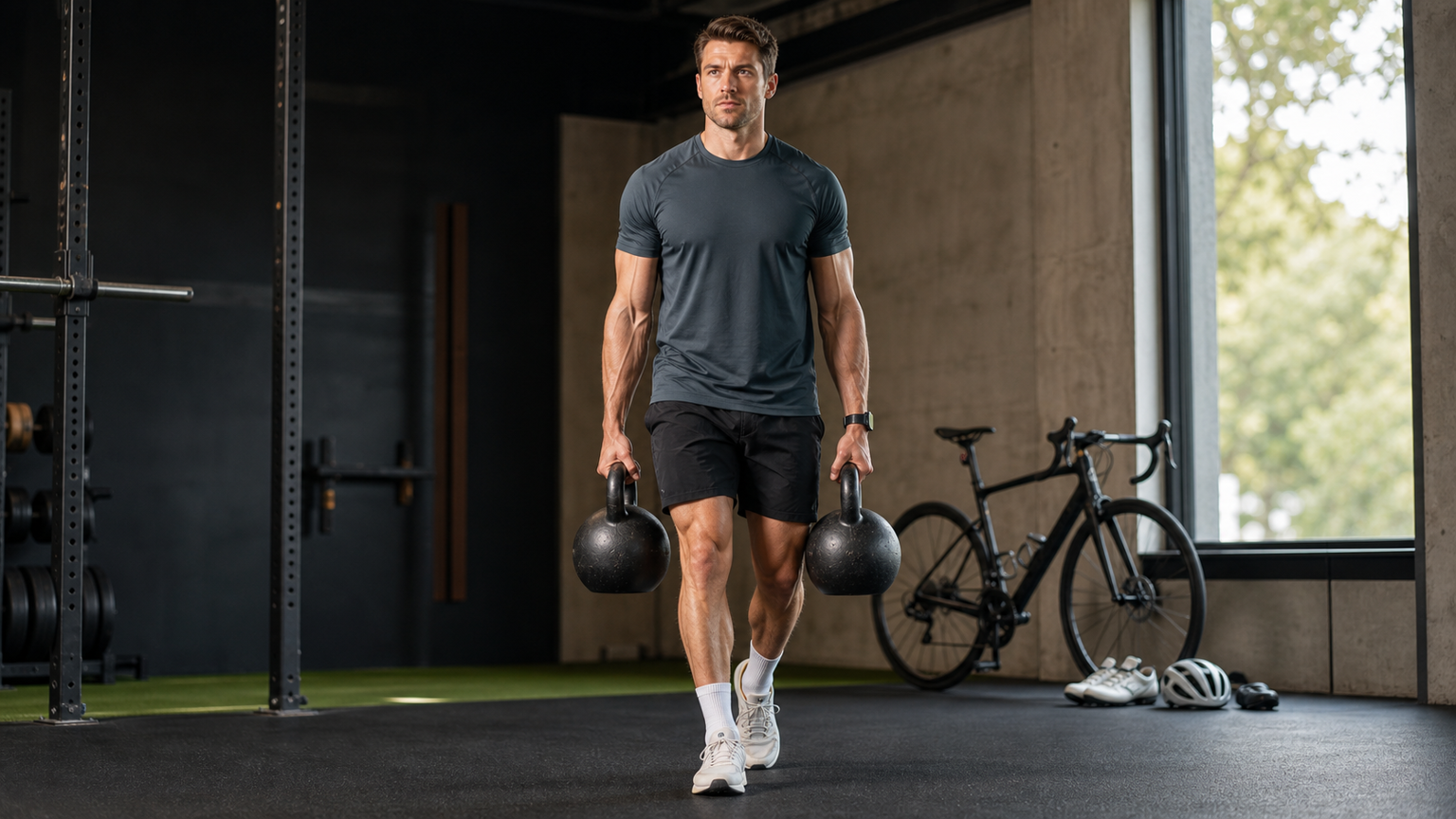
Ask ten runners or cyclists what they should train, and no one will say “grip strength.” But grip strength and loaded carries actually train a more fundamental capacity: the generation and transfer of full-body tension, and maintaining trunk rigidity while in motion. In neuroscience, there is a phenomenon called “irradiation”—when you grip hard, tension spreads along the muscle chain, enhancing proximal joint stability and force output. For endurance athletes who need to maintain posture and technique under fatigue, this value is severely underestimated.
The Transfer Pathway from Grip Strength to Trunk Rigidity
| Training | Direct Stimulus | Transfer to Endurance |
|---|---|---|
| Farmer’s Carry | Grip strength + anti-lateral-flexion core + scapular stability | Trunk doesn’t collapse in the latter stages of running form; stability during single-leg stance |
| Suitcase Carry (unilateral) | Unilateral anti-lateral-flexion, hip stability | Pelvic control during single-leg support in running |
| Overhead Carry | Shoulder stability + anti-extension trunk | Scapular stability in swimming; upright thoracic spine in running form |
| Dead Hang | Grip strength + shoulder decompression + lats | Power at the end of the catch in swimming; shoulder health |
Why Swimmers Especially Should Train Grip Strength
The “end of the catch” in freestyle is directly related to tension in the forearm and grip chain—the more stable the grip, the more solid the purchase during the pull. The dead hang also provides traction and decompression for the shoulder joint, making it a high-return movement for swimmers’ shoulder maintenance on land.
Why Runners Should Train Loaded Carries
What collapses first in the latter stages of a run isn’t leg strength—it’s trunk rigidity—the pelvis drops, the trunk sways side to side, and every step leaks energy and increases injury risk. Unilateral suitcase carries directly train anti-lateral-flexion and pelvic control under single-leg support, which is exactly what the single-leg phase of running requires, and the learning curve is extremely low.
Low-Cost Program (All You Need Is a Pair of Dumbbells or Kettlebells)
| Movement | Dosage | Key Points |
|---|---|---|
| Farmer’s Carry | 4 trips x 20-30 meters, heavy | Trunk tall, shoulders not leaning forward, steady stride |
| Unilateral Suitcase Carry | 3 trips x 20 meters/side | Don’t lean toward the loaded side; pelvis level |
| Overhead Carry (single arm) | 3 trips x 15 meters/side | Ribs down, no arched lower back |
| Dead Hang | 3-4 sets x maximum controllable time | Scapulae actively engaged, not just hanging on ligaments |
1–2 times per week, can be placed at the end of a strength session as an “integrative finisher,” totaling 8–10 minutes.
Programming and Cautions
- Fatigue from loaded carries is mainly in the grip and core, with minimal interference with lower-body recovery, so it can be retained even during the competitive season.
- Grip fatigue can affect sport-specific movements requiring gripping the next day (such as mountain bike handling or open water swimming); avoid heavy grip stimulus the day before a high-volume event.
- For those with existing shoulder injuries, progress gradually with dead hangs, starting with assisted hangs or shorter durations.
Evaluation Metrics
It’s not about how much you can carry, but rather: whether your trunk is more stable in the latter stages of a run, whether left-right symmetry in single-leg support improves, whether the end of your catch in swimming feels more solid, and whether hand fatigue is delayed during prolonged handling (trail/mountain biking).
Grip strength and loaded carries are one of the few investments in endurance training that are “extremely low-cost, minimally disruptive, yet silently hold up your posture in the second half of your event.” It’s not flashy, but you’ll see whether you’ve trained it in whether you fall apart in the final stretch of a race.
“At the end of a race, the loser is rarely the one whose ‘legs gave out’—it’s often the one who ‘couldn’t hold their posture anymore.’ Once the trunk collapses, even strong legs are leaking energy. Clench your fist, carry heavy loads and walk—this is the cheapest posture insurance.” —A functional strength coach specializing in endurance
Related Reading
- Land-Based Strength Training for Swimmers: Which Movements Have the Most Transfer
- Land-Based Power for Swimmers: A Complete Guide to Band Pull Simulations and Shoulder Power Training
- The Flexibility Advantage of Swimming: Improvements in Full-Body Joint Mobility Through Water-Based Exercise
- Land-Based Strength Training for Swimmers: Balancing Shoulder Joint Health and Pull Propulsion
CT 喇低賽) 武嶺牽車 才是王道 西進牽車四小時內秘訣 攝手位置 如何判斷 防抽筋小秘訣
7 年前
[教學] Premiere 影片 手震 修正 教學 防抖 單眼 影像 GoPro 穩定 Video Stabilization
8 年前
抖肩舞 台灣x日本交流版 (台灣 vs 前橋) 赤城山登山賽 coincidance
8 年前
FTL 與 SYB 車隊專訪 西進武嶺 實用攻略分享! 2小時 如何練?!你不知道的眉角!新手準備武嶺必看 EP1 | 實力派女車友 | 精華版 | 公路車 | CTYeh
4 年前
戰略) Zwift Race 如何咬在第一集團 如何評估自己要開多少推力 (請開1.5倍速看)
7 年前
實錄) 車隊中 攝影師 是如何用感情拍片的呢? 單車 移動攝影 攝影師的視角 米粉坡 手持 DJI OSMO POCKET Ft. Team Neko
7 年前
西進武嶺 免費訓練分析服務 Intervals | 練不夠還是練過頭?你哪一種類型選手?AI模型告訴你! | 備戰神器 | 公路車 訓練 | CT Yeh
4 年前
Garmin Edge 1040 重大韌體更新!! / 1050功能全下放!? / 坡度反應變快了嗎?/ 快速對比實測 / 公路車 / CT Yeh
1 年前