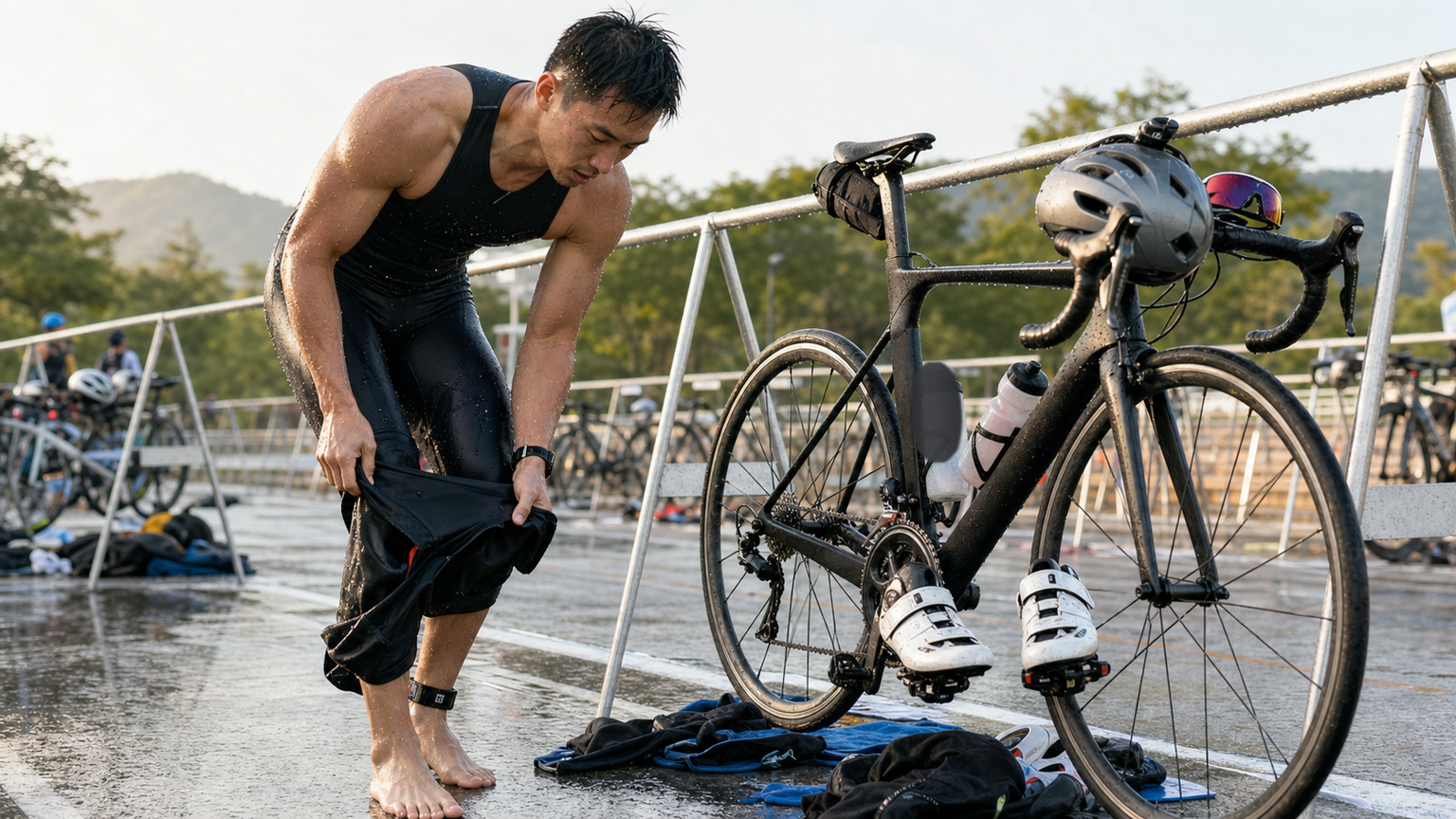
T1: The Underrated “Fourth Discipline”
Age-group athletes average 2:30–4:00 in T1, while pros take just 45–70 seconds. This gap of over 90 seconds requires no fitness at all—only practice.
The Standard Six-Step T1 Sequence
| Order | Action | Target Time |
|---|---|---|
| 1 | Remove goggles and swim cap while running, unzip the wetsuit top half | Complete by the time you enter transition |
| 2 | Stop and peel off the wetsuit bottom half | 8 seconds |
| 3 | Put on helmet (buckle first, then touch the bike) | 4 seconds |
| 4 | Put on sunglasses | 3 seconds |
| 5 | Run with bike to the mount line | Depends on route |
| 6 | Flying mount or stationary mount | 5 seconds |
Equipment Placement Rules
Place the helmet upside down on the handlebars with the straps spread outward; secure shoes to the pedals in a horizontal position with rubber bands; put the race belt on before the wetsuit or around your waist beforehand. Most people are slow because they bend down to look for things.
Wetsuit Removal Technique
100m before exiting the water, undo the Velcro at the back of the neck and peel the top half down to your waist. For the bottom half, step on the opposite leg cuff with the other foot and pull out—this saves 10–15 seconds. Apply talcum powder or water-based lubricant to your ankles before the race.
Attribution Analysis of Time Loss in T1
Breaking down an age-group athlete’s 3-minute T1: running in to find the bike 25–40 seconds (didn’t memorize the spot), removing the wetsuit 30–50 seconds (didn’t practice the peel), helmet and shoes 30–45 seconds (multiple bends), running to the mount line 20–30 seconds (didn’t scout the route), mounting and clipping in 25–40 seconds (standing to put on shoes). Among these, “finding the bike” and “standing to put on shoes” are the two biggest loss points that can be eliminated at zero cost. Walk the actual route twice before the race, and use a highly visible towel or count the rack slots to remember your bike’s position.
Flying Mount Breakdown
| Step | Key Point | Common Mistake |
|---|---|---|
| Shoes on pedals first | Secure horizontally with rubber bands, shoe openings facing outward | Shoes fall off |
| Straddle after the mount line | Lead foot steps onto the shoe first, then push off | Penalty for mounting before the line |
| Glide 10–20m before putting shoes on | Build speed first, then look down to slip in heels | Wobbling from insufficient speed |
| Slip in and tighten | One foot at a time, eyes forward | Losing balance putting both feet in at once |
The flying mount saves 15–25 seconds for those who have mastered it, but for those who haven’t practiced it, it’s slower and more dangerous—if you haven’t trained it during the season, use a stationary mount. Stability beats speed.
I always say transition is the segment “nobody wants to train, but everyone can improve.” It won’t make you more tired, yet it can magically add 1.5 minutes to your results. Cheap speed—why not take it?
Related Reading
- T1 Transition Tactics: The 30 Seconds from Exiting the Water to Mounting the Bike You Can Save
- T1 Transition Optimization: The 90-Second Time-Saving Technique from Exit to Mount
- Swim-to-Bike Transition (T1) Efficiency: Optimizing Seconds for Wetsuit Removal, Shoes, and Mounting
- Triathlon T1 Transition Efficiency: Optimizing Seconds for Wetsuit Removal and Goggle Storage
FTL 與 SYB 車隊專訪 西進武嶺 實用攻略分享! 2小時 如何練?!你不知道的眉角!新手準備武嶺必看 EP1 | 實力派女車友 | 精華版 | 公路車 | CTYeh
4 年前
西進武嶺 免費訓練分析服務 Intervals | 練不夠還是練過頭?你哪一種類型選手?AI模型告訴你! | 備戰神器 | 公路車 訓練 | CT Yeh
4 年前
SRAM FORCE E1 首發!/ 改成短腿了 / 煞車升級有感嗎? / TIME ADH 變速大升級 / 公路車 / CT Yeh
1 年前
CT 喇低賽) 武嶺牽車 才是王道 西進牽車四小時內秘訣 攝手位置 如何判斷 防抽筋小秘訣
7 年前
2016 桐花飛舞 單車挑戰 精華片段
10 年前
西進武嶺 自製新版AI配速表產生器 x 賽前攻略 抱佛腳! 沒有功率計也可以產生配速表嗎?有什麼其他眉角賽前要注意的呢? | 西進武嶺 / 東進武嶺 KOM 攻略 | 公路車 | CT Yeh
4 年前
Live) 備戰2019彰化經典百K 賽前攻略 (已完賽請看新影片
7 年前
風櫃嘴時間 預測西進武嶺時間?13000名車友統計數據分析告訴你 !
5 年前