Head-Up Sight Positioning Under Pressure: Breathing Integration to Keep Your Pace Without Slowing Down
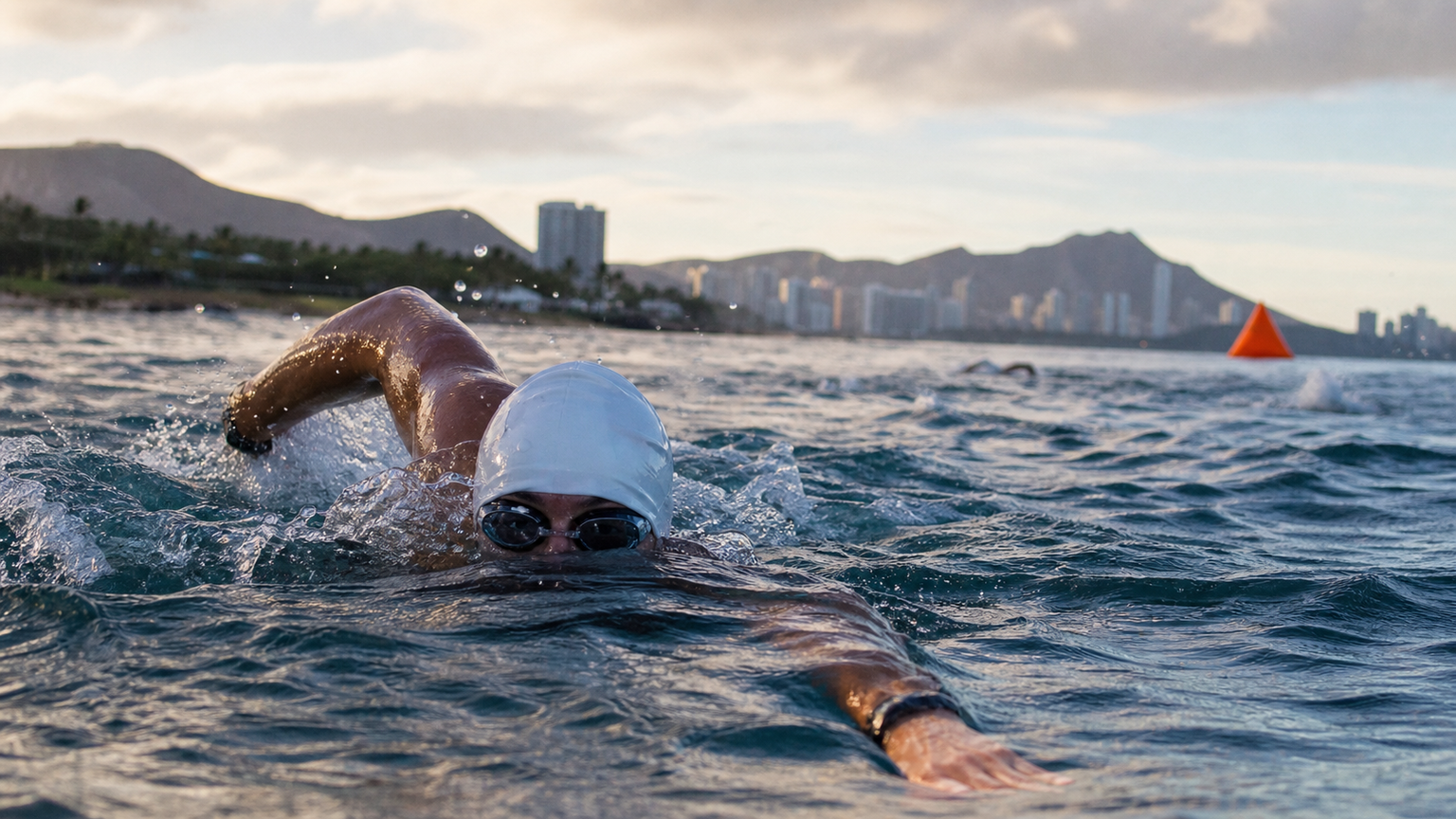
Sighting: The Culprit Behind Swimming Crooked in Open Water
Swimmers who are fast in the pool often end up swimming an S-shaped course in open water, covering 10%–20% more distance. The root cause is poor head-up sighting technique. Every big head lift sinks the hips, spikes drag, and drives heart rate up 5–8 beats.
Crocodile Eye Technique Breakdown
| Phase | Action | Common Mistake |
|---|---|---|
| Lift | Only raise eyes above the water | Lifting the entire head out |
| Look | Capture one landmark at a time | Searching too long |
| Turn | Rotate head naturally to breathe | Doing the lift and breath separately |
| Drop | Return head to neutral immediately | Pausing, causing sinking |
Sighting Frequency Formula
In calm water, sight every 8–10 strokes; in rough water or against the sun, every 4–6 strokes. Integrate sighting into your breathing rhythm: “Eyes up → Look → Turn head to breathe → Enter water” in one fluid motion. This saves one extra head lift compared to “lifting to look, then turning to breathe.”
Aim for Landmarks, Not Buoys
Buoys are often hidden behind crowds. Instead, lock onto large fixed landmarks in the distance (buildings, mountain silhouettes, towers), and use buoys only for fine adjustments when you get close.
Responding Under Pressure
In a chaotic pack, when you can’t see the buoy, following the “collective heading” of swimmers ahead is a reasonable option—but you still need to verify your own position every 30 seconds to avoid the whole group drifting off course together.
Converting Off-Course Drift into Time Lost
In a 1500m race segment, swimming an S-shape adds 12% distance, meaning you actually swim 1680m. At 1:40/100m, that’s roughly 3 extra minutes wasted. And every big head lift sinks your hips, increasing drag by 8%–10% and elevating heart rate. Quantify the cost of sighting: one correct “crocodile eye” lift adds only about 0.3 seconds per stroke without disrupting rhythm; one incorrect “full head out of water + pause to find the buoy” costs 1.5–2 seconds and requires 2–3 strokes to recover your body position. Over a full race, the difference can reach 2–4 minutes.
Sighting Prescriptions for Different Water Conditions
| Water Condition | Sighting Frequency | Target to Lock Onto | Technique Key Points |
|---|---|---|---|
| Calm lake | Every 8–10 strokes | Large distant landmark | Goggles barely above water is enough |
| Waves/swell | Every 4–6 strokes at wave crest | Look at the moment of the wave peak | Don’t waste a head lift in the trough |
| Against the sun/morning glare | Every 6 strokes + side marker | Use shoreline buildings or crowds instead | Wear polarized/tinted goggles |
| Crowded pack | Forced every 30 seconds | Collective heading + self-correction | Don’t blindly trust the direction of those ahead |
I’ve seen someone who swims 1500m in 20 minutes actually cover 1750m due to poor sighting, finishing a full 3 minutes behind their peers while feeling more exhausted. Swimming straight is the most underestimated source of speed in open water.
Related Reading
- Open Water Sighting and Navigation: Visual Correction and Energy-Saving Strategies for Swimming Straight
- The Science of Open Water Sighting: Head-Lift Frequency, Crocodile Eyes, and the Key to Saving 15% of Distance
- Open Water Straight-Line Navigation Sighting: Head-Lift Frequency and Minimum-Energy Techniques
- Open Water Sighting Training: You Can’t Swim Fast If You’re Lost
風櫃嘴 衝刺慢動作回放!
8 年前
西進武嶺 自製新版AI配速表產生器 x 賽前攻略 抱佛腳! 沒有功率計也可以產生配速表嗎?有什麼其他眉角賽前要注意的呢? | 西進武嶺 / 東進武嶺 KOM 攻略 | 公路車 | CT Yeh
4 年前
CT 喇低賽) 武嶺牽車 才是王道 西進牽車四小時內秘訣 攝手位置 如何判斷 防抽筋小秘訣
7 年前
西進武嶺 免費訓練分析服務 Intervals | 練不夠還是練過頭?你哪一種類型選手?AI模型告訴你! | 備戰神器 | 公路車 訓練 | CT Yeh
4 年前
戰略) Zwift Race 如何咬在第一集團 如何評估自己要開多少推力 (請開1.5倍速看)
7 年前
備戰 戀戀197 賽前關門點分析 西濱團練 #公路車 4K高畫質
6 年前
風櫃嘴 | 全台最多大砲的單車路線 | 尋寶網攝影師告訴你怎麼擺拍起來才好看 | 熱門攝影地點巡禮
6 年前
#公路車 #西進武嶺 配速配瓦實驗 坡度分析 四小時內攻略 建大盃 NeverStop #西進武嶺攻略
6 年前