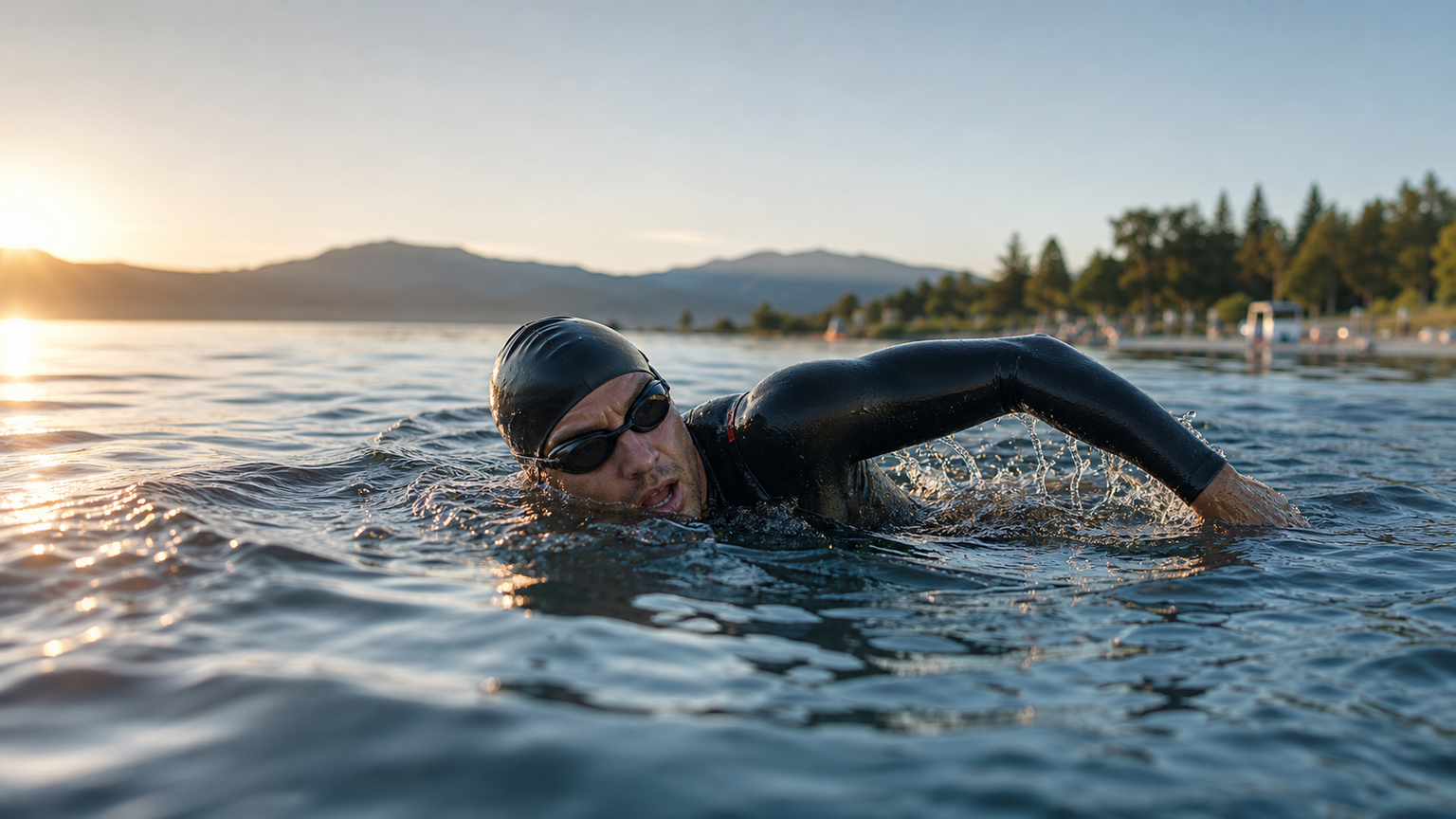
Swimming Has the Lowest Return on Investment
In a 70.3, swimming accounts for only about 10%–13% of total time. The 2 minutes you save by pushing hard in the swim, if it causes your heart rate to spiral out of control on the bike, could cost you more than 10 minutes on the bike and run. The core strategy for the swim is “fast enough is good enough; the key is being able to fight on after exiting the water.”
Marginal Benefits of Swim Investment
| Improvement Area | Investment | Overall Race Return |
|---|---|---|
| Swim pace +5% | Extensive swim training hours | Save 1–2 minutes |
| Drafting technique | Minimal learning | Save 1–3 minutes with less effort |
| Heart rate control on exit | Pacing discipline | Protects the bike leg |
Heart Rate Ceiling Principle
During the swim leg, heart rate should be controlled at 80%–88% of threshold, and perceived exertion (RPE) upon exiting should not exceed 6/10. Test method: Can you complete a full exhale through your nose mid-swim without gasping?
Efficiency Over Speed
For non-professional athletes, instead of training to be faster, it’s better to lengthen “distance per stroke” and improve kicking drag. The energy saved through technical improvements is often more cost-effective than fitness gains and doesn’t add fatigue.
The Buoyancy Bonus of a Wetsuit
In legal water temperatures, wearing a wetsuit can save 5%–10% of energy (torso lift, reduced drag), effectively boosting your return on investment for free.
Quantify “Exit Condition” into Verifiable Metrics
“Fast enough is good enough” is abstract, so here are three hard metrics you can verify in training: First, within 60 seconds of exiting the water, your heart rate must drop back to below 85% of threshold—if it doesn’t, you swam too hard. Second, your stroke count per 50m upon exit should not increase by more than 2 strokes compared to an easy pace (a bigger increase means your technique has broken down and you’re muscling through). Third, during the T1 run into transition, you should still be able to breathe in a normal two-phase rhythm without gasping. Before race day, test these three metrics with a “1000m swim followed by a 5-minute brick ride.” The pace that just barely passes is your optimal swim intensity.
Swim Investment Recommendations by Ability Level
| Swim Ability (1500m) | What to Invest In | What Not to Do |
|---|---|---|
| > 30 min | Technique overhaul, drafting, sighting | Mindlessly piling on volume to chase speed |
| 25–30 min | Draft positioning, open-water pacing | Sacrificing exit condition to save 1 minute |
| < 25 min | Just maintain; shift focus to bike and run | Over-training swim at the expense of bike and run |
I often tell my athletes: swimming is the discipline where triathletes should least try to prove themselves. It takes up the smallest share of time but carries the highest cost of error. Treat the swim as a segment where “not messing up means winning,” and your overall race time will actually be faster.
Related Reading
- Triathlon Swim Leg Pacing and Power Thinking: The Discipline of Treating the Swim as an Investment in Overall Performance
- Triathlon Swim Pacing Strategy: The Controlled Swim Style That Saves Energy
- Swim Technique Workouts: How to Add 10 Minutes of Technique Practice to Every Session
- Time Management for Triathlon Swim Training: Swim Priority Across the Three Disciplines
西進武嶺 免費訓練分析服務 Intervals | 練不夠還是練過頭?你哪一種類型選手?AI模型告訴你! | 備戰神器 | 公路車 訓練 | CT Yeh
4 年前
水金九不厭五分 10度寒流冷到不願停!feat. 卡卡 / 公路車 / CT Yeh
6 個月前
滑雪新手們慘摔學習全紀錄(請開字幕),滑雪好好玩 | Snowboard + Ski | 岩原 スキー場 | 滑雪APP使用 | GoPro Max
6 年前
西進武嶺 8000名單車友數據分析 PART1 | 從新手到高手數量/瓦數/推力比/FTP推力比/功率計使用率 大解析 | 公路車 | CTYeh
5 年前
戰略) Zwift Race 如何咬在第一集團 如何評估自己要開多少推力 (請開1.5倍速看)
7 年前
CT 喇低賽) 武嶺牽車 才是王道 西進牽車四小時內秘訣 攝手位置 如何判斷 防抽筋小秘訣
7 年前
自助洗車場 洗單車 50元有找 清鍊條大法 居然還有小小兵
7 年前
2026 輪霸西濱200K 挑戰VLOG / 第一集團 / 首次參加..經驗不足、膀胱不足 /死守6H內 / AI戰鬥力顯示系統 / 公路車 / CT Yeh
4 個月前