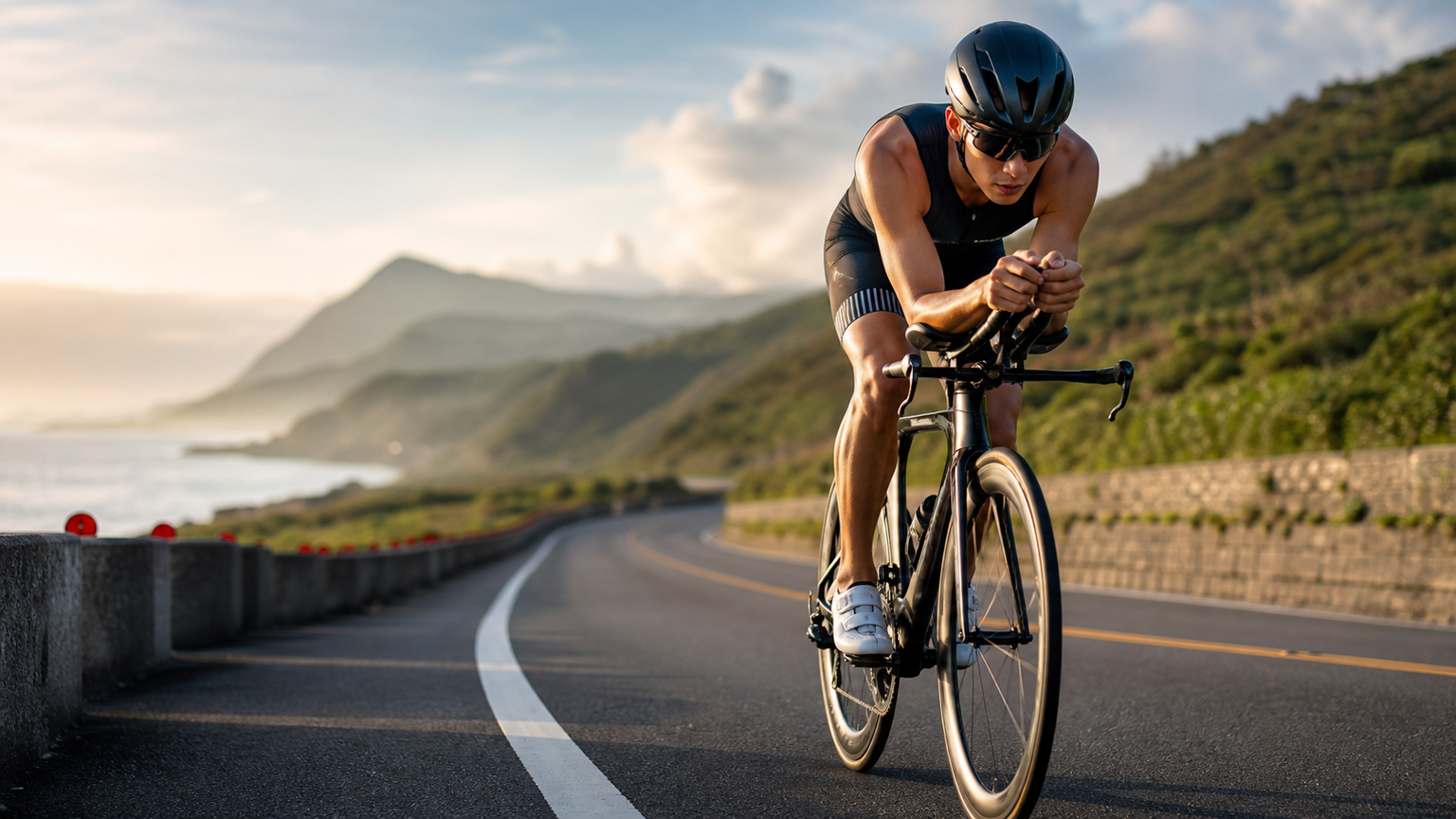
The Bike Leg = Your Biggest Expense Line
The bike leg accounts for 45%–56% of total triathlon time, making it the largest source of energy expenditure—and the easiest place to blow your budget on “feeling good.” A power meter turns this from a feeling into numbers you can track.
Power Accounts by Race Distance
| Distance | Target IF | Estimated TSS (Bike Leg) |
|---|---|---|
| Sprint | 0.95–1.00 | 35–45 |
| Olympic | 0.85–0.90 | 65–80 |
| 70.3 | 0.78–0.83 | 130–160 |
| Ironman | 0.65–0.72 | 270–310 |
TSS is the reconciliation statement for pacing discipline: if your bike-leg TSS exceeds the recommended ceiling, the run leg will almost certainly fall apart.
The W/kg Reality Check
To post a good time in a 70.3, you’ll need an average power of roughly 2.7–3.4 W/kg on the bike; for an Ironman, about 2.2–2.8 W/kg. Go lower and your pacing room is limited; push harder and the run will make you pay.
Spend Where It Counts (Terrain Management)
Loosen your power ceiling by +10% on climbs, but never push hard on descents or with a tailwind (the marginal return is extremely low)—save that power “budget” instead. Flat roads into a headwind are where the investment pays off.
Monitoring Your Variability Index
Keep your VI (NP/average power) below 1.05, which means you’re spending steadily; above 1.08 means you’re making “impulse purchases” and will go bankrupt on the run.
Concrete Rules for Terrain-Based Power
Divide the course into four categories by gradient, each with its own power ceiling (using a 70.3, FTP 250W, target IF 0.80 as an example, with a baseline NP of 200W): flat into a headwind = baseline 200W (worth investing in); flat with a tailwind / gentle descent = 150–170W (pedaling yields minimal return—save it); 2%–5% climb = 220–235W (IF +0.10–0.15, but no single segment over 8 minutes); >5% steep climb = 250W max, and stand to spread the load. On descents steeper than 6%, don’t pedal at all—tuck and reduce drag. This “free speed” can save you 15–40 wasted watt-hours per race.
Early Dashboard Signals of Overspending
| Signal | Threshold Value | Meaning | Countermeasure |
|---|---|---|---|
| Heart rate drift | HR rise >5% at same power | Account starting to overdraw | Drop NP by 5–8W |
| VI | > 1.08 | Sawtooth riding wasting glycogen | Shift early, smooth out power delivery |
| Normalized power/VO2 | Exceeds planned IF by >0.03 | Borrowing from the run | Force a 10-minute ease-off |
I call the power meter the athlete’s “ledger.” Without it, most people overspend on the bike without knowing it, then discover the account is empty on the run. Triathletes who keep the books have money to spend on the run leg.
Related Reading
- Triathlon Power Meter Race Strategy: Using Data to Control Your 180km Fate
- Weight Management for Cyclists: How to Lose Weight Without Sacrificing Power
- Run Energy Budget: The Negative-Split Arithmetic of an Ironman Marathon
- The Pacing Philosophy of the Triathlon Bike Leg: Why “Fastest” Here Isn’t Really Fastest
靠單車減肥35公斤 心得分享與整理
7 年前
2025 自行車錶排行榜 兩萬車友大數據 / Garmin Bryton 排名會大洗牌嗎? / 全新的碼表前身分析 /公路車 / CT Yeh
1 年前
西進武嶺 8000名單車友數據分析 PART1 | 從新手到高手數量/瓦數/推力比/FTP推力比/功率計使用率 大解析 | 公路車 | CTYeh
5 年前
ThinkRider 智騎 XXPRO 訓練台,高階機種功能 只要 1/3價格!? 實測功率對比、噪音實測 / 公路車 / CT Yeh
1 年前
全台首發!邁金P715踏板功率計!市場價格撼動者再出招 / 功率對比實測 / FAVERO ASSIOMA 可參考! / 公路車 / CT Yeh
1 年前
武嶺配速表最佳使用方式 #bike
1 年前
2016/4/20 - 中社路 夜騎 半年甩肉14KG 後測
10 年前
西進武嶺 免費訓練分析服務 Intervals | 練不夠還是練過頭?你哪一種類型選手?AI模型告訴你! | 備戰神器 | 公路車 訓練 | CT Yeh
4 年前