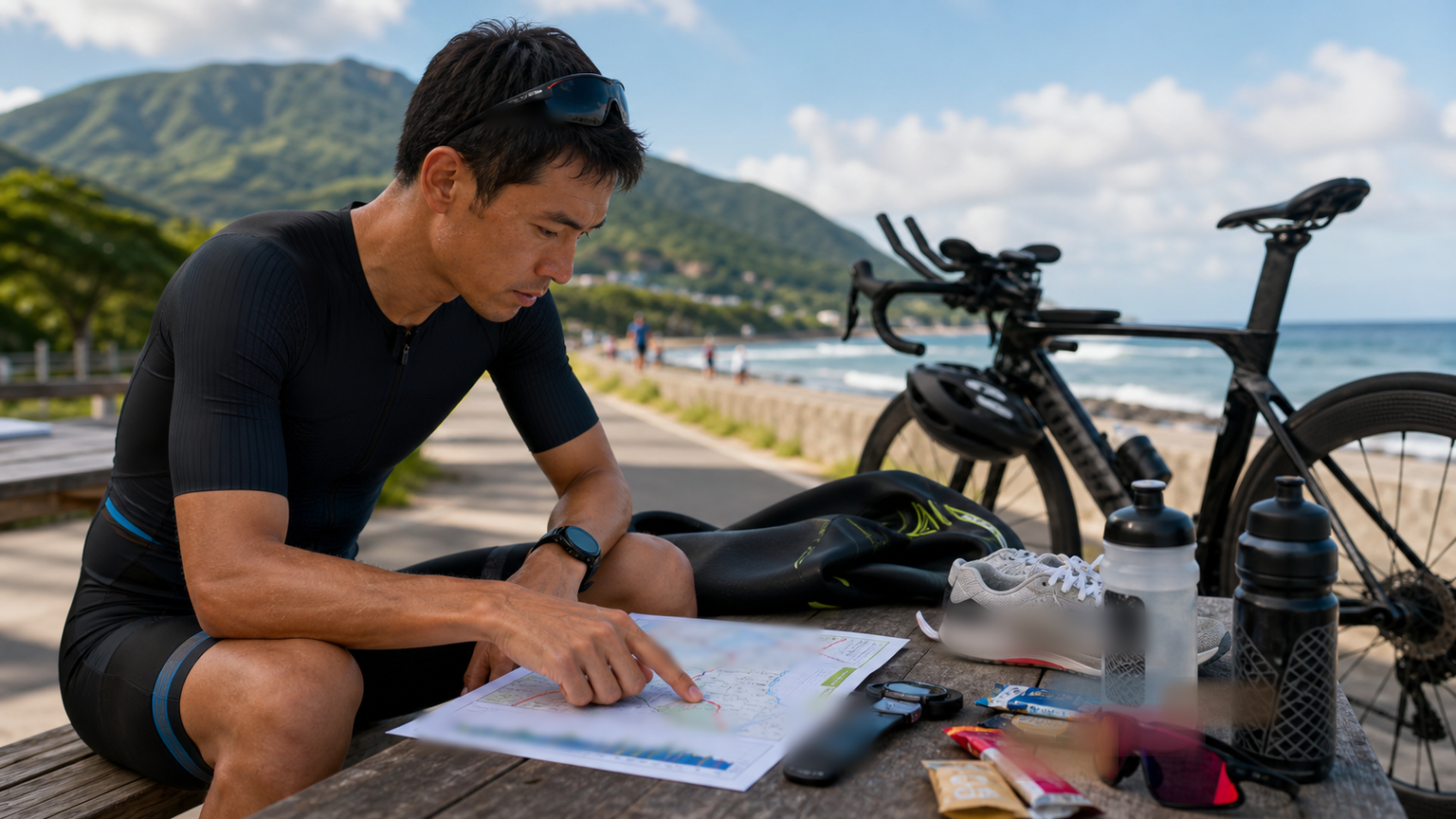
Course Homework: Turning Uncertainty into a Plan
With the same fitness level, those who do their course homework pace more accurately. Reading the elevation profile, turns, aid stations, and typical wind patterns before the race is like writing a “segmented instruction sheet” in advance.
Turning Course Intel into Pacing Instructions
| Course Intel | Pacing Instruction |
|---|---|
| First 30km of the bike leg has more climbing | Widen power ceiling by +5%, but keep IF within target |
| Headwind section at the turnaround point | +10W into the headwind, ease off on the tailwind return |
| Multi-loop marathon | Set the same splits for each lap; don’t break the first lap’s pace in later laps |
| Long distance between aid stations | Carry extra fluid from the previous station |
How to Read the Elevation Profile
Don’t just look at total elevation gain—look at the “distribution.” Whether the climbing is concentrated in the front or back half of the bike leg completely changes your pacing strategy: if the climbs come late, you need to conserve more energy early on.
The Weight of Wind
On out-and-back courses, it’s worth investing more power into headwind sections (high marginal benefit), but never push hard on tailwind sections (extremely low marginal benefit). Check the region’s typical wind patterns and timing for that season before race day.
Mapping Out Aid Stations
Mark every aid station on your plan and align it with your fueling timeline. If the gap between two stations is especially long, you need to carry more from the previous one—this kind of planning can only be done before the race; thinking about it mid-race is already too late.
Using Multi-Loop Courses Psychologically
Multi-loop courses turn “an unknown long distance” into “repeated known short loops,” making it easier to break down mentally. Set “don’t break the first lap’s pace” as your discipline anchor.
Translating Course Intel into an “Instruction Sheet Taped to Your Bike”
With the same fitness level, those who do their course homework pace more accurately. Don’t just look at total elevation gain on the profile—look at the “distribution”: whether the climbing is concentrated in the front or back half of the bike leg completely flips your pacing strategy—if the climbs come late, you must conserve more energy early on. The same logic applies to wind: on out-and-back courses, headwind sections have high marginal benefit and are worth an extra 10W, but never push on tailwind sections. Write these decisions into an instruction sheet and tape it to your stem before race day, so you won’t have to judge the terrain on the fly.
Turning Course Intel into Pacing Instructions
| Intel | Pacing Instruction |
|---|---|
| First 30km has more climbing | Widen power ceiling by +5%, keep IF within target |
| Out-and-back headwind section | +10W into the wind, ease off with the tailwind |
| Multi-loop marathon | Same splits each lap, don’t break the first lap |
| Long distance between aid stations | Carry extra fluid from the previous station |
Common Mistake: Judging Terrain and Fueling Mid-Race
The biggest waste is leaving course decisions to improvisation during the race—hesitating on whether to push harder when the headwind hits, or regretting not carrying more water when you realize the gap between stations is especially long. By then it’s already too late. Multi-loop courses are actually an advantage: they turn an “unknown long distance” into “repeated known short loops.” Set “don’t break the first lap’s pace” as your discipline anchor, and it’s easier to break down mentally. Those who can read a course have essentially raced it in advance.
When I coach athletes, we always read the course map together before the race and translate it into an instruction sheet taped to the bike. Race day shouldn’t be about judging terrain on the fly—those decisions should have been made on the map long before. Those who can read a course have essentially raced it in advance.
Related Reading
- Triathlon Race Simulation Training: A Systematic Rehearsal Strategy from Half to Full Distance
- Triathlon Bike Leg Optimization: T1 Transition and Riding Strategy from Swim Exit to Run Start
- Triathlon Climbing Course Pacing: Uphill Power and Downhill Risk Management
- The Pacing Philosophy of the Triathlon Bike Leg: Why “Fastest” Here Isn’t Really Fastest
西進武嶺配速器 3.0更新 / NEW 免功率FTP估算! / 大數據xAI體能模型 / 如何模擬人止關前集團效應 / 配速儲存功能 / AI全台自行車賽事行事曆 / 公路車 / CT Yeh
1 年前
#公路車 #西進武嶺 配速配瓦實驗 坡度分析 四小時內攻略 建大盃 NeverStop #西進武嶺攻略
6 年前
西進武嶺各路段 前8000名 大數據分析 配速攻略/功率/心律/推力比/維持率/踏頻/踏瓦比/牽車率 大公開 | 建大盃 NeverStop 可參考 | 公路車 | CT Yeh
5 年前
西進武嶺 自製新版AI配速表產生器 x 賽前攻略 抱佛腳! 沒有功率計也可以產生配速表嗎?有什麼其他眉角賽前要注意的呢? | 西進武嶺 / 東進武嶺 KOM 攻略 | 公路車 | CT Yeh
4 年前
西進武嶺 免費訓練分析服務 Intervals | 練不夠還是練過頭?你哪一種類型選手?AI模型告訴你! | 備戰神器 | 公路車 訓練 | CT Yeh
4 年前
單車AI教練!全新 ChatGPT4o 幫你分析訓練成果!排武嶺課表,分析騎車姿勢! 太神了! / 公路車 / CT Yeh / feat. 緯緯
2 年前
武嶺配速表最佳使用方式 #bike
1 年前
#公路車 #Fitting 靠人工智慧APP 幫你調整單車
6 年前