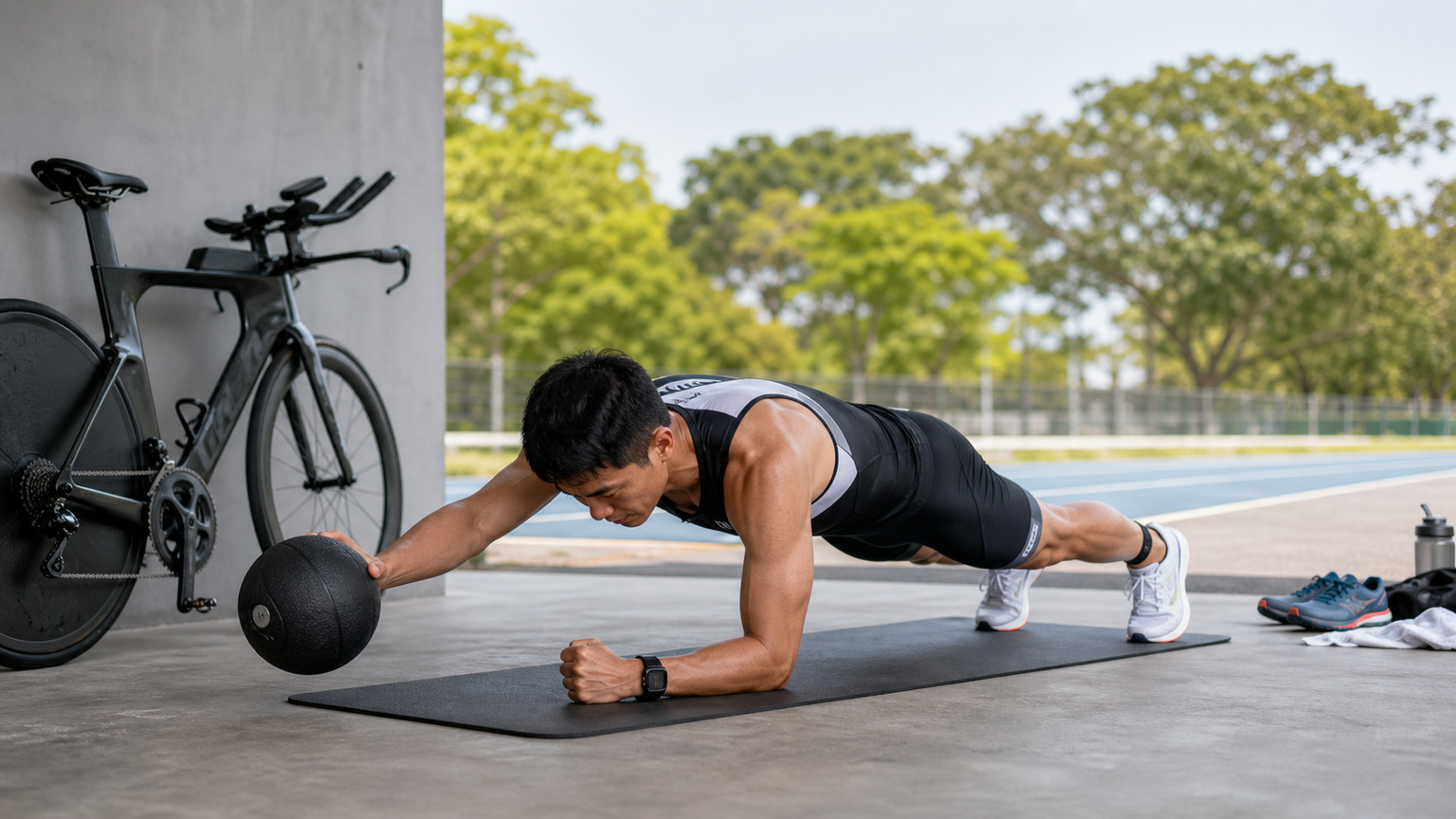
The True Purpose of the Core: Force Transfer and Posture Maintenance
Triathletes train their core not for six-pack abs, but to “hold the aero position on the bike, keep running form from collapsing, and prevent power leakage.” A weak core means the TT aero position can’t be held for long, running form deteriorates in the later stages, and pedaling power leaks through the pelvis.
Key Triathlon Core Exercises
| Function | Training Type | Example |
|---|---|---|
| Anti-extension | Maintain TT aero position without sagging the lower back | Plank variations, ab wheel |
| Anti-rotation | Prevent torso from twisting side to side while running | Pallof press, single-arm loaded carries |
| Anti-lateral flexion | Lateral stability in running form | Side plank, unilateral loaded carries |
| Hip force transfer | Transfer power in pedaling/running | Bridge, dead bug |
Why “Resisting” Matters More Than “Moving”
The triathlete’s core job is to “stay still during movement” (stabilize the torso so the limbs can generate force), so anti-rotation and anti-extension training is more sport-specific than “moving” exercises like sit-ups.
Aero Position Specifics: The Cost of a Weak Core
With a weak core, you’ll sag and sit up after 40 minutes in the TT aero position, causing a sharp increase in wind resistance and a drop in power output. Doing anti-extension core work 3 times per week can significantly extend the time you can maintain the aero position.
Preventing Late-Race Running Form Collapse
When the torso “falls apart” in the later stages of a marathon, ground contact time increases and running economy drops. Anti-rotation core training helps you maintain efficient running form under fatigue, effectively delaying the breakdown.
Prescription Principles
2–3 times per week, 10–15 minutes per session, prioritizing quality over quantity; schedule it after training rather than replacing sport-specific work. Maintain the dose before races—don’t increase it.
The Core Logic: “Anti-Movement” Beats “Movement”
Triathlon core training isn’t about building six-pack abs—it’s about holding the aero position, preventing running form collapse, and preventing power leakage. The key principle is that “resisting” matters more than “moving”: the core’s job is to keep the torso still while the limbs generate force. Therefore, anti-extension (maintaining the TT aero position without sagging the lower back), anti-rotation (preventing the torso from twisting while running), and anti-lateral flexion training are far more sport-specific than “moving” exercises like sit-ups. A quantitative reference—with a weak core, you’ll sag and sit up after 40 minutes in the TT aero position, causing wind resistance to spike and power output to drop noticeably.
The Four Core Functions and Exercises for Triathletes
| Function | Training Purpose | Example Exercise |
|---|---|---|
| Anti-extension | Maintain TT aero position without sagging the lower back | Plank variations, ab wheel |
| Anti-rotation | Prevent torso twisting while running | Pallof press, single-arm loaded carries |
| Anti-lateral flexion | Lateral stability in running form | Side plank, unilateral loaded carries |
| Hip force transfer | Transfer power in pedaling/running | Bridge, dead bug |
Common Mistake: Turning Core Training into an Extra Source of Fatigue
The most typical error is replacing sport-specific anti-movement training with large volumes of “dynamic” sit-up-style exercises, or training the core to failure and draining energy needed for sport-specific work. The correct approach is 2–3 times per week, 10–15 minutes per session, prioritizing quality over quantity, scheduled after training rather than replacing sport-specific work, and maintaining the dose before races without increasing it. When athletes collapse in the later stages, it’s often not the legs that fail first—it’s the core that falls apart. Once the torso collapses, posture collapses; once posture collapses, performance collapses.
I see athletes collapse in the later stages—often it’s not the legs that fail first, but the core that falls apart. Once the torso collapses, posture collapses; once posture collapses, performance collapses. The core isn’t sexy, but it’s the invisible engine that lets you maintain efficiency until the very end.
Related Reading
- The Complete Core Training Guide for Triathletes: Stability Power Across Swim, Bike, and Run
- Strength Training for Triathletes — Core, Single-Leg, and Posterior Chain Prescriptions for Three-Sport Athletes
- What Does the Core Actually Do? The Right Way to Approach Core Training for Endurance Athletes
- Core Training for Triathlon: Beyond the Plank — A Complete Library of Anti-Rotation and Anti-Extension Exercises
福隆鐵人團練隨拍
8 年前
CT 喇低賽) 武嶺牽車 才是王道 西進牽車四小時內秘訣 攝手位置 如何判斷 防抽筋小秘訣
7 年前
FTL 與 SYB 車隊專訪 西進武嶺 實用攻略分享! 2小時 如何練?!你不知道的眉角!新手準備武嶺必看 EP1 | 實力派女車友 | 精華版 | 公路車 | CTYeh
4 年前
Never Stop 西進武嶺 前後雙機 完整全程錄影 訓練台 實境
8 年前
西進武嶺 免費訓練分析服務 Intervals | 練不夠還是練過頭?你哪一種類型選手?AI模型告訴你! | 備戰神器 | 公路車 訓練 | CT Yeh
4 年前
大禹嶺 到 武嶺牌樓 全程前後實況錄影 | 北進武嶺 | 東進武嶺 | KOM | 訓練台 | 坡度分析 | Taiwan KOM Last 10 km HARD | 公路車
6 年前
Live) 備戰2019彰化經典百K 賽前攻略 (已完賽請看新影片
7 年前
實景訓練台) 彰化經典百K 高強度喵團 90分鐘 跟著一起練功 2019 Indoor workout Changhua Classic 100 Taiwan
7 年前