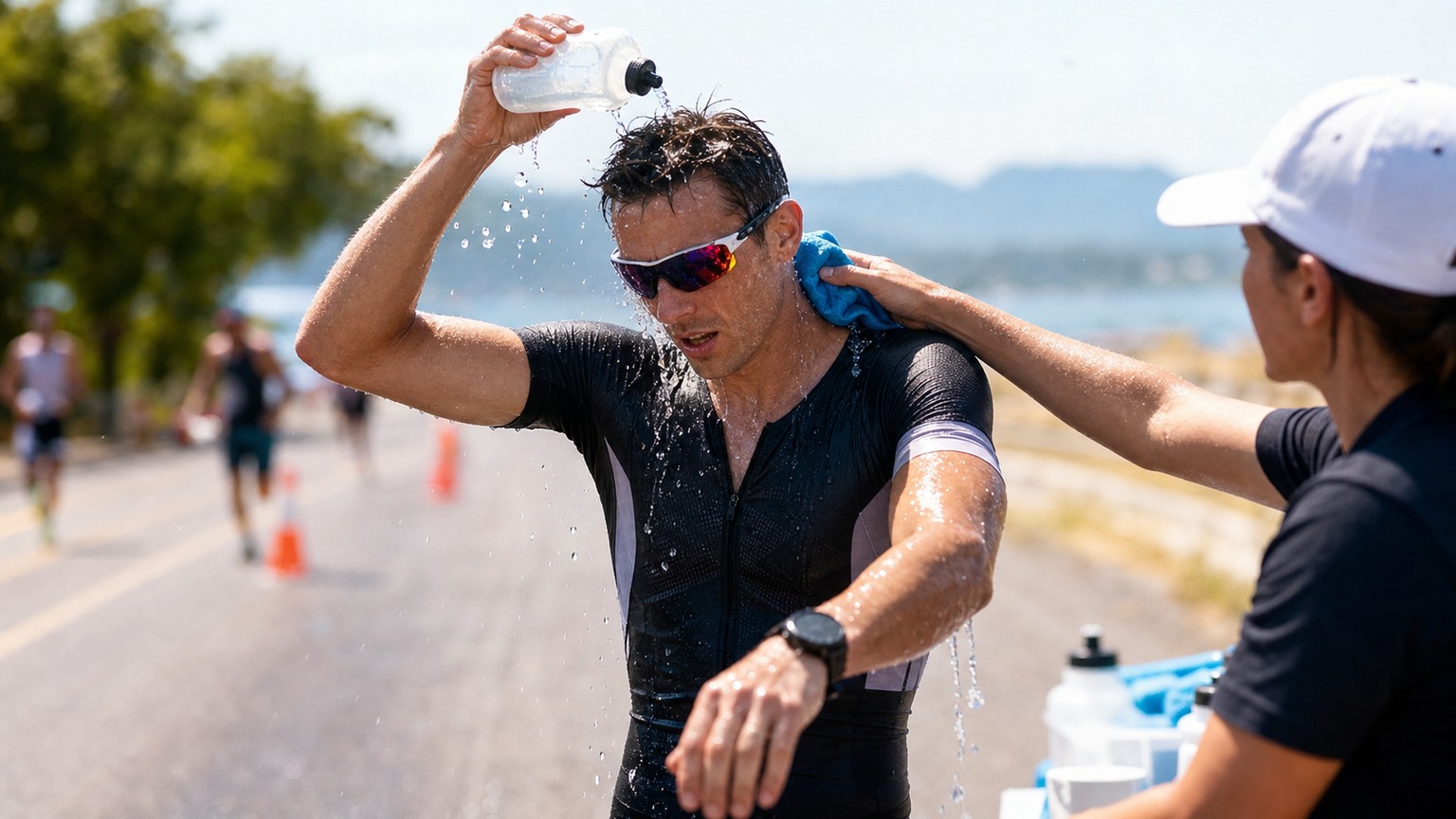
Core Body Temperature Is the Real Limiter in Hot Races
When your pace drops in hot races, the root cause is your core temperature approaching a critical threshold, prompting the body to actively reduce power output to protect itself. Beyond long-term heat acclimatization, pre-cooling before the race and active cooling during the race can significantly delay this critical point.
Cooling Methods and Timing
| Timing | Method | Mechanism |
|---|---|---|
| 30–60 min before race | Ice drinks/slushies, ice vests | Pre-lower core temperature |
| Bike leg | Continuously pour water on head, neck, forearms; take ice drinks | Evaporative heat dissipation |
| Run leg | Pour water at aid stations, sponges, ice packs on neck/groin | Cooling at major blood vessels |
| Entire race | Increase fluid and sodium intake | Maintain sweating and heat dissipation capacity |
The Value of Pre-Race Cooling
Consuming a slushie or wearing an ice vest before the race is like “banking a discount” on your core temperature, delaying the point at which you hit the ceiling during the race. It’s long-lasting but requires race organizer approval and logistics coordination.
The Science of Where to Pour Water During the Race
Pouring water on the head, neck, and forearms—areas with rich superficial blood flow—yields the highest evaporative cooling efficiency; pouring it on the thighs is less effective. During the run leg, placing ice on the back of the neck and the groin (major blood vessels) cools you fastest.
Pacing Itself Is a Cooling Strategy
On hot days, proactively dropping your bike IF by 0.02–0.03 is the most effective “cooling”—less heat production means your body temperature stays manageable. Stubbornly holding your usual hot-weather pace almost always ends in a blowup.
The Link Between Hydration and Heat Dissipation
Dehydration reduces sweating and skin blood flow, weakening heat dissipation. Increasing fluid and sodium intake in hot races isn’t just about preventing dehydration—it’s a prerequisite for keeping the “heat-dissipating machine” running.
In-Race Active Cooling: Site Selection and the Pacing Cost
The real limiter in hot races is core temperature approaching a critical threshold, prompting the body to actively reduce power output to protect itself. Beyond long-term heat acclimatization, active cooling during the race can delay that critical point: pour water on the head, neck, and forearms—areas with rich superficial blood flow—for the highest evaporative cooling efficiency; pouring on the thighs is less effective. During the run leg, placing ice on the back of the neck and the groin (major blood vessels) cools you fastest. Consuming a slushie or wearing an ice vest 30–60 minutes before the race is like “banking a discount” on your core temperature, delaying the point at which you hit the ceiling during the race.
Cooling Methods and Timing
| Timing | Method | Mechanism |
|---|---|---|
| 30–60 min before race | Slushies, ice vests | Pre-lower core temperature |
| Bike leg | Continuously pour water on head, neck, forearms | Evaporative heat dissipation |
| Run leg | Ice packs on back of neck/groin | Cooling at major blood vessels |
| Entire race | Increase fluid and sodium intake | Maintain sweating and heat dissipation |
Common Mistake: Stubbornly Using Your Normal Pace on Hot Days
The most fatal error is still applying your usual IF on hot days. Heat production exceeds heat dissipation capacity, core temperature climbs relentlessly until the body is forced to drastically cut power or even suffer heatstroke. Pacing itself is the most effective cooling method—on hot days, proactively dropping your bike IF by 0.02–0.03 means less heat production, keeping your body temperature manageable. Dehydration weakens sweating and skin blood flow; increasing fluid and sodium intake isn’t just about preventing dehydration—it’s a prerequisite for keeping the “heat-dissipating machine” running. A hot race isn’t a competition against your rivals; it’s a competition against your own body temperature.
My iron rule for athletes in hot races: You’re not racing your rivals—you’re racing your own body temperature. Pour water, take ice, and proactively dial your pace back a notch—those who don’t crack under the blazing sun rely not on stronger legs, but on calmer temperature management.
Related Reading
- The Complete Guide to Cooling Strategies for Hot Races: Pre-Race Cooling, In-Race Cooling, Gear Adjustments, and Pacing Breakdown
- Active Cooling for Hot Races: Pre-Race Cooling, In-Race Ice Drinks, and Managing “Core Body Temperature”
- Practical Running Cooling Strategies: Core Pre-Cooling, Carotid Ice Packs, and the Science of In-Race Cooling
- Running in Hot Environments: Strategies for Core Temperature, Hydration, and Pace Decay
西進武嶺 自製新版AI配速表產生器 x 賽前攻略 抱佛腳! 沒有功率計也可以產生配速表嗎?有什麼其他眉角賽前要注意的呢? | 西進武嶺 / 東進武嶺 KOM 攻略 | 公路車 | CT Yeh
4 年前
西進武嶺 免費訓練分析服務 Intervals | 練不夠還是練過頭?你哪一種類型選手?AI模型告訴你! | 備戰神器 | 公路車 訓練 | CT Yeh
4 年前
#公路車 #Fitting 靠人工智慧APP 幫你調整單車
6 年前
#公路車 #西進武嶺 配速配瓦實驗 坡度分析 四小時內攻略 建大盃 NeverStop #西進武嶺攻略
6 年前
西進武嶺配速器 3.0更新 / NEW 免功率FTP估算! / 大數據xAI體能模型 / 如何模擬人止關前集團效應 / 配速儲存功能 / AI全台自行車賽事行事曆 / 公路車 / CT Yeh
1 年前
CT 喇低賽) 武嶺牽車 才是王道 西進牽車四小時內秘訣 攝手位置 如何判斷 防抽筋小秘訣
7 年前
武嶺配速表最佳使用方式 #bike
1 年前
2016/05/13 單車 冷水坑下滑
10 年前