文章導覽
The Complete Bike Saddle Buying Guide: Say Goodbye to Long-Ride Pain
That “things down there really hurt” feeling after a long ride is something a lot of riders know all too well.
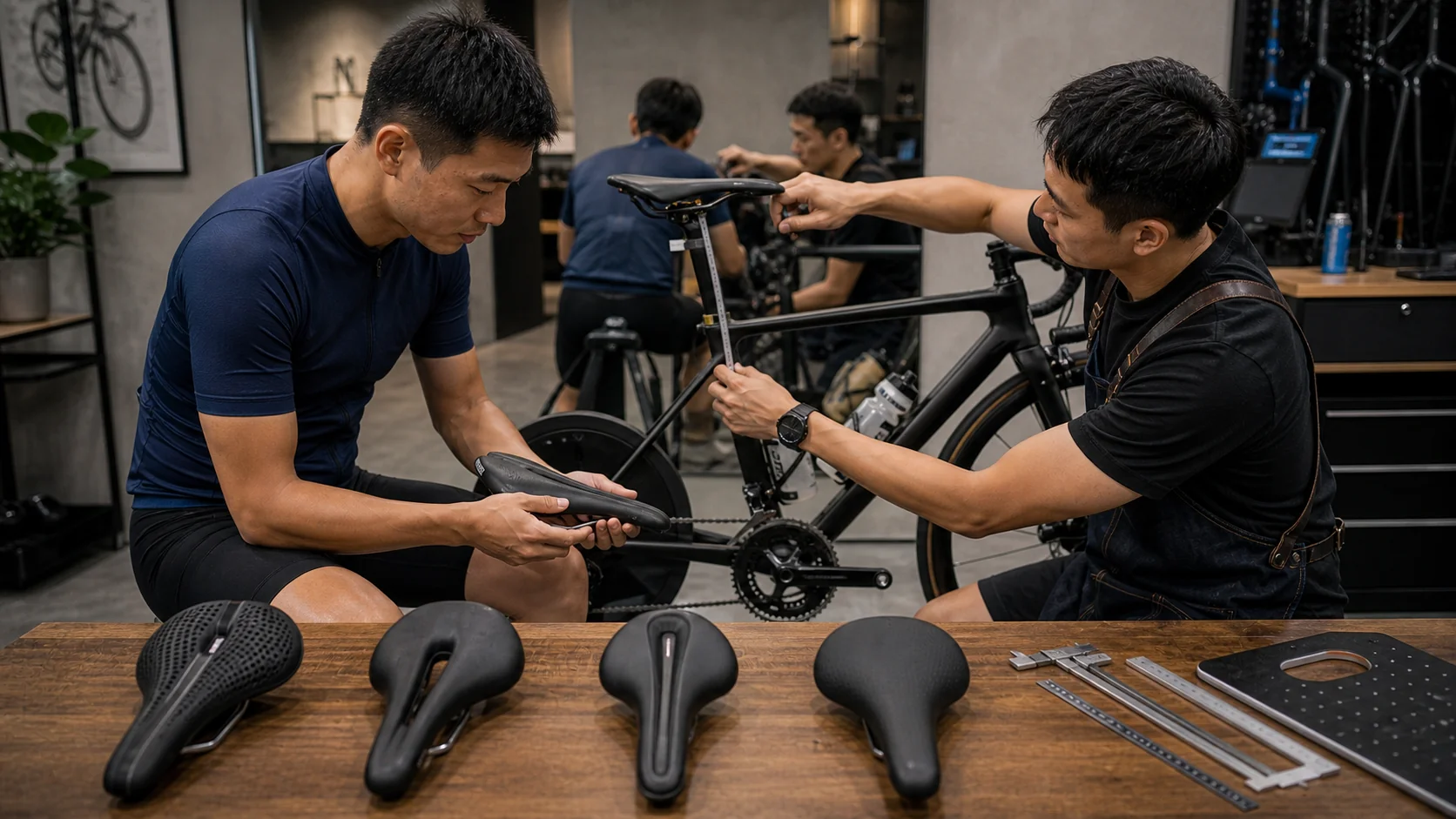
But the problem usually isn’t that you’re riding too much — it’s that you picked the wrong saddle. Get the right saddle, and you can ride for three-plus hours and barely notice it’s there.
The Root Cause of Saddle Pain
Anatomy Basics
When you ride, most of your weight is supported by your ischial tuberosities (sit bones) — the two bony points at the base of your pelvis.
An ideal saddle lets these two points land precisely on the saddle’s weight-bearing area. If your sit bones are wider than the saddle, weight ends up on soft tissue instead; if the saddle is much wider than your sit bones, you’re prone to inner-thigh chafing.
Sit Bone Width: The Most Critical Measurement
How to measure your sit bone width:
- Sit on a piece of memory foam or corrugated cardboard, simulating your riding position (leaning forward slightly)
- Look at the distance between the centers of the two sit-bone impressions
- That distance is your “sit bone width”
Alternative method: many bike shops offer sit bone measurement services using dedicated memory foam pads or digital measuring plates.
Matching Sit Bone Width to Saddle Width
| Sit Bone Width | Recommended Saddle Width |
|---|---|
| <100mm | 130-143mm |
| 100-130mm | 143-155mm |
| 130mm+ | 155-168mm |
Note: this is a general guideline only — you still need to test-ride to confirm the right fit.
Understanding Saddle Shape
Nose Length
Long-nose (traditional) saddles:
- More room for pelvic rotation
- Suited to a lower, more aerodynamic position
Short-nose / blunt-nose saddles:
- Reduce perineal pressure
- Increasingly popular in modern designs
- Especially good for riders with perineal pain issues
Center Cutout Design
Many modern saddles feature a central channel or a fully open cutout:
Purpose:
Reduces direct pressure on the perineal area (the male prostate region, or the female vulva).
Who needs a cutout saddle:
If you experience leg numbness, perineal pain, or urinary tract issues (in men) after riding, a cutout design may help.
Saddle Firmness
Common misconception: softer saddles are more comfortable
Reality: an overly soft saddle lets your sit bones sink in, which actually increases pressure on soft tissue.
The right firmness (foam density) gives your sit bones proper support while keeping soft tissue from taking on excess pressure.
General rule of thumb:
- Short urban rides (<1 hour): a slightly softer saddle is fine
- Long rides (2+ hours): medium firmness is most comfortable
- Competitive riding: firmer saddles, to minimize energy loss
Differences Between Men’s and Women’s Saddles
Women’s pelvises are generally wider than men’s (greater sit bone width), and the forward-lean angle differs too.
Characteristics of women’s saddles:
- Usually wider (to accommodate wider sit bones)
- Central cutout or channel is typically larger
- Usually shorter in length
Rule of thumb:
Don’t buy a saddle just because it’s marketed as a “women’s model” — choose based on your own sit bone width and riding position. Some women are better suited to men’s saddles, and vice versa.
How to Test-Ride a Saddle
The Right Way to Test a Saddle
You can’t just sit on it for a few minutes and call it done. Saddle comfort can really only be judged in the dynamics of actual riding.
Test-ride tips:
- Test it in your actual riding position (not just perched on the shop floor)
- Ride for at least 20-30 minutes
- Compare different widths and shapes
Test-ride programs at Taiwanese bike shops:
More and more bike shops in Taiwan offer “try before you buy” saddle programs — borrow a saddle, take it for a real test ride, and only buy it if you’re satisfied. This is the most highly recommended way to shop.
The Impact of Saddle Height and Position
Even with the perfectly correct saddle, incorrect installation can still cause pain.
Seatpost Height
The most common problem: the seatpost is set too low
A seatpost that’s too low causes excessive knee bend, increases knee stress, and lets your sit bones “sink into” the saddle.
Basic setup method:
- Pedal to the bottom of the stroke
- Rest your heel on the pedal (not the forefoot)
- Adjust until your leg is nearly fully extended (with a slight bend remaining)
A more precise setup requires a professional bike fitting.
Fore-Aft Saddle Position
The saddle can be adjusted forward and backward (using the rail clamp).
Impact: fore-aft position affects your knee’s position relative to the pedal at its highest point (the KOPS principle), as well as upper-body comfort.
Recommendation: if you have persistent knee or back issues, seek out a professional bike fit.
Brand Recommendations
Entry-level / Best Value (NT$1,000-3,000)
Selle Royal: a long-established Italian brand offering a wide range of shapes and widths at a great price point.
Velo: a Taiwanese OEM manufacturer that supplies many well-known brands — its own-brand saddles are excellent quality.
Mid-range (NT$3,000-8,000)
Selle Italia: an Italian brand with a “Form to Function” philosophy and a clear selection matrix for different riding positions.
Fizik: an Italian brand that uses three “spine type” categories (Snake, Bull, Chameleon) to help you find the right saddle shape.
Specialized Power series: the flagship example of short-nose design, and hugely popular.
High-end (NT$8,000-25,000)
Selle SMP: an Italian brand famous for anatomical design; its distinctive central cutout has been a lifesaver for many riders with comfort issues.
Prologo: an Italian brand, with some models built using 3D-printing technology.
Post-Ride Care
Even with the right saddle, proper care still matters:
The importance of chamois pad:
A good chamois pad is just as important to comfort as the saddle itself. Applying chamois cream to the pad before every ride dramatically reduces chafing.
Recommended chamois creams:
- Assos Chamois Crème
- DZ Nuts
- Chamois Butt’r
Conclusion
Choosing the right saddle isn’t just about comfort — it’s the key to being able to keep riding, ride after ride.
Core buying steps:
- Measure your sit bone width
- Choose a shape based on your riding position (upright / leaned forward)
- Test-ride whenever possible before buying
- Confirm your seatpost height and fore-aft position are correct
Once your saddle problem is solved, you’ll be amazed at how comfortably you can cover long distances.
