The Science of Winter Training: Using the Off-Season to Prepare for Next Year’s Breakthrough
For cyclists, November through January is the period most easily “wasted” — riding volume drops, goals become vague, and riders often end up neither properly resting nor systematically building a base for the next season. This article offers a sports-science-based off-season training framework so your winter becomes the secret weapon behind your spring breakthrough.
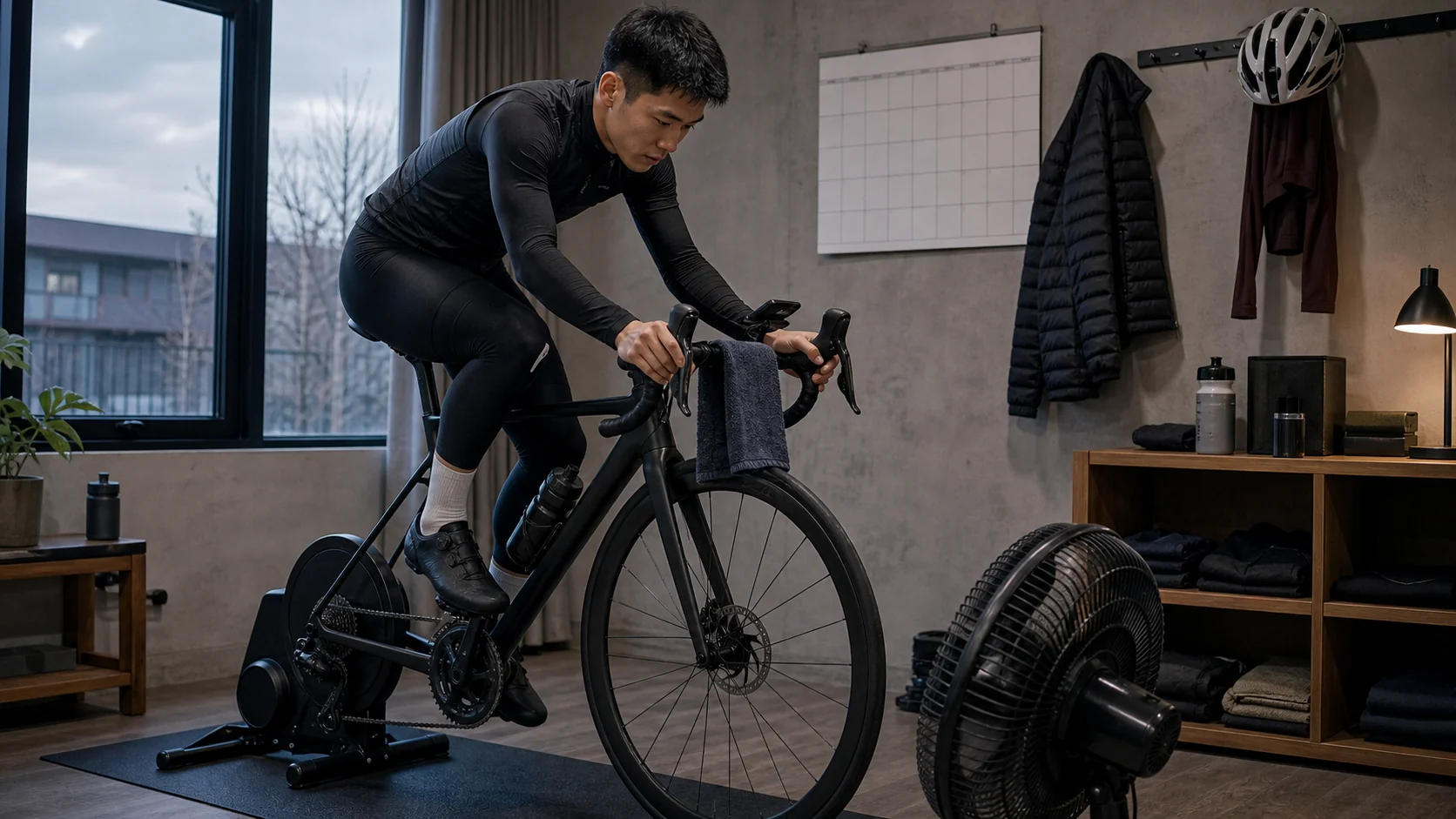
Why the Off-Season Matters
Annual Training Periodization
Professional riders don’t train at high intensity year-round — they follow the principle of periodization:
| Training Phase | Months (Taiwan) | Focus |
|---|---|---|
| Post-season recovery | October | Complete physical and mental rest |
| Off-season / base phase | November–January | Aerobic base, strength training |
| Build phase | February–April | Intensity gradually introduced |
| Peak / race phase | May–September | Race-specific training |
The purpose of winter training: Build a wider “aerobic base” so that spring’s high-intensity training has a better platform to stand on.
The “Wider Base” Analogy
Think of training adaptation as a pyramid:
- Base (bottom) = aerobic capacity (Zone 2 ability)
- Peak (top) = maximum power output
The wider the base, the higher the peak can be stacked. Winter training is the best time to widen that base.
Core Principle 1: Protect the Aerobic Base
The Biggest Winter Training Mistake
Stopping riding entirely.
Even 2–3 weeks of no riding at all causes significant regression in aerobic adaptations (declining mitochondrial density, fewer capillaries). Start again after 3 months and you’ll have to rebuild most of your aerobic base almost from scratch.
The right approach: Reduce training volume, but maintain a minimum riding frequency.
Minimum Winter Maintenance Volume
| Level | Minimum Weekly Riding |
|---|---|
| Casual recreational | 2–3 rides/week, 60–90 min each |
| General recreational | 3–4 rides/week, 90–120 min each |
| Serious recreational | 4–5 rides/week, 90–180 min each |
Intensity should mainly be Zone 2 (low aerobic intensity) — conversational pace, heart rate at 65–75% of max heart rate.
Core Principle 2: The Art of Zone 2
What Is Zone 2?
Zone 2 (low aerobic intensity) is the intensity below lactate threshold 1 (LT1):
- You can speak normally (without gasping)
- Heart rate: roughly 65–75% of max heart rate
- Power: roughly 55–65% of FTP
Why is Zone 2 so important?
| Adaptation | Mechanism |
|---|---|
| Increased mitochondrial density | More “energy factories” inside cells |
| Improved fat-burning efficiency | More fat used at aerobic intensity |
| Increased cardiac stroke volume | More blood pumped per heartbeat |
| Increased capillary density | More efficient oxygen delivery to muscles |
The Minimum Effective Dose of Zone 2
Research suggests: at least 150–200 minutes per week (about 3–4 sessions of 60 minutes) of Zone 2 aerobic work is needed for significant adaptation.
Recreational riders often fall short on Zone 2 because:
- It feels too easy, “not like real training”
- There’s no time carved out for long Zone 2 sessions
- It’s easy to unknowingly drift up into Zone 3 during Zone 2 sessions
How to confirm you’re in Zone 2:
- Using a power meter (55–65% of FTP) is the most accurate method
- Without a power meter, use heart rate (65–75% of max heart rate)
- Subjectively: you can talk comfortably, but you can’t sing
Core Principle 3: Integrating Strength Training
(For the complete 12-week plan, see the article “Strength Training Plans for Cyclists.”)
Key Points for Integrating with Riding
| Principle | Explanation |
|---|---|
| Keep strength training separate from high-intensity riding | Doing both on the same day interferes with each |
| Easy recovery riding after strength training | Zone 1–2 aerobic work can aid recovery |
| Don’t do strength training every day | Muscles need recovery days to adapt |
Priority Off-Season Strength Exercises
- Squat: the most important movement for pedaling power
- Bulgarian split squat: single-leg training that maps directly to riding
- Romanian deadlift: strengthens the glutes and hamstrings
- Glute bridge / hip thrust: glute-specific training
- Core stability: planks, bird-dogs, and similar exercises
Core Principle 4: Technique Improvement
The off-season is the best time to improve technique because:
- There’s no need to worry about affecting race performance
- There’s time to try different setups (bike fitting adjustments)
- Slow, deliberate practice is possible on an indoor trainer
Winter Technique Training Focus
| Technique | Training Method | Goal |
|---|---|---|
| Pedaling efficiency | Single-leg pedaling drills (on trainer) | Improve pedal stroke smoothness |
| High cadence | 110–120rpm light-gear training | Increase neural drive frequency |
| Time trial position | Gradually adapt to the aero position | Prepare for spring time trials |
| Climbing rhythm | Indoor simulated climbing | Build a sense of rhythm |
A Sample Week of Winter Training
For serious recreational riders (10–12 hours of training time per week):
| Day | Session | Duration | Intensity |
|---|---|---|---|
| Monday | Strength training A | 60 min | Medium-high |
| Tuesday | Ride (Zone 2) | 90 min | Low |
| Wednesday | Strength training B | 60 min | Medium-high |
| Thursday | Ride (Zone 2) | 90 min | Low |
| Friday | Strength training A | 60 min | Medium-high |
| Saturday | Long ride (Zone 2) | 180 min | Low |
| Sunday | Rest or easy ride | 60 min | Very low |
Weekly adjustment:
- Schedule a “deload week” every 3–4 weeks (training volume reduced 30–40%)
- The deload week lets the body supercompensate
The Mental Side: Enjoying Winter Training
Shifting Your Mindset
Winter training often leaves riders feeling discouraged because:
- Power numbers are lower than in summer
- The weather is bad and motivation is low
- It feels like “no progress” is being made
The right mindset for winter training:
- “Winter is the investment, spring is the harvest”
- You don’t need to chase speed every time — quality isn’t about power, it’s about consistency
- Think of every Zone 2 ride as making a “deposit”
Keeping the Social Element
Don’t go it alone just because “winter training is the aerobic base phase”:
- Weekend easy rides are perfect for bringing friends
- Bike café culture: socializing and refueling after a ride
- Join winter indoor Zwift community events
Assessing the End of Winter Training
In late January to early February, before entering the build phase, do an FTP test:
- If FTP is higher than or equal to the end of last season: winter training was a success
- If it has dropped noticeably: check whether training volume was too low
Signs of successful winter training aren’t just FTP:
- Is heart rate lower at the same power (improved aerobic efficiency)?
- Has fatigue on long rides improved?
- Have strength training loads increased noticeably?
Conclusion
Winter training is the phase in the annual cycling training cycle that is most easily underestimated and most poorly executed. But it’s also the most important base-building phase — done right, winter training gives you a sense that “this year is different” the first time you clip in come spring.
Turn winter into your secret advantage: while others rest, you build.
Related Reading
- Cross-Season Training for Cyclists: Maintaining Fitness Through Winter
- Building an Aerobic Base on the Bike: Why Long, Slow Winter Rides Matter
- Strength Training Plans for Cyclists: The Golden 12 Weeks of the Off-Season
- Winter Base Phase Training Plan: Building the Fitness Foundation for Next Season
西進武嶺 免費訓練分析服務 Intervals | 練不夠還是練過頭?你哪一種類型選手?AI模型告訴你! | 備戰神器 | 公路車 訓練 | CT Yeh
4 年前
單車AI教練!全新 ChatGPT4o 幫你分析訓練成果!排武嶺課表,分析騎車姿勢! 太神了! / 公路車 / CT Yeh / feat. 緯緯
2 年前
單車賞雪 裝備準備及注意事項分享 | 公路車
5 年前
FTL 與 SYB 車隊專訪 西進武嶺 實用攻略分享! 2小時 如何練?!你不知道的眉角!新手準備武嶺必看 EP1 | 實力派女車友 | 精華版 | 公路車 | CTYeh
4 年前
2025 自行車錶排行榜 兩萬車友大數據 / Garmin Bryton 排名會大洗牌嗎? / 全新的碼表前身分析 /公路車 / CT Yeh
1 年前
備戰 戀戀197 賽前關門點分析 西濱團練 #公路車 4K高畫質
6 年前
靠單車減肥35公斤 心得分享與整理
7 年前
秘境雪場 日本 八甲田 冰樹探險與滑雪體驗 ft. Q老師 & 運動生活
7 年前