Introduction
In 2016, Nike launched the Vaporfly 4%, claiming it could reduce a runner’s energy expenditure by 4% — a number that shook the running world. In 2019, Eliud Kipchoge ran a marathon in 1:59:40 wearing carbon-plated shoes, pushing the technology further into the public eye. Today, nearly every major sportswear brand makes a carbon-plated running shoe, and more and more Taiwanese runners are asking: “Do I need carbon-plated shoes?”
The answer isn’t a simple yes or no — it depends on your pace, technique, and intended use.
How Carbon Plates Make You Faster
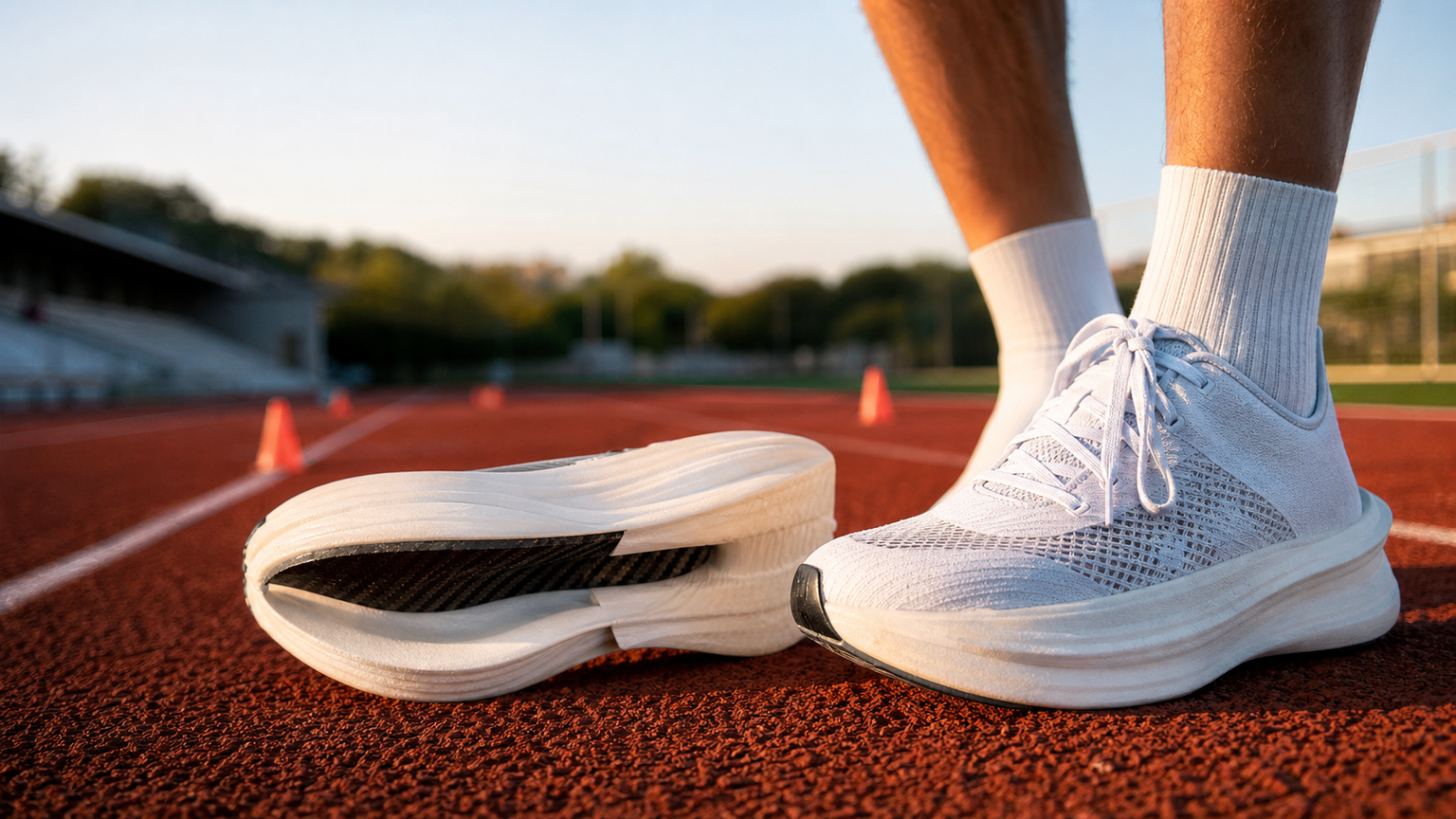
The core principle behind carbon-plated running shoes is “energy return.” In traditional running shoes, the midsole absorbs impact and some of that energy is lost as heat. A carbon fiber plate embedded in an extra-thick, soft midsole (such as Nike ZoomX foam or Adidas Lightstrike Pro) acts as a “rigid lever” — when the forefoot flexes, the plate stores elastic potential energy and releases it at toe-off, propelling the body forward.
Research shows this design can boost energy return efficiency from roughly 60% with traditional EVA foam to over 85%. But there’s a catch: the runner’s cadence and foot-strike pattern must be able to trigger the plate’s elastic cycle.
Who Actually Benefits from Carbon-Plated Shoes
Runners Suited to Carbon Plates
| Condition | Explanation |
|---|---|
| Marathon finish time under 4:30 | Fast enough pace to fully exploit the plate’s rebound rhythm |
| Forefoot or midfoot strike | Heel strikers see relatively lower benefit |
| Cadence above 170 BPM | Higher cadence syncs better with the plate’s elastic cycle |
| Long-distance races | Half and full marathons show the strongest 4–8% benefit |
| Runners in consistent training | Leg strength sufficient to handle the extra calf loading |
When Carbon Plates Are Not Recommended for Regular Use
- Beginners: Without a solid running mechanics foundation, the plate’s feedback can amplify poor form and increase the risk of lower-leg injury.
- Runners in rehab: During recovery from Achilles tendon, metatarsal, or other lower-limb injuries, the forefoot stress concentration from the plate can delay healing.
- Everyday training runs: Carbon-plated midsoles are relatively fragile and wear out quickly under daily training loads; wearing them too frequently during the adaptation period can also cause fatigue.
Comparing Popular Carbon-Plated Shoes
| Brand & Model | Plate Design | Midsole Material | Price in Taiwan | Suitable Pace |
|---|---|---|---|---|
| Nike Vaporfly 3 | Single full-length plate | ZoomX | NT$7,500 | 3:30–5:00/km |
| Adidas Adizero Adios Pro 3 | Multiple carbon rods | Lightstrike Pro | NT$7,000 | 3:20–5:00/km |
| ASICS Metaspeed Sky+ | Full-length plate | FF BLAST TURBO | NT$8,000 | 3:30–5:30/km |
| Saucony Endorphin Pro 4 | Full-length plate | PWRRUN HG | NT$6,500 | 3:40–5:30/km |
| Puma Fast-R NITRO Elite 2 | Full-length plate | NITRO Elite | NT$6,800 | 3:30–5:00/km |
When to Actually Wear Them
Save them for race day is the most widely shared advice. Each pair of carbon-plated shoes has a midsole lifespan of only around 300–500 km before the foam compresses and loses much of its rebound. To be at your best on marathon day, do your training in dedicated trainers and reserve the carbon-plated shoes for races or your final long-distance simulation runs.
Don’t skip the adaptation period: it’s recommended to start wearing them 4–6 weeks before your race, running 10–15 km once or twice a week, letting your calf muscles and Achilles tendon adjust to the different mechanical loading before gradually increasing use.
At major Taiwanese races such as the ING Taipei Marathon and the Wan Jin Shi Marathon, carbon-plated shoes are becoming increasingly common — even sub-5-hour recreational runners report noticeable support benefits in the second half of the race.
Practical Tips
- Before buying carbon-plated shoes, make sure you already have a stable pair of training shoes — don’t make carbon-plated shoes your only pair.
- Pay close attention to forefoot width when trying them on — carbon-plated shoes tend to run narrow, so runners with wider feet should look for wide-fit versions.
- Carbon-plated shoes are not suited to trail running or uneven surfaces; the stiff plate feels awkward and unstable on irregular terrain.
- If budget is a concern, consider a “near-top-tier” option (such as the Nike Pegasus Premium or Brooks Hyperion Elite) — these include a carbon plate at roughly 20% less cost, with very similar performance benefits.
Conclusion
Carbon-plated shoes are a performance tool, not magic. They can amplify good running technique — but they can just as easily amplify the injury risk from poor form. Treat them as your “secret weapon” for race day, and pair them with solid training and a proper break-in cycle to truly experience the speed dividend of the carbon-plate revolution.
Related Reading
- The Science and Buying Guide for Carbon-Plated Running Shoes: Which Runners Are They For?
- How Running Shoes Affect Your PB: The Science of Energy-Saving Carbon Plates and Who They Suit
- Carbon-Plated Shoe Review: The Real Performance Gains of Thick Carbon-Plated Soles for Marathon Times
- The Biomechanics of Carbon-Plated Shoes: The Science Behind Elastic Energy Return and Running Efficiency
Nepest NOVA 碳條輪組:輕量、空力、舒適一次滿足!/ 公路車 / CT Yeh
7 個月前
Unaas X50 全碳纖幅條輪 數據實測對比PK | Lun Hyper 的高階版 | 板輪爬坡也可以很厲害? ! 武嶺2小時大師一起親測! CP值超高 | 公路車 | CT Yeh
4 年前
Garmin Edge 1050 旗艦車錶 全台首測!/ 環法冠軍指定 / 對比Edge 1040改進哪些? / 公路車 / CT Yeh
2 年前
#公路車 #Fitting 靠人工智慧APP 幫你調整單車
6 年前
用了AirTag 單車就不怕被偷?盲點大測試 結果… |公路車|CT Yeh
5 年前
詳測) 小米 電動打氣筒 公路車胎要充多久? 值得買嗎? 米家充氣寶 小心燙手!
7 年前
3D 列印車褲墊 / 舒適改善? / 無痕 x 分區壓縮 / ATK & Decider系列 / JE22黑科技 / #公路車 #CTYEH
11 個月前
CT暗黑廚房) 車友必備 宇宙無敵鮮蚵湯 幫助訓練恢復 天然食補 好市多 超肥鮮蚵 破PR
7 年前