Introduction
The start is the zero moment of every swimming race. A good start allows a swimmer to build an advantage from the very beginning; conversely, a poor start may force you to spend the entire race trying to catch up. For most swimmers, the potential for improvement in starting technique often exceeds their imagination.
Platform starts and in-water starts have clearly defined applications under the rules: freestyle, butterfly, and breaststroke use platform starts, while backstroke uses an in-water start. Understanding the technical essentials of both starting methods is especially important for all-around swimmers.
Platform Start: Technical Breakdown
Modern competitive starts use the “grab start” or the “track start,” with the latter currently being the preferred choice for most swimmers.
Track Start Steps:
- Initial Stance: Grasp the front edge of the starting block with both hands, with one foot at the front of the block and one foot at the back (similar to a track sprint start)
- Set Position: Raise the hips, shift the center of gravity forward, keep the head low, and look at the water
- Takeoff: Drive forcefully off the block with the rear leg, swing both arms forward, and launch the body into the air
- Flight Phase: Keep the body streamlined, tuck the head between the arms, and enter the water at an angle of approximately 30–40 degrees
- Entry: Enter the water hands-first, maintain a streamlined body position, perform a dolphin kick until speed drops, then begin the first stroke
Track Start vs. Grab Start Comparison:
| Comparison Item | Track Start | Grab Start |
|---|---|---|
| Reaction Speed | Faster (more direct drive from the rear leg) | Slightly slower |
| Stability | High (stable foot positioning) | Requires stronger upper-body grip strength |
| Flight Distance | Moderate | Can be longer |
| Entry Angle Control | Easier | Requires more practice |
| Suitable Body Types | Widely applicable | Advantageous for swimmers with long arms |
The Key to the Flight Phase of the Start
Many people believe that jumping high or jumping far makes a good start, but in reality, the entry angle is the most important control target during the flight phase.
The ideal entry angle is approximately 30–40 degrees, allowing the swimmer to reach the optimal propulsion depth below the surface (approximately 0.5–0.8 meters)—not too deep (which increases the time needed to rise) and not too shallow (which creates excessive splash and drag).
Underwater Actions After Entry:
- Maintain a streamlined glide
- Perform a dolphin kick until speed approaches swimming speed
- In freestyle, begin the first stroke approximately 10–15 meters after entry (or when nearing the surface)
- Rule requirement: the head must break the surface before the 15-meter mark
In-Water Start: Backstroke Technical Breakdown
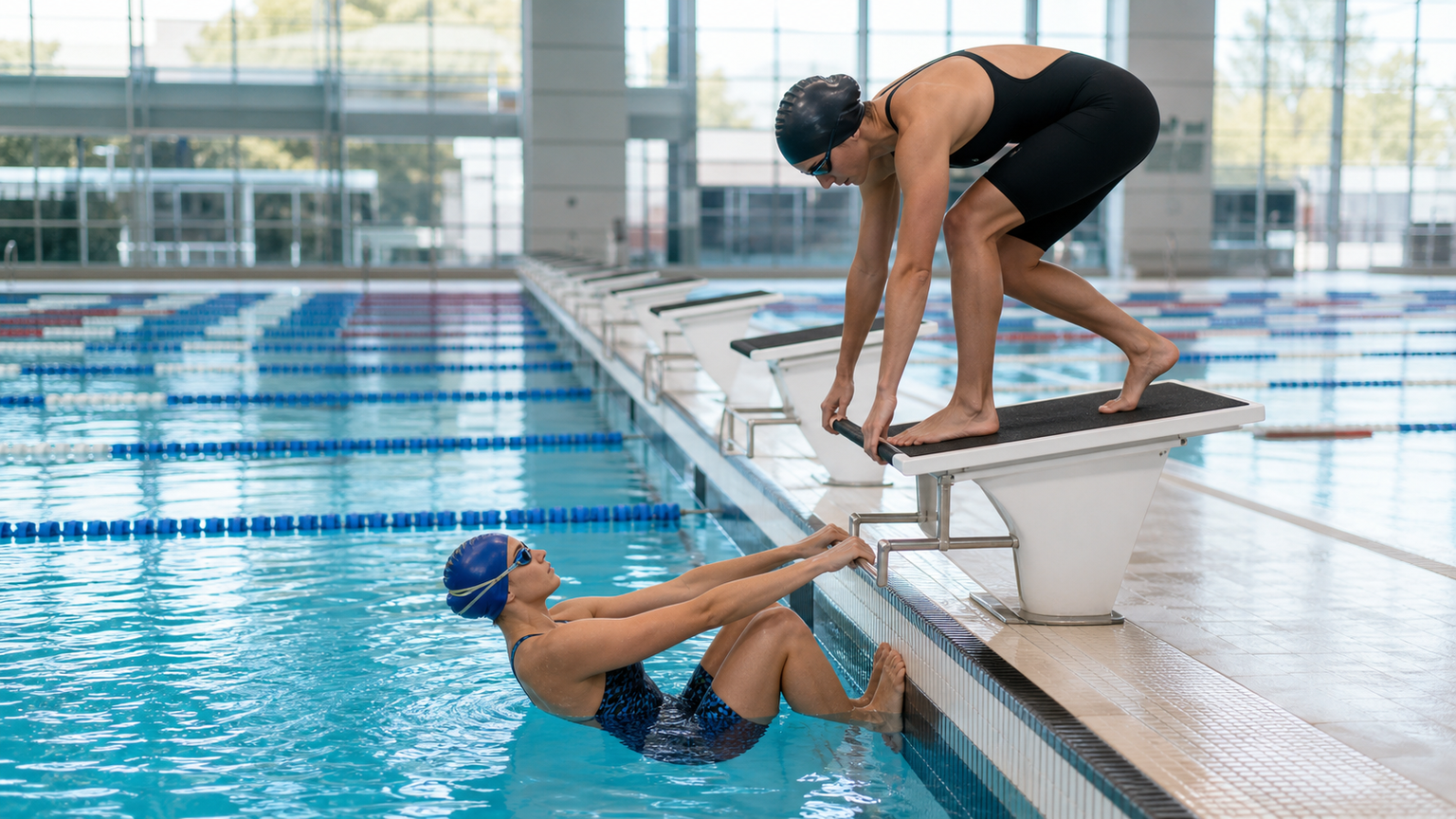
The backstroke in-water start is the most technically complex start among the four strokes, as swimmers must generate force from a stationary position in the water with their back against the wall.
In-Water Start Steps:
- Starting Position: Grasp the starting block (or wall-top) handrails with both hands, place both feet on the wall below the water surface, with knees bent
- Set Position: Lift the hips out of the water, arch the body into a taut position, and prepare to push off the wall
- Wall Push-Off: Drive forcefully off the wall with both legs, swinging both arms upward and backward
- Flight and Entry: Arch the body backward, enter the water hands-first, with the head tucked tightly between the arms
- Underwater Actions: Maintain speed with a dolphin kick, then surface and begin stroking before the 15-meter mark
Common In-Water Start Problems:
| Common Problem | Impact | Correction Method |
|---|---|---|
| Hips too low (not lifted out of the water) | Weak push-off power, poor entry angle | Consciously raise the hips during the set position |
| Hands entering the water too wide | Increased entry drag, loss of streamline | Practice the hands-together entry position |
| Push-off direction upward (rather than backward) | Short flight distance | Adjust foot placement on the wall to below the waterline |
| Head surfacing too early after entry | Loss of underwater propulsion advantage | Strengthen dolphin kick ability, extend underwater time |
Foot Placement Height on the Wall for the In-Water Start
This is the most subtle technical detail in the backstroke start. The position of the feet on the wall affects the direction of the push-off force:
- Feet too high (near the waterline): The body arcs upward significantly after the push-off, the entry angle is steep, and the underwater glide position is shallow
- Feet at moderate height (approximately 30 cm below the waterline): The force direction is angled backward, the flight arc is good, and the entry depth is moderate
- Feet too low: The push-off force is dispersed, failing to fully utilize leg explosive power
Practical Recommendations
- Track Start Practice: First practice the push-off motion on land to familiarize yourself with the feeling of weight transfer, then practice in the pool.
- Timing Start Efficiency: Measure the time and distance from the start to the first stroke, using this as a quantitative indicator for start training.
- Underwater Dolphin Kick Strengthening: Regardless of the start type, the quality of the underwater dolphin kick directly determines the effectiveness of the start and should be a regular training item.
Conclusion
Improving starting technique requires repeated practice and attention to detail, but the payoff is substantial. A perfect start not only provides a speed advantage but also builds psychological confidence, leading to a better overall race performance. Treating the start as an independent technical module in training is one of the most efficient ways to improve competitive results.
Related Reading
CT 喇低賽) 武嶺牽車 才是王道 西進牽車四小時內秘訣 攝手位置 如何判斷 防抽筋小秘訣
7 年前
滑雪新手們慘摔學習全紀錄(請開字幕),滑雪好好玩 | Snowboard + Ski | 岩原 スキー場 | 滑雪APP使用 | GoPro Max
6 年前
戰略) Zwift Race 如何咬在第一集團 如何評估自己要開多少推力 (請開1.5倍速看)
7 年前
#PUSHBIKE 原來這麼好玩! 小朋友 滑步車 初體驗 超可愛
6 年前
崇越盃武嶺冠軍高手 賽前JJSC 群峰會精華!對應大數據分析,會有落差嗎?/ feat. JJSC中部公路車約騎 /公路車 / CT Yeh
2 年前
2025 乘鞍岳登山賽 比賽全紀錄篇 / 完整路線攻略介紹 / 日本版武嶺 公路最高點 / 高山空拍絕景 / 明年會開團! / 公路車 / CT Yeh
10 個月前
Zwift跨國線上追逐賽 第二站 台灣 TTR vs. 日本 JETT 第二場 (台灣追日本) | 數百位國內外公路車高手,同場較勁 | 多視角賽事直播
4 年前
Live) 備戰2019彰化經典百K 賽前攻略 (已完賽請看新影片
7 年前