Introduction
After finishing a long training run or race, your body’s repair process kicks in immediately—but the “raw materials” needed for repair must be actively supplied by you. Post-exercise nutrition is the most directly controllable and clearly beneficial link in the entire training recovery chain. The question is, “what to eat after a run” is a topic of much debate in the running community. Based on ACSM and ISSN guidelines, this article gives you a clear, science-backed answer.
The Golden Supplement Window: 30–60 Minutes Post-Workout
The 30–60 minutes after training is called the “metabolic window.” During this period:
- Muscle cells have the highest capacity for glucose uptake (GLUT-4 transporter protein activation)
- Muscle glycogen resynthesis rate is at its fastest
- Muscle protein synthesis signaling (mTOR pathway) is in a sensitive state
Although recent research indicates the “window” is longer than previously thought (extending up to 2 hours post-training), supplementing as early as possible remains best practice, especially for runners who train twice a day.
Protein: Amount and Timing
Optimal intake:
Consuming 20–40 grams of high-quality protein (containing all essential amino acids) immediately after training maximizes the muscle protein synthesis rate. Exceeding 40 grams does not further enhance MPS; excess protein is primarily oxidized for energy.
Protein source priority (based on Leucine content):
- Whey protein: Fastest absorption, ideal for immediate post-workout supplementation
- Low-fat milk: Contains whey + casein, great value for money
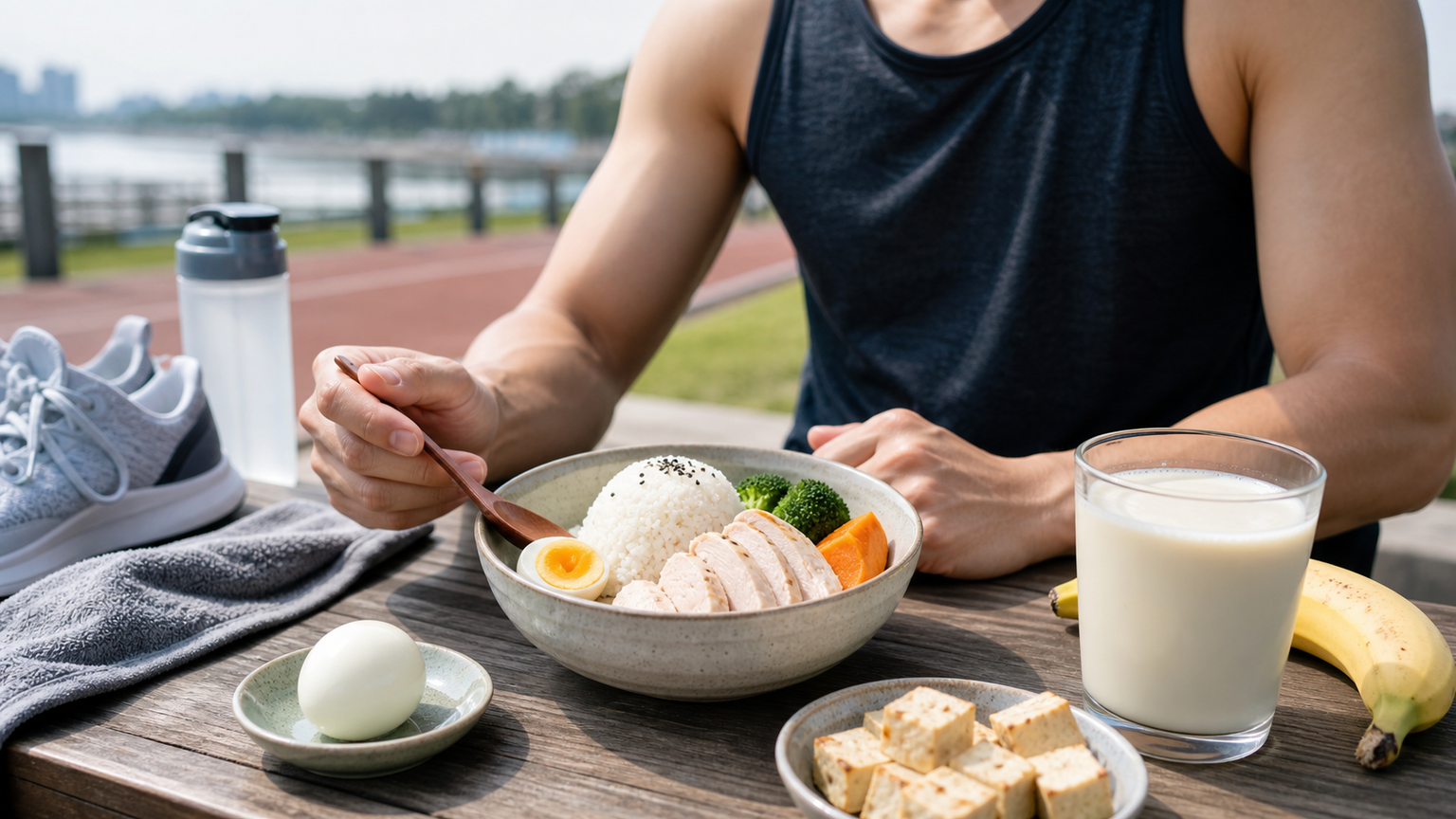
- Chicken breast, tofu, soy milk: High-quality protein sources commonly found in Taiwan
- Egg whites (2–3 eggs): Complete essential amino acids
Carbohydrates: The Key to Replenishing Glycogen
Post-workout carbohydrate intake depends on training duration and intensity:
| Training Intensity | Recommended Carb Intake (/kg body weight) | Priority Foods |
|---|---|---|
| Easy run <45 min | 0.5–0.8 g | Fruit, rice balls |
| Moderate intensity 45–90 min | 0.8–1.0 g | White rice, sweet potato, noodles |
| Long run/post-race >90 min | 1.0–1.5 g | White rice, bananas, bread |
Protein-to-carbohydrate ratio:
Most sports nutrition guidelines recommend a golden ratio of 1:3 to 1:4 (protein:carbohydrates). For example, a 60 kg runner after a long run:
- Protein: 25 g
- Carbohydrates: 75–100 g
Best Combinations Using Local Taiwanese Foods
There’s no need to rely on expensive protein supplements—foods readily available throughout Taiwan can do the job perfectly:
Option 1 (Quick and convenient):
- Fresh milk 300ml (~10g protein) + 2 bananas + 1 tea egg (7g protein)
Option 2 (Meal-style):
- 1 bowl of white rice (55g carbs) + 100g chicken breast (31g protein) + blanched vegetables
Option 3 (Plant-based):
- Soy milk 500ml (16g protein) + sweet potato 200g (44g carbs) + edamame 50g (9g protein)
Option 4 (Heavy post-race replenishment):
- Convenience store: Tea eggs ×2 + sweet potato rice balls ×2 + one carton of soy milk = approx. 28g protein + 90g carbs
Fluids and Electrolytes
Beyond solid food, fluid replenishment is equally critical:
- For every 1 kg of body weight lost, replenish with 1.5 liters of fluid
- Consuming sodium-containing electrolytes after a long run (sports drinks, noodle soup, salted congee) improves fluid retention efficiency
- Avoid drinking large amounts of plain water immediately after racing (it can dilute blood sodium, and in extreme cases trigger hyponatremia)
Practical Tips
- Prepare your recovery meal before heading out for a long run to minimize the gap time spent arranging food after training
- Don’t rely entirely on protein powder—dairy, soy products, and seafood in Taiwanese food culture are all quality protein sources
- If you’re lactose sensitive, soy milk with sweet potato is the most cost-effective plant-based alternative combination
- Post-workout nutrition isn’t a time to “enjoy a reward”—it’s the first building block of the repair process
Conclusion
Post-workout nutrition is one of the most directly controllable factors affecting recovery speed. Master the golden ratio of protein to carbs, make good use of Taiwan’s abundant local ingredients, and you can significantly improve your recovery efficiency without adding extra cost.
Related Reading
- The Post-Run Nutritional Recovery Window: The Golden Ratio of Carbohydrates and Protein
- Recovery Nutrition After Road Running: Protein and Carb Ratios in the 30-Minute Golden Window
- Post-Run Recovery Nutrition: Protein and Carb Supplementation in the Golden 30 Minutes
- Post-Road-Run Nutrition: The Golden Ratio and Timing of Carbohydrates and Protein
CT暗黑廚房) 車友必備 宇宙無敵鮮蚵湯 幫助訓練恢復 天然食補 好市多 超肥鮮蚵 破PR
7 年前
西進武嶺 免費訓練分析服務 Intervals | 練不夠還是練過頭?你哪一種類型選手?AI模型告訴你! | 備戰神器 | 公路車 訓練 | CT Yeh
4 年前
靠單車減肥35公斤 心得分享與整理
7 年前
Live) 備戰2019彰化經典百K 賽前攻略 (已完賽請看新影片
7 年前
FTL 與 SYB 車隊專訪 西進武嶺 實用攻略分享! 2小時 如何練?!你不知道的眉角!新手準備武嶺必看 EP1 | 實力派女車友 | 精華版 | 公路車 | CTYeh
4 年前
一日北高/長距離團騎 常見問題補充篇 / 組團或跟團的眉角 / 壯車友容易被瘦車友慢性拉爆 / 原來屁股痛可能是這個原因...? / 風場配速法 / 公路車 / CT Yeh
2 年前
西進武嶺 自製新版AI配速表產生器 x 賽前攻略 抱佛腳! 沒有功率計也可以產生配速表嗎?有什麼其他眉角賽前要注意的呢? | 西進武嶺 / 東進武嶺 KOM 攻略 | 公路車 | CT Yeh
4 年前
實景訓練台) 彰化經典百K 高強度喵團 90分鐘 跟著一起練功 2019 Indoor workout Changhua Classic 100 Taiwan
7 年前