Introduction
Carbon Fiber Reinforced Polymer (CFRP) is the dominant material in modern high-end road bikes, prized for its light weight, excellent stiffness, and ability to be shaped into complex aerodynamic forms. However, carbon fiber fails very differently from aluminum alloy. When aluminum is damaged, it first develops visible permanent deformation, giving you a warning. Carbon fiber, on the other hand, can suffer a dramatic loss of structural strength with no obvious external damage at all, ultimately failing in a sudden, catastrophic break.
Scenarios common among Taiwanese cyclists include tipping the bike over while parking, being struck by falling rocks on a mountain descent, or getting clipped by a car door. Any of these impacts can leave a crack in a carbon frame that is difficult to spot with the naked eye, yet has already caused serious structural damage.
Key Points for Routine Visual Inspection
Areas That Deserve Special Attention
| Location | Reason | Common Damage Patterns |
|---|---|---|
| Around the BB shell | Point of greatest concentrated pedaling force | Ring-shaped cracks, paint crazing |
| Top tube / head tube junction | Absorbs impact from frontal collisions | Diagonal cracks, paint chipping |
| Bottom bracket junction | Multiple tubes converge here, concentrating stress | Cracked paint, micro-cracks |
| Fork crown | Impact transmitted from the front wheel | Ring-shaped cracks |
| Chainstay | Chain slap + impact from the wheelset | Paint damage, surface cracks |
| Seatpost | Rider weight + road impact | Longitudinal cracks |
Visual Inspection Method
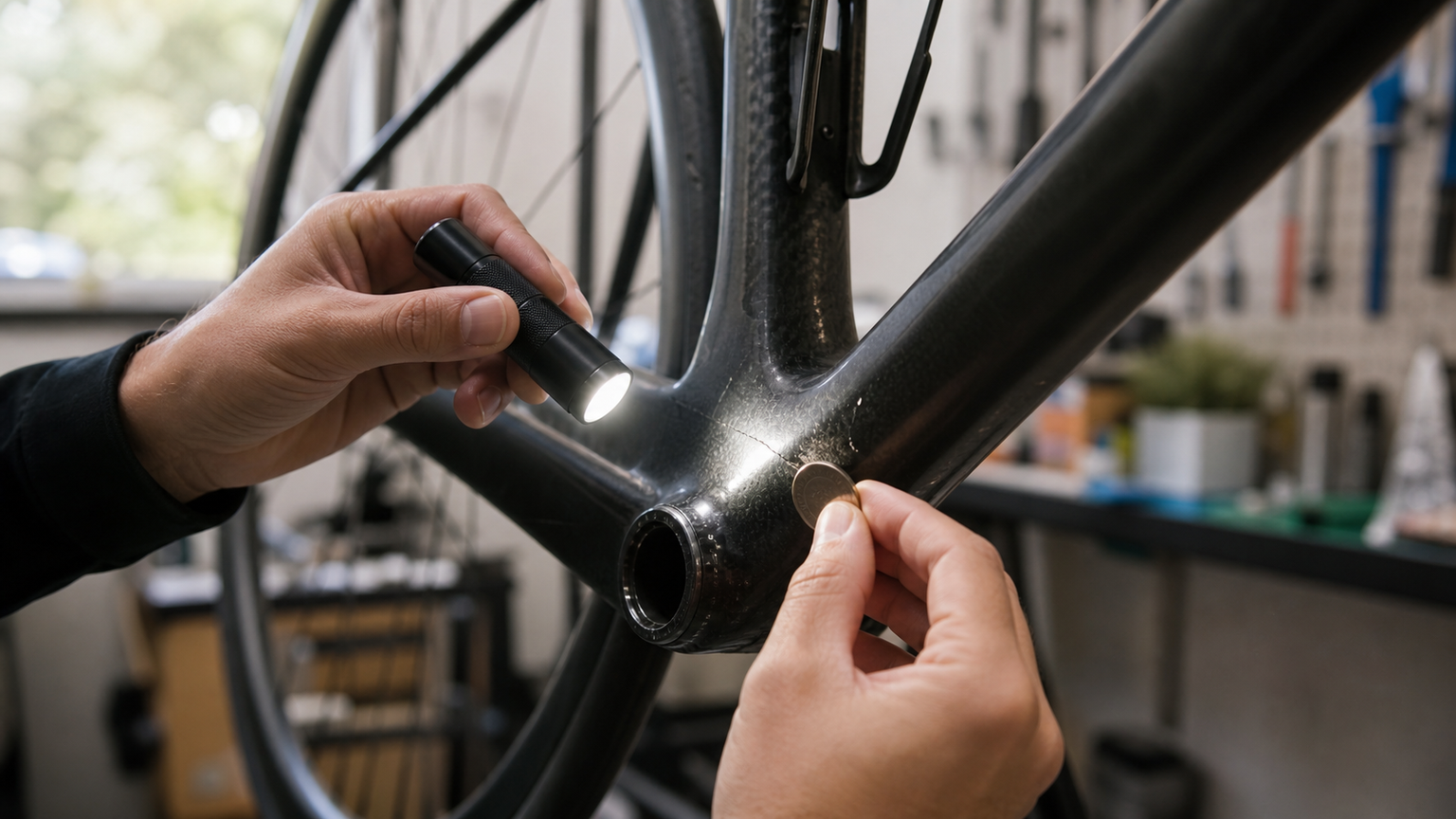
- Inspect in adequate lighting: After cleaning the frame, examine the surface under strong light (a flashlight held at an angle works well) — cracks are much easier to see under raking light.
- Examine the paint layer: If the carbon surface shows “spiderweb-like fine lines,” “paint bubbling,” or “paint flaking away to reveal the carbon weave,” further inspection is required.
- Look through the clear coat: Some frames use a transparent clear coat, and fine cracks in the carbon layer can sometimes be seen directly through it, appearing as white or light-colored lines.
Tap Test
The tap test is a basic on-the-spot method for judging whether carbon fiber has delaminated:
- Use a coin (a Taiwanese NT$10 coin works well) to lightly tap the frame surface, moving along it at a steady rhythm.
- Listen to the sound: a crisp, high-pitched tone = healthy; a dull, muffled tone = possible delamination or a void.
- Tap each area with the same force and compare the pitch. If one area sounds noticeably duller, mark that spot.
- A dull sound doesn’t necessarily mean danger, but it warrants further confirmation via ultrasonic testing or X-ray at a repair shop.
Assessing Damage Severity
Damage You Can Continue to Monitor
- Fine surface cracking limited to the gelcoat/paint layer that does not affect the carbon fiber structure itself
- Small areas of paint loss revealing intact, undamaged carbon weave underneath
Damage Requiring Immediate Repair
- Visible white lines (a “whitening” effect, indicating the carbon fiber matrix has already fractured)
- A large area sounding dull during the tap test
- Slight deformation in a frame tube (the tube no longer presents its original round cross-section)
Damage Requiring Retirement or Manufacturer Assessment
- Any visible crack following a frontal or side impact
- A crack anywhere on the fork — fork failure is the most dangerous carbon failure scenario of all
- A direct impact to the down tube
- Any obvious dent in a frame tube
Carbon Fiber Repair Resources in Taiwan
Taiwan has a number of specialty bike shops and carbon repair services that offer frame assessment and repair, with costs ranging from a few thousand to tens of thousands of NT dollars depending on the extent of the damage. Flagship brands such as Trek, Giant, and Specialized also offer warranty assessment services through their directly operated stores in Taiwan.
If the frame is still under warranty, contact the manufacturer or the Taiwan distributor first (Giant, for example, has a comprehensive after-sales service network in Taiwan). Damage from accidental impacts is usually not covered under warranty, but manufacturers will often offer a replacement frame at a discounted price.
Practical Tips
- Perform a quick visual check after every long ride or mountain ride, especially after riding on rough sections or descents. Spending 2 minutes checking key areas beats letting damage worsen unnoticed.
- Always inspect after a fall: When a road bike goes down, the fork, stem, and top tube are the most likely to be damaged. If any of these three areas show cracks, do not continue riding under any circumstances.
- If you’re not confident in your assessment of the damage, “when in doubt, don’t ride” is the golden rule — keeping an aluminum backup bike while your carbon frame is being repaired is the safest option.
- Some bike shop technicians in Taiwan hold carbon repair certifications, and assessment fees are typically modest. Don’t risk your safety to save a small amount of money.
Conclusion
Inspecting a carbon frame for damage is the last line of defense for riding safety. Build the habit of a visual check after every long ride, learn the basic tap test, and seek professional help immediately whenever in doubt. A bike confirmed to be safe is the reliable partner you need to take on Taiwan’s most spectacular routes.
Related Reading
碟煞公路車 銑面器 !? 原來銑完差這麼多! 降低蹭碟機率! | TIME 公路車 保養小記錄 | CT Yeh
3 年前
Canyon 公路車斷把手 五年老車特規還能修嗎? 維修保養全記錄 feat. 501單車監理站 | 公路車 | CT Yeh
4 年前
功率實測 Lun Hyper 2023 碳幅條輪組 D45 碟煞 | 公路車 | CT Yeh
3 年前
再一組! 全碳幅條 碟煞/無內胎輪組 開箱! 到底好騎嗎? UNAAS X40 | 公路車 | CT Yeh
4 年前
一日北高/長距離團騎 常見問題補充篇 / 組團或跟團的眉角 / 壯車友容易被瘦車友慢性拉爆 / 原來屁股痛可能是這個原因...? / 風場配速法 / 公路車 / CT Yeh
2 年前
Unaas X50 全碳纖幅條輪 數據實測對比PK | Lun Hyper 的高階版 | 板輪爬坡也可以很厲害? ! 武嶺2小時大師一起親測! CP值超高 | 公路車 | CT Yeh
4 年前
鉅齒紋輪組!? ControlTech MEG-T50 EVO 碳纖維幅條輪組/ 功率對比實驗 / 公路車 / CT Yeh
2 年前
公路車 BB培林大升級! / 備戰海鷗繞圈賽 Canyon Aerod & TIME 一起改 / MIT大廠 CEMA對鎖式陶瓷培林BB & 導輪 / 公路車 / CT Yeh
2 年前