Introduction
“Is it too late for me at my age?” is a question on the minds of many swimming enthusiasts. The peak age for competitive swimming varies by event—some dominate the world at 19, while others truly reach the top at 30. Understanding the patterns of peak age in swimmers not only helps young athletes plan their career paths but also gives adult enthusiasts more realistic expectations and training direction.
Peak Age Analysis by Event
| Event Type | Peak Age Range | Notable Examples | Key Physiological Basis |
|---|---|---|---|
| Sprint Freestyle (50/100m) | 20–27 years | Cielo (Olympic champion at 21) | Muscular explosive power, neural conduction speed |
| Middle Distance (200m) | 22–28 years | Popovici (world record at 17) | Balance of explosive power + aerobic capacity |
| Long Distance (800/1500m) | 24–32 years | Ledecky (multiple Olympic champion at 19–27) | Aerobic endurance, pacing intelligence |
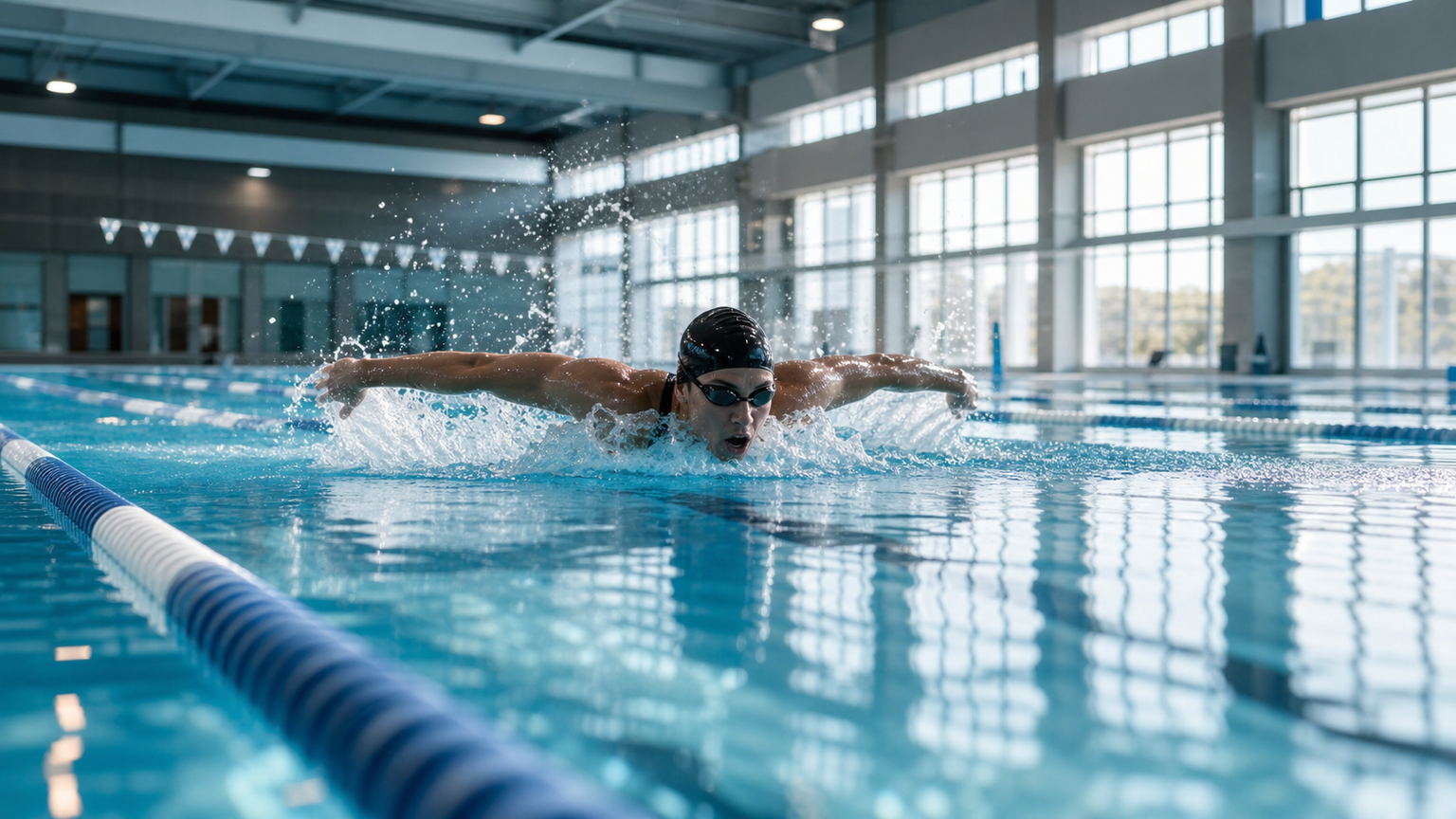
| Butterfly | 21–27 years | Phelps (Olympic peak at 23–27) | Core strength + explosive power |
| Individual Medley | 22–28 years | Lochte (world record at 27) | Technical completeness across four strokes |
| Open Water | 25–34 years | Multiple European swimmers still medaling at 30+ | Aerobic endurance + tactical intelligence |
Physiological Factors Influencing Peak Age
Muscular Explosive Power (Key for Sprint Events)
Human muscular explosive power (Type II fast-twitch fiber ratio and power output) reaches its physiological peak at 20–25 years, then declines approximately 3–5% per decade. This explains why sprint swimmers in the 50m and 100m events have shorter career peaks and retire earlier (typically at 28–30 years).
Maximal Oxygen Uptake (Key for Long Distance)
The physiological peak of VO2max occurs around 22–26 years, but with years of training, the aerobic base can be maintained beyond age 35. More importantly, “pacing intelligence”—aerobic endurance athletes’ race strategy and energy management skills continue to improve with age, offsetting some physiological decline.
Nervous System Efficiency
The refinement of swimming technique (such as start reaction, turn efficiency, and stroke rhythm) actually reaches full maturity at 25–30 years. This is why many swimmers can still maintain elite performance through technical efficiency even as their physical capacity slightly declines.
Special Cases of Early Maturation
In recent years, more and more “early maturation” phenomena have emerged:
- Rōmān Makhloufi (Algeria): Not swimming, but the track and field case illustrates that early maturation is the exception rather than the norm
- David Popovici (Romania): Broke the 100m freestyle world record at 17, considered an extreme case of talent; his coach emphasized that long-term sustainability requires “preventing overtraining burnout”
- Katie Ledecky: Olympic gold medalist at 15, considered to have an extraordinary aerobic base rather than early maturation followed by decline
Athletes who peak early often face the risk of “burnout.” How to balance youthful achievements with long-term career longevity is a key challenge for modern elite coaches.
Current Age Distribution of Taiwanese Swimmers
The age distribution of champions at Taiwan’s National Intercollegiate Athletic Games and National Games roughly falls between 19–26 years, consistent with international trends. However, Taiwanese swimmers generally have weaker career longevity—most exit competitive swimming around age 28 due to work or academic pressures, failing to fully realize the extended careers that aerobic events should allow.
Areas for improvement:
- Strengthen post-university professional swimming support systems (corporate sponsorship, national training center subsidies)
- Encourage flexible training time arrangements for athletes in teaching or civil service positions
Training Focus Adjustments by Age Group
- 16–22 years: Focus on technical foundation, avoid excessive intensity training that could cause physical injury
- 22–28 years: High-intensity competitive training, fully challenging personal limits
- 28–35 years: Transition to longer-distance events (if suitable), emphasizing technical efficiency and fitness maintenance
- 35+ years: Transition from active competition to fitness swimming or Masters Swimming competitions
Practical Recommendations
- Choose your primary event based on your strengths (explosive power vs. endurance)
- Do not sacrifice long-term aerobic foundation for short-distance results during adolescence
- Masters Swimming competitions are an excellent platform for swimmers over 30 to maintain competitive passion
- Taiwan hosts Masters Swimming events annually; registration information can be found through the Chinese Taipei Swimming Association or local city/county sports bureaus
Conclusion
The peak age for swimmers is not a fixed number but a curve shaped by event characteristics, training methods, and individual physiological conditions. For Taiwanese swimming enthusiasts, the most important thing is to do the right things at the right age: build a solid technical foundation when young, fully ignite competitive passion in your prime years, and extend your swimming life through Masters events in midlife and beyond.
Related Reading
- The Aging Curve of Athletic Performance: When Is the Peak, and How to Train Afterward
- The Science of Talent Identification in Competitive Swimming: Body Composition and Giftedness Recognition
- Upper Elementary Swimming (Ages 9–12): Technical Refinement and Competition Introduction
- Youth Swimming Training: Training Volume Recommendations and Technical Development Focus by Age Group
西進武嶺 免費訓練分析服務 Intervals | 練不夠還是練過頭?你哪一種類型選手?AI模型告訴你! | 備戰神器 | 公路車 訓練 | CT Yeh
4 年前
如果Pogačar騎西進武嶺可以多快?會破2嗎?各種情況深度推估探討 / 公路車 / CT Yeh
2 年前
滑雪新手們慘摔學習全紀錄(請開字幕),滑雪好好玩 | Snowboard + Ski | 岩原 スキー場 | 滑雪APP使用 | GoPro Max
6 年前
2026 輪霸西濱200K 挑戰VLOG / 第一集團 / 首次參加..經驗不足、膀胱不足 /死守6H內 / AI戰鬥力顯示系統 / 公路車 / CT Yeh
4 個月前
FTL 與 SYB 車隊專訪 西進武嶺 實用攻略分享! 2小時 如何練?!你不知道的眉角!新手準備武嶺必看 EP1 | 實力派女車友 | 精華版 | 公路車 | CTYeh
4 年前
崇越盃武嶺冠軍高手 賽前JJSC 群峰會精華!對應大數據分析,會有落差嗎?/ feat. JJSC中部公路車約騎 /公路車 / CT Yeh
2 年前
2022 前十五大自行車錶 !? 兩萬名車友大數據統計 | 你的上榜了嗎? | 菁英車友都用哪些錶? | Bryton Garmin 誰能拔得頭籌?| 車錶推薦 | 公路車 CT Yeh
4 年前
2025南庄山水悠遊行 仙山KOM 網路直播! / 男菁英組A / 女菁英組A
9 個月前