UCI Road World Championships Race Strategy: The One-Day Tactical Chess Game for the Rainbow Jersey
Introduction
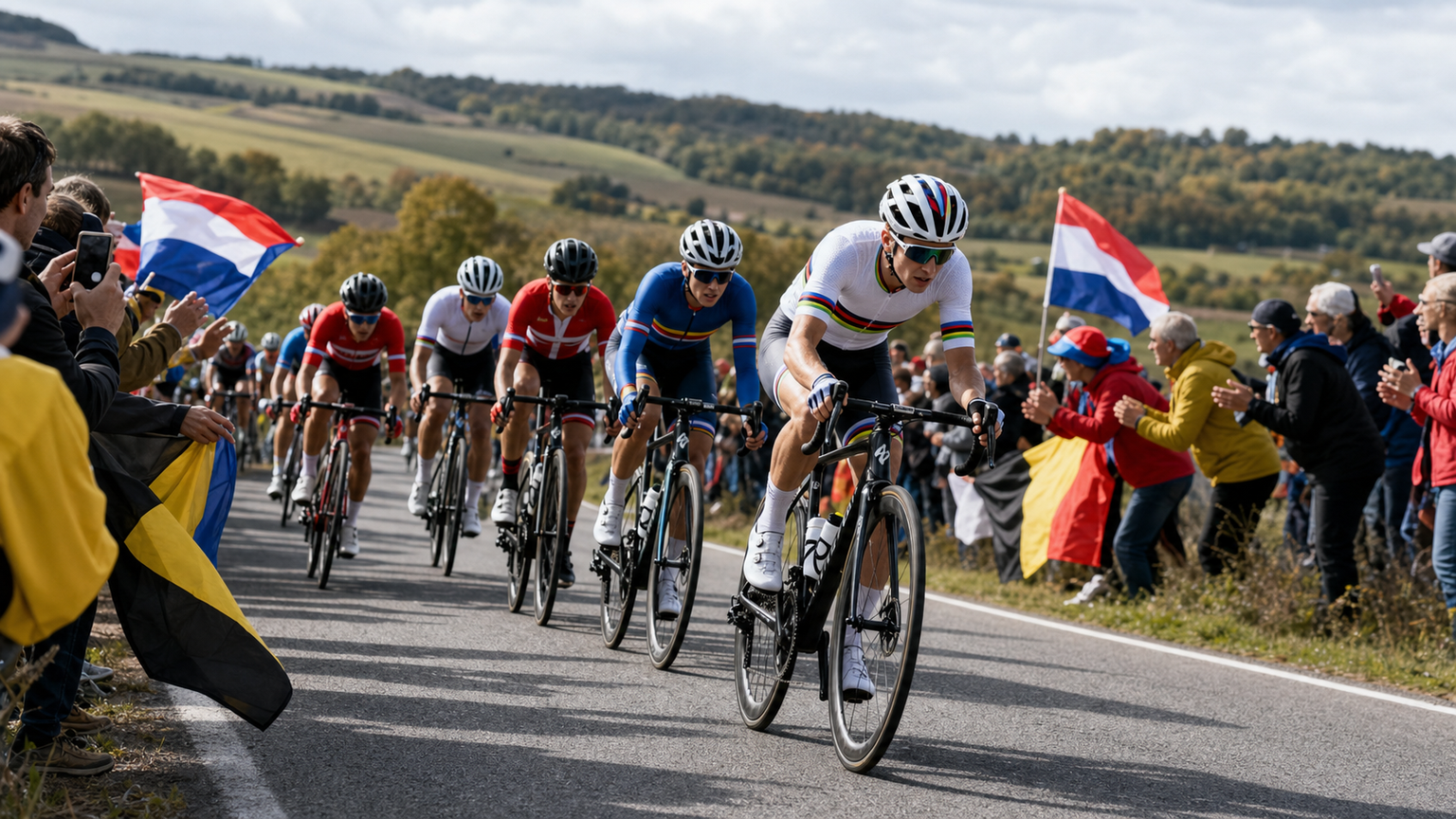
Held every September or October, the UCI Road World Championships is the most special race in the minds of professional cyclists. It lasts only one day, with no general classification to speak of and no commercial considerations from team sponsors—the sole goal is to put a rider from your nation in the Rainbow Jersey and crown them World Champion.
Compared to the team tactics of the professional circuit, the national-team collaboration model at the World Championships is completely different: riders who are fierce rivals on the same trade team during the regular season must now sacrifice for one another; the internal tactics of professional teams are useless here, replaced by a precise combination of national interest and individual sprinting ability.
The World Championships Format and Its Unique Nature
Basic Race Format
| Item | Details |
|---|---|
| Race schedule | One-day race, circuit course typically 10–16 laps |
| Distance | Men’s elite race approximately 260–280 km |
| Rider selection | National teams from each country, with start quotas determined by UCI points |
| Prize | The World Champion may wear the Rainbow Jersey in all races the following year |
| Course characteristics | Depending on the host country’s terrain, can be flat (sprint-oriented) or hilly (climbing-oriented) |
The Unique Dilemma of National Teams
The World Championships have no established hierarchy from a professional trade team, so national team coaches must make difficult decisions before the race:
- Who is the team leader? Who are the domestiques?
- If two riders are of equal strength, how do you coordinate?
- How much personal opportunity must a domestique sacrifice to serve the leader?
This decision-making dilemma has caused multiple “national team infighting” incidents throughout history, the most famous being cases where two top riders from the same country refused to cooperate, ultimately leading to mutual defeat.
Tactical Differences Across Course Types
Flat Courses (Sprint-Oriented)
When the course is predominantly flat, the decisive moment usually comes in the final 200 meters of the bunch sprint. Nations employ a “lead-out train” tactic similar to professional teams:
- In the final 5 km, domestiques take turns accelerating to burn the legs of rivals
- In the final 1 km, 2–3 domestiques form a lead-out train to shepherd the sprinter
- In the final 300 meters, the sprinter unleashes full power
In this scenario, nations with top-tier sprinters (such as Belgium, the Netherlands, and Germany) hold a natural advantage.
Rolling and Hilly Courses (Climbing-Oriented)
When the course features multiple short climbs, the peloton shrinks dramatically after repeated circuits, sprinters are eliminated, and climbing specialists ultimately decide the outcome. Typical strategies:
- Control the pace in the first half of the race, allowing the breakaway to gain a reasonable gap
- Increase the tempo before key climbs to force difficult decisions
- In the final laps, the strongest domestique “clears the road,” leaving the leader to face only his true rivals
The 2021 World Championships in Leuven, Belgium, is the perfect example: multiple short climbs kept shrinking the peloton, and Tadej Pogačar’s solo move left everyone in awe.
The Special Status of the Breakaway at the World Championships
In the professional circuit, breakaways are usually caught by the peloton; but the difficulty of national-team cooperation at the World Championships makes breakaways far harder to chase down effectively:
- If the breakaway contains 2–3 riders of different nationalities, the chasers behind each of them “go through the motions” without committing, unwilling to work for a rival
- When no single nation takes control of the chase, the breakaway often survives to the finish
- At the 2020 World Championships, Julian Alaphilippe’s final climbing attack finally delivered a long-awaited Rainbow Jersey for France—a victory born of exactly this logic
Taiwan’s Current Status and Outlook at the World Championships
Taiwan’s current qualification for the elite road race at the World Championships depends on UCI points, placing it in the middle tier of Asian points competition. Future development directions:
- Actively participate in UCI WorldTour and ProSeries events to accumulate points
- Cultivate all-rounder climbing riders (suited to the hilly format of the World Championships)
- Build a “national team tactical culture”: help riders understand early in their professional careers the meaning of sacrificing personal gain for national glory
Practical Advice
For amateur riders, the national-team tactics of the World Championships offer several takeaways:
- Define roles clearly: Before racing as a team, decide in advance who is the sprinter and who are the domestiques to avoid disputes on race day
- Sacrifice is a two-way street: Today you work as a domestique to help a teammate; next time it’s your turn to be the protagonist—build mutual trust for long-term cooperation
- Read the course: Study the climb distribution of the course in advance and decide the best attacking positions; don’t attack randomly and burn energy
Conclusion
The Road World Championships is a pure theater of competition: no commercial considerations, no season points, no tomorrow—only the Rainbow Jersey of the moment and the eternal title of World Champion. Its significance for Taiwanese riders lies in this: understand the logic of “national team tactics,” and you understand the core of all one-day races—cooperation, sacrifice, and timing are the three cornerstones of victory.
Related Reading
- UCI Road World Championships: Analysis of Taiwanese Riders’ Performances Through the Years
- The UCI World Championships Rainbow Jersey: The Weight and Pressure of Glory in Wearing the Stripes
- History of the UCI Road World Championships: A Century of Rainbow Jersey Legend and Famous Champions
- Olympic Road Cycling: Course Design, Weather Factors, and Medal-Battle Strategies
「悲情男車友」創作單曲 爆笑MV / 公路車 / CT Yeh / 4K劇情版
7 個月前
#公路車 #西進武嶺 配速配瓦實驗 坡度分析 四小時內攻略 建大盃 NeverStop #西進武嶺攻略
6 年前
微雨戰! 2022桃園市長盃錦標賽 無敵交管 沒來玩太可惜了! 羅馬公路太可怕 差點成佛! 公路車 | CT Yeh
4 年前
如何 搶 #中央山脈 報名 #公路車 #報名 #搶票
7 年前
2024 春季KOM 賽事精華版 / 太魯閣 / 貓捉老鼠精彩追擊 / 錄影剪輯版 / 東進武嶺 / 公路車 (請開啟字幕)
2 年前
2025 崇越盃「西進武嶺」CT挑戰直播測試 / 公路車 / CT Yeh
1 年前
一個測試有沒有認真練車的方法😂 #公路車
10 個月前
新屋團體繞圈賽 | 眾多菁英好手賽道奔馳 | 千瓦女子軍團 | 無敵交管狂獲好評 明年你一定不能錯過 | #公路車
5 年前