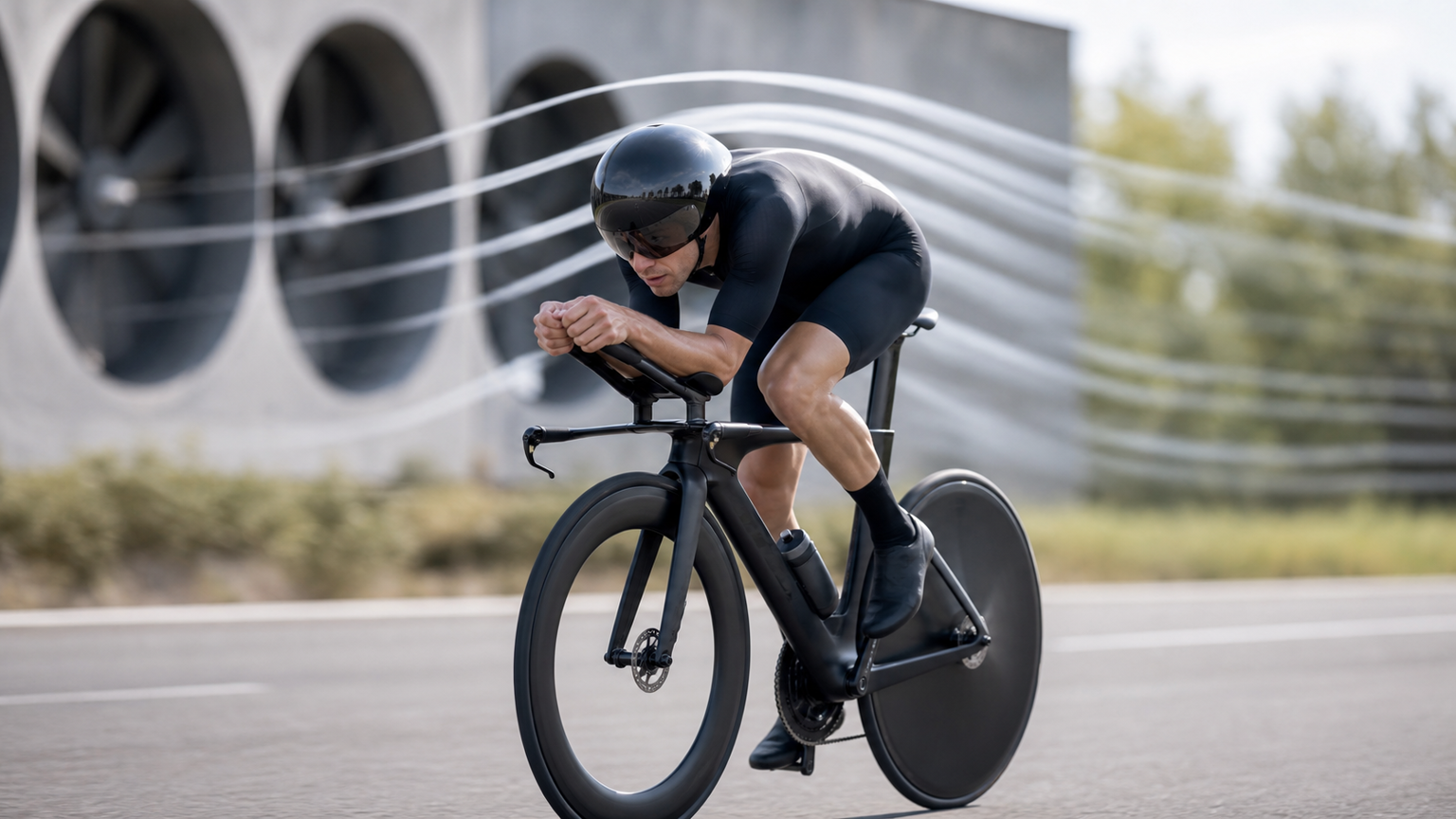
Introduction
When you cruise on the road at 40 km/h, the biggest resistance your legs fight against is not the gradient, but air resistance—it accounts for over 80% of your total riding resistance. For professional riders, optimizing aerodynamic performance (lowering CdA) is, aside from training, the most effective way to improve time trial results.
Wind Tunnel Testing is standard equipment for professional teams, but in recent years, with the democratization of technology, amateur riders have also begun using tools such as the Notio aero meter and CdA calculation software to optimize their riding position. This article takes you from the fundamental physics to practical applications, introducing the core knowledge of modern cycling aerodynamics.
Fundamentals of Aerodynamics
What is CdA?
CdA (Coefficient of Drag × Frontal Area) is a composite metric that measures an object’s resistance in the air:
- Cd (Drag Coefficient): Related to the object’s shape; the more streamlined, the lower it is
- A (Frontal Area): Related to the “wind-facing area” of your posture and equipment
Typical CdA reference values:
| Posture / Equipment | CdA Value (m²) |
|---|---|
| Upright riding posture (non-aero) | 0.45–0.55 |
| Standard road riding posture (drops) | 0.32–0.38 |
| Time trial aero posture (forearm platform) | 0.20–0.26 |
| World-class time trialists (optimized) | 0.18–0.22 |
A 10% reduction in CdA at 40 km/h is equivalent to saving approximately 30–40W of power output, or saving about 2–3 minutes in a 40-kilometer time trial.
The Practical Process of Wind Tunnel Testing
Standard Testing Procedure
Professional teams’ wind tunnel testing is typically divided into several stages:
- Baseline measurement: Establish a baseline CdA value with current equipment and posture
- Posture adjustments: Test variables such as head height, arm angle, and back curvature in sequence
- Equipment comparison: Test the impact of different helmets, skinsuits, and wheelsets on CdA
- Integrated optimization: Find the best combination (usually requiring a trade-off between comfort and aerodynamics)
- Power maintenance verification: The optimal aero posture must be able to sustain the target power; otherwise, lowering CdA while losing power is meaningless
Estimated Aero Contribution of Each Equipment
| Equipment/Adjustment | Typical CdA Savings | Time Saved in 40km TT |
|---|---|---|
| Aero helmet vs. standard helmet | 0.010–0.020 m² | 30–60 seconds |
| Time trial skinsuit vs. standard jersey | 0.005–0.010 m² | 15–30 seconds |
| Disc wheel vs. standard wheelset | 0.005–0.015 m² | 15–45 seconds |
| Head lowered 5cm forward | 0.010–0.015 m² | 30–45 seconds |
| Forearm platform posture | 0.060–0.080 m² | 180–240 seconds |
The forearm platform (time trial handlebars) is the single most effective aero improvement, saving far more time than all other equipment upgrades combined.
Modern Alternative Testing Methods
Wind tunnel costs are high (typically several hundred to several thousand US dollars per hour), but modern technology offers alternatives:
On-site CdA Testing (Track/Road Method)
On a flat, windless section of road, perform a steady-speed test. Combined with power meter data, CdA can be derived using the following formula:
CdA ≈ P / (0.5 × ρ × v³)
Where P is power, ρ is air density, and v is speed. Actual calculations require a more precise formula, but the principle is the same.
Aerolab (Strava Feature)
Strava Premium’s Aerolab feature can estimate CdA values for different segments using GPS speed, elevation, and power data. While not as accurate as a wind tunnel, it is sufficient for comparing the relative differences between different postures or equipment.
Notio Konect
The Notio Konect is an aerodynamic sensor mounted on the helmet or handlebar that measures CdA in real time on actual roads, allowing riders to directly compare the aerodynamic performance of different postures during training.
Practical Strategies for Posture Optimization
Key Optimization Points for Pro Riders
Different race types determine the priority of aerodynamics:
- Time trials: Aerodynamics take priority; slightly reduced posture comfort is acceptable
- Climbing: Weight takes priority; a slightly more upright posture is used to maintain maximum power output
- Flat one-day races: Strike a balance between comfort and aerodynamics, as the posture must be maintained for long periods
Practical Advice for Taiwanese Riders
Most Taiwanese riders use road bikes and cannot adopt a time trial posture, but there is still room for optimization:
- Riding in the drops: The drops (the lower curved section of the drop bar) have about 15–20% lower wind resistance than the tops; use the drops more on long, high-speed sections
- Helmet selection: Aero road helmets (such as the Abus Gamechanger, Bell Falcon) can save 10–20W compared to standard ventilated helmets
- Jersey selection: Tight-fitting jerseys (with no excess fabric flapping) have lower wind resistance than loose jerseys
- Posture training: Practice maintaining a low, tucked posture (forearms close to the handlebar) during long-distance training, gradually improving posture stability
Limitations of Aerodynamics
Although aero optimization is important, it has several limitations:
- Power loss issue: An overly aggressive aero posture may restrict diaphragm expansion, leading to a decrease in VO2 max and maximum power output; the wind resistance saved may be lost to power reduction
- Diminishing returns on climbs: At speeds below 25 km/h, the benefits of aero optimization drop significantly; weight and power become the dominant factors
- Comfort affects endurance: An uncomfortable aero posture causes fatigue accumulation over long distances, affecting performance in the latter stages
Practical Recommendations
- Conduct a “low-cost aero test”: Choose a fixed 5–10 kilometer flat, windless section of road and compare the speed differences between different postures (upright, drops, extremely low tuck) at the same power output
- The highest-priority aero investment is the helmet: Compared to other equipment, an aero helmet offers the best value for money and affects both daily training and racing
- Don’t wear loose jerseys: Even during training, develop the habit of wearing form-fitting jerseys to build good aerodynamic habits
Conclusion
Cycling aerodynamics is a composite science combining physics, biomechanics, and equipment engineering. From the wind tunnel to simple roadside tests, every step of optimization seeks the same answer: given your power output and weight, how can you make the air flow most smoothly over your body? Understanding the essence of CdA means you have grasped the core code of modern high-speed cycling.
Related Reading
- Home Aero Testing in Practice: Optimize Your Riding Position Without a Wind Tunnel
- Interpreting Wind Tunnel Data: How Pro Teams Use Aero Data to Win Races
- Advanced Cycling Aerodynamics: How to Quantify and Improve Your CdA
- Quantitative Study of Wind Tunnel Testing on Drag Reduction from a Tucked Road Bike Position
2026 車錶排行榜!誰是最多車友正在使用?練家子最愛哪款?🏆 (2萬名車友數據) / 公路車 / CT Yeh
5 個月前
車錶新黑馬? / 超狂續航 / 超好用錶冠 / 無敵準定位 / Dash圖表合成!?/ COROS DURA 評測!/ 公路車 / CT Yeh
2 年前
#公路車 #Vo2Max #最大攝氧量 測驗 體驗 | 心肺測試
6 年前
3D 列印車褲墊 / 舒適改善? / 無痕 x 分區壓縮 / ATK & Decider系列 / JE22黑科技 / #公路車 #CTYEH
11 個月前
西進武嶺 免費訓練分析服務 Intervals | 練不夠還是練過頭?你哪一種類型選手?AI模型告訴你! | 備戰神器 | 公路車 訓練 | CT Yeh
4 年前
西進武嶺各路段 前8000名 大數據分析 配速攻略/功率/心律/推力比/維持率/踏頻/踏瓦比/牽車率 大公開 | 建大盃 NeverStop 可參考 | 公路車 | CT Yeh
5 年前
再一組! 全碳幅條 碟煞/無內胎輪組 開箱! 到底好騎嗎? UNAAS X40 | 公路車 | CT Yeh
4 年前
Unaas X50 全碳纖幅條輪 數據實測對比PK | Lun Hyper 的高階版 | 板輪爬坡也可以很厲害? ! 武嶺2小時大師一起親測! CP值超高 | 公路車 | CT Yeh
4 年前