Introduction
“Just stretch a bit before getting in the water, right?” This is the mindset of many swimming enthusiasts in Taiwan. However, swimming’s unique movement patterns—high shoulder joint mobility, repeated neck rotation, and ankle dorsiflexion with eversion—all require targeted warm-up preparation. Skipping the warm-up not only increases injury risk but also diminishes swimming performance (muscles in a cold state contract 20–30% less efficiently). This article provides a complete, science-based warm-up and cool-down SOP for swimming, suitable for swimming enthusiasts of all levels in Taiwan.
Why Does Swimming Require a Special Warm-Up?
The biggest differences between swimming and running or cycling are:
- Water’s resistance environment: Once swimming movements become inefficient, whole-body muscle compensation quickly sets in. If joint mobility is insufficient, injury is almost inevitable.
- Heavy shoulder joint load: For every 1,000 meters swum, the shoulder joint repeats its motion over 7,000 times. High-frequency stroking without a warm-up is a direct trigger for tendinitis.
- Difficulty correcting form in the water: It’s hard to notice the discomfort caused by movement errors while in the water. If you exert excessive force before being properly warmed up, injuries often aren’t discovered until after you get out.
Before Swimming: Dynamic Warm-Up SOP (10–15 Minutes)
Phase 1: Full-Body Activation (5 Minutes)
Perform on dry land by the pool:
| Exercise | Reps/Duration | Purpose |
|---|---|---|
| Marching in place with high knees | 30 seconds | Raise core body temperature, activate hip flexors |
| Large arm circles (forward and backward) | 20 each direction | Activate shoulder joints, increase rotator cuff blood flow |
| Chest opener (arms extended horizontally, opening and closing) | 20 reps | Stretch the pectoralis minor, prepare for pulling motions |
| Dynamic neck rotation (slowly turning left and right) | 10 each side | Activate neck rotator muscles |
| Ankle circles (seated) | 20 circles each direction | Prepare ankle mobility for breaststroke kicking |
| Bodyweight squats | 10 reps | Activate glutes and quadriceps |
Phase 2: Shoulder-Specific Activation (3–4 Minutes)
This is the most commonly skipped yet most important part:
- Shoulder external rotation warm-up: Using a resistance band or bodyweight, bend the elbow to 90°, rotate the forearm outward 15 times per side to activate the infraspinatus and teres minor.
- Scapular retraction: Stand with arms hanging naturally, slowly perform a combined scapular retraction and elevation movement, 15 reps.
- PNF shoulder spiral movements: Perform dynamic “large spiral” arm movements while rotating the torso, 3 sets of 8 reps per side.
Phase 3: In-Water Warm-Up Swim (5 Minutes)
An in-water warm-up is essential before formal training:
- First 2 laps (50m): Swim at a very slow pace, feel the water’s resistance, don’t time yourself, and focus on stroke feel.
- Laps 3–4: Switch to kicking with a kickboard to confirm symmetrical leg movements.
- Laps 5–6: Gradually accelerate to 70% of normal training intensity. Only begin the formal workout once the body is fully warmed up.
After Swimming: Static Stretching Cool-Down SOP (10 Minutes)
Muscle temperature is elevated after exercise, making this the best time to improve flexibility. Hold each stretch for 30–45 seconds.
Upper Body and Shoulders
| Stretch | Description | Target Muscles |
|---|---|---|
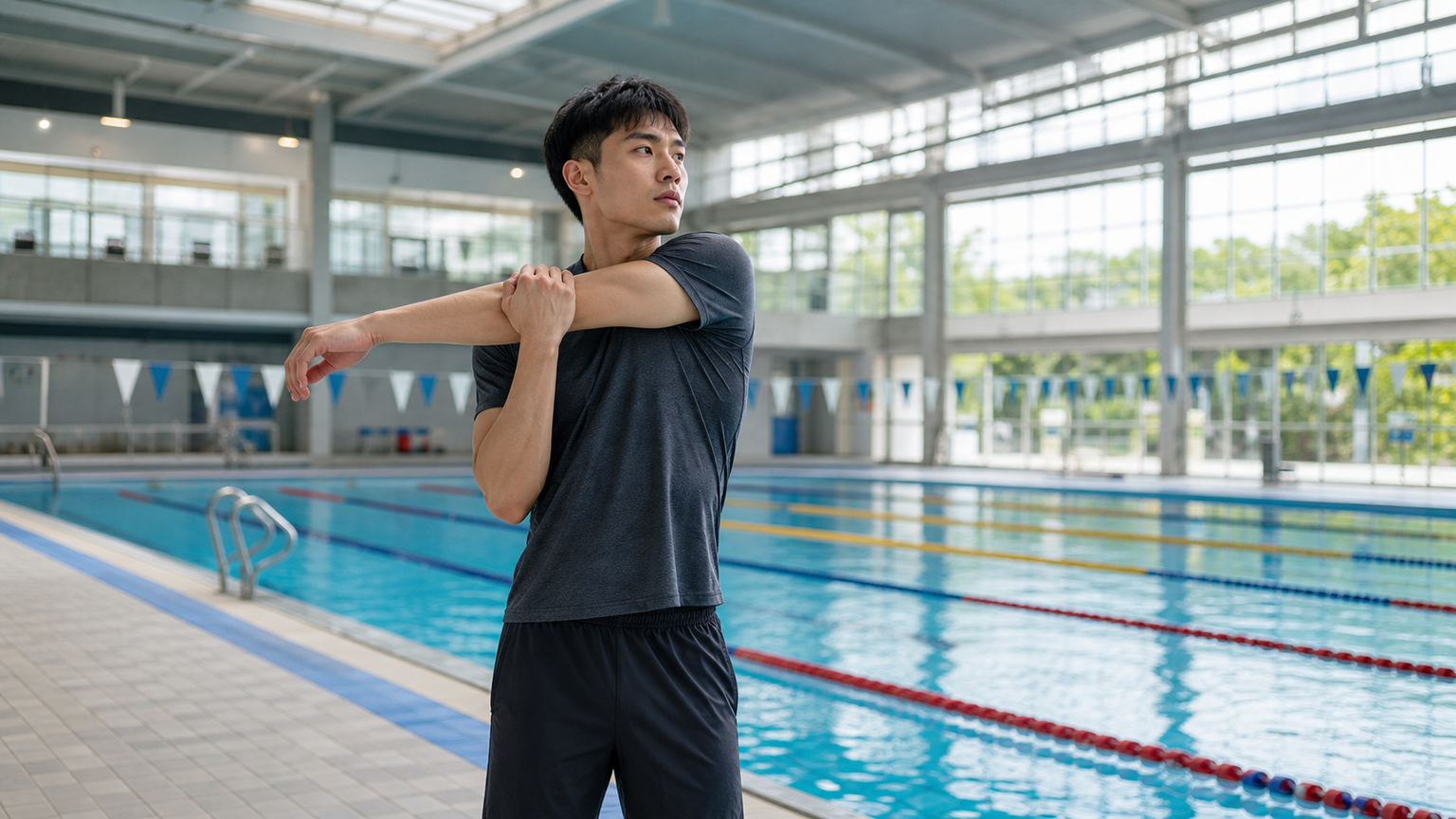
| Cross-body chest stretch | Bring one arm across the chest, gently press on the outer forearm with the other hand | Posterior deltoid, rhomboids |
| Overhead side bend | Raise one arm overhead, gently press the elbow toward the opposite side while side-bending the torso | Latissimus dorsi |
| Shoulder external rotation stretch | Bend the elbow to 90°, place the forearm against a wall, slowly rotate the body forward | Front of shoulder (anterior deltoid, pectoralis minor) |
| Eagle arms behind the back | Yoga eagle pose, cross and wrap the arms, raise the elbows | Rotator cuff, posterior shoulder |
Neck and Spine
- Neck side stretch: Tilt the head to one side, lightly place the opposite hand on top of the head for slight pressure—do not force. 30 seconds per side.
- Thoracic rotation (seated twist): Sit on the pool edge with legs crossed, rotate the upper body backward, 30 seconds per side.
- Cat-cow spine mobility: On all fours, alternately arch and sink the back, 10 reps.
Lower Body (Breaststroke Focus)
- Quadriceps stretch: Stand, lift one foot behind you, hold the ankle while keeping the knee pointing down. 30 seconds per leg.
- Hip external rotation stretch (figure-4): Seated, place one ankle on the opposite knee, lean forward. 40 seconds per side.
- Soleus calf stretch: Lunge against a wall, back heel on the ground, back knee slightly bent. 30 seconds per side.
Stroke-Specific Warm-Up Reminders
| Stroke | Areas Requiring Extra Warm-Up |
|---|---|
| Freestyle | Shoulder external rotators, neck rotation mobility |
| Breaststroke | Ankle dorsiflexion, hip external rotation, medial knee ligaments |
| Butterfly | Full shoulder joint range of motion, lumbar spine extension |
| Backstroke | Anterior shoulder stretch, thoracic spine extension |
Practical Tips
- Invest 10 minutes in warming up to protect 10 years of swimming career: Many swimming injuries result from “saving 10 minutes of warm-up and paying with 10 weeks of rehab.”
- Don’t rush to change and leave after swimming: The cool-down stretching takes 10 minutes. Don’t skip it entirely due to time constraints—at minimum, do the key shoulder and neck stretches.
- Build a personalized warm-up checklist: Based on your most injury-prone areas, list 2–3 of the most important exercises as must-dos every session. Save them in your phone’s notes and build the habit.
- Extend warm-up time in cold weather: In autumn/winter or when the morning pool temperature is lower, extend the warm-up to 15–20 minutes to ensure muscles are fully warmed up.
Conclusion
Warming up and cooling down are the most underestimated components of swim training, yet they are also the easiest injury-prevention strategy to implement. Establishing proper pre- and post-swimming rituals not only protects your body but also significantly enhances the quality of every swim. Keep this SOP in your swim bag and put it into full practice starting with your next swim.
Related Reading
- Swimming Warm-Up Protocol: Land-Based Dynamic Warm-Up + 800m In-Water Warm-Up Complete Flow
- Swimming 400m Standard Warm-Up Flow: The Essential Ritual Before Every Swim
- Warm-Up and Cool-Down for Swimmers: Pre- and Post-Session Procedures to Maximize Training Results
- Pre-Race Swimming Warm-Up Design: Activation Flow 45 Minutes Before Entering the Water
一起升級!海鷗盃LSD團練...JJSC Zone2招待 騎到手抖 / 公路車 / CT Yeh
1 天前
一日北高/長距離團騎 常見問題補充篇 / 組團或跟團的眉角 / 壯車友容易被瘦車友慢性拉爆 / 原來屁股痛可能是這個原因...? / 風場配速法 / 公路車 / CT Yeh
2 年前
[教學] Premiere 影片 手震 修正 教學 防抖 單眼 影像 GoPro 穩定 Video Stabilization
8 年前
FTL 與 SYB 車隊專訪 西進武嶺 實用攻略分享! 2小時 如何練?!你不知道的眉角!新手準備武嶺必看 EP1 | 實力派女車友 | 精華版 | 公路車 | CTYeh
4 年前
Live) 備戰2019彰化經典百K 賽前攻略 (已完賽請看新影片
7 年前
單車 一日北高 ( 雙城 ) 肥宅雙人瘋狂行 紀錄片 REACTO
10 年前
CT 喇低賽) 武嶺牽車 才是王道 西進牽車四小時內秘訣 攝手位置 如何判斷 防抽筋小秘訣
7 年前
西進武嶺 自製新版AI配速表產生器 x 賽前攻略 抱佛腳! 沒有功率計也可以產生配速表嗎?有什麼其他眉角賽前要注意的呢? | 西進武嶺 / 東進武嶺 KOM 攻略 | 公路車 | CT Yeh
4 年前