Introduction
The swimming start is the first technical checkpoint of every race. From the starting signal to the swimmer entering the water, the movement—lasting less than a second—can affect the rhythm and results of the entire race. Modern starting blocks feature an adjustable rear footrest, designed to support two mainstream starting postures: the Grab Start and the Track Start. Each technique has its own strengths and weaknesses. This article provides a full breakdown from three perspectives—mechanical principles, suitable scenarios, and practice tips—to help you find the starting method that suits you best.
Grab Start: A Stable, Traditional Choice
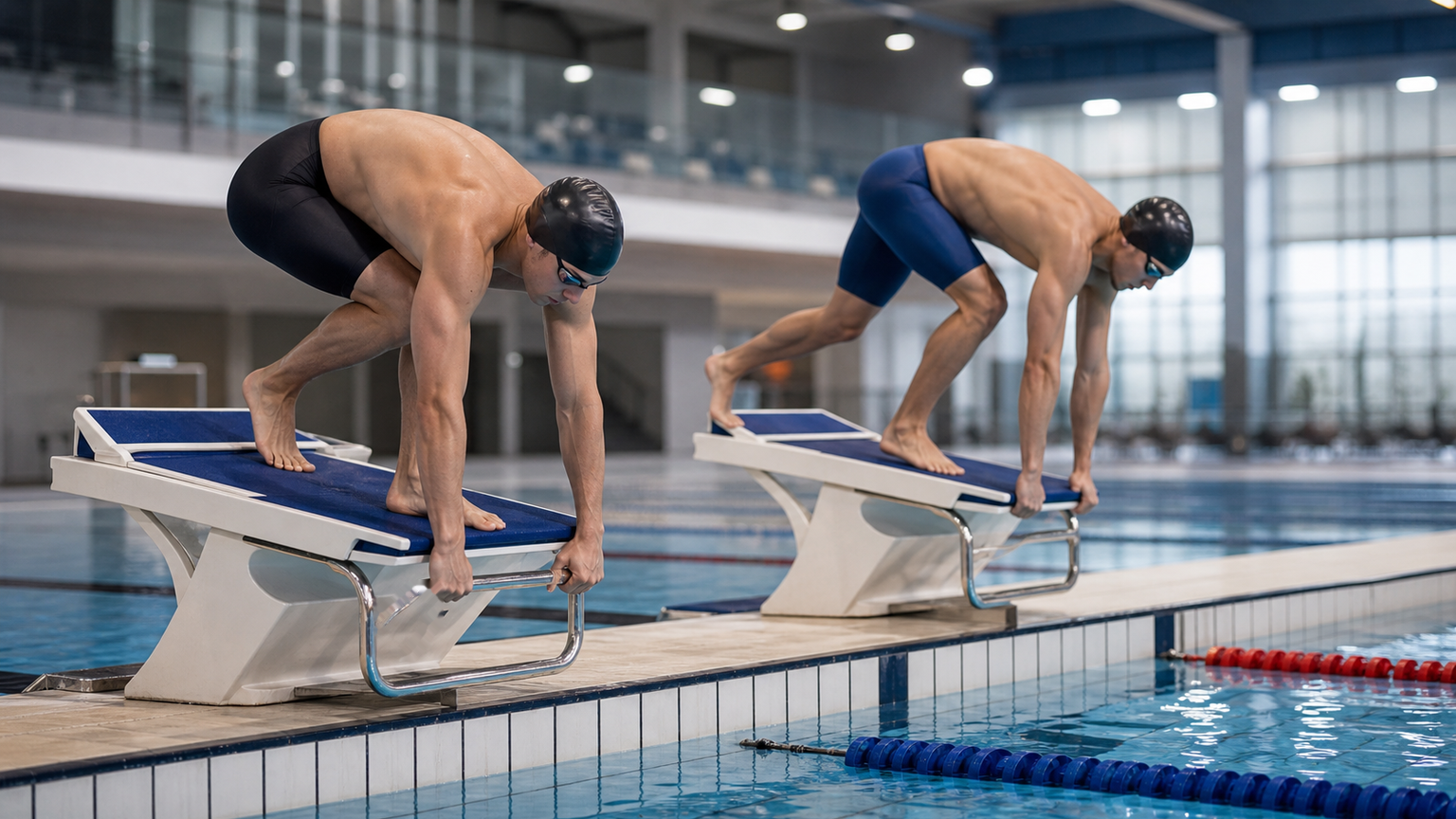
The Grab Start is a more traditional starting method. Both feet stand side by side at the front edge of the block, with both hands gripping the front edge and the body leaning forward in preparation. Its characteristics are a low center of gravity and high stability, making it suitable for situations where reaction time is longer but a stable entry angle is needed.
Key technical points:
- Feet shoulder-width apart or slightly narrower, toes curling over the front edge of the block
- Both hands grip the block, elbows slightly bent, allowing the arms to provide extra push during the jump
- Knees slightly bent, hips slightly higher than the knees, body leaning forward but center of gravity not past the toes
- After the starting signal, first push off the block with both hands to drive the body forward, then add the leg drive
Advantages:
- Low center of gravity for a stable start
- Entry angle is easy to control
- Suitable for sprint swimmers in short distances (50 meters)
Disadvantages:
- Greater forward lean of the upper body results in shorter flight time
- The rear leg has no pre-load, so overall jump distance is slightly shorter
Track Start: The Choice for More Explosive Power
The Track Start borrows from track-and-field starting posture: one foot forward (dominant foot) and one foot on the rear footrest, forming a staggered stance. This method leverages the rear footrest to generate greater drive, increasing starting distance.
Key technical points:
- Dominant foot (usually the right) on the front edge of the block, non-dominant foot on the rear footrest
- Both hands grip the block, body leaning forward
- On the start, the rear leg pushes off the footrest first to drive the body forward and accelerate, followed by the front leg pushing off the block
- After the hands leave the block, quickly extend them forward into the entry position
| Comparison Item | Grab Start | Track Start |
|---|---|---|
| Reaction Time | Slightly faster | Slightly slower |
| Flight Distance | Shorter | Longer |
| Technical Difficulty | Low | Moderate |
| Suitable Distance | 50m sprint | 100m and above |
| Stability | High | Requires practice |
How to Choose the Starting Method That Suits You
Research shows that most modern elite swimmers use the Track Start, because the drive from the rear footrest can increase starting distance by 10–20 centimeters, a benefit that becomes more pronounced in longer races. However, for beginners or 50-meter swimmers where reaction time is critical, the stability of the Grab Start still holds value.
Suggested selection logic:
- Focus on 50 meters: First master the Grab Start to ensure fast and stable reactions
- Focus on 100–400 meters: Practice the Track Start to gain a longer glide advantage
- Beginners: Start with the Grab Start to build a feel for the entry, then learn the Track Start
- Those with strong lower-body explosive power: The Track Start can more fully utilize leg strength
Practical Tips
- Practice both: Even if you primarily use the Track Start, keep the Grab Start polished as a backup technique to handle different venues or competition requirements.
- Dry-land simulation drills: Repeatedly practice the starting posture and takeoff movement on the block without entering the water each time—use a mat or the floor instead.
- Time your reaction: Use a stopwatch or have a coach time you to test the reaction time and entry distance of both starts for an objective comparison.
- Adjust the rear footrest height: The height of the rear footrest in the Track Start affects drive power. Test different heights to find the most comfortable setting.
Conclusion
Starting technique is a skill that can be significantly improved through extensive repetition. Regardless of which method you choose, the key lies in consistency of movement and a quick response to the starting signal. It is recommended to dedicate 5–10 minutes at the beginning of each training session specifically to starts, treating it as part of technical training rather than a last-minute review before competition.
Related Reading
- Starting Technique: Comparison of Grab Start, Track Start, and In-Water Start
- Swimming Start Technique: Speed Differences Between Grab Start and Rearward Start
- Block Dive vs In-Water Start: Technical Choices and Race Rule Analysis
- Swimming Race Start Technique: Details and Improvement Methods for the Grab Start
CT 喇低賽) 武嶺牽車 才是王道 西進牽車四小時內秘訣 攝手位置 如何判斷 防抽筋小秘訣
7 年前
#PUSHBIKE 原來這麼好玩! 小朋友 滑步車 初體驗 超可愛
6 年前
戰略) Zwift Race 如何咬在第一集團 如何評估自己要開多少推力 (請開1.5倍速看)
7 年前
滑雪新手們慘摔學習全紀錄(請開字幕),滑雪好好玩 | Snowboard + Ski | 岩原 スキー場 | 滑雪APP使用 | GoPro Max
6 年前
Live) 備戰2019彰化經典百K 賽前攻略 (已完賽請看新影片
7 年前
Zwift跨國線上追逐賽 第二站 台灣 TTR vs. 日本 JETT 第二場 (台灣追日本) | 數百位國內外公路車高手,同場較勁 | 多視角賽事直播
4 年前
爬坡ITT實境)台中 魔王 松鼠坡 首航 6:12 大肚山 大三元 科福路
8 年前
一起升級!海鷗盃LSD團練...JJSC Zone2招待 騎到手抖 / 公路車 / CT Yeh
1 天前