Introduction
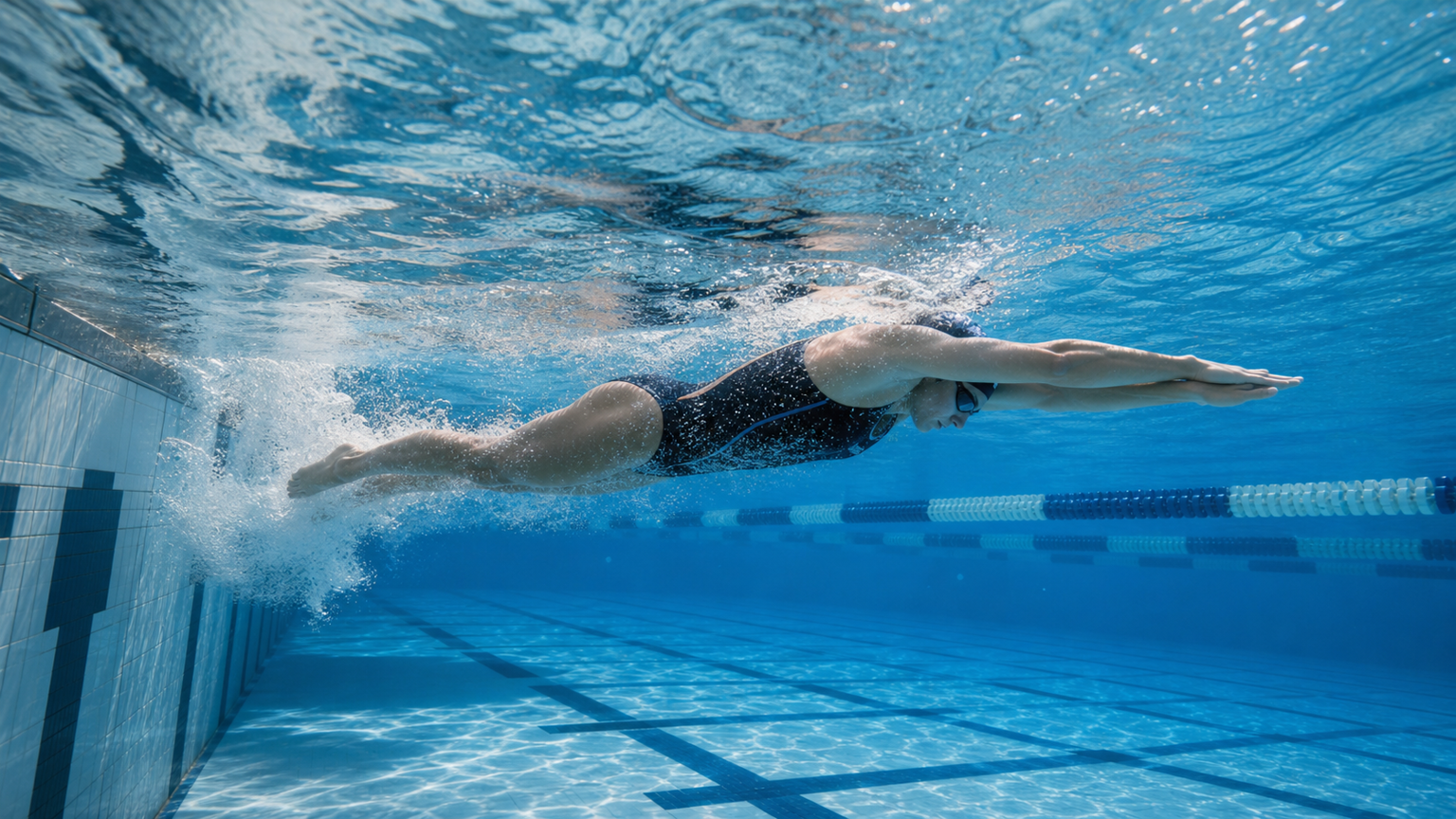
In competitive swimming research, there is a well-known finding: after the start and each turn, the speed of the Underwater Dolphin Kick (UDK) is generally higher than surface swimming speed. This means that if swimmers can maintain an efficient dolphin kick underwater and extend the underwater distance as long as possible (within the rules), they can significantly reduce their finish times. For this reason, modern competitive swimming regards the underwater dolphin kick as the “fifth stroke” and one of the core competitive advantages of elite swimmers.
The Mechanics of the Underwater Dolphin Kick
The dolphin kick is a full-body undulating movement initiated from the hips (not the knees). The correct sequence of force generation is:
Hips → Thighs → Lower Legs → Ankles → Feet
Many beginners mistakenly think the dolphin kick is “kicking up and down with the lower legs,” but this is only the most superficial movement. What actually generates propulsion is the downward swing of the hips, which drives the entire leg to form a backward pushing surface.
Mechanical differences between the up-kick and down-kick:
- Downbeat: The hips press down, the thighs move downward, and the lower legs and feet accelerate downward in sequence. This movement generates the primary propulsion.
- Upbeat: The legs rebound upward from below, with the ankles remaining soft, allowing the feet to create appropriate resistance to stabilize the body.
The amplitude of the body’s undulation should not be excessive, as this increases drag. The ideal kick amplitude is an ankle range of motion of about 30–40 cm, with the hips moving up and down about 15–20 cm.
Rule Limitations and Strategic Application
Different strokes have different regulations regarding underwater distance:
| Stroke | Start Underwater Rule | Post-Turn Underwater Rule |
|---|---|---|
| Freestyle | Within 15 meters | Within 15 meters |
| Butterfly | Within 15 meters | Within 15 meters |
| Backstroke | Within 15 meters | Within 15 meters |
| Breaststroke | One pull-out | One pull-out |
Freestyle, butterfly, and backstroke swimmers can perform dolphin kicks underwater until the 15-meter mark, which is the maximum underwater distance allowed by the rules. Elite swimmers typically aim for an underwater distance that is close to but does not exceed 15 meters.
Training Methods: From Feel to Efficiency
Beginner Drill—Kickboard-Assisted Dolphin Kick
- Hold a kickboard with both hands in front, performing only leg dolphin kicks while focusing on feeling the hip-driven force
- Ensure the ankles are relaxed rather than stiff, letting the feet move softly like a fish tail
- Deliberately slow down the movement during practice to feel the point of force application in each kick
Intermediate Drill—Streamlined Underwater Kick
- Stack both hands in a streamlined position, propelling entirely underwater with dolphin kicks
- Measure the distance covered in 10 kicks to find the most efficient kick tempo
- Practice breath-holding for 15 meters of underwater kicking to improve lung capacity and kick efficiency
Advanced Drill—Start Followed by Underwater Kick
- After a full start, maintain a streamlined position and perform dolphin kicks underwater, timing from the start to the 15-meter flag
- Compare the effects of different kick tempos (fast/small amplitude vs. slow/large amplitude) to find your optimal combination
Practical Advice
- Ankle flexibility is key: Dolphin kick efficiency is highly correlated with ankle flexibility. It is recommended to practice ankle stretching daily to increase the range of motion in the ankle joint.
- Don’t hold your breath too long: When training underwater kicks, prioritize safety. Surface immediately if you feel discomfort—do not force yourself to hold your breath to the limit.
- Core strength provides support: Without sufficient core strength, the undulating motion of the dolphin kick will cause excessive swaying in the lower back, increasing drag. It is recommended to incorporate dry-land core training.
- Kick deliberately after every turn: Many swimmers rush to surface and start stroking after a turn, wasting the opportunity for underwater acceleration. Develop the habit of performing several dolphin kicks after every turn.
Conclusion
The underwater dolphin kick is one of the most effective technical investments in modern competitive swimming. For swimmers seriously pursuing better results, treating the underwater kick as a core component of training—rather than an add-on drill—is the only way to fully unlock the potential of this fastest phase of the race.
Related Reading
- The Hidden Speed in Swimming Turns and Starts: Why the Underwater Dolphin Kick Is the Fastest Phase of the Race
- Underwater Dolphin Kick: The Speed Advantage Within the 15m Rule
- Open Water Run-In Technique: The Dolphin Dive from the Beach into the Water
- The Wave Rhythm of the Butterfly Dolphin Kick: Coordinated Training from the Lumbar Spine to the Ankles
海豚島滑沙
11 年前
CT 喇低賽) 武嶺牽車 才是王道 西進牽車四小時內秘訣 攝手位置 如何判斷 防抽筋小秘訣
7 年前
一起升級!海鷗盃LSD團練...JJSC Zone2招待 騎到手抖 / 公路車 / CT Yeh
2 天前
白沙屯媽祖進香在家走!UREVO 坡度自調走步機 / 可連接訓練遊戲APP MyWhoosh / 邊看直播邊走起來 / CT Yeh
11 個月前
#PUSHBIKE 原來這麼好玩! 小朋友 滑步車 初體驗 超可愛
6 年前
風櫃嘴 衝刺慢動作回放!
8 年前
戰略) Zwift Race 如何咬在第一集團 如何評估自己要開多少推力 (請開1.5倍速看)
7 年前
抖肩舞 台灣x日本交流版 (台灣 vs 前橋) 赤城山登山賽 coincidance
8 年前