Introduction
Many runners hold the misconception: “To get better at running, you just need to run more.” But high mileage often comes with a high injury rate. Modern sports science has long confirmed that strength training is one of the most effective non-running training methods for improving running efficiency and preventing overuse injuries. Research shows that 2–3 targeted strength training sessions per week can significantly reduce the risk of running injuries while improving running economy (burning less energy at the same pace).
This article introduces six key movements every runner should master. Each movement has a clear injury-prevention goal, requires no equipment, and can be done at home.
Why Do Runners Need Strength Training?
Running is a dynamic, single-leg support activity. With every foot strike, the leg muscles must absorb 2–3 times body weight in impact and generate propulsion within an extremely short time (about 0.2 seconds). If strength is insufficient:
- Joints (knees, ankles, hips) are forced to absorb more impact from the activity, increasing the risk of bone and cartilage damage.
- Running form breaks down due to fatigue, leading to compensation patterns and various injuries.
- Energy transfer efficiency drops, making running harder and more fatiguing.
Six Key Strength Movements
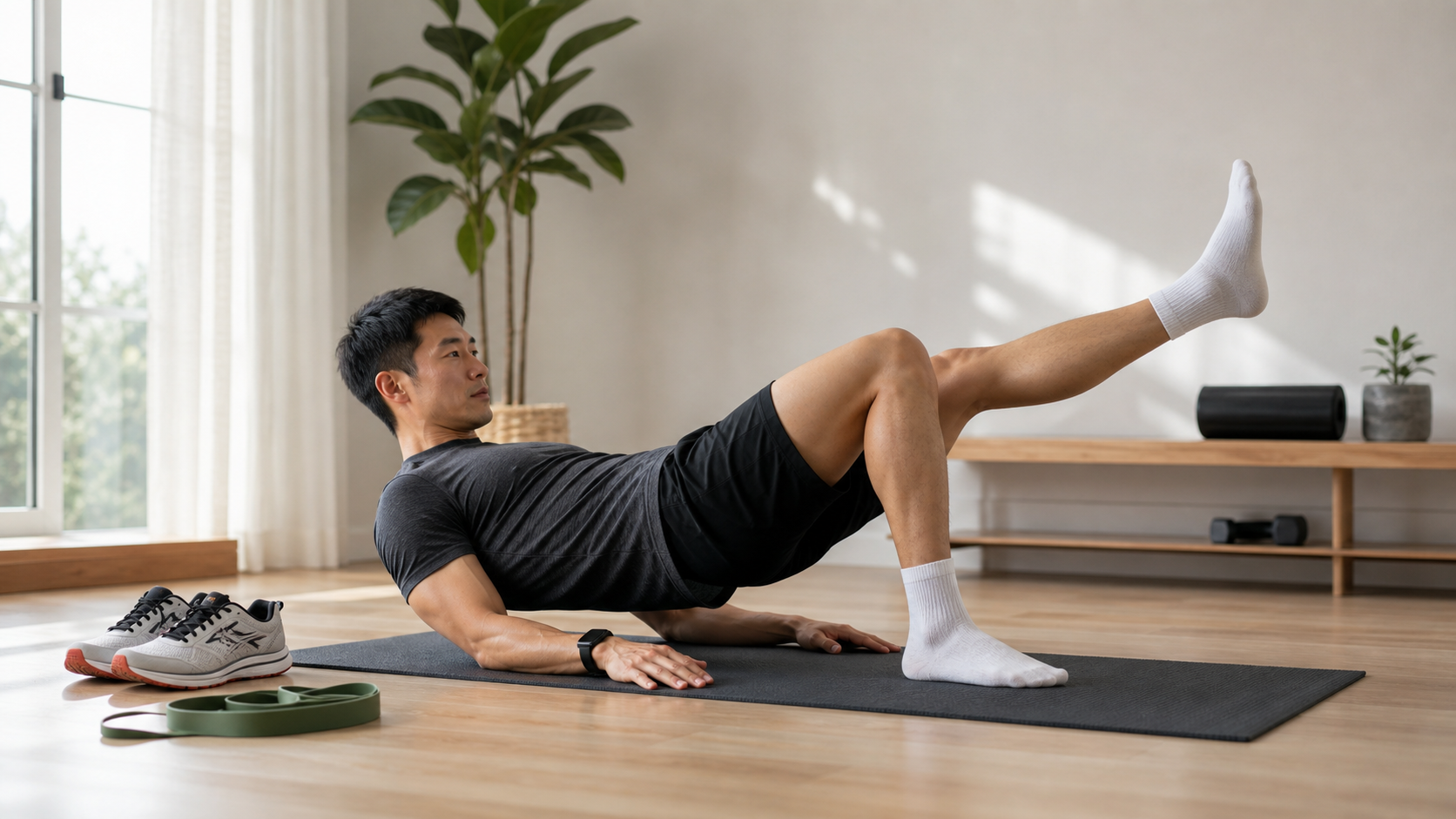
Movement 1: Single-leg Glute Bridge
Target Muscles: Gluteus maximus, hamstrings
Injury Prevention: Runner’s knee, IT band syndrome, lower back pain
Execution: Lie on your back with both feet on the floor. Lift one leg (either straight or with the knee bent at 90 degrees). Using the strength of the supporting leg, drive your hips up off the floor to the highest point. Hold at the top for 2 seconds, then lower slowly. 12–15 reps per side × 3 sets.
Key Points: Avoid pelvic tilt (check that both hip bones stay level), and drive through the glutes rather than the lower back.
Movement 2: Banded Lateral Walk
Target Muscles: Gluteus medius
Injury Prevention: IT band syndrome, runner’s knee (knee valgus caused by insufficient pelvic stability)
Execution: Place a resistance band (light to medium resistance) around your ankles or just above the knees. Stand with feet shoulder-width apart, knees slightly bent. Step sideways (lateral movement), keeping toes pointing forward and steps even. 15 steps each direction × 3 sets.
Key Points: Keep steps small (about 30–40 cm) to ensure the gluteus medius stays engaged rather than relying on momentum.
Movement 3: Single-leg Squat / Pistol Squat
Target Muscles: Quadriceps (especially VMO), glutes, ankle stabilizers
Injury Prevention: Runner’s knee, IT band syndrome, ankle sprains
Execution: Stand on one leg with the other leg lifted (extended forward or bent). Bend the knee to squat down until the thigh is roughly parallel to the floor (or at least 60 degrees), keeping the knee aligned with the second toe (no caving inward). Keep your torso upright and stand back up. 8–10 reps per side × 3 sets.
Progression: Perform on a Bosu ball to add ankle stability training.
Regression: Hold onto a chair back for balance support.
Movement 4: Nordic Hamstring Curl
Target Muscles: Hamstrings (eccentric contraction)
Injury Prevention: Hamstring strains (the single most evidence-based exercise in the world for preventing hamstring injuries)
Execution: Kneel with a partner securing your ankles (or anchor them under a sofa). Keep your body straight and lean forward slowly (3–5 seconds). Just before you’re about to fall, catch yourself with your hands (temporarily), then use your hamstrings to pull yourself back upright. 6–8 reps × 3 sets.
Note: This is extremely intense for beginners. Start with 3–4 reps, and you don’t need to lean all the way to 90 degrees.
Movement 5: Calf Raise with Eccentric Emphasis
Target Muscles: Gastrocnemius, soleus
Injury Prevention: Achilles tendinitis, plantar fasciitis
Execution: Stand on the edge of a step (balls of your feet on the edge). Raise both heels to the highest point, then lower slowly (3 seconds) on a single leg until the heel drops below the step edge. 15 reps per side × 3 sets (1 set with knees straight + 1 set with knees slightly bent, targeting the gastrocnemius and soleus respectively).
Movement 6: Plank Variations
Target Muscles: Transversus abdominis, multifidus (deep core)
Injury Prevention: Running-related lower back pain, anterior pelvic tilt
Recommended Variations:
- Standard Plank: Forearm support, body in a straight line, hold for 30–45 seconds.
- Side Plank: Lie on your side, supported on your forearm, hold for 20–30 seconds per side.
- RKC Plank: Standard plank position, but actively “squeeze” your abs toward the floor. Higher intensity, hold for 20 seconds per set.
Training Program Recommendations
| Runner Level | Recommended Frequency | Time per Session |
|---|---|---|
| Beginner (weekly mileage < 25 km) | 3 times per week | 20–30 minutes |
| Intermediate (weekly mileage 25–50 km) | 2–3 times per week | 30–40 minutes |
| Advanced (weekly mileage > 50 km) | 2 times per week (less volume, more intensity) | 30–40 minutes |
It’s recommended to schedule strength training on easy run days or rest days, avoiding stacking it on long run or speed workout days.
Practical Tips
- Start with bodyweight exercises only. Prioritize movement quality over load, and only add weight once you’ve confirmed there’s no compensation.
- Mild muscle soreness after training is a normal adaptation response, but if you experience joint pain, you need to re-evaluate your form.
- Reduce strength training intensity 2 weeks before a race (tapering period) to ensure your legs feel fresh on race day.
Conclusion
Six movements, twice a week, no more than 30 minutes—this is the highest cost-performance investment in preventing running injuries. Don’t wait until you’re injured to start rehab training. Incorporate strength training into your running plan now, and become a robust runner who simply “doesn’t break down.”
Related Reading
Never Stop 西進武嶺 前後雙機 完整全程錄影 訓練台 實境
8 年前
[教學] Premiere 影片 手震 修正 教學 防抖 單眼 影像 GoPro 穩定 Video Stabilization
8 年前
西進武嶺 免費訓練分析服務 Intervals | 練不夠還是練過頭?你哪一種類型選手?AI模型告訴你! | 備戰神器 | 公路車 訓練 | CT Yeh
4 年前
摔車後補裝備: 好市多新款單車安全帽& Specialized Romin 北高整路屁股都不痛的坐墊 | 一千元居然有MIPS | CT Yeh | 公路車
4 年前
CT 喇低賽) 武嶺牽車 才是王道 西進牽車四小時內秘訣 攝手位置 如何判斷 防抽筋小秘訣
7 年前
滑雪新手們慘摔學習全紀錄(請開字幕),滑雪好好玩 | Snowboard + Ski | 岩原 スキー場 | 滑雪APP使用 | GoPro Max
6 年前
西進武嶺 自製新版AI配速表產生器 x 賽前攻略 抱佛腳! 沒有功率計也可以產生配速表嗎?有什麼其他眉角賽前要注意的呢? | 西進武嶺 / 東進武嶺 KOM 攻略 | 公路車 | CT Yeh
4 年前
Insta 360 One 超級防手震技術實測
7 年前