Introduction
“No matter how good your swimming technique is, once your breathing falls apart, everything is ruined.” This is a phrase many swim coaches repeat. Breathing in freestyle is a very brief action, accounting for only about 20–30% of the entire stroke cycle, yet it has a decisive impact on the overall fluidity of your movement.
Over-lifting the head is one of the most common and far-reaching technical errors in freestyle. This article will provide a comprehensive analysis of the causes of this error, its chain reactions, and systematic corrective training methods.
What Is Over-Lifting the Head
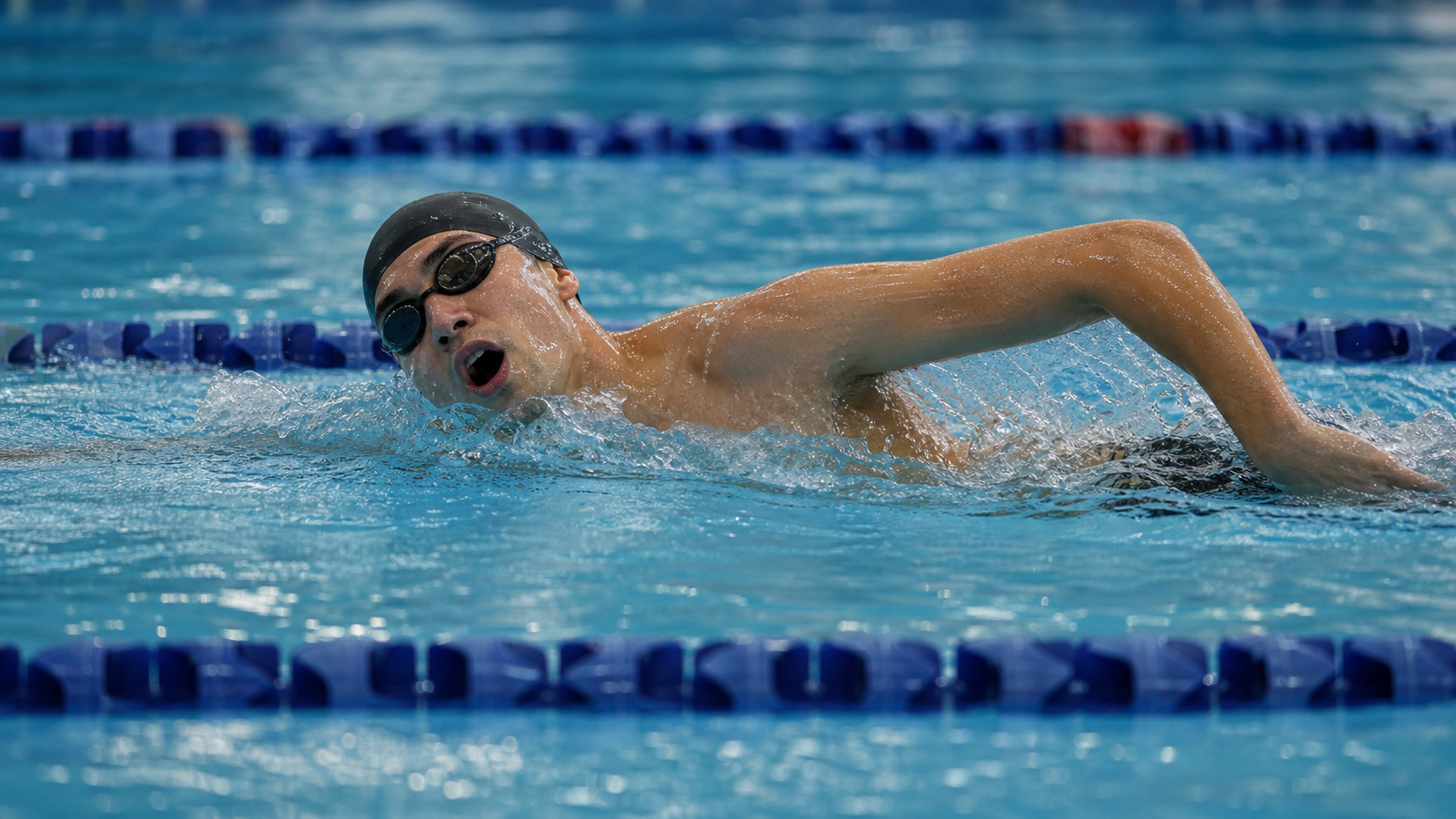
Correct freestyle breathing is: the head rotates with the body’s side roll, the mouth just clears the water, and after inhaling, it immediately rotates back into position. During this process, one eye is below the water’s surface while the other eye is right at the waterline.
Over-lifting the head, on the other hand, means the head does not rotate but instead lifts upward as a whole, with both eyes leaving the water and even the chin rising significantly. This seemingly minor difference of “just lifting a bit higher” triggers a cascade of technical problems.
Chain Reaction: One Error Triggers Multiple Problems
Over-lifting the head is not an isolated technical issue; it triggers the following chain reactions like falling dominoes:
| Chain Reaction | Mechanism | Consequence |
|---|---|---|
| Opposite shoulder drops | Head lifts, opposite shoulder presses down to compensate | Stroke path deviates |
| Hips sink | Lever effect: head high means hips low | Significant increase in drag |
| Side roll interrupted | Head lifting breaks the body’s rotation rhythm | Core power connection lost |
| Pulling arm entry point shifts | Body unstable during breathing, hand crosses the line on entry | Cross-over entry problem |
| Speed drops significantly | Body position deteriorates during breathing | 0.1–0.3 seconds lost per breath |
Looking at timing data, in competitive races, breathing strokes are typically about 3–5% slower than non-breathing strokes. This gap is smaller in more skilled swimmers because their breathing motion barely alters body position.
Breakdown of Correct Breathing Technique
Correct freestyle breathing can be broken down into the following steps:
- Side roll drives the breath: When the shoulder on the breathing side rotates to its highest point, the head follows the body’s side roll, and the mouth naturally approaches the water’s surface.
- Mouth just clears the water: Only the corner of the mouth needs to break the surface to breathe; the entire face does not need to leave the water.
- Use the “bow wave”: As the body moves forward, the water beside the head forms a lower-pressure zone (Bow Wave), creating a small “dry pocket” around the head, allowing the mouth to inhale air even when it is close to the surface.
- Exhale quickly into the water: After breathing, the head immediately rotates back into position while rapidly expelling carbon dioxide to prepare for the next breath.
The “Bow Wave” Breathing Technique
Understanding and utilizing the bow wave is the core of advanced breathing technique. As the swimmer moves forward, the head pushes water aside to form wave crests on both sides of the body, while right next to the head a relatively low-water “trough” forms. The mouth in correct breathing should sit in this trough, not outside the wave crest.
Key points for using the bow wave to breathe:
- The face’s rotation direction is synchronized with the body’s side roll, rather than rotating at a greater angle than the body.
- Keep the head low when breathing, aiming the corner of the mouth at the trough beside the waterline, rather than lifting upward to search for air.
- The faster the speed, the more pronounced the bow wave, and the more effective low-head breathing becomes.
Practical Tips
- Single-side kickboard breathing drill: Hold a kickboard with one hand and practice the rotation on the breathing side, feeling the difference between rotating the head versus lifting it, and confirming the mouth’s height at the corner.
- “One eye in the water” cue: Remind yourself on every breath, “The eye on the breathing side is below the water, the other eye is above the water.” This is the visual confirmation of correct head position.
- Slow-speed height awareness: Swim at a slow pace and immediately after each breath, feel whether the head truly returns to the “waterline at the front hairline” position.
- Breathing rhythm drill: Stand by the wall and practice completing the entire breathing motion—inhale plus head rotation back—within 1.5 seconds to build a fast-breathing reflex habit.
Conclusion
Correcting breathing technique requires building two awarenesses simultaneously: “the body roll drives the breath” and “return to position immediately after breathing.” Over-lifting the head usually stems from the fear that “if I don’t lift high enough, I won’t get air,” but in reality, proper low-head breathing is entirely sufficient with the help of the bow wave. Overcoming fear and trusting the technique are the psychological keys to improving your breathing.
Related Reading
- Freestyle Breathing with Excessive Body Roll: Corrective Training for Bilateral Breathing
- Freestyle Flip-Turn Breathing: Breathing-Side Rotation Angle and Drag-Minimization Technique
- Over-Lifting the Head in Swimming: Relaxation Drills for a Stiff Neck
- Freestyle Roll Breathing: Core Technique Analysis for Swimming 30% More Efficiently
一日北高/長距離團騎 常見問題補充篇 / 組團或跟團的眉角 / 壯車友容易被瘦車友慢性拉爆 / 原來屁股痛可能是這個原因...? / 風場配速法 / 公路車 / CT Yeh
2 年前
CT 喇低賽) 武嶺牽車 才是王道 西進牽車四小時內秘訣 攝手位置 如何判斷 防抽筋小秘訣
7 年前
[教學] Premiere 影片 手震 修正 教學 防抖 單眼 影像 GoPro 穩定 Video Stabilization
8 年前
戰略) Zwift Race 如何咬在第一集團 如何評估自己要開多少推力 (請開1.5倍速看)
7 年前
風櫃嘴 衝刺慢動作回放!
8 年前
#公路車 #Vo2Max #最大攝氧量 測驗 體驗 | 心肺測試
6 年前
抖肩舞 台灣x日本交流版 (台灣 vs 前橋) 赤城山登山賽 coincidance
8 年前
西進武嶺 自製新版AI配速表產生器 x 賽前攻略 抱佛腳! 沒有功率計也可以產生配速表嗎?有什麼其他眉角賽前要注意的呢? | 西進武嶺 / 東進武嶺 KOM 攻略 | 公路車 | CT Yeh
4 年前