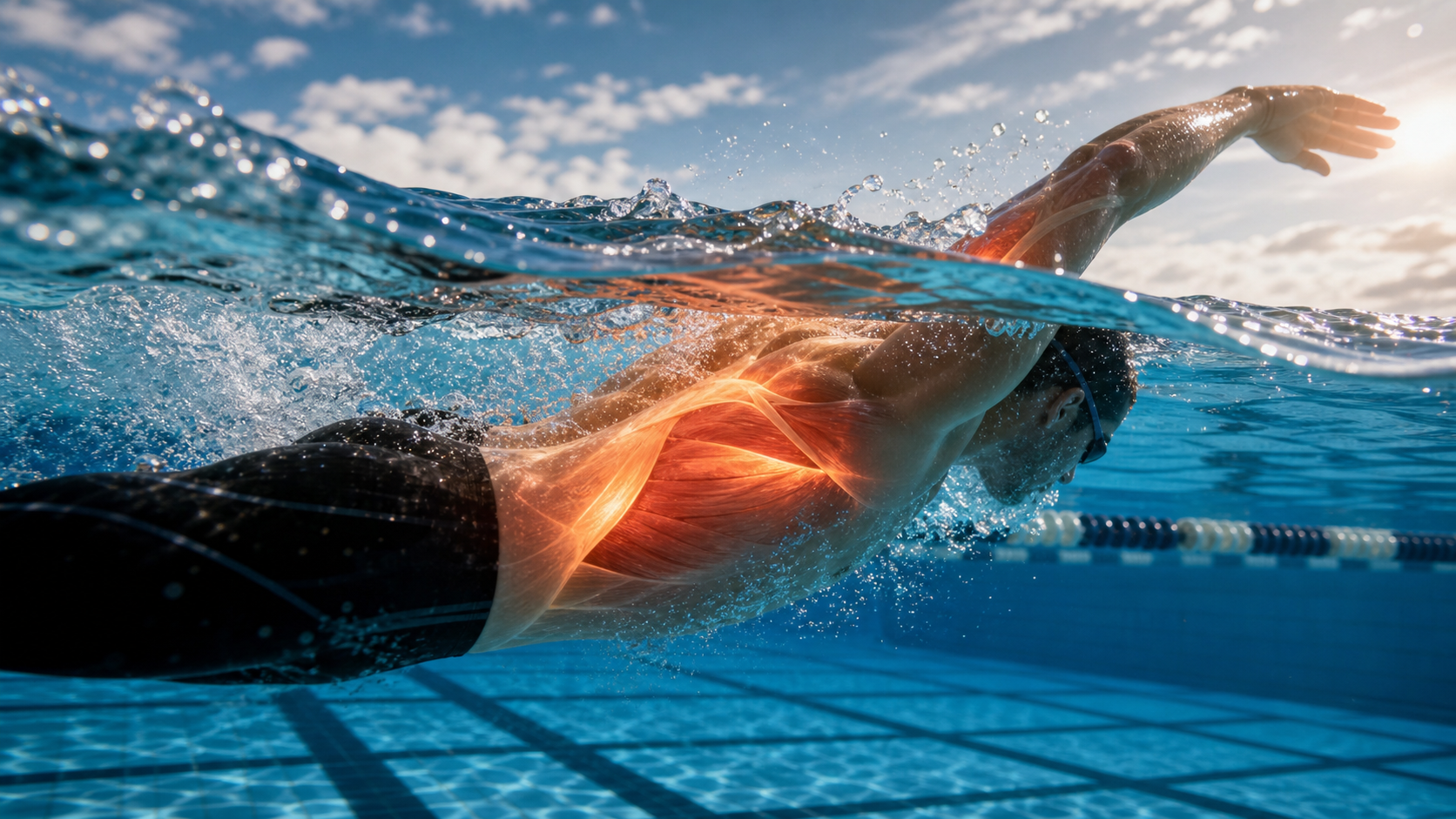
Introduction
Swimming is not a sport where “brute force equals speed.” The Muscle Activation Sequence directly determines the magnitude of propulsion and swimming endurance. By using the correct muscle group sequence, swimmers can generate greater propulsion with less energy expenditure. Conversely, if the wrong muscle groups (such as the rotator cuff) over-dominate the stroke, it not only reduces efficiency but also increases the risk of injury.
This article focuses on freestyle, analyzing the role and correct activation timing of each major muscle group during the stroke.
Major Muscle Groups in the Freestyle Stroke
The freestyle stroke is a complex multi-muscle coordinated movement, which can be divided into the following major participating muscle groups:
| Muscle Group | Primary Function | Phase of Action |
|---|---|---|
| Latissimus Dorsi | Primary driver pulling the arm from front to back | Catch → Pull (entire phase) |
| Teres Major | Assists the latissimus dorsi in pulling the arm back | Pull phase |
| Triceps | Extends the elbow at the end of the push | Push → Exit |
| Pectoralis Major | Adducts the arm (toward the midline of the body) | Catch → Early pull |
| Core | Transmits rotational force from the torso | Entire stroke |
| Deltoid | Recovers the arm forward (above water) | Recovery phase |
| Rotator Cuff | Stabilizes the shoulder joint | Entire stroke |
It is important to note that many recreational swimmers rely excessively on the deltoid and rotator cuff muscles during the stroke, rather than being latissimus dorsi-dominant. The deltoid is a relatively small muscle group, unsuitable for repetitive stroking over long distances—this is one of the main reasons for shoulder fatigue after long-distance swimming.
Correct Muscle Activation Sequence
The ideal muscle activation sequence for the freestyle stroke is as follows:
Phase 1: Catch
Core activation → Latissimus dorsi pre-tension → Pectoralis major assists in arm positioning
The key to this phase is the “pre-tension” of the latissimus dorsi—before the hand begins to pull, the latissimus dorsi is already slightly contracted, ready to take on the upcoming load of the pull. This pre-tension allows the subsequent pull to be immediately driven by the large muscle group, rather than being initiated by the small muscles around the shoulder joint.
Phase 2: Pull
Latissimus dorsi primary contraction (driving the arm backward) → Pectoralis major assists adduction → Core maintains rotational stability
The latissimus dorsi is the protagonist of this phase, not the shoulders. A common cue used by coaches is “pull the elbow backward and downward”—this movement imagery effectively activates the latissimus dorsi, rather than allowing the deltoid or trapezius to take over.
Phase 3: Push/Finish
Triceps primary contraction (extending the elbow) → Latissimus dorsi continues to assist → Core completes the rotation
At the end of the push phase (when the hand approaches the thigh), the elbow must fully extend from a bent position—this movement is driven by the triceps. Many swimmers have an incomplete push (exiting the water before the arm is fully extended), leaving the triceps’ power underutilized.
Proprioceptive Training for Latissimus Dorsi Activation
The latissimus dorsi is the most important yet hardest muscle group to feel in swimming. The following methods can help build proprioceptive awareness of latissimus dorsi activation:
- Pull-up (on land): Pull-ups are the most direct movement for activating the latissimus dorsi. With each upward pull, focus on feeling the contraction of the latissimus dorsi beneath the armpit.
- Straight Arm Pulldown: Using a resistance band or cable machine, pull downward with straight arms. This movement angle closely resembles the swimming catch and effectively builds the sensation of latissimus dorsi activation during the stroke.
- Pre-swim latissimus dorsi touch activation: Before entering the water, touch the latissimus dorsi area beneath the armpit and perform a few deliberate contractions to help establish muscle awareness once in the water.
Practical Recommendations
- During stroke technique training, focus on “pulling the elbow backward” rather than “pushing the arm backward”—the former more effectively activates the latissimus dorsi.
- Add 2–3 sessions of land-based swimming muscle training per week (pull-ups, rowing movements, triceps extensions) to strengthen weak muscle groups.
- If you feel significant fatigue in the front of the shoulder (deltoid) after swimming, it typically indicates insufficient latissimus dorsi activation and a need for technical adjustment.
- Use a resistance band on land to simulate the catch movement, performing it slowly to feel the latissimus dorsi-dominant pulling sensation, then carry that feeling into the water.
Conclusion
The correct muscle activation sequence is the “hidden code” of swimming efficiency. When the latissimus dorsi successfully replaces the small muscle groups as the primary driver of the stroke, swimmers will notice significantly reduced fatigue during long-distance swimming and a more solid sense of propulsion with each stroke. This change is not achieved through brute force, but through a deep understanding and training of muscular coordination.
Related Reading
- Muscle Recruitment in Swimming: Analysis of Primary and Accessory Muscle Groups in the Freestyle Stroke
- Muscle Adaptation in Swimming: Prioritizing Development of the Latissimus Dorsi, Deltoid, and Core
- Swimming Muscle Activation Patterns: Which Muscle Groups Matter Most
- Training Methods for the Latissimus Dorsi and Teres Major in Swimming
西進武嶺 免費訓練分析服務 Intervals | 練不夠還是練過頭?你哪一種類型選手?AI模型告訴你! | 備戰神器 | 公路車 訓練 | CT Yeh
4 年前
一日北高/長距離團騎 常見問題補充篇 / 組團或跟團的眉角 / 壯車友容易被瘦車友慢性拉爆 / 原來屁股痛可能是這個原因...? / 風場配速法 / 公路車 / CT Yeh
2 年前
CT 喇低賽) 武嶺牽車 才是王道 西進牽車四小時內秘訣 攝手位置 如何判斷 防抽筋小秘訣
7 年前
2023桃園團體繞圈賽 / 海鷗繞圈賽 | 全程空拍數據版 | 公路車 | CT Yeh
2 年前
一起升級!海鷗盃LSD團練...JJSC Zone2招待 騎到手抖 / 公路車 / CT Yeh
1 天前
戰略) Zwift Race 如何咬在第一集團 如何評估自己要開多少推力 (請開1.5倍速看)
7 年前
Live) 備戰2019彰化經典百K 賽前攻略 (已完賽請看新影片
7 年前
[教學] Premiere 影片 手震 修正 教學 防抖 單眼 影像 GoPro 穩定 Video Stabilization
8 年前