Introduction
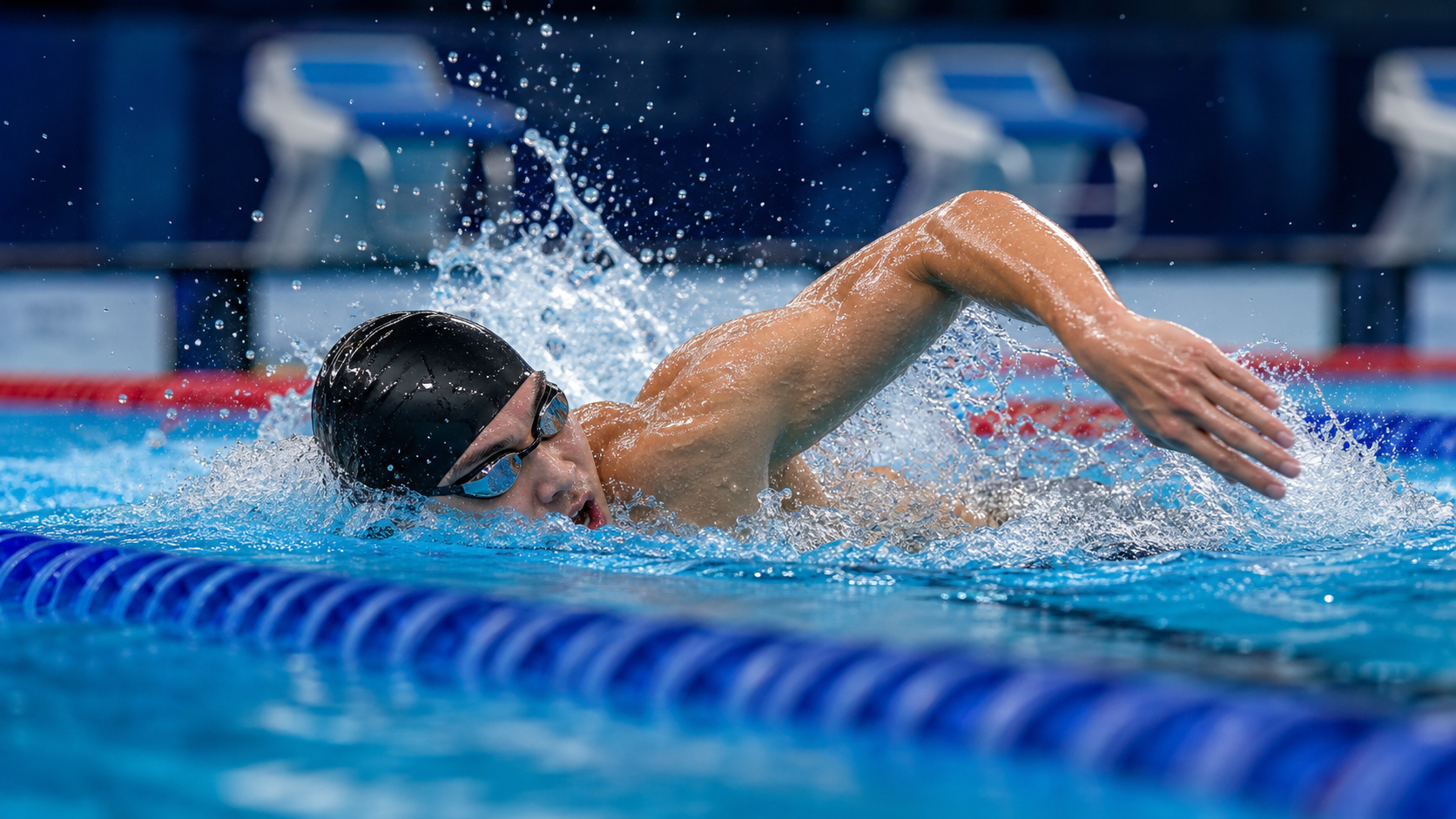
The 50m freestyle—swimming’s “100m sprint”—is the purest test of speed. In Taiwan’s national short-course (25m) competitions, elite male swimmers can finish in under 22 seconds, while in long-course (50m) events, times range from approximately 22 to 24 seconds. The entire race is an almost purely anaerobic explosion, leaving no room for error. However, 50m freestyle race strategy is not as simple as “sprinting from start to finish”—the start, mid-race swimming, and sprint each have their own intricacies.
The Start: Winning 0.1 Seconds Before the Race Begins
In a short-distance event like the 50m freestyle, reaction time off the blocks can account for a significant portion of the final placing gap. FINA rules dictate that a reaction time under 0.1 seconds is considered a false start. Elite swimmers typically have reaction times between 0.62 and 0.68 seconds (the time from the starting signal to leaving the blocks).
Key Start Techniques:
- Grab Start vs. Track Start: Modern competitive swimming predominantly uses the track start, with the front foot at the front edge of the block and the center of gravity shifted forward for a quicker launch
- Flight Angle: Entry angle should be approximately 15 to 18 degrees; too steep increases drag upon entry, while too flat fails to fully utilize the jumping power
- Entry Posture: Arms extended straight with hands together behind the head, body in a streamlined position, with full extension of the toes before leaving the block
- Underwater Propulsion: After entry, maintain a streamlined glide until speed approaches swimming velocity, then transition into dolphin kicks for acceleration, typically switching to arm strokes within 15 meters of entry
Reaction Time Training Methods:
| Training Method | Effect |
|---|---|
| 10 × short starts | Practice conditioned reflexes to the starting signal |
| Starts with a partner’s visual signal | Train reactions to different stimulus sources |
| Timing the first 5 meters after the start | Quantify starting efficiency |
| Relaxed start imagery practice | Avoid excessive muscle tension during the start |
Mid-Race Swimming: Maintaining Maximum Speed
The mid-race segment of the 50m freestyle—roughly from 15 meters to 40 meters—is the fastest phase of the entire race. At this point, swimmers should be at maximum speed output, but how well you maintain technical efficiency at high speed determines whether you “surge to the finish” or merely “hang on to the end.”
Key Mid-Race Techniques:
- Stroke Rate Control: The stroke rate in the 50m freestyle is far higher than in longer distances, but a high stroke rate must be paired with effective hand support; otherwise, you’re just “splashing water” rather than “propelling forward”
- Body Roll: Maintain a moderate side-to-side body roll (approximately 40 to 45 degrees) to facilitate full arm extension during the stroke
- Kick Rhythm: The six-beat kick is the mainstream choice; some swimmers opt for a four-beat kick to conserve energy (but in the 50m freestyle, a full-effort six-beat kick is typically chosen)
- Breathing Frequency: Many 50m freestyle swimmers choose to go the entire race without breathing or take only one breath. Not breathing reduces drag but requires sufficient lung capacity training
Key Technique: Swimming the Entire Race Without Breathing
If you choose to swim without breathing, you need to “hyperventilate” (take deep, full breaths) before the start. Build up gradually by practicing 25m no-breath swims in training; never attempt it prematurely without adequate preparation.
The Final 10 Meters: Sprinting with Technical Discipline
Many swimmers experience a noticeable drop in speed in the final 10 meters—muscle fatigue accumulates, breathing rhythm breaks down, and technique deteriorates. True 50m freestyle specialists can “preserve their technique” at this point rather than merely “grinding through the distance.”
Sprint Phase Strategy:
- When fatigue sets in, deliberately increase kick rate rather than lengthening the stroke (the latter consumes more oxygen)
- Keep the head in a low position; don’t lift it due to fatigue
- Don’t glide or decelerate before touching the wall; reach for the touch at full speed with your fingertips (a 0.01-second difference can decide the placing)
Practical Advice
- Pre-Race Warm-Up: The 50m freestyle requires full nervous system activation; include 2 to 3 short sprints (15m all-out) in your warm-up
- Race-Day Mindset: In the 50m freestyle, you only get one chance—give your all in the preliminaries; don’t “save energy” for the final
- Video Analysis: Have someone record every race to analyze your start flight trajectory, mid-race stroke rate, and touch technique
- Taiwan Standards: The Taiwan National Youth Championships qualifying standard for the 50m freestyle A group is approximately 26 seconds (women) and 23 seconds (men), which can serve as a reference for goal setting
Conclusion
The 50m freestyle is a precisely calculated art of explosive power. The millisecond differences in reaction time, mid-race technical efficiency, and the precision of the final touch—every element influences the final result within these brief 20-plus seconds. Continuously refine every detail, and trust your training when you step onto the starting block. That is the essence of 50m freestyle racing.
Related Reading
- 50m Freestyle Splitting Strategy: The Optimal Ratio of the First 15m, Middle Segment, and Final Sprint
- Short-Course (50m) Swimming Power Training: Neural Preparation for Maximum Speed
- 200m Freestyle Splitting Strategy: Pacing Control Across Four 50m Segments
- Butterfly Race Preparation: 50m Butterfly Sprint and 100m Splitting Strategy
Live) 備戰2019彰化經典百K 賽前攻略 (已完賽請看新影片
7 年前
2024 彰化經典百K 參賽直播 / 黃亭茵集團 / 公路車 / CT Yeh
2 年前
CT 喇低賽) 武嶺牽車 才是王道 西進牽車四小時內秘訣 攝手位置 如何判斷 防抽筋小秘訣
7 年前
西進武嶺 自製新版AI配速表產生器 x 賽前攻略 抱佛腳! 沒有功率計也可以產生配速表嗎?有什麼其他眉角賽前要注意的呢? | 西進武嶺 / 東進武嶺 KOM 攻略 | 公路車 | CT Yeh
4 年前
2019 夏季KOM 5小 完賽心得 準備攻略 東進武嶺 夏季登山王之路 Taiwan KOM Challenge
7 年前
live) 超越北高 之一日北高12小時 策略
7 年前
實景訓練台) 彰化經典百K 高強度喵團 90分鐘 跟著一起練功 2019 Indoor workout Changhua Classic 100 Taiwan
7 年前
富士山KOM 賽事篇 VLOG!/ 小野田出沒!/ 完整路段分析 / 武嶺要騎多快才能拿環?/ 台灣選手 第20回Mt.富士ヒルクライム 参加!/ 公路車 / CT Yeh
2 年前